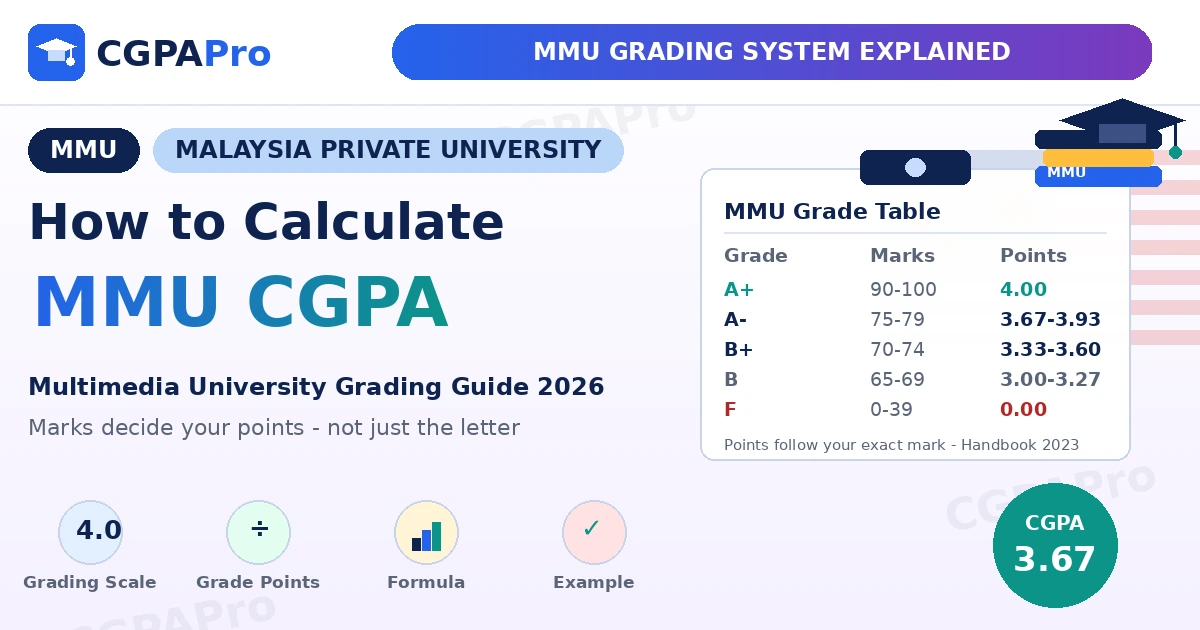
If you study at Multimedia University — MMU Cyberjaya or MMU Melaka — and you have ever calculated your GPA with the standard “A = 4.00, A− = 3.67, B+ = 3.33” table and found it doesn’t match your result slip, you are not bad at maths. You used the wrong table. MMU does not assign one fixed point value per letter grade. At MMU, your exact mark decides your grade points: 76 marks earns you 3.73, while 75 marks earns you 3.67, even though both are an A−. That single difference is why so many MMU students miscalculate their own GPA — and why most online “MMU grading” summaries get it wrong.
This guide is built on MMU’s own Academic Handbook (July 2023) — A Study Guide to Academic Regulations & Procedures, the official document for Foundation, Diploma and Bachelor’s programmes. Every table, threshold and rule below is verified against it, including the degree-classification bands that other websites routinely misstate. You will find the full official mark-to-point table, the exact GPA and CGPA formulas, two fully worked examples with every step of the arithmetic shown, and straight answers to the questions MMU students actually argue about — including whether 3.21 is Second Upper (it isn’t).
Quick answer: how MMU grading works
- Grade points come from your mark, not just your letter. A is 4.00 (80–89 marks), but A− ranges from 3.67 (75 marks) to 3.93 (79 marks), and B ranges from 3.00 to 3.27. The full table is below.
- Pass mark: 40% (grade D) for most programmes. Law, Accounting and Diploma in Accounting use a 50% pass mark, where C−, D+, D and F are fails.
- GPA = total grade points ÷ total credit hours for one trimester. CGPA = the same calculation across all trimesters from the start of your studies.
- Graduation line: CGPA 2.00, plus your programme’s credit and MUET requirements.
- First Class: CGPA 3.67–4.00. Second Upper: 3.33–3.66. Second Lower: 2.67–3.32. Third: 2.00–2.66.
- Dean’s List: trimester GPA 3.67+ (Bachelor/Foundation) or 3.50+ (Diploma), with at least 12 graded credit hours in a long trimester.
Step 1: use the CGPAPro calculator
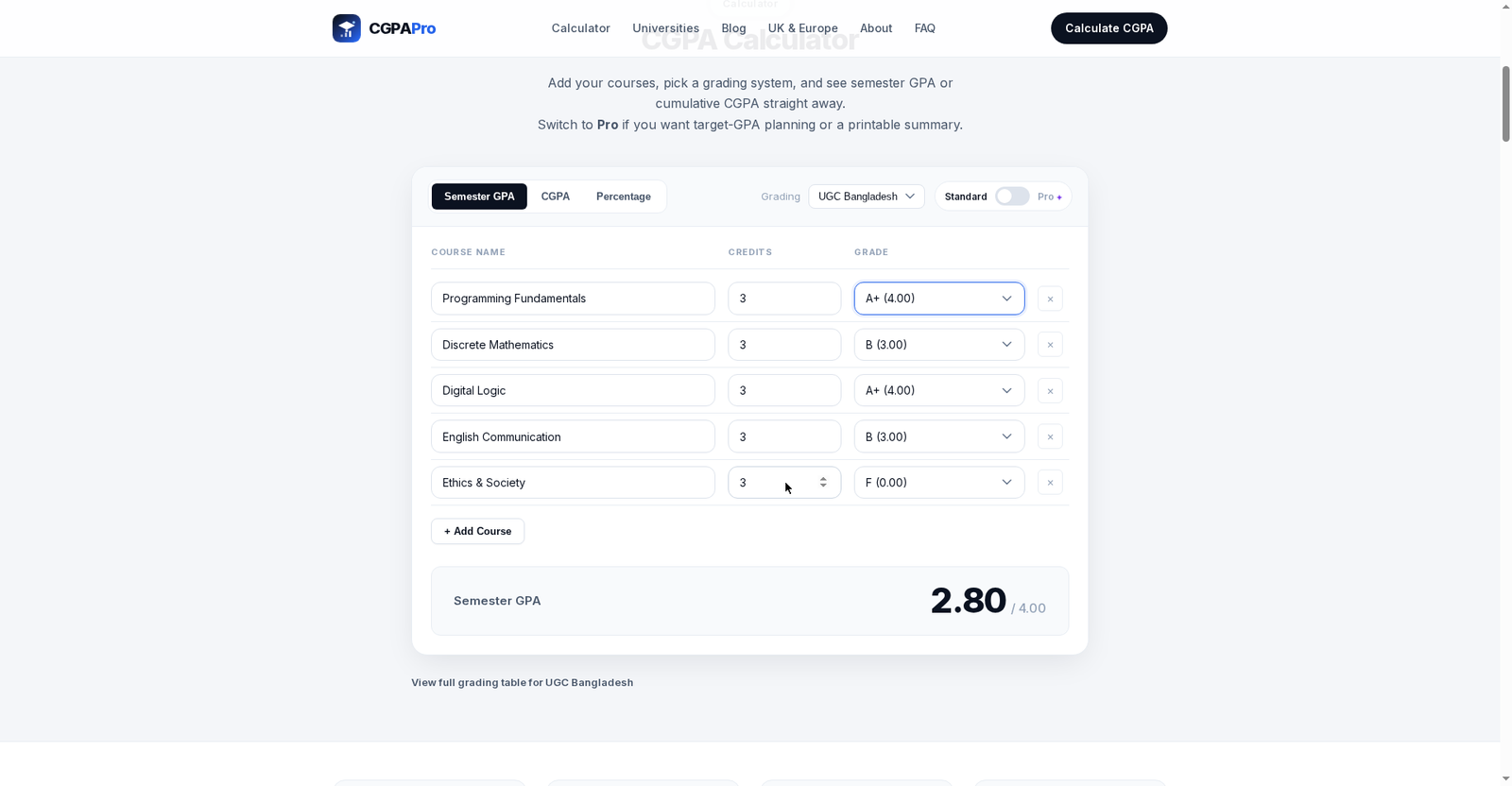
The fastest way to check your own numbers is the CGPAPro calculator: add each course, set its credit hours, pick the grade, and read off your semester GPA instantly. Below is a screenshot of it filled with a simplified five-course MMU example — the grades here are ones whose points are identical on MMU’s official scale and on the calculator’s dropdown (A+ = 4.00, B = 3.00, F = 0.00). The calculator reads 2.80.
The official MMU grade table: marks decide your points
Section 8.1 of the MMU Academic Handbook gives the scheme of marks and grades in force since Trimester 3 of the 2022/2023 session. Read it carefully: within every letter band, each mark (or one-mark step) carries its own point value. Two students with the same letter grade can legitimately have different grade points — and a one-mark improvement near the top of a band can be worth more than a five-mark improvement at the bottom of the next one.
| Grade | Marks | Points | Grade | Marks | Points |
|---|---|---|---|---|---|
| A+ | 90–100 | 4.00 | B− | 62–<63 | 2.80 |
| A | 80–<90 | 4.00 | B− | 61–<62 | 2.73 |
| A− | 79–<80 | 3.93 | B− | 60–<61 | 2.67 |
| A− | 78–<79 | 3.87 | C+ | 59–<60 | 2.59 |
| A− | 77–<78 | 3.80 | C+ | 58–<59 | 2.53 |
| A− | 76–<77 | 3.73 | C+ | 57–<58 | 2.46 |
| A− | 75–<76 | 3.67 | C+ | 56–<57 | 2.40 |
| B+ | 74–<75 | 3.60 | C+ | 55–<56 | 2.33 |
| B+ | 73–<74 | 3.53 | C | 54–<55 | 2.26 |
| B+ | 72–<73 | 3.47 | C | 53–<54 | 2.20 |
| B+ | 71–<72 | 3.40 | C | 52–<53 | 2.13 |
| B+ | 70–<71 | 3.33 | C | 51–<52 | 2.07 |
| B | 69–<70 | 3.27 | C | 50–<51 | 2.00 |
| B | 68–<69 | 3.20 | C− | 47–<50 | 1.67 |
| B | 67–<68 | 3.13 | D+ | 44–<47 | 1.33 |
| B | 66–<67 | 3.07 | D | 40–<44 | 1.00 |
| B | 65–<66 | 3.00 | F | 0–<40 | 0.00 |
| B− | 64–<65 | 2.93 | PS | 40–100 | — (no points) |
| B− | 63–<64 | 2.87 | FL | 0–<40 | — (no points) |
Three things in that table deserve emphasis. First, A and A+ both earn 4.00 — there is no bonus for crossing 90. Second, the steps inside a band are 0.06 or 0.07 per mark, so the difference between 75 and 79 marks (both A−) is 0.26 grade points. Third, PS (Pass) and FL (Fail) are used only for pass/fail subjects and carry no grade points at all, so they never move your GPA or CGPA.
If you only remember one thing from this table, remember this: never convert an MMU letter grade with the generic table. On the generic table, a B is 3.00. At MMU, a B earned with 68 marks is 3.20, and a B earned with 65 marks is 3.00.
How to calculate your MMU GPA, step by step
- For each graded course, find your mark, not just your letter. Your result slip shows both. Look up the mark in the table above to get the exact grade point (GP).
- Multiply credit hours × grade point for each course. This gives the course’s grade points earned.
- Add up all grade points earned — that is your Total Grade Points (TGP).
- Add up all credit hours for graded courses only — that is your Total Credit Hours (TCH). Leave out PS, FL, W and I courses entirely: they contribute neither points nor hours.
- Divide TGP by TCH. That is your trimester GPA. MMU reports GPA and CGPA to two decimal places.
- For CGPA, do the same across every trimester so far: add all grade points earned since you started (CTGP), add all credit hours taken (CTCH), and divide.
The formulas
GPA = Total Grade Points (TGP) ÷ Total Credit Hours (TCH)
CGPA = Cumulative Total Grade Points (CTGP) ÷ Cumulative Total Credit Hours (CTCH)
Credit hours are the weights. A 4-credit course moves your GPA roughly twice as much as a 2-credit course with the same grade, which is why a single bad result in a heavy core subject hurts far more than a bad result in a light elective — and why a strong result in a heavy subject is the fastest way to pull a CGPA back up.
Worked example 1: a real MMU trimester, marks-based
Take a first-trimester MMU student with five graded courses. Watch how the marks, not the letters, drive the result:
| Course | Credit hours | Mark | Grade | Grade point | Points earned |
|---|---|---|---|---|---|
| Programming Fundamentals | 3 | 82 | A | 4.00 | 3 × 4.00 = 12.00 |
| Discrete Mathematics | 3 | 76 | A− | 3.73 | 3 × 3.73 = 11.19 |
| Digital Logic | 4 | 68 | B | 3.20 | 4 × 3.20 = 12.80 |
| English Communication | 3 | 58 | C+ | 2.53 | 3 × 2.53 = 7.59 |
| Media Culture | 3 | 45 | D+ | 1.33 | 3 × 1.33 = 3.99 |
| Total | 16 | 47.57 |
GPA = 47.57 ÷ 16 = 2.973125 → 2.97.
Now compare with the generic table. A student converting those same letters generically (A 4.00, A− 3.67, B 3.00, C+ 2.33, D+ 1.33) would get 12.00 + 11.01 + 12.00 + 6.99 + 3.99 = 45.99, and 45.99 ÷ 16 = 2.87. That is a full 0.10 lower than the true 2.97 — the difference between worrying about probation and not, or between two degree classes at graduation. Every mark in the worked example above was read straight from the official table: 76 marks is an A− worth 3.73, 68 marks is a B worth 3.20, and 58 marks is a C+ worth 2.53.
Worked example 2: the handbook’s own sample, verified
MMU’s handbook prints a two-trimester sample calculation, and it is worth re-checking because it proves the mark-driven table in action. In Trimester 1, the student’s courses include a C worth 2.200 (53 marks) and another C worth 2.000 (50 marks) — the same letter, different points. The trimester totals are 34.201 grade points over 13 credit hours: 34.201 ÷ 13 = 2.6316… → GPA 2.63. In Trimester 2, the student earns 22.600 points over 7 credit hours: 22.600 ÷ 7 = 3.2285… → GPA 3.23. Cumulatively: (34.201 + 22.600) ÷ (13 + 7) = 56.801 ÷ 20 = 2.84005 → CGPA 2.84. It also shows how CGPA resists quick moves: a strong second trimester (3.23) only lifted the cumulative figure to 2.84, because the first trimester’s 13 credit hours still dominate the average.
GPA vs CGPA at MMU: what counts, what doesn’t
Your GPA is one trimester. Your CGPA is everything, weighted by credit hours, from your first trimester to now. Three counting rules catch students out:
- PS and FL courses never count. Pass/fail subjects (usually co-curricular or MPU-type courses) add credit toward graduation but zero to your GPA or CGPA.
- Withdrawn (W) and Incomplete (I) courses don’t count in the trimester they occur. An I must be resolved — usually through a supplementary examination — before the course enters your GPA.
- U (unofficial withdrawal) and R (barred from examination) count as F. Disappearing from a course without a formal withdrawal is scored as a fail, with 0.00 points and the credit hours included in the denominator.
One more counting rule works in your favour: when you repeat a course, only the best grade counts toward your CGPA. You still have to re-do the whole course — all coursework and examinations — and repeat fees apply, but the old grade stops dragging your CGPA down once the better grade replaces it. The repeat rules are covered in detail in our guide to how retaking a course affects your CGPA.
Degree classification: the bands everyone gets wrong
At graduation, MMU awards Bachelor’s honours classifications on CGPA cut-offs set out in Section 12.2 of the handbook. These are the verified bands — note carefully that Second Lower starts at 2.67, not 3.00, a mistake repeated across forums and summary sites:
| Bachelor’s classification | CGPA |
|---|---|
| First Class | 3.67 – 4.00 |
| Second Upper | 3.33 – 3.66 |
| Second Lower | 2.67 – 3.32 |
| Third Class | 2.00 – 2.66 |
Diploma students have a three-band scale:
| Diploma classification | CGPA |
|---|---|
| Distinction | 3.50 – 4.00 |
| Credit | 3.00 – 3.49 |
| Pass | 2.00 – 2.99 |
To graduate at all, you need the credits prescribed for your programme, a minimum CGPA of 2.00, and your faculty’s and the Senate’s requirements — including the MUET exit requirement (generally MUET Band 3 or IELTS 5.0; Law and Strategic Communication require Band 4 / IELTS 6.0). For the full picture of what each band means for jobs and further study, see our guide to Second Class Upper CGPA in Malaysia.
Two boundary facts are worth pinning down. A CGPA of 3.21 is Second Lower at MMU — it sits inside 2.67–3.32 — even though 3.21 would be Second Upper at several other Malaysian universities. And a CGPA of 3.66 is Second Upper, while 3.67 is First Class: one hundredth of a point at the boundary is worth an entire class.
Pass, fail, and the F# trap: 40% is not always enough
The general pass mark at MMU is 40% (grade D). But “40% overall” is not the whole story for two large groups of students:
- Law, Accounting and Diploma in Accounting: 50% pass. These professional-body programmes treat C− (1.67), D+ (1.33), D (1.00) and F (0.00) as fails, even though the same marks are passes elsewhere in the university. If you are in one of these programmes, a 45-mark result is a fail — plan accordingly.
- IT & Computing (FCI/FIST): separate 40% floors. Under the MQA programme standard, you must pass the coursework component, pass the final assessment component, and reach 40% overall. Fail the coursework but pass the final with 40%+ overall, and you still fail the subject — with grade F# and 0.00 grade points.
- Engineering (FET/FOE): pass the final exam. The Engineering Accreditation Council requires at least 40% in the final examination on top of 40% overall. The handbook’s own example is brutal: a student with 54.8 overall who failed the final has the mark downgraded to 39 and the grade to F#. No supplementary examination is granted for mandatory-pass-final subjects.
The F# rule is the cruellest surprise in MMU grading, because it can turn a comfortable-looking overall mark into a fail. If you are in IT, Computing or Engineering, treat the final examination as a separate pass/fail gate: strong coursework cannot rescue a failed final.
Probation and termination: the 2.00 line
MMU’s academic-status rules are blunt. If your GPA and CGPA are both below 2.00 in a trimester, you are placed on probation (PROB). If that happens for two consecutive trimesters, your studies are terminated (TERM). Terminated students may appeal to the Senate Appeal Committee, with a second appeal to the President of MMU, through the Examination and Records Unit — but reinstatement is not guaranteed, and failing a subject more than twice can make a reinstatement appeal ineligible. The practical lesson: one bad trimester is recoverable, especially with the best-grade repeat rule; two in a row can end your enrolment. If your CGPA is sliding toward 2.00, that is the semester to cut your load, use repeats strategically, and talk to your faculty early.
Dean’s List at MMU
The Dean’s List recognises excellent trimester performance with a Dean’s Certificate from your faculty. The requirements are a trimester GPA of 3.67 or above for Foundation and Bachelor students (3.50 or above for Diploma students), with at least 12 graded credit hours in a long trimester or 6 in a short trimester. Note the credit-hour condition: a brilliant 4.00 across only two light courses does not qualify, because the graded load is too small. For how Dean’s List thresholds compare across Malaysian universities, see our guide to Dean’s List CGPA requirements and probation.
Repeating a course and supplementary examinations
Repeats: you may repeat a course at most two times. Only the best grade counts in your CGPA, but you must re-do the entire coursework and examinations, and the fee is 50% of the tuition/programme fee for a failed subject (100% for retaking a subject you already passed, or for U/R/W grades).
Supplementary examinations: held in week 1 of the following trimester, with a RM50 per course administrative fee payable before the result is released. Critically, a supplementary is not automatic: your eligibility must be recommended by the Board of Examiners and approved by the Senate. Fail grades that qualify carry an asterisk (for example F*), and there is no second supplementary examination under any circumstances — if you miss it or fail it, you retake the subject. Students granted a supplementary as a “first attempt” (grade I, for genuine medical or special cases) sit it as their main examination instead.
How MMU compares with other Malaysian universities
MMU’s system differs from its neighbours in two ways that matter when you compare CGPAs. First, the mark-driven point table means an MMU transcript’s grade points are more granular than the fixed-letter tables used at most public universities — an MMU 3.20 and a 3.00 can both be a “B”. Second, the classification bands are tighter at the top: MMU’s First Class starts at 3.67, while some universities start it at 3.50, and MMU’s Second Upper floor of 3.33 is higher than the 3.00 used at several others. For the closest public-university comparisons, see our guides to the UKM grading system and the UNIMAS grading system.
Common mistakes MMU students make
- Converting letters with the generic table. The single most expensive mistake: using A− = 3.67, B+ = 3.33, B = 3.00. At MMU those are only the bottom-of-band values. Use your marks.
- Assuming 3.00+ means Second Upper. At MMU, Second Upper starts at 3.33. A 3.00–3.32 CGPA is Second Lower.
- Counting PS/FL, W or I courses in the denominator. They carry no grade points and no credit hours for GPA purposes. Including them understates your GPA.
- Forgetting the F# rule. In IT, Computing and Engineering, passing overall is not enough — you must pass the final assessment too.
- Treating a supplementary exam as a right. It needs Board of Examiners recommendation plus Senate approval, and there is no second chance.
- Assuming a C− is a pass in every programme. In Law and Accounting programmes, C− is a fail under the 50% rule.
- Rounding your way across a class boundary. 3.665 is not 3.67 unless the transcript says so. Check with ERU before celebrating — or despairing.
Tips for lifting your MMU CGPA
- Chase marks, not letters. Because points step with every mark, one extra mark at 75→76 (3.67→3.73) is worth more than five marks at 80→85 (both 4.00). Spend revision time where the next mark actually pays.
- Weight your effort by credit hours. A 4-credit core subject moves your GPA twice as much as a 2-credit elective. Protect the heavy subjects first.
- Guard the final examination. In IT, Computing and Engineering, a failed final means F# regardless of coursework. Never “bank” coursework and coast into the final.
- Use repeats surgically. Only the best grade counts, so repeating your worst heavy subject is usually the highest-return move — but you have at most two repeats per course, and each costs time and fees.
- Watch the 12-credit Dean’s List condition. If you are aiming for a Dean’s Certificate, keep at least 12 graded credit hours in the trimester.
- Check your current handbook. This guide reflects the July 2023 Academic Handbook; programme-specific pass rules and MUET requirements can change, and your faculty’s current handbook is the final word.
Frequently asked questions
Is 3.21 CGPA Second Upper at MMU?
No. At MMU, Second Upper is 3.33–3.66. A CGPA of 3.21 falls in Second Lower (2.67–3.32). Other Malaysian universities use different bands — that is where the confusion comes from — but for MMU the official table in Section 12.2 of the handbook is the only one that counts.
What CGPA do I need for First Class at MMU?
3.67 or above on graduation, for a Bachelor’s degree. For a Diploma, the top band is called Distinction and starts at 3.50.
Why doesn’t my GPA match the generic A = 4.00, A− = 3.67 table?
Because MMU assigns grade points by exact mark. A 76-mark A− is worth 3.73, a 79-mark A− is worth 3.93, and a 68-mark B is worth 3.20. The generic table only matches MMU at the bottom mark of each band (75, 70, 65, and so on). Use the official mark-to-point table above.
Is C− a pass at MMU?
In most programmes, yes — C− (47–49 marks, 1.67 points) is a pass under the general 40% rule. In Law, Accounting and Diploma in Accounting, no: those programmes use a 50% pass mark, and C−, D+, D and F are all fails.
Can I get a supplementary exam if I fail?
Maybe. Supplementary examinations are granted only on the Board of Examiners’ recommendation with Senate approval, cost RM50 per course, and are capped per trimester. There is no second supplementary examination — if you miss it or fail it, you retake the subject. Failing the final assessment in a mandatory-pass-final subject (IT, Computing, Engineering) does not qualify for a supplementary at all.
Does repeating a subject replace my old grade?
For CGPA purposes, yes: only the best grade counts. But you must re-do all coursework and examinations, you can repeat a course at most twice, and fees apply (50% of tuition for a failed subject, 100% for retaking a passed subject).
What happens if my CGPA drops below 2.00?
If both your GPA and CGPA are below 2.00 in a trimester, you go on probation. If that happens for two consecutive trimesters, your studies are terminated, subject to appeal to the Senate Appeal Committee and then to the President of MMU.
The bottom line
MMU’s grading system rewards precision. Your grade points come from your exact marks, your degree class is decided by bands that start at 3.67, 3.33 and 2.67, and your faculty’s pass rules — 40% generally, 50% for Law and Accounting, separate final-exam gates for IT, Computing and Engineering — decide whether a mark that looks like a pass actually is one. Calculate with the official table, weight by credit hours, and the number on your result slip will stop being a surprise. And if your CGPA is sitting near a boundary, remember that at MMU a single mark can be worth 0.07 grade points — which, over a degree, is sometimes the whole difference between one class and the next.
Sources: MMU Academic Handbook (July 2023), Sections 8.1–8.5, 9.1–9.2, 7.9, 3.2.5 and 12 — official PDF on mmu.edu.my; programme and campus information via Multimedia University (mmu.edu.my). Programme-specific rules can change: confirm against your current faculty handbook.