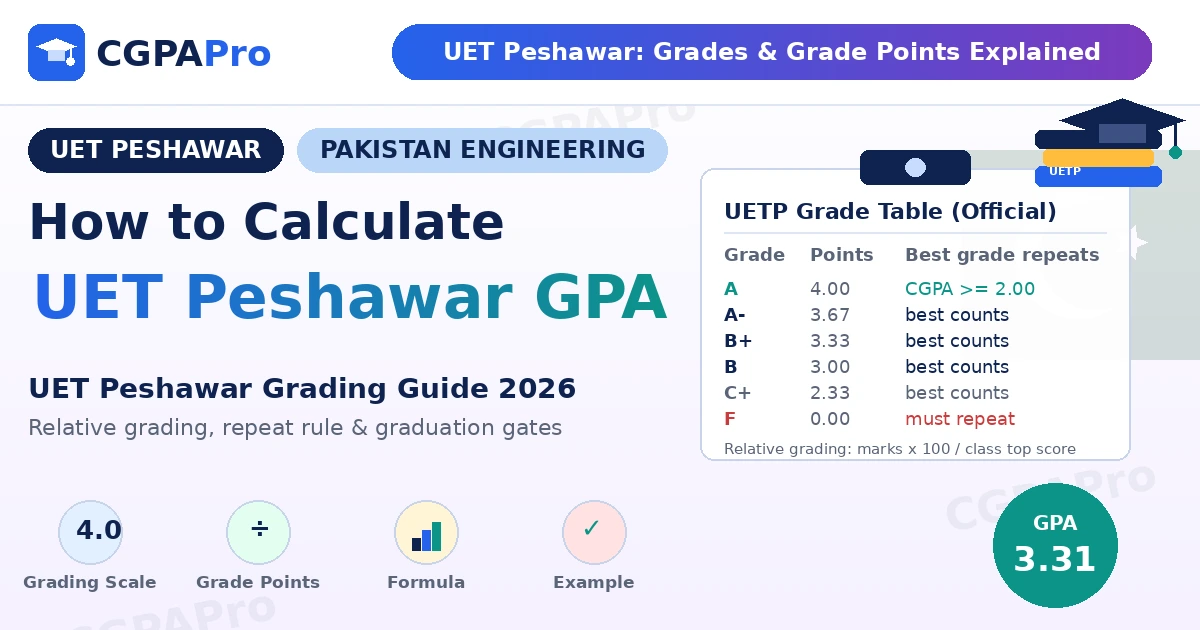
UET Peshawar Grading System 2026: GPA & CGPA Guide
You scored 80 out of 100 and got a B. Your friend in the next section scored 74 out of 100 and got a B+. Nobody in your group chat can explain why, and the “official-looking” percentage tables on Google disagree with each other anyway. Here is the real answer: UET Peshawar does not grade you on your raw marks. It grades you on your marks relative to the top scorer in your class — and once you understand the normalization formula, the whole system clicks into place.
This guide covers the complete official system: the verified 11-grade point table, the normalization math with real numbers, how theory, lab and capstone marks are weighted, the credit-weighted SGPA/CGPA formula with a fully worked 5-course example, the warning and registration-block ladder students usually learn about too late, the repeat rule that is the opposite of UET Lahore’s, and everything required to graduate. Everything below traces to UET Peshawar’s Examination Rules for the semester system — the governing regulation for all undergraduate degrees.
Try it: calculate your UET-style semester GPA
The fastest way to understand any grading system is to run your own numbers. Use the free CGPAPro calculator — enter your courses, credit hours, and letter grades, and it computes the semester GPA instantly. The screenshot below shows a 5-course engineering semester (the same one worked out by hand later in this article).
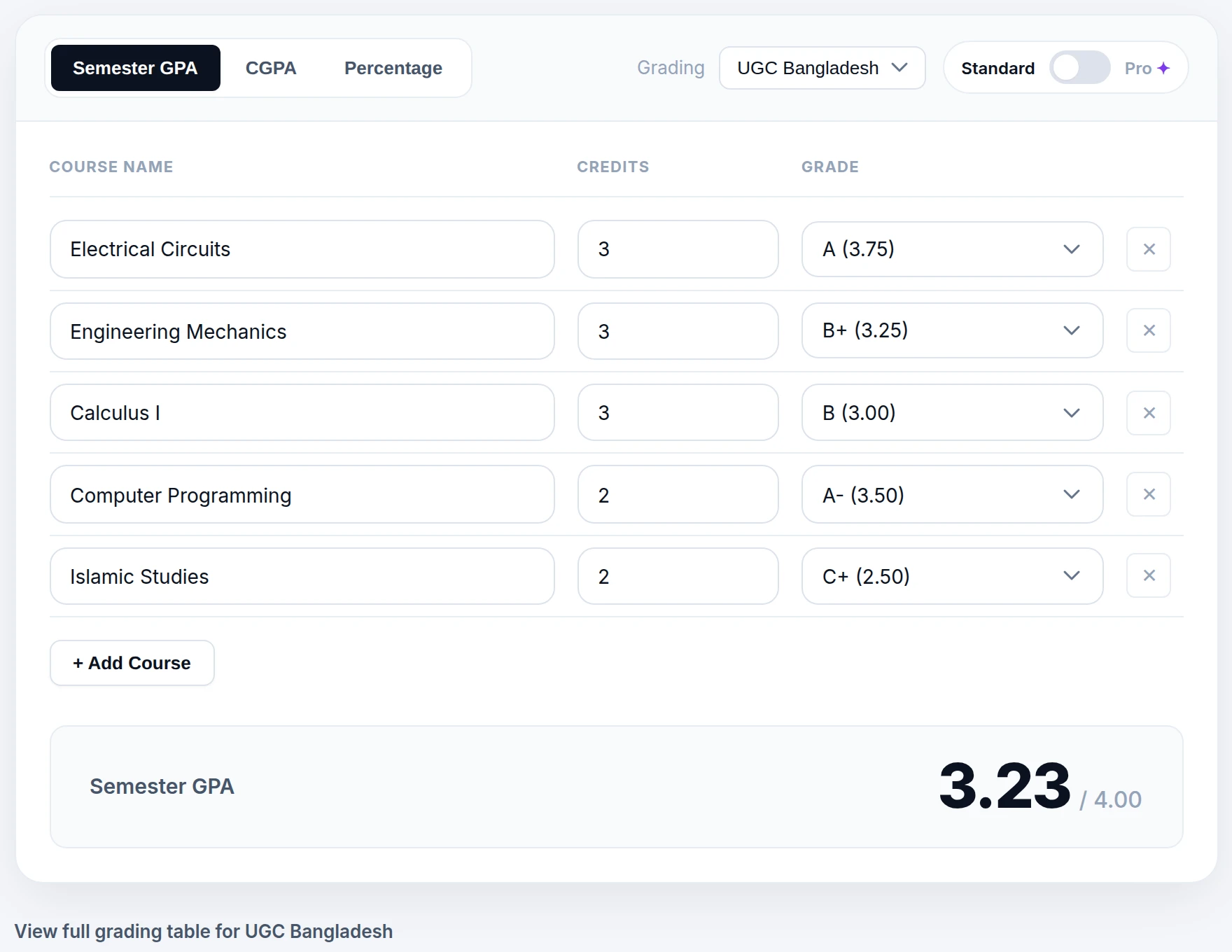
About this screenshot: it was taken on the CGPAPro homepage calculator, which uses a generic 4.0 scale — so the same five letter grades read 3.23 there, while UET Peshawar’s official grade points (A− = 3.67, B+ = 3.33, C+ = 2.33 instead of the generic 3.50/3.25/2.50) give 3.31. Same letters, different numbers — which is exactly why the scale table below matters more than any calculator.
The official UET Peshawar grade table (verified)
UET Peshawar’s Examination Rules prescribe an eleven-grade table. Three things calculators and rival universities’ tables usually get wrong: there is no A+ at UET Peshawar (unlike UET Lahore), the minus grades carry the HEC-style two-decimal values 3.67 / 2.67 / 1.67 (not the rounder 3.70 / 2.70), and D is a genuine passing grade worth 1.00 — only F earns zero.
| Grade | Grade points | What it means in practice |
|---|---|---|
| A | 4.00 | Top band of the normalized scale — the ceiling |
| A− | 3.67 | Excellent — just below the top cluster |
| B+ | 3.33 | Very good |
| B | 3.00 | Good, solid performance |
| B− | 2.67 | Above average |
| C+ | 2.33 | Average to satisfactory |
| C | 2.00 | The minimum “safe” grade — the good-standing benchmark |
| C− | 1.67 | Weak pass; drags the average down |
| D+ | 1.33 | Very weak pass |
| D | 1.00 | Lowest passing grade |
| F | 0.00 | Fail — must be repeated |
Keep this table open while reading the next section, because the table alone does not decide your grade — your class does.
How relative grading actually works at UET Peshawar (the normalization formula)
This is the part that confuses nearly every UETP student, and the part no competitor article explains with numbers. UET Peshawar sets no fixed percentage band for any letter grade. Instead, the Examination Rules lay down a normalization procedure:
- Each student’s actual marks are converted to normalized marks:
normalized marks = actual marks × 100 ÷ highest marks obtained in that class - The normalized 50–100 range is split into ten equal five-point bands.
- Letter grades D through A are awarded across those bands, in order — a normalized mark below 50 is an F.
Concretely: if the class topper scores 92, your 80 becomes 80 × 100 ÷ 92 = 86.96, and that normalized number — not the 80 — decides your grade. In a class where the topper scored only 70, your 65 becomes 92.86 — and suddenly the “worse” raw score earns the better grade. This is why an 80/100 can land a B while a 74/100 earns a B+ in another section: the two sections had different toppers.
Two caveats worth knowing: first, the rules do not publish the exact band-to-letter mapping in the public excerpt, so the ten-band table in most online calculators is the natural reading of the rules’ ordering (D lowest, A highest) — check your current program handbook if your department applies a tweak. Second, a normalized score under 50 is an F regardless of how generous the curve looks.
Theory, lab and project marks: how your final number is built
Before normalization, your course total is assembled from sessional work, the mid-semester exam and the final exam. The standard UET Peshawar undergraduate split is:
- Sessional (quizzes, assignments, attendance): 20 marks
- Mid-semester exam: 30 marks
- Final exam: 50 marks
Laboratory courses follow their own sessional-plus-practical split, and the final-year capstone/design project is assessed across proposal, progress and final demonstration with external evaluation — always confirm the current weightages with your department, since councils of studies occasionally adjust them.
One more trap students fall into: the sessional component is where most D-to-C borderline battles are actually decided. A student who skips assignments has already capped their ceiling before the final exam even happens.
SGPA and CGPA: the formulas
UET Peshawar uses the standard credit-weighted formulas:
SGPA = Σ (credit hours × grade points) ÷ Σ credit hours (for the semester)
CGPA = Σ (credit hours × grade points across all semesters) ÷ Σ credit hours (across all semesters)
The degree CGPA is cumulative across all eight semesters — every course you ever take, weighted by its credit hours, goes into the same pot. Retakes are handled by the best-grade rule explained below.
Worked example: a real 5-course engineering semester
Take a typical first-year engineering semester and run the official UET Peshawar grade points through it:
| Course | Credit hours | Grade | Grade points | Quality points |
|---|---|---|---|---|
| Electrical Circuits | 3 | A | 4.00 | 12.00 |
| Engineering Mechanics | 3 | B+ | 3.33 | 9.99 |
| Calculus I | 3 | B | 3.00 | 9.00 |
| Computer Programming | 2 | A− | 3.67 | 7.34 |
| Islamic Studies | 2 | C+ | 2.33 | 4.66 |
| Totals | 42.99 | |||
SGPA = 42.99 ÷ 13 = 3.31. Now run the same letters through a generic calculator (A− = 3.50, B+ = 3.25, C+ = 2.50): you get 3.23 — eight hundredths lower. That gap is the whole point of this guide: the letters are the same, the numbers behind them are not.
For CGPA, repeat the calculation across semesters. Suppose semester 2 comes in at 3.10 across 17 credit hours: CGPA = (42.99 + 52.70) ÷ (13 + 17) = 95.69 ÷ 30 = 3.19. Early weak semesters dilute slowly — which is why the improvement strategies later in this guide matter most in years one and two.
SGPA vs CGPA: the distinction that costs students their degree
SGPA measures one semester; CGPA measures your entire degree to date. UET Peshawar’s academic rules use both as gates: semester-level warnings look at recent SGPA, while the ultimate gate — graduation — is a minimum CGPA of 2.00 across all courses.
The dangerous mistake is assuming a good SGPA fixes everything. A student who bounces between 3.50 and 1.20 semesters can hold a “fine” CGPA on paper while accumulating warnings — and the registration blocks below trigger on the semester record, not the cumulative one.
Warnings and registration blocks: the ladder students learn about too late
UET Peshawar’s Examination Rules tie academic standing to hard numbers:
- Academic warning when semester performance slips — treat any warning as a serious signal, not a formality.
- Registration blocked at CGPA below 1.50 — fall under 1.50 and you cannot register for the next semester until you repair your standing.
- Three or more F grades in a semester can also block registration and force a repeat year.
These blocks are the real teeth of the system. Unlike the gentle-sounding “warning”, a registration block stops your degree in its tracks — which is why the recovery section below exists.
The repeat rule: only the best grade counts
Here is where UET Peshawar differs sharply from its Lahore namesake. At UET Lahore, a repeated course averages the old and new grades. At UET Peshawar, only the best grade counts — the repeat replaces the earlier attempt in the CGPA computation.
This makes repeating a rational strategy at Peshawar in a way it is not at Lahore: if you earned a D in Calculus I, retaking it and scoring a B genuinely erases the damage. The myth that “repeating is dangerous because it averages” comes from students confusing the two UETs — a confusion this guide exists to kill.
Migration and transfer: what carries over
Students migrating into UET Peshawar from another HEC-recognized institution carry their credits under the migration rules: courses are mapped to the Peshawar scheme of studies, and only the transferred credits count — grades from the previous institution do not recompute your Peshawar CGPA. Always confirm the current migration policy with the Directorate of Admissions before assuming anything transfers.
Graduation requirements: the final gates
To walk out with a UET Peshawar undergraduate degree you need:
- Minimum CGPA of 2.00 across all degree courses.
- No outstanding F grades — every failed course must be repeated and passed.
- Completion of the full scheme of studies within the maximum allowed duration.
Gold medals and scholarships (see the Students Handbook link below) go to the top CGPA holders — and at Peshawar, with relative grading, the medal race is a race against your classmates, not against a fixed percentage.
Common mistakes UET Peshawar students make
- Reading percentage tables as gospel. “85% = A” tables from other universities do not apply here — your grade depends on the class topper.
- Ignoring sessional marks. 20 of every 100 marks are decided before the midterms; skipping assignments caps your ceiling.
- Confusing UET Lahore’s rules with Peshawar’s. The repeat-averaging rule is Lahore’s; Peshawar counts only the best grade.
- Assuming a good SGPA means a safe CGPA. Registration blocks and warnings key off semester performance — one catastrophic semester can halt registration even with a decent cumulative number.
- Waiting until the final year to care about CGPA. Credit-weighted math means early semesters dominate the final CGPA; repair is cheapest in year one and two.
How to improve your UET Peshawar CGPA: practical strategies
- Target the repeat rule. Your D and C− courses are the cheapest CGPA points on the board — only the best grade counts at Peshawar, so a retaken course can only help.
- Play the normalization. Since grades are relative, the students who study in groups around the class topper’s pace get a free lift from the curve — collaboration beats isolation here.
- Front-load credit hours in strong subjects. High-credit courses move the SGPA needle most; schedule your hardest electives when your load is lightest.
- Protect the sessional 20. Attendance and assignments are the most controllable marks in the whole system.
Read more: How Retaking a Course Affects Your CGPA (2026)
FAQ
What is the passing grade at UET Peshawar?
D (1.00 grade points) is the lowest passing grade; F (0.00) is a fail and must be repeated.
Does UET Peshawar have an A+ grade?
No. Unlike UET Lahore, UET Peshawar’s official table tops out at A (4.00) — there is no A+.
What CGPA do I need to graduate from UET Peshawar?
A minimum CGPA of 2.00 across all degree courses, with no outstanding F grades.
How does relative grading work at UET Peshawar?
Actual marks are normalized against the class topper (actual × 100 ÷ highest marks), the 50–100 normalized range is split into ten five-point bands, and grades D through A are awarded across those bands. Below 50 normalized is an F.
If I repeat a course at UET Peshawar, which grade counts?
Only the best grade counts — the repeat replaces the earlier attempt in the CGPA computation. This is the opposite of UET Lahore’s averaging rule.
Can a low CGPA block my registration?
Yes — falling below a 1.50 CGPA, or accumulating three or more F grades in a semester, can block registration for the next semester.
Is UET Peshawar’s grading the same as UET Lahore’s?
No. Key differences: Peshawar has no A+, uses 3.67/2.67/1.67 minus-grade values, and counts only the best grade on repeats — Lahore averages them.
Conclusion
UET Peshawar’s system rewards one thing above all: outperforming your class. The normalization formula means your raw percentage is only half the story — the other half is the topper’s score. Keep the verified 11-grade table handy, protect your sessional marks, use the repeat rule aggressively on D-grade courses, and never confuse Peshawar’s rules with Lahore’s. Run your own numbers on the CGPAPro calculator, and check the related guides: the UET Lahore grading guide, the NUST grading guide, the CGPA vs GPA vs SGPA comparison, and the retake guide.
Official sources: UET Peshawar. Students Handbook (gold medals, scholarships): UET Peshawar Students Handbook (PDF).
Read More: UET Lahore vs UET Peshawar: 5 grading differences every applicant should know · NUST Grading System 2026: GPA & CGPA Guide