The 60-second answer
If you’re a University of Karachi student, three facts matter more than anything else on this page. First, KU does not call its cumulative average “CGPA” — your transcript says CGPR, Cumulative Grade Point Ratio. The maths is identical to CGPA; only the name is different, and it confuses students every single semester. Second, the official grade table from the University of Karachi’s Admissions Prospectus 2025 is not the generic HEC table most calculator websites show you. At KU, anything below 45 is a fail, a D starts at 45, and both 85–89 and 90–100 give you 4.0 grade points. Third, you need a minimum of 2.2 or 2.45 CGPR to graduate, depending on your programme — and if you fall short, you get exactly one further chance to fix it.
This guide walks through the official table grade by grade, shows you the exact formula KU’s examinations section uses, works two full examples with real numbers (one hand-checked on the official KU table, one on our free calculator), and answers the questions KU students actually ask — like whether a D is a pass or a fail, and what happens if you clear theory but fail the practical.
Calculate your KU semester GPA in 60 seconds
The fastest way to sanity-check your grades is the free calculator on our homepage. Here’s how KU students should use it:
- Open the CGPA calculator and add one row per course.
- Type the course name and its credit hours exactly as they appear on your date sheet.
- For the grade, first convert your marks using KU’s official table below — find your percentage band, take the letter grade, and select that letter in the calculator.
- Hit calculate. The result is your semester GPA on the calculator’s default scale.
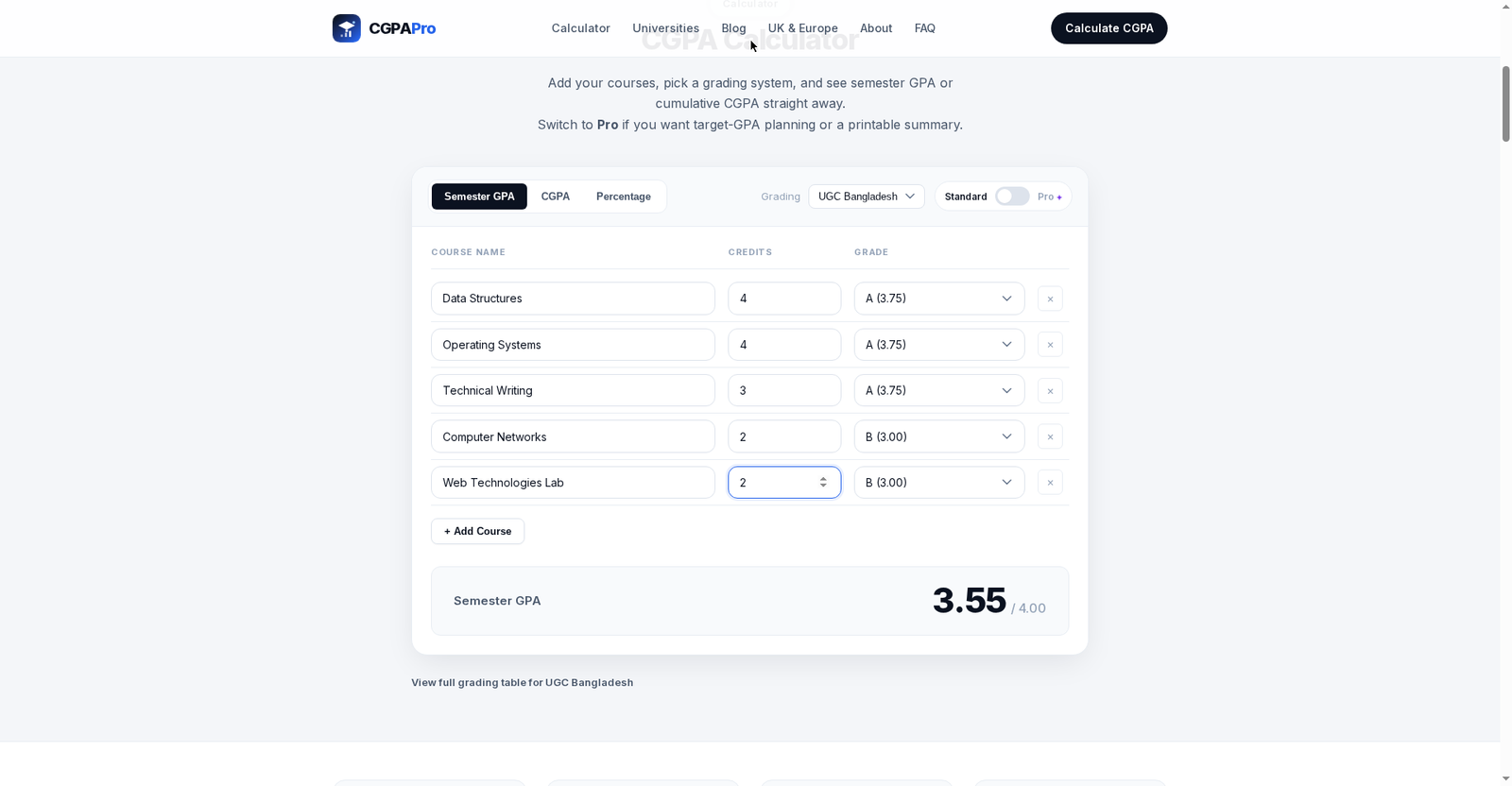
Screenshot: a 5-course BS semester on the calculator — Data Structures (4 cr, A), Operating Systems (4 cr, A), Technical Writing (3 cr, A), Computer Networks (2 cr, B), Web Technologies Lab (2 cr, B) = 53.25 ÷ 15 = 3.55. One honest caveat: the calculator’s built-in scale is the generic 4.0 scale, while KU’s official table (below) uses its own grade points — so always convert your marks to KU letter grades first using the official table, then enter the letters here. The weighting maths is the same either way.
The official KU grade point table (Prospectus 2025)
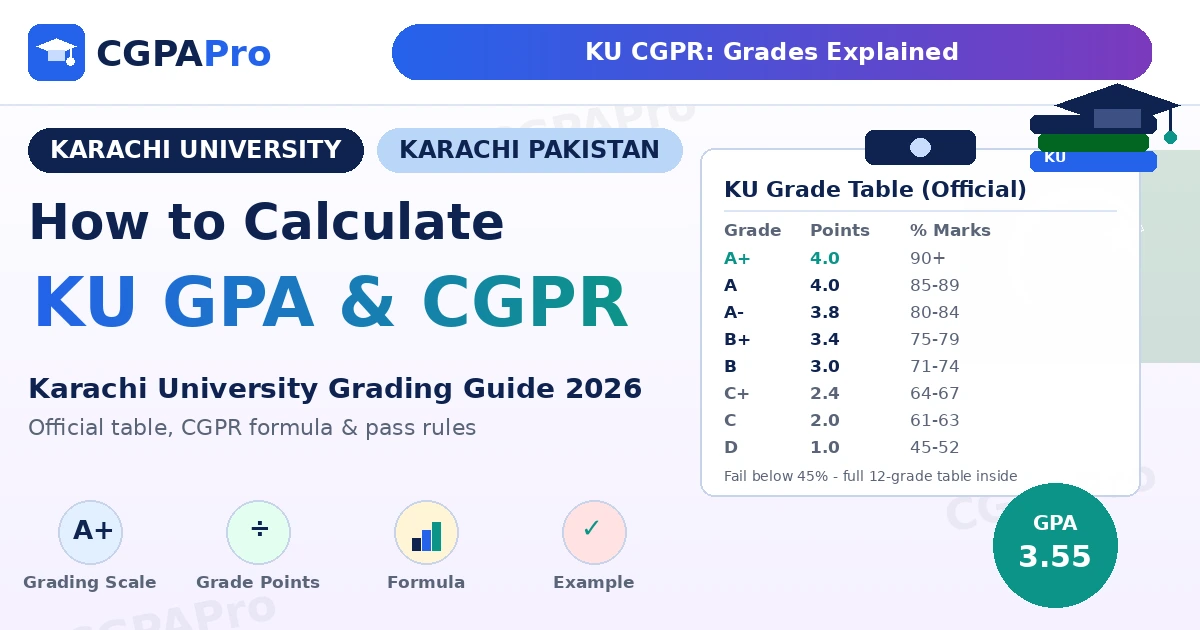
This is the table from the “Grade Point & CGPR Formula” section of the University of Karachi’s official admissions prospectus. It applies to all degree programmes at the university except the School of Law, which follows its own separate rules. If a random calculator site shows you a different table for KU — especially one where D is 40–49 and anything below 40 fails — that site is showing you the generic HEC table, not KU’s.
| Marks (%) | Letter grade | Grade points | What it means |
|---|---|---|---|
| 90 and above | A+ | 4.0 | Outstanding |
| 85 – 89 | A | 4.0 | Excellent |
| 80 – 84 | A− | 3.8 | Very good |
| 75 – 79 | B+ | 3.4 | Good |
| 71 – 74 | B | 3.0 | Above average |
| 68 – 70 | B− | 2.8 | Average |
| 64 – 67 | C+ | 2.4 | Satisfactory |
| 61 – 63 | C | 2.0 | Pass |
| 57 – 60 | C− | 1.8 | Weak pass |
| 53 – 56 | D+ | 1.4 | Marginal pass |
| 45 – 52 | D | 1.0 | Minimum pass |
| Below 45 | F (Fail) | 0.0 | Fail — repeat required |
Three things in this table surprise almost every KU student:
- A and A+ are both worth 4.0. Scoring 96 instead of 86 buys you a prettier letter but zero extra grade points. Once you’re above 85, every additional mark is cosmetic — spend that study energy on your weakest course instead.
- A− is 3.8, B+ is 3.4. These are not the 3.67 / 3.33 values you’ll see on generic GPA charts. KU’s scale is its own; using a generic converter silently miscalculates your GPA.
- The fail line is 45, not 40 or 50. A 46 is a D — a pass, worth 1.0 grade points. A 44 is a fail, worth nothing, and the credits still count in your divisor (more on that disaster below).
The official formula, step by step
KU’s prospectus states the formula in two lines, and it’s refreshingly simple:
- Grade points in a course = (credit hours of the course) × (grade point for your marks band).
- CGPR = (total grade points in all courses) ÷ (total credit hours).
Your semester GPA uses the same formula on one semester’s courses; your CGPR runs it across every course you’ve taken. Credit hours are the weights — a 4-credit core course moves your CGPR roughly twice as much as a 2-credit elective with the same grade.
Worked example: a real KU semester, hand-calculated
Let’s run a first-year BS Computer Science semester through the official KU table, exactly as the examinations section would:
| Course | Cr. hrs | Marks | KU grade | Grade pts | Cr. hrs × pts |
|---|---|---|---|---|---|
| Programming Fundamentals | 3 | 87% | A | 4.0 | 12.00 |
| Discrete Structures | 3 | 82% | A− | 3.8 | 11.40 |
| Calculus | 3 | 76% | B+ | 3.4 | 10.20 |
| English Composition | 2 | 72% | B | 3.0 | 6.00 |
| Pakistan Studies | 2 | 66% | C+ | 2.4 | 4.80 |
| Total | 13 | 44.40 |
Semester GPA = 44.40 ÷ 13 = 3.42.
Notice the traps this example walks past: 87% is an A (not A+, which needs 90+); 82% is A− worth 3.8 (not 3.67); 66% is C+ worth 2.4. If you’d used a generic online converter for this same semester, you’d have gotten a different — and wrong — number. That’s the entire reason this article exists: KU’s table is non-standard, and generic tools don’t know it.
Now the CGPR version. Say the same student earned a 3.10 in semester one (15 credits) and this 3.42 in semester two (13 credits). CGPR is not the average of 3.10 and 3.42 — it’s credit-weighted: (3.10 × 15 + 3.42 × 13) ÷ 28 = (46.50 + 44.46) ÷ 28 = 90.96 ÷ 28 = 3.25. Averaging the two semester GPAs directly would give 3.26 — close here, but the gap widens with uneven credit loads, and the examinations section uses the weighted version.
CGPR vs CGPA: what’s the difference at KU?
Nothing — mathematically. CGPR (Cumulative Grade Point Ratio) is simply the name the University of Karachi uses on transcripts and in its prospectus for what the rest of Pakistan calls CGPA. Same formula, same 4.0 scale, same meaning. If a job application asks for your CGPA and your transcript says CGPR 3.25, write 3.25 — then mention in the interview that KU labels it CGPR, because some HR software flags unfamiliar terms.
The one place the terminology matters is credential evaluation: agencies like WES work from your actual marks and their own conversion tables, not from your CGPR number — so don’t “convert” your CGPR to a percentage with a random multiplier before sending documents. Send the transcript as-is. For the general GPA-vs-CGPA-vs-SGPA vocabulary, our CGPA vs GPA vs SGPA explainer covers how the three terms relate.
The 61% danger line: KU’s one-chance improvement rule
This is the rule most KU students discover too late. The prospectus says a student who falls short of the required CGPR gets one further chance — a single chance, not one per semester — to improve it, by re-appearing in two courses in which they scored below 61 marks, i.e. courses graded C−, D+, or D.
Read that carefully, because every clause matters:
- 61 is the cutoff, not 60. A C (61–63) is safe; a C− (57–60) makes the course eligible. One mark can decide whether a course counts.
- Only two courses. If three courses are dragging you down, you must pick the two where an improvement buys the most grade points — usually the highest-credit ones.
- One chance total. There is no second improvement round. Prepare for those two re-appears like they’re your finals, because functionally they are.
- It only triggers if you’re short of the graduation CGPR. You can’t use it to polish a 3.4 into a 3.6.
If you’re weighing whether a re-appear is worth it, our guide on how retaking a course affects your CGPA walks through the replacement maths — at KU the logic is the same, except the failed/improved course’s credits were already sitting in your divisor the whole time, which is exactly why the improvement moves the needle so fast.
Graduation floors: 2.2 or 2.45?
The prospectus sets the degree-award floor at “a minimum of 2.2 CGPR or 2.45 CGPR, whichever is applicable to the respective degree programmes.” In practice, this means different programmes set different bars — professional and postgraduate-leaning programmes tend to sit at the higher floor. The prospectus doesn’t publish a programme-by-programme list in the grading section, so the honest advice is: confirm your programme’s exact floor with your department’s examinations office in your first semester, not your final one. Aim for 2.5+ regardless and the question becomes moot.
For context on what these numbers mean: a 2.2 CGPR is roughly a straight-C average (remember, C at KU is 61–63%, worth 2.0), while 2.45 sits between C and C+. Neither is a high bar — but with D grades worth only 1.0 and fails worth 0.0 while still consuming credit hours, a couple of bad semesters can put even a decent student within sight of the floor. That’s what the improvement rule is for.
7 mistakes KU students make (and what the official rules actually say)
- Using the generic HEC table. The most expensive mistake. Generic charts say D = 40–49 and F = below 40; KU says D = 45–52 and F = below 45. A student with 46% who thinks they’ve failed has actually passed; a student with 42% who thinks it’s “just a D” has failed. Always use KU’s table.
- Assuming 85% is an A+. At KU, A+ starts at 90. An 89 is an A — still 4.0 grade points, so no harm done — but students who chase the “+” waste revision time that would earn more points in a weaker subject.
- Forgetting that theory and practical are separate passing heads. The prospectus is explicit: both must be passed separately, with a 50% minimum in each (except Business Administration programmes, which have their own scheme). Scoring 70 in theory and 40 in the practical means repeating the practical — the theory marks don’t rescue it.
- Treating annual-system programmes like semester programmes. KU still runs traditional annual-examination programmes where your percentage marks are the primary metric, not a CGPR. If your programme issues a marks percentage rather than letter grades, GPA maths doesn’t apply to you — converting percentage to CGPA is only an approximation for such cases, and employers looking at annual-system transcripts read the percentage directly.
- Ignoring the School of Law exception. The entire grade table and CGPR formula above do not apply to KU’s School of Law. Law students must follow their school’s own regulations — don’t use this guide’s table for a law transcript.
- Averaging semester GPAs instead of credit-weighting. (3.10 + 3.42) ÷ 2 ≠ your CGPR when the semesters carry different credit loads. Small error, but it compounds across eight semesters.
- Sleeping through the <61 improvement window. The one-chance, two-course rule only helps if you act while you’re short of the floor — and only courses below 61 marks qualify. A 62 (C) doesn’t.
6 tips to raise your KU CGPR
- Attack high-credit courses first. A 4-credit course moving from C (2.0) to B (3.0) adds 4.0 grade points — the same as two 2-credit courses making the same jump. Rank your effort by credit hours, not by fear.
- Exploit the 85 plateau. Since 85–89 and 90–100 both give 4.0, once a course is safely above 85, stop polishing it. Those hours earn literally zero additional grade points — move them to the course sitting at 78.
- Guard the practical head. Practicals are usually fewer marks and feel less important, but a failed practical head fails the course regardless of theory. Treat practicals as a separate subject with its own pass line.
- Know your 61 line mid-semester. Track your sessional marks; if you’re trending toward the 50s in a course, that’s your early warning that it could become an improvement-eligible drag — or a fail. Intervene before the final, not after the result.
- Never let a fail sit. A failed course contributes 0.0 grade points while its credits inflate your divisor — it’s the single most damaging line on a transcript. Clear it at the earliest re-appear opportunity; the replacement effect on CGPR is dramatic.
- Verify your programme’s floor in writing. 2.2 vs 2.45 is a departmental detail worth one email in your first year. Students who discover the higher floor in their final semester have no good options left.
Frequently asked questions
What is CGPR at the University of Karachi?
CGPR stands for Cumulative Grade Point Ratio — KU’s official name for what most universities call CGPA. It’s calculated as total grade points earned across all courses divided by total credit hours attempted, on a 4.0 scale defined in the university’s admissions prospectus.
Is a D grade a pass or a fail at Karachi University?
A pass. At KU, D covers 45–52% and is worth 1.0 grade points. Only marks below 45 are a fail (0.0 grade points). This differs from the generic HEC charts many websites show, where D is often listed as 40–49 — for KU, the official fail line is 45.
What is the minimum CGPR required to graduate from KU?
A minimum of 2.2 CGPR or 2.45 CGPR, whichever applies to your degree programme. Professional and postgraduate-leaning programmes generally use the higher floor. Confirm the exact figure with your department’s examinations office early in your degree.
Can I improve my CGPR if it falls below the graduation requirement?
Yes — once. The prospectus grants a student who is short of the required CGPR a single further chance to improve it by re-appearing in two courses in which they scored below 61 marks (grades C−, D+, or D). There is no second chance after that, so prepare thoroughly.
What are the minimum passing marks per course at KU?
A minimum of 50% marks is required to pass a course, except in Business Administration programmes which follow their own scheme. Importantly, theory and practical examinations are separate passing heads — you must clear 50% in each independently.
How do I convert my KU CGPR to a percentage for jobs or WES?
There is no official KU-published CGPR-to-percentage formula, so any conversion is an approximation. For job applications in Pakistan, employers familiar with KU read the CGPR directly; for WES or foreign credential evaluation, submit your official transcript and let the agency apply its own conversion — don’t pre-convert with a random multiplier. Our percentage-to-CGPA guide explains which conversions are legitimate and which are myths.
Does this grading system apply to KU’s School of Law?
No. The prospectus states the grade point table and CGPR formula apply to all degree programmes except the School of Law, which follows its own separate assessment rules. Law students should consult their school’s regulations instead of this table.
Conclusion
The University of Karachi’s grading system rewards students who read the actual rules. The official table is more forgiving than the generic charts in some places (the fail line is 45, not 50; 85+ already earns full 4.0 points) and stricter in others (separate theory/practical heads, a single one-shot improvement chance, programme floors up to 2.45). Calculate with KU’s real numbers — use the free CGPA calculator with your KU letter grades from the official table above — guard your 61 line, and confirm your programme’s graduation floor long before your final semester. Do that, and the CGPR on your transcript will say exactly what you earned: no surprises.