Quick Answer: How BUP Grades Work
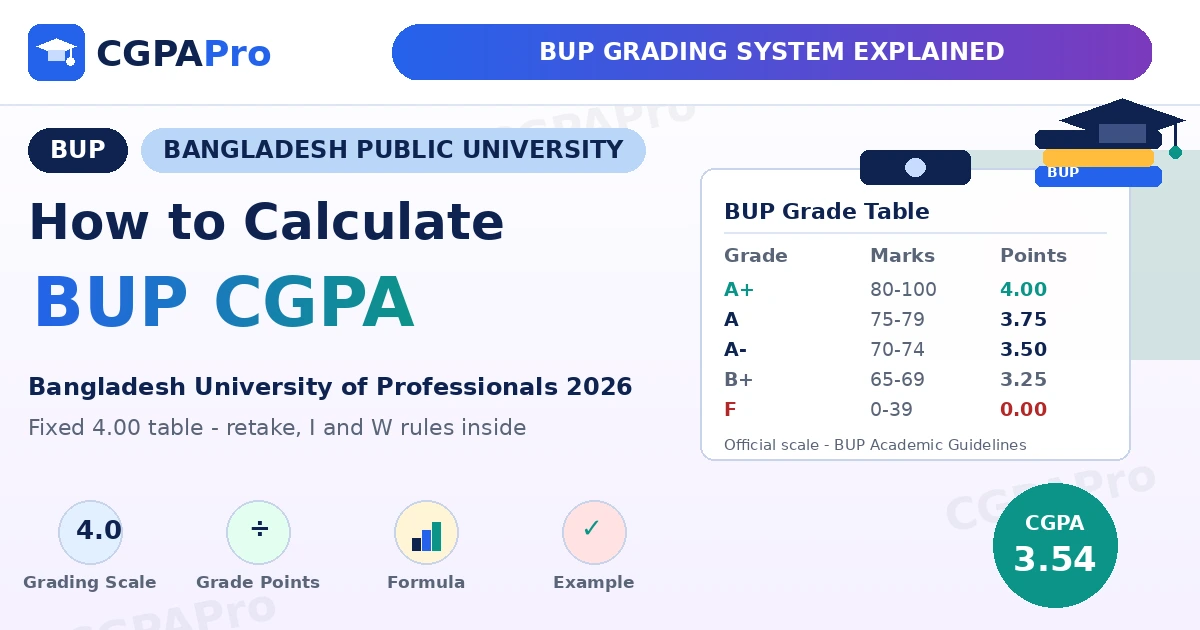
If you study at the Bangladesh University of Professionals (BUP), your results run on a 4.00 CGPA scale. Every course gives you a letter grade from A+ down to F, each worth a fixed grade point: A+ is 4.00, A is 3.75, A− is 3.50, B+ is 3.25, B is 3.00, B− is 2.75, C+ is 2.50, C is 2.25, and D — the lowest passing grade — is 2.00. Score below 40% and you get an F worth 0.00, which means you must retake the course. Your semester GPA is the credit-weighted average of your grade points, and your CGPA is the same idea stretched across every semester you have completed.
That is the whole system in one paragraph. The rest of this guide shows you exactly how BUP turns your marks into grades, how to calculate your GPA and CGPA yourself with worked examples, what happens when you get an F, an Incomplete (I), or a Withdrawn (W), and the mistakes that quietly cost BUP students grade points every semester. Everything here is checked against BUP’s own published academic guidelines — where a rule varies by faculty or program, we say so instead of guessing.
How to Calculate Your BUP GPA With the Calculator
The fastest way to check your numbers is the CGPAPro calculator. It uses the same official UGC-style 4.00 scale BUP follows, so the grade points match exactly:
- Open the Bangladesh university GPA calculator (same official 4.00 grade scale BUP uses).
- For each course, enter the credit hours and the grade point for the letter grade you earned (A+ = 4.00, A = 3.75, and so on from the table below).
- The calculator multiplies each grade point by its credit hours, adds up the quality points, and divides by your total credits — that is your semester GPA.
- To track your CGPA, repeat the process for each past semester and combine them using the credit-weighted CGPA formula in the worked examples below.
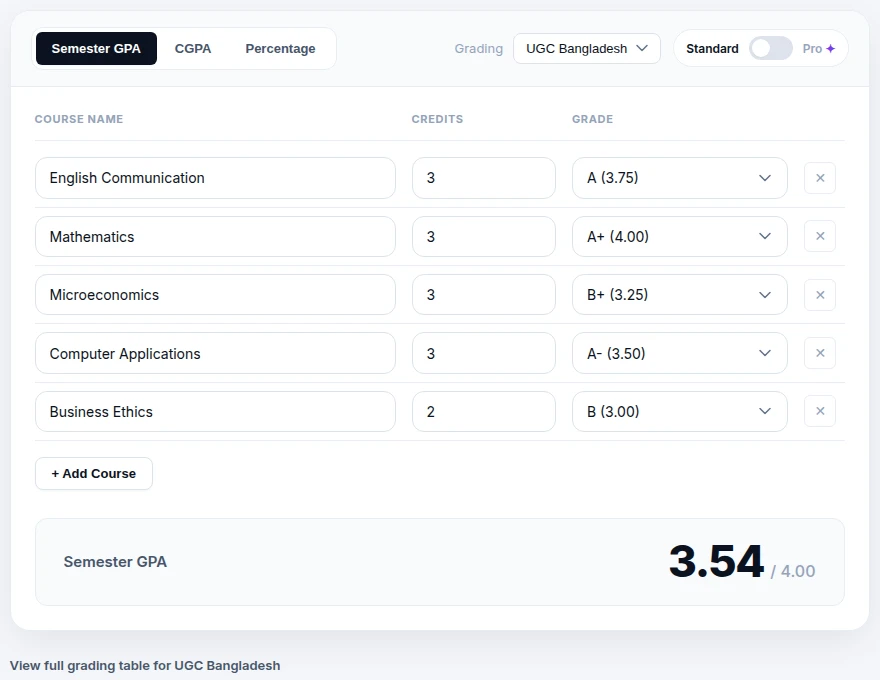
Screenshot: the CGPAPro calculator running a BUP-style semester. Enter grade points and credits per course; the tool does the weighted maths for you.
What BUP Is — and Why Its Grading Feels Different
BUP is a public university in Mirpur Cantonment, Dhaka, run under the armed forces, and it was established in 2008. It runs faculties including Business Studies (FBS), Arts and Social Sciences (FASS), Science and Technology (FST), and Security and Strategic Studies, plus medical and postgraduate programs. Two things about BUP shape how grading feels in practice.
First, admission is fiercely competitive. Applicants sit a written MCQ test — typically 100 marks, with 0.50 marks deducted for each wrong answer — and final selection weights the admission test at 55%, the HSC/equivalent result at 25%, and the SSC/equivalent result at 20%. Eligibility cutoffs differ by faculty and group (for example, FBS BBA applicants from the Science group have historically needed a combined SSC+HSC GPA around 9.00), and they change from year to year, so always check the current admission circular rather than last year’s numbers.
Second, BUP runs on continuous assessment. Your grade is not decided by one final exam alone. In-course work — class tests, assignments, presentations, midterms, and attendance — carries a large share of the total marks, and the exact split varies by program: some course outlines use 50% in-course and 50% final, others use 60% in-course and 40% final. Class-test handling varies too: some departments average your best 2 of 3 class tests, others total a different number of tests. That variation is exactly why generic “BUP calculator” pages disagree with each other — and why you should always confirm the weightage in your own course outline before trusting any single tool’s breakdown.
The Official BUP Grading Table (2026)
This is the grading scale published in BUP’s academic guidelines. The mark bands are fixed: your total percentage in a course maps to one letter grade, and that letter grade maps to one grade point. There is no curve and no rounding up across a band boundary — 79.9% is an A (3.75), not an A+.
| Marks Obtained | Letter Grade | Grade Point | Status |
|---|---|---|---|
| 80% and above | A+ | 4.00 | Pass |
| 75% to < 80% | A | 3.75 | Pass |
| 70% to < 75% | A− | 3.50 | Pass |
| 65% to < 70% | B+ | 3.25 | Pass |
| 60% to < 65% | B | 3.00 | Pass |
| 55% to < 60% | B− | 2.75 | Pass |
| 50% to < 55% | C+ | 2.50 | Pass |
| 45% to < 50% | C | 2.25 | Pass |
| 40% to < 45% | D | 2.00 | Pass (lowest) |
| Below 40% | F | 0.00 | Fail — must retake |
| — | I | — | Incomplete (see below) |
| — | W | — | Withdrawn (see below) |
This is the same 4.00 UGC-style scale used across most Bangladeshi universities, which is why BUP grades transfer cleanly to other institutions’ frameworks — but the retake, Incomplete, and in-course rules around the table are BUP’s own, and they are where students get caught out. For comparison, see how the same scale plays out at Dhaka University, BRAC University, and BUET.
BUP GPA Formula: The 4-Step Method
BUP’s own guidelines describe CGPA computation as a 4-step procedure. It is the standard credit-weighted formula, and once you see it once, you can do it on paper:
- Step 1 — Quality points per course: multiply the grade point you earned in each course by that course’s credit hours.
- Step 2 — Total quality points: add up all the course quality points.
- Step 3 — Total credits: add up the credit hours of all the courses.
- Step 4 — Divide: semester GPA = total quality points ÷ total credits. CGPA uses the same formula across all semesters.
Formula: GPA = Σ (Grade Point × Credit Hours) ÷ Σ Credit Hours
CGPA formula: CGPA = Σ (Semester GPA × Semester Credits) ÷ Σ Semester Credits — or, equivalently, total quality points across every semester ÷ total credits across every semester. Both give the same answer; use whichever your records make easier.
Two details matter. First, the weighting is by credits, not by number of courses: a 3-credit A+ moves your GPA more than a 2-credit A+. Second, BUP computes CGPA after each semester to determine your academic standing, so every semester counts — there is no “first semester doesn’t matter” rule.
Worked Example 1: One Semester’s GPA
Suppose a BUP BBA student finishes a semester with these five courses:
| Course | Credits | Marks | Grade | Grade Point | Quality Points |
|---|---|---|---|---|---|
| English Communication | 3 | 77% | A | 3.75 | 3 × 3.75 = 11.25 |
| Mathematics | 3 | 84% | A+ | 4.00 | 3 × 4.00 = 12.00 |
| Microeconomics | 3 | 68% | B+ | 3.25 | 3 × 3.25 = 9.75 |
| Computer Applications | 3 | 71% | A− | 3.50 | 3 × 3.50 = 10.50 |
| Business Ethics | 2 | 62% | B | 3.00 | 2 × 3.00 = 6.00 |
| Total | 14 | — | — | — | 49.50 |
GPA = 49.50 ÷ 14 = 3.54. Notice how the 2-credit B contributed less than the 3-credit courses, and how the single B+ (68%) pulled the average down more than the A+ pulled it up — because grade points are not symmetric: the gap between A+ and A− (0.50) is bigger than the gap between B+ and B (0.25) in the middle of the table. That asymmetry is the reason one slipped course hurts more than one great course helps.
Worked Example 2: CGPA Across Three Semesters
Now stretch the same student across three semesters:
| Semester | Semester GPA | Credits | Weighted Points |
|---|---|---|---|
| Semester 1 | 3.40 | 15 | 3.40 × 15 = 51.00 |
| Semester 2 | 3.54 | 14 | 3.54 × 14 = 49.56 |
| Semester 3 | 3.75 | 16 | 3.75 × 16 = 60.00 |
| Total | — | 45 | 160.56 |
CGPA = 160.56 ÷ 45 = 3.57. A common mistake is to average the three semester GPAs directly: (3.40 + 3.54 + 3.75) ÷ 3 = 3.56. Here the error is small because the credit loads are similar — but when one semester carries 18 credits and another carries 12, the simple average is simply wrong. Always weight by credits.
Worked Example 3: The Grade-Boundary Cliff (and a Reality Check)
BUP’s band boundaries are cliffs, not slopes. A student at 69% gets a B+ (3.25); one mark more, at 70%, gets an A− (3.50) — a 0.25 jump for a single mark. The same cliff sits at every boundary: 74% vs 75% (A− vs A), 79% vs 80% (A vs A+). If you are sitting at 69% or 74% or 79% in a course, one more assignment mark, one more class-test mark, or one corrected marking error is worth more than the same effort anywhere else in the band. Check your in-course marks before the final, not after.
Now the reality check. Suppose you have completed 60 credits with a CGPA of 3.20, and you want to graduate at 3.50 after one more 15-credit semester. The semester GPA you would need is: (3.50 × 75 − 3.20 × 60) ÷ 15 = (262.50 − 192.00) ÷ 15 = 70.50 ÷ 15 = 4.70. That is above the maximum 4.00 — mathematically impossible in one semester. The honest conclusion is not to give up; it is to plan across two or three semesters, where the target becomes reachable, and to stop spending energy on impossible one-semester rescue plans. If you want the general method behind targets like this, our CGPA improvement guide walks through semester-by-semester planning.
GPA vs CGPA at BUP
Students mix these up constantly, and the confusion costs marks in viva and interview questions. GPA is one semester: the credit-weighted average of that semester’s courses. CGPA is cumulative: the credit-weighted average across every semester so far. BUP recomputes your CGPA after each semester to determine your academic standing. A strong final semester lifts your CGPA, but it cannot erase earlier semesters — it can only dilute them, because every past credit stays in the denominator. That is why early semesters matter more than students expect: a weak first year is not a disaster, but it takes several good semesters to wash out. If the distinction is still fuzzy, our What Is CGPA guide and the GPA vs CGPA vs SGPA comparison spell it out with examples.
F, I, and W: What Happens When a Course Goes Wrong
This is the section most BUP guides skip, and it is the one students search for after results come out.
F grade — fail, must retake
An F (below 40%) earns 0.00 grade points and no credit. Because passing every course individually is a degree requirement at BUP, a student who earns an F must improve the grade by retaking the course when it is offered in a subsequent available semester. The F stays visible on your academic record, but the grade earned on the retaken course is what counts toward your final CGPA.
Retaking for improvement — even without an F
BUP’s rule is unusually generous here: a student earning a grade of A− or below may also elect to improve the grade by retaking the course when offered in the subsequent semester. In other words, you can retake a B+ or a C if you believe you can do better — but there are hard limits. A course can be retaken only once. You must apply at least 4 weeks before the commencement of the semester. And you cannot retake any course after graduation — if you want a final-semester retake, you must apply to the Program Committee to withhold your graduation first. The retaken course appears on your transcript with an R symbol for Retake, and the new grade is the one used for CGPA. Before retaking a passed course, read our retake and CGPA guide — the maths only helps if the new grade is meaningfully higher, and the retake consumes a semester slot you could use for a fresh course.
I grade — Incomplete
If you cannot complete coursework for a valid reason, you may be assigned an Incomplete (I) — but only if the Academic Council permits it. The I is recorded with an alternative grade based on the work you completed up to that point. If you fail to complete the course requirements within 4 weeks of the publication of the provisional results, that alternative grade automatically comes into effect. The practical lesson: an I is a deadline, not a pause button. Get the completion requirements and the exact deadline in writing the day the I is recorded.
W grade — Withdrawn
A W records that you formally withdrew from a course. It carries no grade point and does not drag your GPA down the way an F does — but it also earns no credit, and withdrawal deadlines and procedures are set by your program. Never just stop attending and assume a W will appear; an unrecorded absence can end as an F. Confirm the withdrawal in writing with your program office.
How Your Final Mark Is Built: In-Course vs Final
Your percentage in a course — the number that hits the grading table — is a blend of in-course assessment and the final examination. As noted above, the blend varies by program: some outlines split it 50/50, others 60/40. Within the in-course share, the components typically include class tests, assignments or case studies, presentations, midterms, and attendance marks. Two consequences follow.
First, attendance is not free marks — it is a slice of your final percentage, and missing it can drop you a full band. Second, the class-test rule matters: if your department counts your best 2 of 3 class tests, a single bad test is recoverable; if it totals all tests, it is not. Because these rules differ across BUP’s faculties and departments, treat any single “BUP weightage” table you find online as a sample from one program, not a university-wide rule. Your course outline is the authority for your course.
Common Mistakes BUP Students Make
- Averaging semester GPAs without weighting by credits. The simple average is wrong whenever semesters carry different credit loads. Always weight by credits.
- Converting marks to grade points course-by-course, then averaging the grade points. Same error in miniature: a 2-credit course and a 3-credit course do not count equally. Multiply first, then divide.
- Confusing the SSC/HSC GPA-5 scale with the university CGPA-4 scale. Your SSC/HSC GPA was out of 5.00. Your BUP CGPA is out of 4.00. A “4.00” at BUP is a perfect A+ average, not a mediocre school result — and converting between the two scales by simple proportion is wrong. See our CGPA to percentage guide for the correct conversions.
- Assuming an F disappears after a retake. The retaken grade counts for CGPA, but the attempt stays on your transcript with the R marker. For most jobs and admissions, that is fine — but do not assume the record is wiped.
- Letting an Incomplete lapse. The 4-week clock from provisional results is short. If you do not finish, the alternative grade applies automatically, and it is usually lower than what you hoped for.
- Ignoring the band cliffs. Effort spent moving from 69% to 70% is worth 0.25 grade points; the same effort moving from 71% to 72% is worth nothing on the transcript. Spend revision time where the cliff is.
- Trusting a random calculator’s weightage. Online BUP calculators disagree about in-course splits because programs genuinely differ. Use the calculator for the grade-point maths, and your course outline for the weightage.
Tips to Protect (and Raise) Your BUP CGPA
- Bank in-course marks early. Class tests and assignments are the most controllable part of your percentage. A strong in-course score means the final only has to hold your band, not rescue it.
- Play the credit weights. A 3-credit course is worth 50% more than a 2-credit one. When time is short, protect the high-credit courses first.
- Retake strategically. Retaking a C+ (2.50) that you can plausibly turn into an A− (3.50) is worth a full grade point on those credits. Retaking a B+ to chase an A is usually a worse use of a semester — and you only get one retake per course.
- Plan targets backwards. Use the target-GPA formula from Worked Example 3 before each semester: required semester GPA = (target CGPA × total credits after − current CGPA × credits done) ÷ next semester’s credits. If the answer is above 4.00, stretch the plan over more semesters.
- Check your transcript every semester. Confirm that retakes show the R marker, that I grades resolved correctly, and that credits match your course registrations. Errors are far easier to fix in the semester they happen.
- Keep your handbook. BUP notes that its grading system is reviewed and revised when the university changes its grading policy. A rule that was true for a senior’s batch may not be true for yours — verify against your current program handbook.
Frequently Asked Questions
What is the highest CGPA at BUP?
4.00 — a straight-A+ average across every course. It is rare precisely because every course counts and every band boundary is a cliff.
What CGPA do I need to graduate from BUP?
BUP requires you to pass every course individually. The published guidelines describe CGPA being computed each semester to determine academic standing; the specific minimum-CGPA and standing rules for your program are set in your faculty’s regulations, so confirm the exact graduation threshold in your current program handbook rather than relying on a number quoted for another batch or faculty.
Is 3.5 CGPA good at BUP?
Yes — 3.50 is an A− average, comfortably above the middle of the scale, and competitive for most graduate jobs and many scholarships in Bangladesh. For MS-abroad and top scholarships, 3.50 is a solid base and 3.75+ is stronger. Our full breakdown is in Is 3.5 CGPA Good?
Can I retake a course I already passed at BUP?
Yes, if your grade was A− or below: you may elect to retake it when offered in a subsequent semester, once only, by applying at least 4 weeks before the semester starts. The new grade counts for CGPA and the transcript shows an R marker. You cannot retake after graduation without first having graduation withheld.
Does an F at BUP stay on my transcript after a retake?
The attempt stays visible, marked with R on the retaken course, but the retaken grade is what counts toward your final CGPA. An F you never retake stays at 0.00 and blocks graduation, since passing every course is a degree requirement.
How is BUP’s grading different from NSU, IUB, or BRACU?
The grade-point table is the same standard UGC 4.00 scale, so the numbers line up. The differences are in the surrounding rules: BUP’s retake window (A− or below, once, R marker), its Incomplete-with-alternative-grade mechanism, and its program-specific in-course weightages. That is why a guide written for another university can mislead you on the rules even when the table looks identical.
Where can I verify BUP’s official grading rules?
Start with BUP’s own site: the academic guidelines published on bup.edu.bd carry the official grading table, and your faculty’s program handbook carries the rules for your batch. If a blog post (including this one) and your handbook disagree, the handbook wins.
The Bottom Line
BUP’s grading system is straightforward once you see it whole: a fixed 4.00 table, a credit-weighted formula, and a small set of rules — retake, Incomplete, Withdrawn — that decide what happens when things go wrong. The students who do best at BUP are not the ones who cram hardest before finals; they are the ones who bank in-course marks, watch the band cliffs, weight their effort by credits, and deal with F and I grades immediately instead of hoping they sort themselves out. Run your numbers through the calculator, check them against the worked examples above, and keep your handbook within reach. Your CGPA is just arithmetic — but it is arithmetic you control.