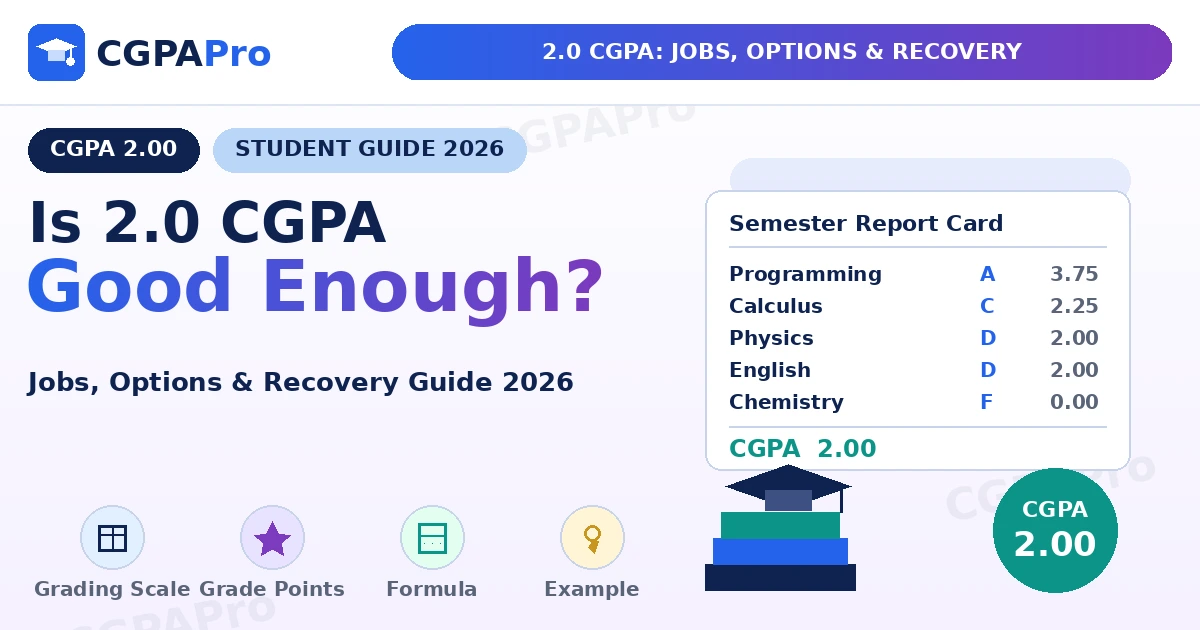
Is 2.0 CGPA Good? Options, Jobs & Recovery 2026
Quick answer: A 2.0 CGPA is not a good CGPA — it is the survival line. In Pakistan, 2.00 is the minimum qualifying CGPA for a bachelor’s degree under the Higher Education Commission’s semester-system policy, which means it is the lowest number that still earns you a degree at most universities. It keeps you in the game, but it closes almost every door that a 3.0 opens: merit scholarships, most management-trainee programmes, and direct admission to competitive master’s programmes abroad. The honest way to read a 2.0 is this: you passed, but you now have to out-work the number — with skills, experience, retakes, and a realistic recovery plan. This guide shows you exactly what is open, what is closed, and the highest CGPA you can still reach.
If you are still studying, the most useful thing you can do right now is to stop guessing and compute where you actually stand. A 2.0 after one year is a very different problem from a 2.0 after three years, and the maths below will show you why.
Check Your CGPA With the Calculator
Use the free CGPA calculator on cgpacalculatorpro.com to enter your real grades. Pick your grading scale, add each course with its credit hours, and the calculator gives you your semester GPA and cumulative CGPA instantly. The screenshot below shows a worked example that lands on exactly 2.00 — one A, one C, two Ds, and one failed course across five 3-credit courses. Notice how a single F wipes out the entire benefit of the A. That is the arithmetic of a 2.0 transcript in one picture.
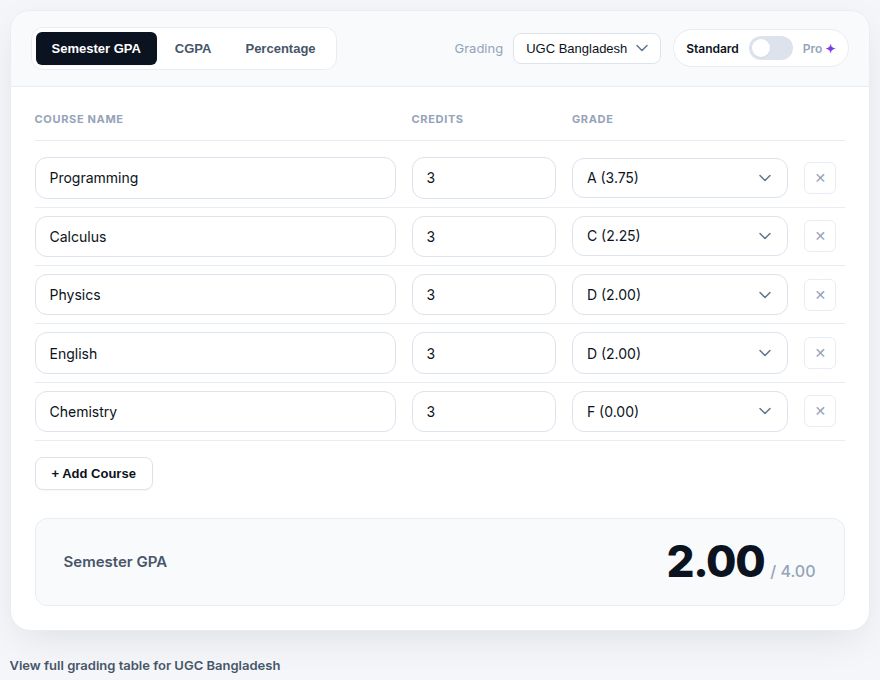
How to use it: (1) select your grading system, (2) type each course name, (3) enter its credit hours, (4) choose the grade you earned, (5) click Add Course for the next one. Your CGPA updates as you go. Try it twice — once with your real grades, and once with the grades you are aiming for next semester — and you will see exactly how much room you have to climb.
What a 2.0 CGPA Means in Each Country
The same 2.0 means very different things depending on where you study. This is the part most generic “is 2.0 GPA good” articles get wrong, because they only describe the American system. Here is the country-by-country picture.
| Country / system | What 2.00 means | Degree / standing |
|---|---|---|
| Pakistan (HEC) | Minimum qualifying CGPA for a bachelor’s degree under HEC’s uniform semester-system policy | Degree awarded at most universities; below 2.00, no degree — retakes required |
| Bangladesh (UGC) | D grade (40–44 marks) = 2.00, a pass; 3rd Class (2.00–2.24) | Pass, but several universities require 2.50 for degree award — see the trap below |
| Malaysia | PASS status at several universities (CGPA ≥ 2.00) | Proceed to next semester; below 2.00, repeat courses after readmission appeal |
| United States | C average; the usual minimum for graduation and good standing | Graduate, but below nearly every graduate-school and employer screen |
| United Kingdom | Below the 2:2 line (roughly 2.5/4.0) — third-class honours territory | Direct entry to most taught master’s programmes is very difficult |
Pakistan: 2.00 is the floor, not a target
The Higher Education Commission’s policy guidelines for the uniform semester system state that the minimum qualifying CGPA for BS students is 2.0 (and 2.50 for MS/MPhil students). If you finish your final semester below 2.00, the same policy allows re-admission in one or more courses where your grade is below C, so you can repair the number — provided you are not barred by the CGPA-improvement rules or the programme’s time limit. On probation, the pattern is consistent across Pakistani universities: a semester GPA below 2.00 puts you on warning or probation, and repeated failure to climb back above 2.00 ends the programme. Quaid-i-Azam University, for example, places students with a CGPA between 1.0 and 2.0 on probation, allows three probation chances, and ends enrolment if 2.0 is not reached on the fourth attempt. Bahria University places students on probation when CGPA falls below 2.0 but above 1.5, and drops students who cannot get back above 2.0 after their probations are used up. PAF-IAST states flatly that securing a CGPA of 2.00 is mandatory for graduation. FAST-NU, BRACU and most others follow the same 2.00-floor pattern — but the exact number of probations, retake caps, and grade-replacement rules differ, so verify them in your own programme handbook before you plan around them.
Bangladesh: the 2.50 degree-award trap
On the UGC scale, 2.00 is a D — a pass, worth 40–44 marks — and a CGPA of 2.00–2.24 puts you in the Third Class, the lowest passing class. That sounds survivable. But here is the trap that catches Bangladeshi students: several universities set their degree-award floor higher than the UGC pass mark. The International Islamic University Chittagong requires a minimum CGPA of 2.50 for awarding a degree (alongside a minimum GPA of 2.00 in each semester), and ASA University Bangladesh likewise requires a minimum CGPA of 2.50 for both graduate and undergraduate programmes. At those universities, graduating with a flat 2.00 is not an option — you must improve to 2.50 or you do not get the degree. This is not universal across Bangladesh, but it is common enough that no Bangladeshi student should assume 2.00 guarantees graduation. Check your own university’s degree requirements, not just the UGC grade table.
Malaysia: 2.00 passes — at undergraduate level
In Malaysia, a CGPA of 2.00 is typically enough to keep going. Universiti Poly-Tech Malaysia’s academic regulations give PASS status to students who obtain a minimum CGPA of 2.00, and graduating students who fall below 2.00 may repeat available courses after appealing for readmission. But do not confuse undergraduate and postgraduate floors: at graduate level, Malaysian universities are far stricter — Universiti Kebangsaan Malaysia treats a CGPA of 2.00–2.99 as a conditional pass on probation, not eligible for degree conferment, and Universiti Putra Malaysia’s graduate rules terminate candidature below 2.500 in a semester. A 2.00 undergraduate CGPA also puts Malaysian postgraduate study effectively out of reach until the number improves.
How CGPA Is Calculated
CGPA is a weighted average. Each course contributes its grade points multiplied by its credit hours (called quality points), and the CGPA is total quality points divided by total credit hours attempted.
Formula: CGPA = Σ (Grade Point × Credit Hours) ÷ Σ Credit Hours
Step-by-step calculation
- Convert each course grade to grade points using your university’s scale (on the UGC Bangladesh scale: A = 3.75, C = 2.25, D = 2.00, F = 0.00).
- Multiply each course’s grade points by its credit hours to get its quality points.
- Add up all quality points.
- Add up all credit hours.
- Divide total quality points by total credit hours.
Worked example: exactly 2.00
Five courses, 3 credits each, on the UGC scale:
| Course | Credits | Grade | Grade points | Quality points |
|---|---|---|---|---|
| Programming | 3 | A | 3.75 | 11.25 |
| Calculus | 3 | C | 2.25 | 6.75 |
| Physics | 3 | D | 2.00 | 6.00 |
| English | 3 | D | 2.00 | 6.00 |
| Chemistry | 3 | F | 0.00 | 0.00 |
| Total | 15 | 30.00 |
CGPA = 30.00 ÷ 15 = 2.00 exactly. The lesson is brutal: the A earned 11.25 quality points, and the F threw away 11.25 points of potential. One failed course cancels one excellent course. If you are carrying failed courses, clearing them is the single highest-leverage move you have — see the retake section below. If failed subjects are dragging your number down, read our guide on how to calculate CGPA with failed subjects and backlogs.
GPA vs CGPA
GPA measures one semester. CGPA measures your entire degree so far. A single good semester GPA of 3.50 does not make your CGPA 3.50 — it pulls your CGPA part of the way toward 3.50, in proportion to how many credits that semester represents. This is why the recovery maths in the next section matters so much: the more credits already on your transcript, the heavier the anchor. A 2.0 after 30 credits is a setback. A 2.0 after 90 credits is close to a verdict.
Recovery Maths: The Highest CGPA You Can Still Reach
This is the section other articles skip, and it is the one you actually need. Your ceiling depends on two numbers: how many credits you have already completed (N), and how many credits remain (M). The formula is:
New CGPA = (Current CGPA × N + Average of remaining credits × M) ÷ (N + M)
Assume you earn straight 4.0s — perfect As — for every remaining credit. That gives the absolute ceiling. Here are three realistic scenarios for a student sitting at 2.0.
| Scenario | Completed (N) | Remaining (M) | Ceiling with straight 4.0s | What it means |
|---|---|---|---|---|
| A — end of Year 1 | 30 credits (QP 60) | 90 credits | (60 + 360) ÷ 120 = 3.50 | Full recovery is possible. Reaching 3.00 needs a 3.33 average (A−/B+ mix) across all remaining credits. |
| B — end of Year 2 | 60 credits (QP 120) | 60 credits | (120 + 240) ÷ 120 = 3.00 | Even perfection only reaches 3.00. Reaching 2.50 needs straight B’s (3.00 average) from here. |
| C — end of Year 3 | 90 credits (QP 180) | 30 credits | (180 + 120) ÷ 120 = 2.50 | The ceiling is 2.50. Reaching 3.00 would need a 6.00 average — mathematically impossible. |
There is a clean rule hiding in this maths. To lift a 2.0 to a 3.0 using straight As alone, you need straight-A credits equal to all your completed credits: at 2.0 after 90 credits, you would need 90 credits of straight As — three more full years of perfection — and you do not have them. That is why the honest advice for a late-stage 2.0 student is different from the advice for a first-year student. Early on, grade repair is the strategy. Late in the degree, the strategy shifts to skills, internships, and the pathways in the jobs and MS sections below, because the CGPA itself can no longer be moved far enough.
One more check, because students get this wrong: if you are at 2.0 after 60 credits and one more 3-credit F lands in a semester where everything else is a B, your new CGPA is (120 + 36) ÷ 75 = 2.08. A single F barely moves a 2.0 student — there is almost nothing left to lose. The damage of an F is worst when your CGPA is high; at 2.0, the damage was done earlier, by the accumulation of C and D grades. For the full playbook on lifting a low CGPA, see how to improve your CGPA.
Retake Strategy: Which Grades to Retake for Maximum ROI
Not all retakes are equal. Under a grade-replacement policy — where the new grade replaces the old one in your CGPA — retaking a course moves your CGPA by the difference between the new and old grade points, times the credit hours, divided by your total completed credits. Here is the ranking for a student at 2.0 after 60 completed credits, retaking one 3-credit course and earning an A:
| Retake | Quality-point gain | New CGPA (from 2.00) | Priority |
|---|---|---|---|
| F → A | +11.25 | 2.19 (+0.19) | 1st — always retake failed courses first |
| D → A | +5.25 | 2.09 (+0.09) | 2nd |
| C → A | +4.50 | 2.08 (+0.08) | 3rd |
| C+ → A | +3.75 | 2.06 (+0.06) | Last |
Three rules follow from this table. First, failed courses first — an F-to-A retake is worth more than twice a D-to-A retake, and it also clears the backlog that employers and graduate schools ask about. Second, retake low-grade, high-credit courses — a 4-credit D is worth more than a 2-credit D. Third, verify the retake rule before you spend money and a semester on it: some universities replace the old grade, others average both attempts (which roughly halves every gain in the table), and others cap the retake grade. If your university averages, the F-to-A retake at 60 credits gains only about +0.09, and the whole retake strategy becomes much weaker. Read our detailed guide on how retaking a course affects your CGPA before you register for any retake. And remember the scale of the tool: at 120 completed credits, even an F-to-A retake buys only about +0.09 CGPA. Retakes buy time and clear failures — they cannot, on their own, rescue a late-stage 2.0.
Jobs With a 2.0 CGPA: What Accepts It and What Filters It Out
Let us be blunt about the job market. A 2.0 does not make you unemployable, but it does change which doors open on the first knock. Employers fall into three groups.
Jobs that filter at 3.0 — mostly closed at 2.0
Structured graduate and management-trainee programmes are the hardest hit. Across Pakistani banks and multinationals, the typical management-trainee floor is a CGPA of 3.0/4.0 or around 70% marks — the pattern reported for Allied Bank’s and Bank of Khyber’s MTO programmes, and Nestlé’s Nesternship internship programme, which asks for above 3.00. Even Bank AL Habib’s Graduate Trainee Officer programme, one of the more accessible bank programmes, sets its minimum at a CGPA of 2.5 — still half a point above a 2.0. These are secondary-reported figures, so confirm any specific programme’s current circular, but the direction is consistent: formal trainee programmes screen at 2.5–3.0, and a 2.0 CV usually gets filtered before a human reads it.
Jobs that ask for a degree, not a CGPA — open at 2.0
The good news: a large part of the job market never asks for a CGPA at all. Small and medium companies, startups, sales and customer-facing roles, many private-sector office jobs, and skill-tested roles (development, design, content, digital marketing, data entry with tools) typically ask for a completed degree plus a skills test, portfolio, or interview — not a transcript. Internships also vary: some large-company internships publish CGPA floors, but many (including BRAC’s internship circulars, which state no minimum CGPA) select on CV, cover letter, and interview. Freelancing on platforms like Fiverr and Upwork does not ask for a CGPA at all; clients buy portfolios and reviews. The pattern from recruiters is consistent: your CGPA may get you to the door, but skills close the deal — and at 2.0, you should be applying where the door is a skills test, not a CGPA filter.
Government jobs: the division problem
Pakistan’s Central Superior Services (CSS) exam requires at least a bachelor’s degree in the Second Division. A 2.0 CGPA sits below the second-division line in the HEC division mapping (2.50 falls inside the Second Division), so a flat 2.0 is likely to fall short of the CSS division requirement — confirm this against your university’s division certificate, because the division printed on your degree is what counts. The same division logic applies to many public-sector job advertisements that ask for a second division. In Bangladesh, a 2.0 is a Third Class degree, which similarly fails advertisements asking for a Second Class. If a government career is your goal, lifting the CGPA into the second-division/second-class band is not optional — it is the entry ticket.
Practical CV rule for 2.0 graduates: leave the CGPA off your CV. The widely repeated recruiter consensus is to omit a GPA of 3.0 or below, and at 2.0 that advice is unambiguous. Lead with skills, internships, projects, and any work experience. If an application form asks for your CGPA, answer honestly — never inflate it — but do not volunteer the number where it is not asked. For comparison, see how the picture changes one band up in Is 2.5 CGPA Good? and Is 3.0 CGPA Good?
Scholarships With a 2.0 CGPA
Honest answer: merit scholarships are effectively closed at 2.0, and even need-based aid usually requires more. Merit scholarships typically require a CGPA of 3.5–3.7 for partial awards and 3.7–3.9 for full awards. HEC’s Indigenous scholarships require a minimum CGPA of 3.0, and its overseas scholarships likewise require 3.0/4.0. The Malaysia International Scholarship enforces a strict 3.00 CGPA cutoff — applications below it are filtered out automatically. Chinese CSC and Turkish government scholarships sit around 2.75–2.8. Need-based scholarships, which judge financial need rather than grades, typically still ask for around 2.5 for continuation. At 2.0, you are below every one of these lines. The realistic sequence is: first raise the CGPA (retakes plus strong semesters), then apply — or target funding that does not grade-screen at all, such as employer sponsorship, small departmental awards, and need-based support from your own university, where the criteria may be set locally. Do not pay any agent who promises a merit scholarship at 2.0; the published floors say otherwise.
MS Abroad With a 2.0 CGPA: The Honest Pathway Map
Direct admission to a competitive master’s programme at 2.0 is near-impossible, and you should not waste application fees pretending otherwise. Chevening requires a CGPA of 3.0+ (a 2:1 equivalent). HEC’s overseas scholarships require 3.0. Most universities in the US, UK, Canada, and Australia state a 3.0 minimum for graduate admission, and in the UK a 2.0 maps below the 2:2 line, so most taught master’s programmes will not consider it directly. That is the closed door. Here are the doors that are actually open:
- Conditional / provisional admission (mainly US). A significant minority of US graduate programmes — roughly a quarter to a third, by one admissions guide’s estimate — offer conditional admission, where you start graduate coursework provisionally and must earn a set GPA (often around 3.0) in your first courses to continue. At 2.0 this is a long shot at selective schools, but realistic at less selective ones, especially with a strong final-year trend.
- Pre-master’s / foundation programmes (mainly UK, Australia, Canada). These are taught bridging programmes designed for students whose undergraduate grades fall short. You complete the pre-master’s, hit its grade target, and progress to the master’s. This is the most structured route for a 2.0 holder, and the one to ask about first when contacting universities.
- Postgraduate diploma (PG diploma). A shorter, cheaper credential — common in Canada and the UK — that does not demand a 3.0 for entry. A strong PG diploma result can then support a later master’s application.
- Work experience + a strong finish. Admissions tutors weight recent performance. A final-year GPA of 3.5+, two years of relevant work, a solid GRE score, and strong recommendation letters can make a 2.0 application readable — this is also the Fulbright route, since Fulbright (USEFP) sets no minimum CGPA and judges the whole profile. But “readable” is not “competitive”: apply to programmes that explicitly welcome non-traditional profiles, and include a short, honest explanation of the weak early semesters in your statement of purpose — with evidence that the pattern changed.
- A second bachelor’s-level record. Post-baccalaureate coursework — extra upper-level courses in your field, taken after graduation — builds a fresh, recent transcript that admissions committees can weigh alongside the old one. It costs time and money, but for students targeting competitive programmes it is often the only route that genuinely repairs the academic record.
Whichever route you take, get a WES-style credential evaluation before you apply, so you know what your CGPA converts to on the target country’s scale — and target programmes whose published minimum you actually meet. Applying to programmes whose floor is 3.0 with a 2.0 is not optimism; it is a donation.
Common Mistakes at 2.0
- Assuming 2.0 guarantees graduation everywhere. It does not — several Bangladeshi universities require 2.50 for degree award, and some Pakistani programmes set higher floors than HEC’s minimum.
- Putting 2.0 on the CV. It invites a filter you would otherwise pass. Lead with skills and experience.
- Retaking the wrong courses. Retaking a C+ when you still carry an F is backwards — the F retake is worth three times as much (see the ROI table).
- Trusting “average both attempts” to behave like replacement. If your university averages retakes, every gain in the ROI table roughly halves. Check the rule first.
- Chasing merit scholarships at 2.0. The floors are 2.5–3.7. Raise the number first, or target non-grade-screened funding.
- Applying to 3.0-minimum master’s programmes and hoping. Published minimums are real filters. Use the pathway map above instead.
- Ignoring the credit-count clock. A 2.0 after 30 credits is fixable; a 2.0 after 90 credits is mostly locked. Match your strategy to your ceiling.
- Comparing your 2.0 to someone else’s scale. A 2.0 on a 4.0 scale, a 2.0 on a 5.0 scale, and a 2.0 on a 10-point CGPA scale are three different things. Always state the scale.
Tips: Your 90-Day Recovery Plan
- Week 1: Compute your exact CGPA and your ceiling (formula above). Know your N, your M, and your maximum reachable CGPA.
- Week 1: Read your handbook’s probation, retake, and grade-replacement rules. Photograph the relevant pages.
- Weeks 2–4: Register retakes for failed courses first, then D grades in high-credit courses — only if replacement applies.
- Every semester: Pick the two weakest subjects from last semester and fix the specific cause (attendance, past papers, concepts) rather than “studying harder” in general.
- Alongside grades: Start one skill that employers test — a programming language, Excel/financial modelling, design tools, or English writing — and one internship or freelance project. At 2.0, skills are your second transcript.
- Before graduating: Line up references from lecturers who saw your improvement, and draft the one-paragraph honest explanation of your early semesters for applications.
- After graduating: If the CGPA is locked, stop re-litigating it. Build the work-experience route: a job, a PG diploma, or a pre-master’s, and let the new record speak.
FAQ
Is 2.0 CGPA good?
No — but it is not a failure either. It is the lowest passing CGPA in most Pakistani and Malaysian undergraduate systems: enough to graduate, not enough to impress. Treat it as a warning, not a verdict.
Can I get a job with a 2.0 CGPA?
Yes. Formal trainee programmes that screen at 2.5–3.0 will mostly reject you, but many employers — SMEs, startups, sales roles, skill-tested roles, freelancing — hire on skills, portfolio, and interview. Leave the CGPA off your CV and lead with proof of work.
Can I do an MS abroad with a 2.0 CGPA?
Not directly at programmes with a 3.0 minimum. Realistic routes: conditional admission, a pre-master’s/foundation programme, a PG diploma, or work experience plus a strong final-year trend and a strong GRE. Fulbright has no minimum CGPA, but competition is fierce and a 2.0 profile needs exceptional supporting evidence.
Can I get a scholarship with a 2.0 CGPA?
Merit scholarships are effectively closed — their floors run from 2.5 (need-based) to 3.0 (HEC) to 3.5+ (merit). Raise the CGPA first, or seek non-grade-screened funding such as employer sponsorship or local university support.
Can I improve my CGPA from 2.0 to 3.0?
It depends on how many credits you have completed. From 2.0 after 60 credits with 60 remaining, even straight As only reach 3.00 — and reaching it requires perfection. From 2.0 after 90 credits with 30 remaining, 3.00 is mathematically impossible. Compute your ceiling with the formula above before you set the target.
Is 2.0 CGPA enough to graduate in Bangladesh?
On the UGC scale, 2.00 is a passing D and a Third Class. But several universities, including IIUC and ASA University Bangladesh, require a minimum CGPA of 2.50 to award the degree. Check your own university’s degree requirements — the UGC grade table alone does not settle it.
Should I mention my 2.0 CGPA in interviews?
Only if asked — and then honestly, with the recovery story: what went wrong, what changed, and what the recent trend shows. Never inflate the number. An honest “2.0, with a 3.6 in my final year” beats a vague evasion.
Final Word
A 2.0 CGPA is a narrow ledge, not a cliff edge. It keeps your degree, your graduation, and a large part of the job market within reach, while closing the merit-scholarship and selective-graduate doors until you earn your way past them. The students who recover from a 2.0 do three things: they learn the exact maths of their ceiling, they retake in the right order, and they build a second transcript out of skills and work. If you are early in your degree, the CGPA is still yours to change — start this semester. If you are late, stop mourning the number and start building the record that replaces it. Either way, the next move is yours, and it starts with knowing exactly where you stand — so run your real grades through the CGPA calculator today.