SEU Grading System 2026: GPA, CGPA & Retake Rules Guide
Quick Answer: How SEU Grades Work
If you study at Southeast University (SEU) in Dhaka, your results run on a 4.00 CGPA scale with fixed marks bands — no curve, no relative grading. Every course gives you a letter grade from A+ down to F, each worth a fixed grade point: A+ is 4.00, A is 3.75, A− is 3.50, B+ is 3.25, B is 3.00, B− is 2.75, C+ is 2.50, C is 2.25, and D — the lowest passing grade — is 2.00. Score below 40% and you get an F worth 0.00. Your semester GPA is the credit-weighted average of your grade points, and your CGPA is the same calculation stretched across every semester you have completed.
That is the whole system in one paragraph — but the details that actually decide students’ futures at SEU are the ones nobody prints in one place: the 2.50 minimum CGPA for the degree, the better-grade improvement rule, the transfer-credit exclusion, and the trap that catches half the searchers on this topic — a different “SEU” in Florida, USA, whose grading scale has nothing to do with yours. This guide verifies every number against SEU’s own published documents, and where a rule is not published, we say so instead of guessing.
A note before we start, because this confusion is genuinely everywhere: “SEU” is also the acronym of Southeastern University in Florida, USA. This guide is about Southeast University, Tejgaon, Dhaka, Bangladesh — established in 2002, one of the country’s leading private universities, ~12,000 students, and a 2026 debutant in the QS Asia University Rankings. If you searched “SEU grading system” and found a scale with A− = 3.67, you found Florida’s. Do not use it — the two systems differ at almost every letter.
How to Calculate Your SEU GPA With the Calculator
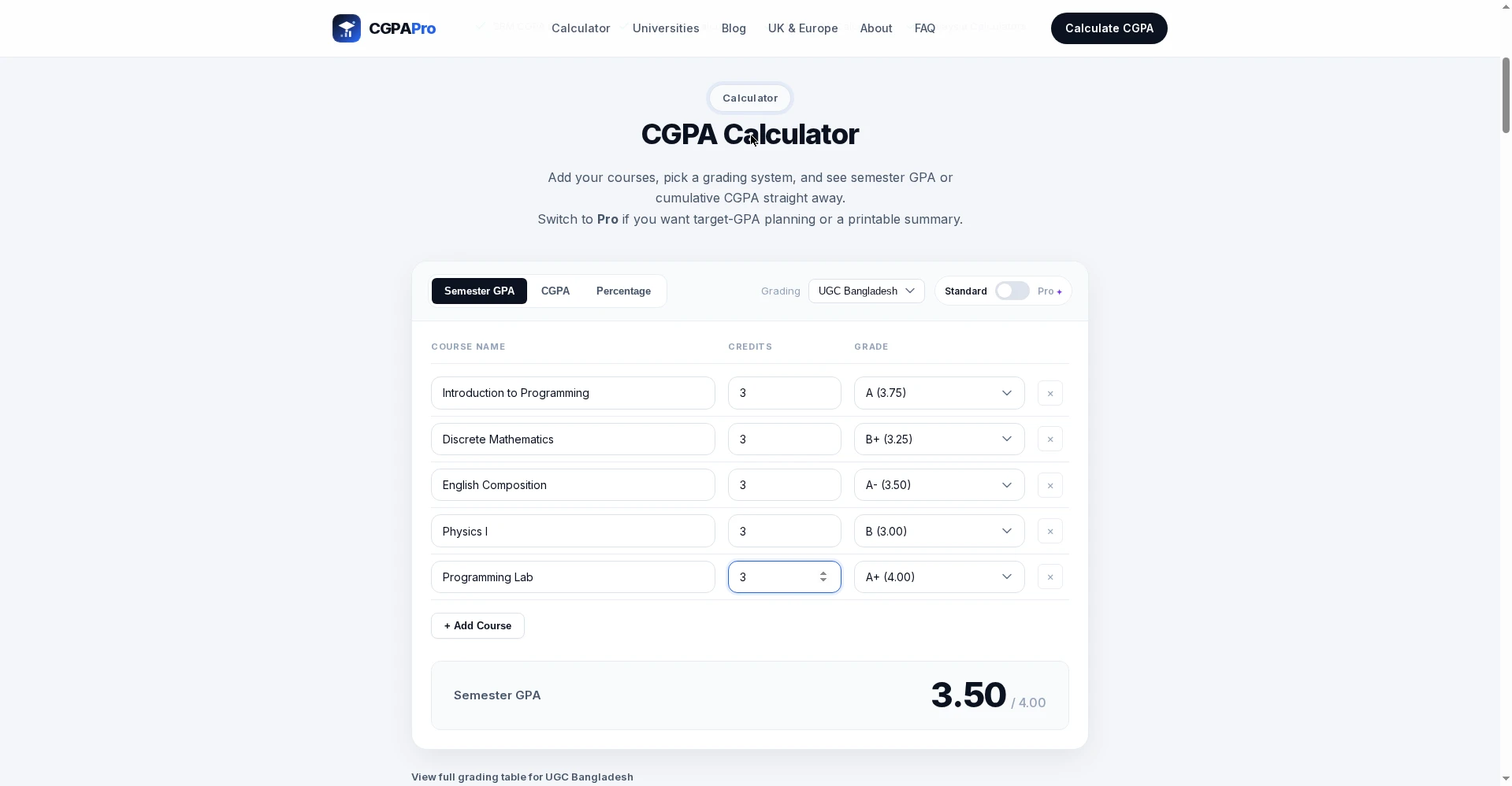
The fastest way to check your numbers is the CGPAPro calculator — and here is the good news, verified grade-by-grade against SEU’s official table: SEU’s official grading scale is identical to the calculator’s UGC Bangladesh scale — same letters, same grade points, including the D band. So the numbers the calculator gives you are exactly right for SEU, with no conversion needed:
- Open the CGPAPro CGPA calculator (its UGC Bangladesh scale matches SEU’s official table exactly).
- For each course, enter the credit hours and select the letter grade you earned (A+ = 4.00, A = 3.75, A− = 3.50, B+ = 3.25, B = 3.00, B− = 2.75, C+ = 2.50, C = 2.25, D = 2.00, F = 0.00).
- The calculator multiplies each grade point by its credit hours, adds up the quality points, and divides by your total credits — that is your semester GPA.
- To track your CGPA across semesters, repeat for each past semester and combine them with the credit-weighted CGPA formula in the worked examples below.
What SEU Is — and Why Its Calendar Matters for Your GPA
Southeast University runs on the North American open credit system, and its academic year is split into three semesters (Spring: January–April, Summer: May–August, Fall: September–December). The Department of Pharmacy is the exception — it keeps a bi-semester year. What this means for your GPA math is simple but easy to overlook: you accumulate grade points across three result cycles a year instead of two, so a weak Spring semester can be diluted faster — but it also means three deadlines a year where your numbers go on the record.
One credit hour at SEU means one lecture hour of study per week for a semester — the standard definition, published by the Office of the Controller of Examinations. Programs range from around 120 credits (business, arts) up to 150 credits (the IEB-accredited CSE program, for example), so the exact number of “credit attempts” you will accumulate depends on your department. Every credit counts the same in the denominator of your CGPA — a 3-credit course moves your average three times as much as a 1-credit course.
The Official SEU Grade Table (2026)
This is SEU’s published grading table, reproduced from the university’s own Degree Requirements document. Notice the absolute marks bands: 79 is an A (3.75), not an A+, and 74 is an A− (3.50), not an A. There is no curving, so these cutoffs are exact.
| Class interval of scores | Letter grade | Grade points |
|---|---|---|
| 80 – 100 | A+ | 4.00 |
| 75 – 79 | A | 3.75 |
| 70 – 74 | A− | 3.50 |
| 65 – 69 | B+ | 3.25 |
| 60 – 64 | B | 3.00 |
| 55 – 59 | B− | 2.75 |
| 50 – 54 | C+ | 2.50 |
| 45 – 49 | C | 2.25 |
| 40 – 44 | D | 2.00 |
| Below 40 | F | 0.00 |
Two things in this table surprise students every year. First, D is a pass — the lowest passing grade, worth 2.00. Only F fails. Second, the band edges are hard: a 79.4 is an A, and SEU does not round 79.4 up to an A+. Know your band before results day, not after.
The Florida Trap: SEU Bangladesh vs Southeastern University (USA)
Type “SEU grading system” into Google and the top results are about Southeastern University in Florida. Its scale runs A = 4.0, A− = 3.67, B+ = 3.33, B = 3.0, B− = 2.67, C+ = 2.33, C = 2.0 — a completely different ladder. If an SEU Bangladesh student plugs those values into a calculator, an A− semester becomes 3.67 instead of 3.50, a B+ becomes 3.33 instead of 3.25, and every result is wrong. The giveaway: if the table has no A+ and no D band, it is the American SEU. Your table is the one above — A+ through D with the 3.75/3.50/3.25/3.00 ladder. Always check which SEU the page you are reading is about.
How to Calculate Your SEU GPA, Step by Step
SEU’s own Controller of Examinations states the official method: the Grade Point of a course is its grade value multiplied by its credit hours, and the CGPA is total grade points divided by total credits attempted. Follow these steps:
- List every course with its credit hours and your letter grade.
- Convert each letter grade to its grade point using the official table above.
- Multiply each grade point by the course’s credit hours. This is the course’s grade points (sometimes called quality points).
- Add up all the grade points → this is your total grade points.
- Add up all the credit hours → this is your total credits attempted.
- Divide total grade points by total credits attempted. Round to two decimals — that is your semester GPA.
The Formula
Semester GPA = Σ (credit hours × grade point) ÷ Σ credit hours
CGPA = total grade points earned across all semesters ÷ total credits attempted across all semesters
The second formula is the important one. Your CGPA is not the average of your semester GPAs — it is the credit-weighted total. A 15-credit semester and a 21-credit semester do not pull equally.
Worked Example 1: A Semester GPA
Take a typical SEU first-semester CSE-style load — five courses, 3 credits each — and the grades below. Every number here is checked:
| Course | Credits | Letter grade | Grade point | Grade points (credits × point) |
|---|---|---|---|---|
| Introduction to Programming | 3 | A | 3.75 | 11.25 |
| Discrete Mathematics | 3 | B+ | 3.25 | 9.75 |
| English Composition | 3 | A− | 3.50 | 10.50 |
| Physics I | 3 | B | 3.00 | 9.00 |
| Programming Lab | 3 | A+ | 4.00 | 12.00 |
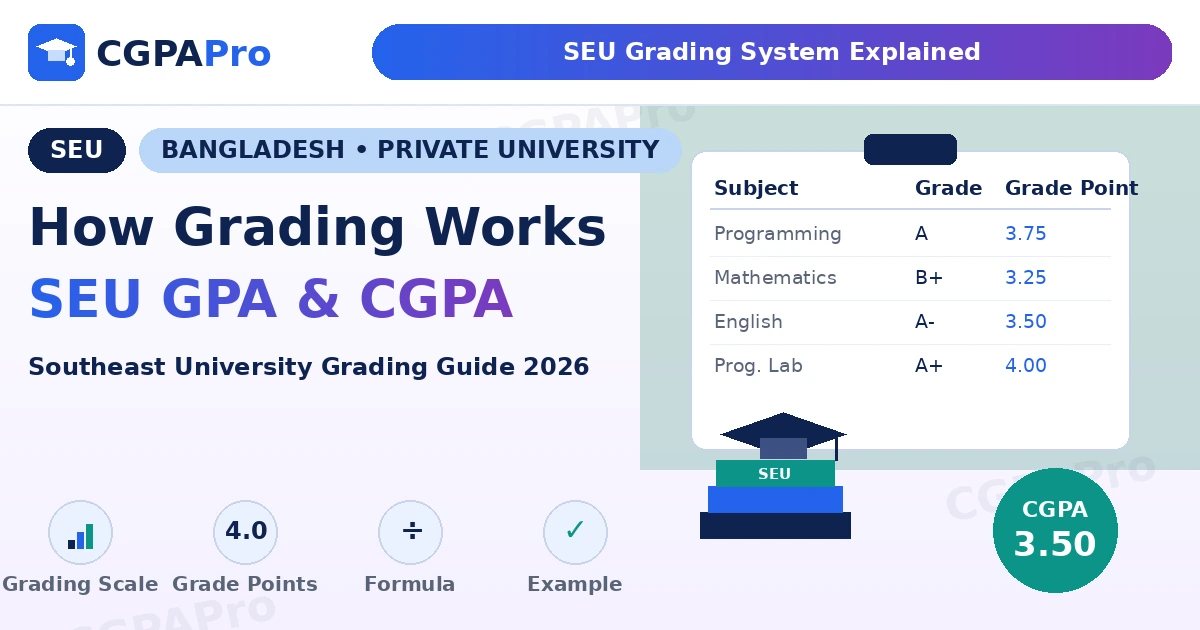
Total grade points: 11.25 + 9.75 + 10.50 + 9.00 + 12.00 = 52.50. Total credits: 3 + 3 + 3 + 3 + 3 = 15. Semester GPA = 52.50 ÷ 15 = 3.50 exactly. That 3.50 is the number on this article’s featured image — it is the real result of the example above, not a decorative figure. Notice what decided it: the A+ in the lab course pulled 12.00 points, while the B in Physics contributed only 9.00 — a 3.00-point swing from one course.
Worked Example 2: Building a CGPA Across Semesters
Now stretch it. Say the student above finished the previous semester with 18 credits at a 3.20 GPA, then had the 3.50 semester from Example 1. Here is the correct CGPA math:
- Previous: 18 credits × 3.20 = 57.60 grade points
- Current: 15 credits × 3.50 = 52.50 grade points
- Total: 57.60 + 52.50 = 110.10 grade points; 18 + 15 = 33 credits
- CGPA = 110.10 ÷ 33 = 3.34
See the drag: the earlier 18-credit semester at 3.20 kept the new CGPA at 3.34, below the 3.50 of the latest semester — because it carried more credits. And here is the mistake to never make: (3.20 + 3.50) ÷ 2 = 3.35. That looks close, but it is wrong in principle — it ignores the credit weights. With unequal semester loads (and SEU’s tri-semester system produces them), the shortcut error grows. If you want to recover from a low CGPA, the guide on improving your CGPA walks through the recovery math in detail.
The 2.50 Rule: What You Need to Graduate
Here is the number that matters most at SEU: a minimum CGPA of 2.50 is required for the award of the degree, per the Office of the Controller of Examinations. That floor is higher than the 2.00 most Bangladeshi students assume is “the” graduation line, and it changes the planning math.
Now an honest caveat, because conflicting documents circulate: an older SEU CSE course-curriculum document states that “the minimum CGPA requirement for obtaining a Bachelor degree in engineering is 2.” That document is dated and contradicts the Controller of Examinations’ current published rule of 2.50. We present 2.50 as the official requirement and recommend every student confirm against their current program handbook — do not plan your degree around the older 2.0 figure.
Worked Example 3 — the climb to 2.50. Suppose a student has 60 completed credits at a 2.30 CGPA and asks how much straight-A work it takes to clear the floor. 60 × 2.30 = 138.00 grade points banked. If the remaining courses are all A grades (3.75), how many credits N are needed? (138.00 + 3.75N) ÷ (60 + N) ≥ 2.50 → 138 + 3.75N ≥ 150 + 2.5N → 1.25N ≥ 12 → N ≥ 9.6. So about 10 credits of straight A — realistically 12 credits (four 3-credit courses), which gives (138 + 45.00) ÷ 72 = 183.00 ÷ 72 = 2.54, clearing the floor with a small margin. Two more things to notice: the closer your completed credits are to 2.50 already, the fewer A-credits you need — and every credit below the floor makes the climb steeper, which is why catching a slide early beats retaking later.
Improvement and Retake: The Better Grade Counts
SEU’s official improvement rule is short and favorable to students: in case of improvement, the better grade is used for CGPA calculation. If you repeat a course and earn a higher grade, the CGPA computation uses the better one. That single sentence is the whole of what SEU publishes on the mechanics — which grades you are allowed to improve, how many times you may attempt, and the registration process are not on any published SEU page we could find, so confirm them with the Controller of Examinations or your department office before planning around them.
The practical takeaway: improvement at SEU is a genuine CGPA repair tool, not just a formality. A 3-credit course moved from D (2.00) to B+ (3.25) swings the numerator by (3.25 − 2.00) × 3 = 3.75 grade points on the same denominator — worth roughly +0.03 to +0.06 on a 60–120 credit CGPA, depending on your base. For the full retake-ROI picture, see how retaking a course affects your CGPA, and for the general strategy, how to improve your CGPA.
Transfer and Waived Credits: Counted, But Not in Your CGPA
Another official rule students routinely get wrong: credits accepted as transfer from other universities, or waived on previous coursework, count toward the degree but are NOT included in the CGPA calculation. So a transferred A does not lift your CGPA, and a transferred C does not drag it. Your SEU CGPA reflects only the credits you actually attempted at SEU. If you are comparing your number with a friend who transferred in, you are not comparing the same denominators.
Class Equivalents: What Your GPA Means in Bangladesh
Per the Ministry of Education notification (02.06.2009) reproduced in SEU’s grading documents, GPA bands map to traditional classes:
- 3.00 – 4.00: 1st class
- 2.25 – 2.99: 2nd class
- 1.65 – 2.24: 3rd class
That 1st-class line at 3.00 matters beyond pride: SEU’s limited need-based financial assistance requires a semester GPA above 3.00, and each semester the top-ranked students of every department — ranked by semester GPA — receive partial financial assistance. Meanwhile, the degree floor is 2.50, which sits inside the 2nd-class band. In other words, SEU’s graduation line and the country’s class-division line are different numbers — graduate at 2.50 and you have cleared the degree requirement but landed in the 2nd class. Students aiming at scholarships, trainee jobs, or MS admissions abroad should target 3.00+ as the practical floor, not 2.50. The is 2.5 CGPA good and is 3.0 CGPA good guides put those thresholds in context.
GPA vs CGPA: The Two Numbers, Plainly
Your semester GPA covers one semester only — 15 or 18 or 21 credits, one result sheet. Your CGPA covers everything: every credit attempted since you enrolled, weighted together. Employers and admission offices ask for the CGPA; department top-ranker lists and need-based aid use the semester GPA. The relationship between them is mechanical: each new semester’s GPA pulls the CGPA toward itself, with a force proportional to its credits. A 3.80 on 21 credits pulls harder than a 3.80 on 12. That is the whole secret of CGPA recovery — and also why a single bad heavy semester haunts you for years.
Common Mistakes SEU Students Make
- Using the Florida SEU scale. The top Google results for “SEU grading system” describe Southeastern University (Florida), where A− = 3.67 and B+ = 3.33. None of those values exist at SEU Bangladesh. Always verify the table matches the A+ 4.00 / A 3.75 / A− 3.50 ladder.
- Averaging semester GPAs. (3.20 + 3.50) ÷ 2 is not a CGPA. Weight by credits, always.
- Thinking D is a fail. D (40–44%, 2.00) is a pass at SEU. Only F fails. Confusing the two leads students to panic-retake courses that are already earned.
- Assuming 2.00 is enough to graduate. The official degree floor is 2.50 — and older documents saying 2.0 are not the current rule. Plan to 2.50, target 3.00.
- Counting transfer credits in the CGPA. They count toward the degree but are excluded from the CGPA. Recalculating “with” them gives a number SEU will not recognize.
- Assuming improvement erases history. The official rule is that the better grade is used in CGPA calculation. Do not assume the old attempt vanishes from your transcript — confirm the transcript treatment with the Examinations office.
- Ignoring the marks-band edges. A 74 is an A− (3.50), a 75 is an A (3.75). In a 3-credit course that one mark is worth 0.75 grade points — real CGPA money.
Tips for Keeping Your SEU CGPA High
- Track every semester in the calculator. Run your numbers after each result sheet with the CGPAPro calculator — SEU’s scale matches it exactly, so what you see is what the Examinations office computes.
- Attack heavy-credit semesters first. With three semesters a year, you get three chances to move the needle — but a weak 21-credit semester costs more than a weak 12-credit one. Plan your load accordingly.
- Use improvement strategically, not emotionally. The better grade counts in the CGPA, so prioritize retakes with the biggest point swing per credit — a D→B+ jump beats a C+→A− jump for the same effort.
- Keep your eye on 3.00, not 2.50. 2.50 keeps your degree; 3.00 puts you in the 1st class, unlocks need-based assistance eligibility, and puts you in the running for departmental top-ranker assistance.
- Check your program handbook for the unpublished rules. Probation ladders, withdrawal deadlines, and improvement eligibility caps are not on SEU’s public pages. Five minutes with your department office beats a semester of wrong assumptions.
Frequently Asked Questions
What is the CGPA scale at Southeast University (SEU)?
SEU uses a 4.00 scale: A+ 4.00 (80–100), A 3.75 (75–79), A− 3.50 (70–74), B+ 3.25 (65–69), B 3.00 (60–64), B− 2.75 (55–59), C+ 2.50 (50–54), C 2.25 (45–49), D 2.00 (40–44), F 0.00 (below 40). It is identical to the UGC Bangladesh scale.
I found a scale with A− = 3.67 for “SEU” — is that right?
No. That is Southeastern University in Florida, USA. SEU Bangladesh’s A− is 3.50, its B+ is 3.25, and it has an A+ (4.00) that Florida’s scale lacks. Using the Florida values will compute a wrong CGPA.
What CGPA do I need to graduate from SEU?
A minimum CGPA of 2.50 is required for the award of the degree, per the Office of the Controller of Examinations. Note that some older departmental documents mention 2.0 — the current official rule is 2.50, but confirm against your program’s current handbook.
Is a D grade a fail at SEU?
No. D (40–44%) is a passing grade worth 2.00 grade points. Only F (below 40%) is a fail. Many students confuse the two and needlessly plan retakes of already-passed courses. If you did fail a course, this guide to calculating CGPA with failed subjects and backlogs shows exactly how the F drags your numbers and how to recover.
If I improve a course, which grade counts toward my CGPA?
The better grade is used in the CGPA calculation, per SEU’s official rule. What we could not verify from published sources is which grades you are allowed to improve and how many attempts you get — confirm the eligibility and process with the Controller of Examinations.
Do transfer or waived credits affect my SEU CGPA?
No. Credits accepted as transfer from other universities or waived on previous coursework count toward the degree but are excluded from the CGPA calculation. Your SEU CGPA reflects only credits you attempted at SEU.
Does SEU have a probation policy?
No probation or academic-standing policy was found on SEU’s published pages — and every “SEU probation” search result actually describes the American Southeastern University. The verified binding number is the 2.50 degree floor. Ask your department office for your program’s standing rules rather than trusting search results.
Final Word
SEU’s grading system is, on paper, one of the simplest in Bangladesh: fixed bands, a scale identical to the UGC standard, and a clean credit-weighted formula. The complexity is all around the edges — the 2.50 degree floor that most students underestimate, the better-grade improvement rule that most students underuse, and a name-twin university in Florida that pollutes every search. Get those three right, track each of the three semesters in the calculator as you go, and the numbers will take care of themselves. And if you ever need the authoritative word on anything here, the Office of the Controller of Examinations (degree-verify.seu.edu.bd) is the primary source this guide was checked against — start there before you trust any blog, including this one.
Read More
Sources: SEU Office of the Controller of Examinations (degree-verify.seu.edu.bd); Southeast University “Terms and grading” table via Wikipedia, citing SEU’s Degree Requirements; SEU Online Admission FAQ (admission.seu.edu.bd). Rules verified 2026-10-15; where SEU has not published a rule, the article says so.