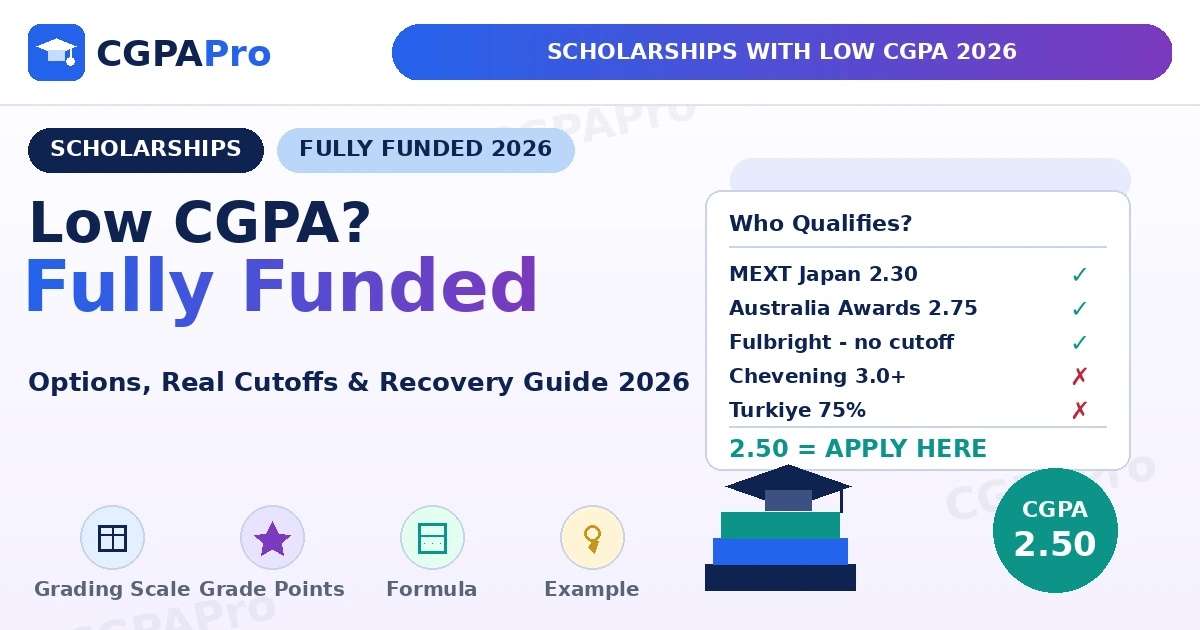
Quick answer: Yes — a low CGPA does not end your fully funded scholarship chances in 2026. But it ends your chances at the programs most blogs keep listing for you. Chevening needs 3.0+, Türkiye Burslari’s “75%” is effectively a 3.0+ bar, and Malaysia’s MTCP wants 3.0 too. The real openings for a 2.4–2.9 student are elsewhere: Japan’s MEXT University Recommendation (minimum 2.30 on MEXT’s 3.00 scale — verified in the official guideline), Australia Awards country programs with floors as low as 2.75, and no-published-cutoff programs like Fulbright and Erasmus Mundus where work experience and leadership carry real weight. Below, every rule is named and sourced, plus the exact grade math you need to rescue your CGPA.
First, Know Exactly Where You Stand
Before you believe any “low CGPA scholarship” list, put your real number on paper. I ran a typical struggling-student profile through the CGPAPro CGPA calculator — six 15-credit courses:
- Data Structures — 15 credits — B+ (3.25)
- Operating Systems — 15 credits — B (3.00)
- Calculus II — 15 credits — C+ (2.50)
- Discrete Math — 15 credits — C (2.25)
- Statistics — 15 credits — D (2.00)
- English — 15 credits — D (2.00)
Grade points: (3.25 × 15) + (3.00 × 15) + (2.50 × 15) + (2.25 × 15) + (2.00 × 15) + (2.00 × 15) = 48.75 + 45.00 + 37.50 + 33.75 + 30.00 + 30.00 = 225.00 over 90 credits = 2.50 CGPA. Here is the actual calculator output:
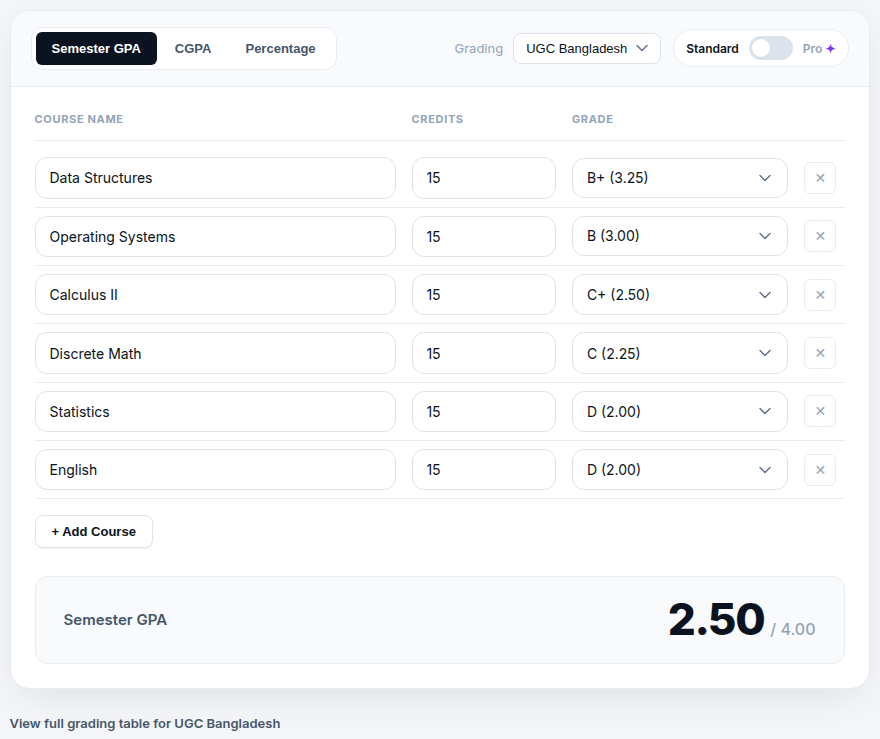
Screenshot: the six courses above on cgpacalculatorpro.com’s free CGPA calculator, reading 2.50/4.00. One caveat: the calculator’s default grade scale is the official UGC Bangladesh scale (A+ 4.00, A 3.75, A− 3.50, B+ 3.25, B 3.00, B− 2.75, C+ 2.50, C 2.25, D 2.00, F 0.00). If your university uses a different mapping, match the letters to your own scale — the method is identical.
This 2.50 profile is the exact student this guide is written for. Every strategy below assumes you have checked your own real number the same way. Now — the honest part.
The 3.0 Wall: Programs You Are NOT Eligible For
Most “scholarships for low CGPA” articles list the same famous programs and hope you never check the eligibility pages. Let’s check them:
| Scholarship | Published CGPA rule | What it means for you |
|---|---|---|
| Chevening (UK) | 3.0+ CGPA (upper second-class / 2:1 equivalent) | Below 3.0, do not apply. The line is explicit. |
| Türkiye Burslari — Master’s/PhD | Minimum 75% academic achievement | 75% is NOT a low bar. On HEC’s official bands, 3.00 CGPA starts at 71% — so 75% sits at roughly 3.0–3.33. A 2.5 student does not meet it. |
| MTCP (Malaysia) | 3.0 CGPA | Hard floor, same as Chevening. |
| DAAD EPOS (Germany) | “Above-average — top third of class”; program pages set ~German 2.5 (≈ 3.0/4.0) | Effectively ≈ 3.0, and it also requires 2 years of relevant work experience. |
These four are the wall. If your CGPA is below 3.0, every application you send to them is a lottery ticket you cannot win — the eligibility screen filters you out before anyone reads your SOP. We mapped these cutoffs in detail in our Is 3.0 CGPA Good? guide. Your job is not to break the wall — it is to walk through the doors that are actually open.
📖 Read More: Is 3.0 CGPA Good? Jobs, Scholarships & MS Abroad Guide 2026 — the full per-country verdict on what a 3.0 unlocks, and why 75% is not what you think it is.
The Real Doors: Fully Funded Programs a Low-CGPA Student Can Actually Apply To
1. MEXT University Recommendation — Japan (verified: minimum 2.30 on MEXT’s 3.00 scale)
This is the single most underrated opening for low-CGPA students, and it is the only one on this list where I can quote the official rule directly. The University of Tsukuba’s official 2026 MEXT application guideline states: “Minimum requirement of Grade Point Average (GPA) on your latest academic record should be at least 2.30 on 3.00 scale.” The University of Tokyo’s official MEXT rules confirm the same 2.30 maintenance bar during the scholarship.
MEXT computes its own 3.00 scale: 80–100% = 3.0, 70–79% = 2.0, 60–69% = 1.0, below 60% = 0.0, weighted by credits. Watch what this does to a typical 2.5–2.7 student’s transcript: if 60% of your credits were 80% or above (3.0) and 40% were in the 70–79 band (2.0), your MEXT GPA is (0.6 × 3.0) + (0.4 × 2.0) = 2.60 ≥ 2.30 ✓. A transcript averaging just 75–80% clears the floor.
Two honest warnings: first, universities set their own nomination bars above 2.30, so this is the floor, not a guarantee. Second, the Embassy-research route uses percentage thresholds, not this scale — this opening applies to the university-recommendation route, where you apply through a Japanese university’s graduate program and get nominated.
2. Australia Awards — country-specific floors as low as 2.75 (verified)
Australia Awards is not one bar — every country gets its own. The official DFAT country pages for the 2027 intake show exactly why you must check your country’s page:
| Country program | Master’s GPA floor (official DFAT page) |
|---|---|
| Timor-Leste | 2.75 + minimum 2 years relevant work experience |
| Indonesia | 2.9 (exceptions down to 2.75) |
| French Polynesia | 3.0 |
The Timor-Leste rule is a perfect example of the CV-led strategy working as designed: the published bar pairs 2.75 with two years of relevant experience — the experience is doing half the lifting. If your country page lists 3.0, look at whether a neighboring country’s program or a partner-university pathway fits you instead. (India/Pakistan/Bangladesh applicants: check your own country page before assuming either number.)
3. Fulbright Foreign Student Program — no published numeric cutoff
Fulbright publishes no minimum GPA. Selection weighs academic achievement, leadership, community service, and your proposed study objective together. A 2.6 student with a coherent research proposal, strong references, and real community impact is a legitimate applicant — but be honest with yourself: “no cutoff” is not “grades don’t matter.” It means a weak transcript must be compensated, not ignored.
4. Erasmus Mundus Joint Masters — consortium-dependent, low-CGPA admits reported
Erasmus Mundus has no single CGPA rule; each consortium (the group of European universities running the program) sets its own criteria. Scholarship-listing sites report that students in the 2.5–3.0 range have been selected — treat that as anecdotal, not verified. The reliable move: shortlist 3–4 specific Erasmus Mundus programs in your field, read each one’s published criteria, and apply where your profile fits. Many weigh motivation letters and references heavily.
5. Stipendium Hungaricum & Chinese Government Scholarship — no published minimum
Neither publishes a hard CGPA floor; selection runs through partner universities (Hungary) or Chinese universities. Competition is still fierce, so these belong in your list as qualified options — apply, but do not bank your whole plan on them.
6. The need-based lane: don’t ignore money that isn’t merit-based
Everything above is merit-adjacent. If your family income is low, Pakistan’s HEC need-based programs (including the Ehsaas undergraduate framework) fund students at partner universities primarily on financial need — the academic bars are lower than merit scholarships by design. Always verify current criteria on hec.gov.pk before assuming anything, but this is the lane most low-CGPA, low-income students never investigate.
The CV-Led Strategy: How a 2.5 Becomes Fundable
Here is the uncomfortable truth every competitor article dances around: at 2.5, you are not the applicant — your transcript is the liability and everything else on your CV is the argument. Scholarship committees that forgive a low CGPA all forgive it for the same reason: proof you can do the work anyway. Follow this sequence:
Step 1 — Shortlist doors only. Build your application list exclusively from the programs in the section above. Zero applications to 3.0-wall programs. Every hour you spend on Chevening with a 2.6 is an hour stolen from MEXT.
Step 2 — Get the work experience the programs actually weight. DAAD EPOS requires 2 years of relevant post-degree experience. Australia Awards’ 2.75 programs ask for 2 years. Chevening demands two years of work experience too (for when your CGPA is above 3.0). If you are in your final year, a relevant internship + a part-time role now builds the runway; if you have graduated, the smartest move is often to work 1–2 years in your field and then apply — a 2.6 with two years of relevant engineering work beats a fresh 3.1 in experience-weighted programs.
Step 3 — Rescue what you can still rescue. If you have semesters left, the math below tells you exactly what average you need. A single retaken D can move a CGPA more than a semester of new B’s — read our retake guide before you register for anything.
Step 4 — Add a compensating score. A strong GRE or GMAT quant score, or a high IELTS/TOEFL, gives committees a second data point on your ability. It does not erase the transcript, but it gives your recommender something concrete to cite: “weak early semesters, 165 quant, top 10% in my lab.”
Step 5 — Write the SOP that names the elephant. Committees read thousands of essays; they respect one honest paragraph: early-semester grades, what changed, what the last two semesters prove. Pair it with two recommenders who can attest to your recent work specifically — a supervisor who writes “strongest research assistant I’ve had” outweighs a transcript line.
Step 6 — Build publications or projects. One conference paper, one open-source project with users, one field project — pick the one your field respects. For research-heavy programs (MEXT, Erasmus Mundus research tracks, Fulbright), this is often the tiebreaker.
Your 12-month action plan
- Months 1–2: Compute your real CGPA and your rescue math (below). Pick 4–6 door-only programs and note their cycles: MEXT university-recommendation nominations typically run through autumn (university deadlines vary); Türkiye Burslari opens around January–February (for when you’re above the bar).
- Months 3–6: Max out remaining semesters (target the exact averages from your math), start test prep, line up recommenders.
- Months 7–9: Draft SOP + research proposal; get work experience documented (certificates, reference letters).
- Months 10–12: Apply. Most programs want final transcripts + test scores by their deadline — work backwards from each deadline, not forwards from today.
📖 Read More: How to Improve Your CGPA: 15 Proven Strategies for 2026 — the semester-by-semester tactics behind the rescue math below.
The Rescue Formula: What Average Do You Actually Need?
Here is the formula that decides whether your remaining semesters can save you. Let:
- C = credits completed, P = grade points earned, T = target CGPA, r = credits remaining
Average needed over remaining credits = (T × (C + r) − P) ÷ r
Using our 2.50 profile: C = 90, P = 225.
Case 1 — Target 2.75 (the Australia Awards 2.75 bar), 30 credits left:
(2.75 × 120 − 225) ÷ 30 = (330 − 225) ÷ 30 = 105 ÷ 30 = 3.50. You need an A− average across every remaining course. Hard, but a defined target — and 3.50 is achievable if those 30 credits are retakes of your D’s and F’s, where you already know the material.
Case 2 — Target 3.00 (the Chevening/Turkey/MTCP bar), 30 credits left:
(3.00 × 120 − 225) ÷ 30 = (360 − 225) ÷ 30 = 135 ÷ 30 = 4.50. Impossible — no scale goes to 4.50. This is the honest answer most blogs won’t give you: with 30 credits left, 3.00 is mathematically out of reach from 2.50. Stop planning around it.
Case 3 — Target 3.00, 60 credits left (e.g., a full remaining two years or a retake-heavy plan):
(3.00 × 150 − 225) ÷ 60 = (450 − 225) ÷ 60 = 225 ÷ 60 = 3.75. Straight A’s with the odd A−. Brutal, but at least it is a real number on a real scale.
Case 4 — Target 2.80, 30 credits left:
(2.80 × 120 − 225) ÷ 30 = (336 − 225) ÷ 30 = 111 ÷ 30 = 3.70. Notice how fast the required average climbs — this is why retaking your worst courses (replacing 2.00s with 3.75s) moves the needle more than adding new courses.
Run your own numbers on the free CGPA calculator before you believe any plan. If the math says your target needs above 4.00, change the target — aim for the programs whose bar the math says you can actually reach.
Common Mistakes That Kill Low-CGPA Applications
- Applying to 3.0-wall programs anyway. Chevening’s 3.0+ and Türkiye Burslari’s 75% are eligibility screens, not suggestions. Applications below the floor are rejected before review.
- The WES myth. A top-ranking article claims a WES course-by-course evaluation “removes irrelevant courses” and raises your CGPA. That is false — WES evaluates every course on your transcript; it cannot hide your D’s. If you need the conversion done right, see our WES CGPA conversion guide.
- Misreading “75%” as low. Türkiye Burslari’s 75% minimum is roughly a 3.0–3.33 CGPA on HEC bands — students who read it as “basically 2.5” waste an entire application cycle. Percentage-to-CGPA mapping is trickier than it looks; our CGPA-to-percentage guide walks through the band math.
- Trusting listing-site claims as rules. “University X welcomes low CGPA” on a scholarship-listing blog is marketing copy, not a published rule. Always trace the claim to the university’s own page before you plan around it.
- Zero work experience for experience-weighted programs. DAAD EPOS and the 2.75 Australia Awards programs publish experience requirements. A transcript-only application to them is incomplete by definition.
- Waiting until after graduation to start. MEXT nominations, recommendation letters, and test scores all have lead times. The 12-month plan above exists because committees notice who prepared.
7 Tips That Actually Move the Needle
- Retake your worst courses first. Replacing a D (2.00) with an A (3.75) on the same 3 credits adds 5.25 grade points — more than any study hack.
- Front-load the math. Compute the required average for every remaining semester before the semester starts, and pick courses where that average is realistic.
- Document everything as you go. Experience certificates, project links, volunteer hours — collect them now; you cannot reconstruct two years of work in the week before a deadline.
- Pick recommenders who saw your best work. A supervisor from your strongest semester beats a famous professor who barely knows you.
- Apply to 4–6 programs, not 1. Doors-only, but several doors. MEXT + two Erasmus Mundus consortia + a no-cutoff national program is a sane spread.
- Address the transcript in your SOP. One honest paragraph beats hoping the committee doesn’t notice. They will notice.
- Consider the work-then-apply route. Two years of relevant work turns a 2.6 into a competitive DAAD/Australia Awards/Chevening (post-3.0) candidate. The delay pays for itself.
Frequently Asked Questions
Can I get a fully funded scholarship with a 2.5 CGPA?
Yes — but through the right programs. MEXT’s university-recommendation route publishes a minimum of 2.30 on its 3.00 scale (official guideline), and some Australia Awards country programs set floors of 2.75–2.9. What you cannot do is apply to Chevening (3.0+), MTCP (3.0), or Türkiye Burslari Master’s (75% ≈ 3.0+) with a 2.5 — those are hard eligibility floors.
Can I apply for Chevening with a 2.7 CGPA?
No. Chevening’s published eligibility requires the equivalent of an upper second-class honours degree — roughly 3.0+ CGPA on a 4.0 scale. Below that, your application is screened out before review. Target MEXT, Australia Awards, or Fulbright instead.
Is Türkiye Burslari good for low-CGPA students?
Honestly, no. Its published Master’s minimum is 75% academic achievement, which maps to roughly 3.0–3.33 CGPA on HEC bands — not a low-CGPA bar at all. It is a great scholarship for students at or above 3.0; below that, look elsewhere. (turkiyeburslari.gov.tr)
Does a WES evaluation increase my CGPA?
No. WES course-by-course evaluation converts every course on your transcript to the US scale — it does not drop weak courses or raise your GPA. Any article telling you otherwise is wrong. See our WES conversion guide for how it actually works.
What GPA does MEXT require?
For the university-recommendation route, the official guideline requires a minimum of 2.30 on MEXT’s own 3.00 scale (80%+ = 3.0, 70–79% = 2.0, 60–69% = 1.0, weighted by credits). A transcript averaging roughly 75–80% typically clears it — which is why MEXT is genuinely reachable for 2.5–2.7 students. Note: you must also keep above 2.30 during the scholarship or lose funding. (Official 2026 MEXT guideline, University of Tsukuba)
Can I get Australia Awards with a 2.8 CGPA?
It depends on your country program — the bar is per-country, not global. Timor-Leste’s Master’s program publishes 2.75 (+ 2 years work experience), Indonesia publishes 2.9 (exceptions to 2.75), and French Polynesia requires 3.0. Check your own country’s Australia Awards page; never assume one country’s number applies to yours. (Timor-Leste 2027 country page, DFAT)
Is 75% the same as a 3.0 CGPA?
Not exactly, and the direction matters. On HEC’s official percentage bands, 3.00 CGPA starts at about 71% — so 75% lands in the roughly 3.0–3.33 band. That means a “75% minimum” scholarship is asking for at least a 3.0, often a bit more. Never multiply by 25 and call it done.
The Bottom Line
A low CGPA closes some doors permanently — Chevening, Türkiye Burslari, MTCP, and DAAD’s ≈3.0 floors are real, published, and non-negotiable. But the scholarship world is much bigger than four programs. MEXT’s 2.30 floor, Australia Awards’ 2.75 country programs, and no-published-cutoff programs like Fulbright and Erasmus Mundus are real doors with real money behind them. Your playbook: stop applying to walls, rescue every grade point your remaining semesters allow, build the work experience that experience-weighted programs reward, and write the honest SOP. The math is unforgiving — but it is also the most honest advisor you have.