
Eastern University Grading System 2026: GPA & CGPA Guide
Quick Answer: How Eastern University Grades Work
If you study at Eastern University (EU) in Ashulia, Dhaka, your results run on a 4.00 CGPA scale with fixed marks bands — no curve, no relative grading. Eastern University follows the UGC uniform grading system used across Bangladesh’s private universities: every course gives you a letter grade from A+ down to F, each worth a fixed grade point — A+ is 4.00, A is 3.75, A− is 3.50, B+ is 3.25, B is 3.00, B− is 2.75, C+ is 2.50, C is 2.25, and D — the lowest passing grade — is 2.00. Score below 40% and you get an F worth 0.00. Your trimester GPA is the credit-weighted average of your grade points, and your CGPA is the same calculation stretched across every trimester you have completed.
One important caveat, stated plainly because it matters: Eastern University does not publish its own grading table on its public website (we checked its site pages, webportal forms, and search engines on 2026-10-15 — no handbook or academic-regulations PDF is publicly available). The table in this guide is the UGC uniform grading scale — published verbatim by multiple UGC-affiliated universities as the scale “introduced by the UGC as a uniform grading system for public and private universities in Bangladesh” — which EU, as a UGC-affiliated private university, follows. Where a rule below is drawn from the UGC framework rather than an EU-published document, we say so. No invented numbers.
A note before we start, because the confusion here is worse than usual: “Eastern University” is also the name of a university in St. Davids, Pennsylvania, USA (eastern.edu) — and it owns the English-language search results for “Eastern University grading system.” Its scale has nothing to do with yours. Add to that East West University (a different Dhaka private university entirely), the European University of Bangladesh (domain eub.edu.bd — a completely separate institution), and even an illegal outfit called “East Asian University” that the UGC publicly warned students against in January 2025. This guide is about Eastern University, Bangladesh — established 2003, permanent campus at Ashulia Model Town, Savar, Dhaka. If a page you are reading says “eastern.edu” in its URL, it is the American university. Close it.
How to Calculate Your EU GPA With the Calculator
The fastest way to check your numbers is the CGPAPro calculator — and here is the good news, verified grade-by-grade against the UGC uniform table EU follows: the calculator’s UGC Bangladesh scale is identical to EU’s official table — same letters, same marks bands, same grade points, including the D band. So the numbers the calculator gives you are exactly right for Eastern University, with no conversion needed:
- Open the CGPAPro CGPA calculator (its UGC Bangladesh scale matches EU’s grading table exactly).
- For each course, enter the credit hours and select the letter grade you earned (A+ = 4.00, A = 3.75, A− = 3.50, B+ = 3.25, B = 3.00, B− = 2.75, C+ = 2.50, C = 2.25, D = 2.00, F = 0.00).
- The calculator multiplies each grade point by its credit hours, adds up the quality points, and divides by your total credits — that is your trimester GPA.
- To track your CGPA across trimesters, repeat for each past trimester and combine them with the credit-weighted CGPA formula in the worked examples below.
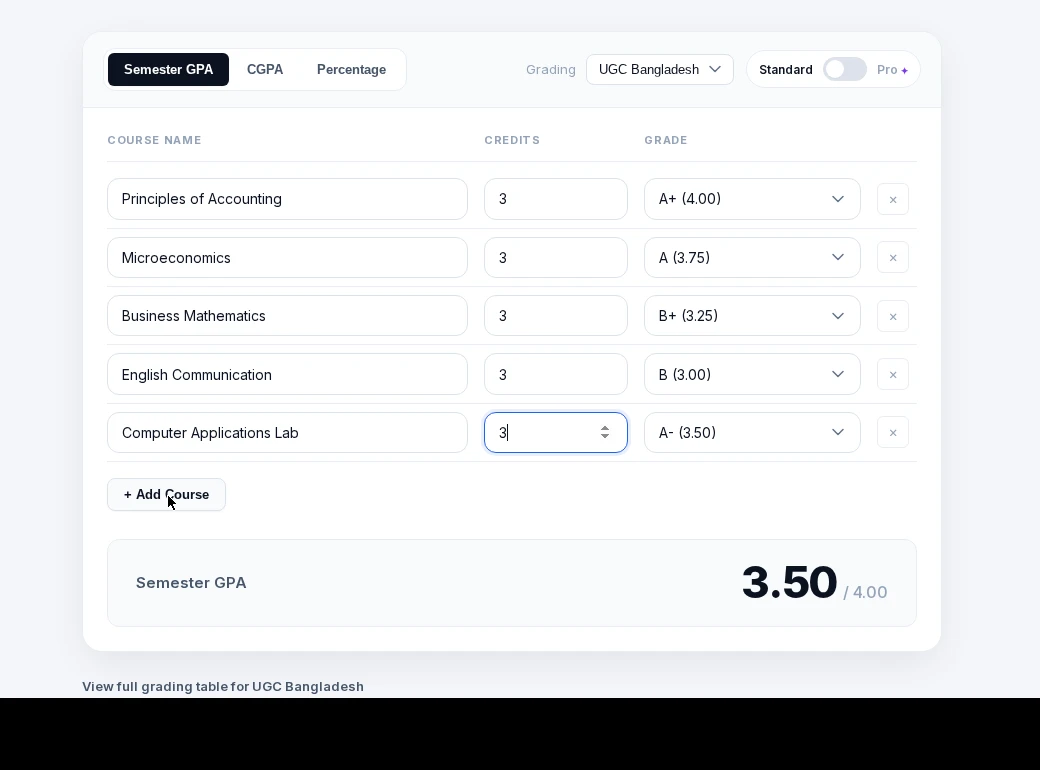
The Official Grade Table (2026)
This is the UGC uniform grading table that Eastern University follows, published verbatim by ASA University Bangladesh’s official academic rules page as the UGC scale for public and private universities, and corroborated by UODA’s academic regulations and the Wikipedia record of Bangladesh’s public-university grading. Notice the hard marks bands: 79 is an A (3.75), not an A+, and 74 is an A− (3.50), not an A. There is no curving — these cutoffs are exact, and marks do not round up into the next band.
| Class interval of scores | Letter grade | Grade points |
|---|---|---|
| 80 and above | A+ | 4.00 |
| 75 to less than 80 | A | 3.75 |
| 70 to less than 75 | A− | 3.50 |
| 65 to less than 70 | B+ | 3.25 |
| 60 to less than 65 | B | 3.00 |
| 55 to less than 60 | B− | 2.75 |
| 50 to less than 55 | C+ | 2.50 |
| 45 to less than 50 | C | 2.25 |
| 40 to less than 45 | D | 2.00 |
| Less than 40 | F | 0.00 |
Two things surprise students every year. First, D is a pass — the lowest passing grade, worth 2.00. Only F fails. Second, the phrase “75 to less than 80” is doing real work: a 79.99 is an A, and nothing rounds it up to an A+. Know your band before results day, not after. We work through what a single mark costs you, in real CGPA terms, in the band-edge section below.
Two Calendars, One Campus: EU’s Trimester System
Most Bangladeshi private universities run two semesters a year. Eastern University is different: per its official admission page, almost all EU programs run on a tri-semester system, four months each — Spring (January–April), Summer (May–August), Fall (September–December). Three result cycles a year instead of two.
But there is an EU-specific quirk that breaks every generic assumption: Pharmacy and Law run on a bi-semester calendar on the same campus — Spring (January–June) and Summer (July–December), six months each. So an EU CSE student and an EU Pharmacy student on the same campus get results on completely different schedules. If you are comparing CGPA trajectories with a friend in Pharmacy or Law, you are not comparing the same denominators — their semesters are longer, their credit loads per cycle are structured differently, and their GPA “pulls” arrive half as often.
What the tri-semester system means for your GPA math is the heart of the pace trap below: you accumulate grade points across three result cycles a year, so a weak Spring trimester dilutes faster — but each individual cycle moves your CGPA less than a two-semester student’s cycle would. Three deadlines a year where your numbers go on the record, and three chances to repair them.
How to Calculate Your EU GPA, Step by Step
The official UGC-framework method — the one EU’s examinations office follows — is mechanical: the grade points of a course are its grade point multiplied by its credit hours, and the CGPA is total grade points divided by total credits attempted. Follow these steps:
- List every course with its credit hours and your letter grade.
- Convert each letter grade to its grade point using the official table above.
- Multiply each grade point by the course’s credit hours. These are the course’s grade points (sometimes called quality points).
- Add up all the grade points → your total grade points.
- Add up all the credit hours → your total credits attempted.
- Divide total grade points by total credits attempted. Round to two decimals — that is your trimester GPA.
The Formula
Trimester GPA = Σ (credit hours × grade point) ÷ Σ credit hours
CGPA = total grade points earned across all trimesters ÷ total credits attempted across all trimesters
The second formula is the important one. Your CGPA is not the average of your trimester GPAs — it is the credit-weighted total. A 15-credit trimester and a 12-credit trimester do not pull equally. (Pharmacy and Law students: your two 6-month semesters will usually carry heavier loads per cycle than your friends’ 4-month trimesters, so each of your cycles pulls harder.)
Worked Example 1: A Trimester GPA
Take a typical first-year BBA-style load — five courses, 3 credits each — and the grades below. Every number here is checked by hand:
| Course | Credits | Letter grade | Grade point | Grade points (credits × point) |
|---|---|---|---|---|
| Principles of Accounting | 3 | A+ | 4.00 | 12.00 |
| Microeconomics | 3 | A | 3.75 | 11.25 |
| Business Mathematics | 3 | B+ | 3.25 | 9.75 |
| English Communication | 3 | B | 3.00 | 9.00 |
| Computer Applications Lab | 3 | A− | 3.50 | 10.50 |
Total grade points: 12.00 + 11.25 + 9.75 + 9.00 + 10.50 = 52.50. Total credits: 3 + 3 + 3 + 3 + 3 = 15. Trimester GPA = 52.50 ÷ 15 = 3.50 exactly. That 3.50 is the number on this article’s featured image and in the calculator screenshot above — it is the real result of the example you just read, not a decorative figure. Notice what decided it: the A+ in Accounting pulled 12.00 points while the B in English Communication contributed only 9.00 — a 3.00-point swing from one course. That is the whole game in one observation: credit hours are leverage, and grade points are the force you apply to them.
Worked Example 2: Building a CGPA Across Trimesters
Now stretch it across two trimesters — and notice that they do not carry equal weight. Take the 3.50 trimester above (15 credits, 52.50 grade points) and add this 13.5-credit Spring trimester:
| Course | Credits | Marks | Letter grade | Grade point | Grade points |
|---|---|---|---|---|---|
| Financial Accounting | 3.0 | 79 | A | 3.75 | 11.25 |
| Macroeconomics | 3.0 | 74 | A− | 3.50 | 10.50 |
| Statistics for Business | 3.0 | 55 | B− | 2.75 | 8.25 |
| Principles of Marketing | 3.0 | 83 | A+ | 4.00 | 12.00 |
| English Composition Lab | 1.5 | 64 | B | 3.00 | 4.50 |
Second trimester: 13.5 credits, 46.50 grade points → GPA = 46.50 ÷ 13.5 = 3.44. Now the true CGPA: 52.50 + 46.50 = 99.00 grade points over 15 + 13.5 = 28.5 credits → CGPA = 99.00 ÷ 28.5 = 3.47. Now look at the marks column and find the two most expensive numbers on the page: 79 and 74. At 79%, Financial Accounting is an A — one mark short of an A+. At 74%, Macroeconomics is an A− — one mark short of an A. Each miss cost 0.25 grade points per credit × 3 credits = 0.75 quality points, so the two misses together cost 1.50 quality points — on a 28.5-credit base, that is 1.50 ÷ 28.5 ≈ 0.05 of CGPA, lost to two single marks. That is what “hard bands” means in money terms.
And here is the mistake to never make: (3.50 + 3.44) ÷ 2 = 3.47. Here the shortcut happens to coincide with the true 3.47 — and that coincidence is exactly why the shortcut is dangerous. It looks right, so students trust it; the moment your trimester loads differ more (a 15-credit trimester next to a 12-credit one, or the heavier Pharmacy/Law bi-semester cycles), the shortcut drifts and the drift is always invisible. Weight by credits, always.
Retake and Improvement: The Better Grade Wins
Here is the most valuable paragraph in this guide for anyone below their target. Under the UGC uniform framework EU follows, the retake rule is replacement, not averaging: when you repeat a course and earn a higher grade, the previous lower grade is marked ‘R’ (Retaken) on the transcript and the higher grade is used for the CGPA. Both grades stay visible on the transcript — the history is not erased — but the CGPA only feels the better one. A course passed with a grade below B may be repeated for improvement (on your advisor’s advice); a course failed with an F must be retaken, normally within the next two semesters.
Worked Example 3 — the retake ROI. Take Statistics for Business from Example 2: 3 credits, B− (2.75), contributing 8.25 quality points to the 99.00-point, 28.5-credit CGPA of 3.47. The student retakes it, scores 76%, and earns an A (3.75): the course now contributes 11.25 instead of 8.25 — a gain of 3.00 quality points. New total: 99.00 − 8.25 + 11.25 = 102.00 points on the same 28.5 credits → CGPA = 102.00 ÷ 28.5 = 3.58. One 3-credit retake moved the CGPA from 3.47 to 3.58: +0.11. If the retake had only reached B+ (3.25), the gain would be 99.00 − 8.25 + 9.75 = 100.50 ÷ 28.5 = 3.53 (+0.06). Two lessons: retakes are genuine CGPA repair tools under replacement rules, and the lower the original grade, the more each retake buys you — a B−→A retake is worth nearly twice a B+→A retake on the same base. For the full retake-ROI picture across universities, see how retaking a course affects your CGPA.
Three things EU has not published about retakes: the fee (the UGC-framework norm at sister universities is full tuition again for the retaken course, but EU’s own figure is unpublished), any cap on how many courses you may improve, and the exact registration process. Confirm all three with your department office or advisor before planning around them. And a standing warning that applies everywhere: ‘W’ (withdrawal) carries no grade points and is excluded from the GPA — but an un-excused absence in the final exam is an F, not a W.
Your Transcript Shows Letters, Not Marks
Here is a fact that should lower your blood pressure: under the UGC uniform rules EU follows, the transcript/grade sheet shows only the letter grade, the corresponding grade points, and finally the CGPA — not the numerical marks. Your future employer, your MS admissions office, your scholarship evaluator: none of them will ever see “79”. They see “A”. This reframes the band-edge anxiety from the other direction — the difference between 75 and 79 is real for your GPA math (3.75 either way, so no), but the difference between 79 and 80 is 0.25 grade points per credit that the whole world will see as the difference between “A” and “A+”. Fight your band-edge battles, but know which marks the world actually sees.
The Band-Edge Trap: 79 Is Not 80, and 39 Is Not 40
The UGC table’s band wording — “75 to less than 80” — means marks never round up into the next grade. Memorize the four cliffs that matter most:
- 79 → A (3.75); 80 → A+ (4.00). One mark = 0.25 grade points per credit.
- 74 → A− (3.50); 75 → A (3.75). Same one-mark, same 0.25.
- 69 → B+ (3.25); 70 → A− (3.50). The most common heartbreak band in business programs.
- 39 → F (0.00); 40 → D (2.00). One mark = the difference between failing and passing, a 2.00-per-credit swing — the steepest cliff in the whole table.
A practical consequence most students never compute: on a 28.5-credit base like our worked example, a single mark that flips one 3-credit course across a band edge moves the CGPA by 0.75 ÷ 28.5 ≈ 0.026 — about 0.03. Two band-edge misses cost 0.05 (we showed this in Example 2). When your total sits at 2.98 or 3.47, 0.03–0.05 is the difference between a class boundary, a scholarship cutoff, or an admissions threshold. Scrutinize every borderline mark at recheck time — the bands are hard, but the marking that placed you just below one is worth one polite, evidence-based look.
The Tri-Semester Pace Trap
Here is the arithmetic nobody warns EU students about. At a two-semester university, one strong semester of straight A− (3.50) on 15 credits pulls a 60-credit 3.00 CGPA to (180 + 52.50) ÷ 75 = 232.50 ÷ 75 = 3.10. At EU’s tri-semester pace, your cycles are typically lighter per cycle — the same repair effort arrives in smaller bites. More cycles per year, but each cycle moves the needle less. Students at EU consistently overestimate how fast a bad trimester can be repaired, because they count cycles instead of credits. Count credits.
Worked Example 4 — the climb, honestly priced. Start from Example 2’s CGPA: 28.5 credits at 3.47 (99.00 points). How many straight-A (3.75) trimesters of 13.5 credits does it take to reach 3.60? (99.00 + 3.75N) ÷ (28.5 + N) ≥ 3.60 → 0.15N ≥ 3.60 → N ≥ 24 credits. Realistically two full trimesters of 3.75: (99.00 + 101.25) ÷ 55.5 = 200.25 ÷ 55.5 = 3.61. And a deeper hole: 40 credits at 2.90 (116.00 points) → 3.25 needs (116 + 3.75N) ÷ (40 + N) ≥ 3.25 → 0.5N ≥ 14 → N ≥ 28 credits — again about two strong trimesters: (116 + 105) ÷ 68 = 221 ÷ 68 = 3.25. The pattern is the lesson: early CGPA damage is cheap to prevent and expensive to repair, and EU’s three-cycles-a-year calendar means you get more chances to start the repair — but each chance is smaller. If you are planning a recovery, the guide on improving your CGPA walks through the strategy in full.
What EU Does Not Publish (Read This Before You Trust Search Results)
Most grading guides invent numbers for this section. We will not. Eastern University’s public site does not publish a probation threshold, a Dean’s List cutoff, a minimum graduation CGPA, maximum degree-completion years, or a retake fee schedule — we verified the absence on 2026-10-15. For context only, not as EU’s rules: UGC-affiliated private universities overwhelmingly treat CGPA 2.00 as the good-standing and graduation floor (UODA publishes probation below 2.00 and a 3.5 Dean’s List, but that is UODA’s number, not EU’s). If a blog or calculator site quotes an “Eastern University probation at X” figure, ask it for the source document — if the source is eastern.edu, it is quoting the American university. For the binding numbers at your university, confirm with your advisor or the Registrar’s office. An unanswered question, stated honestly, beats an invented answer every time — and it is precisely the kind of invented answer that costs students a semester.
Class Equivalents: What Your GPA Means in Bangladesh
Per the Ministry of Education notification (02.06.2009) reproduced in Bangladesh’s grading references, CGPA bands map to the traditional class divisions:
- 3.00 – 4.00: 1st class
- 2.25 – 2.99: 2nd class
- 1.65 – 2.24: 3rd class
That 3.00 line is the practical target for most EU students: 1st class, and the level at which the is 3.0 CGPA good guide’s job, scholarship, and MS-abroad doors start opening. The UGC-norm graduation floor of 2.00 sits inside the 2nd-class band — clearing the degree requirement and landing in the 1st class are different numbers, and your plan should name the right one.
Trimester GPA vs CGPA: The Two Numbers, Plainly
Your trimester GPA covers one trimester only — 12 or 13.5 or 15 credits, one result sheet. Your CGPA covers everything: every credit attempted since you enrolled, weighted together. Employers and admission offices ask for the CGPA; internal rankings and any merit considerations use the trimester GPA. The relationship between them is mechanical: each new trimester’s GPA pulls the CGPA toward itself, with a force proportional to its credits. A 3.80 on a heavy Pharmacy/Law bi-semester pulls harder than a 3.80 on a light 12-credit trimester. That is the whole secret of CGPA recovery — and also why a single bad heavy trimester haunts you for years.
Common Mistakes EU Students Make
- Using the American Eastern University’s scale. The top English-language results for “Eastern University grading system” describe eastern.edu in Pennsylvania. Its numbers have nothing to do with EU Bangladesh’s UGC table. Check the domain of every page you read: easternuni.edu.bd is yours; eastern.edu is not.
- Mixing up EU with EUB, EWU, or “East Asian University”. eub.edu.bd is the European University of Bangladesh (a different institution); EWU is East West University (different too); “East Asian University” is an illegal outfit the UGC warned against. None of their documents apply to you.
- Averaging trimester GPAs. (3.50 + 3.44) ÷ 2 is not a CGPA — here it coincidentally matches, but with unequal loads it drifts silently. Weight by credits, always.
- Thinking D is a fail. D (40–44%, 2.00) is a pass under the UGC scale. Only F fails. Confusing the two leads students to panic-retake courses that are already earned.
- Assuming marks round up into the next band. “75 to less than 80” means 79.99 is an A. Nothing rounds. Fight borderline marks at recheck, not at assumption.
- Counting marks the transcript will never show. Only letters, points, and CGPA appear on the transcript. Plan your anxiety around letters, not around “79”.
- Assuming improvement erases history. Under replacement rules the better grade drives the CGPA, but the old attempt stays on the transcript marked ‘R’. Do not assume it vanishes — and confirm EU’s retake eligibility, caps, and fees with your department before planning around them.
- Trusting invented probation/Dean’s List numbers. EU publishes none. Any figure without an easternuni.edu.bd source is somebody’s guess or the American university’s rule.
Tips for Keeping Your EU CGPA High
- Track every trimester in the calculator. Run your numbers after each result sheet with the CGPAPro calculator — EU’s UGC table matches it exactly, so what you see is what the examinations office computes.
- Count credits, not cycles. Three trimesters a year means three chances to move the needle — but each bite is smaller. A weak 15-credit trimester costs more than a weak 12-credit one. Plan your load accordingly.
- Use retakes strategically, not emotionally. Replacement means the lowest grades buy the most CGPA per retake — a B−→A jump beats a B+→A jump for the same effort. Prioritize by point swing per credit.
- Keep your eye on 3.00, not 2.00. 2.00 keeps you in good standing under the national norm; 3.00 puts you in the 1st class and opens the scholarship and MS-abroad doors.
- Verify the unpublished rules in person. Probation ladders, Dean’s List, retake fees, and improvement caps are not on EU’s public site. Five minutes with your advisor beats a trimester of wrong assumptions.
Frequently Asked Questions
What is the grading scale at Eastern University Bangladesh?
Eastern University follows the UGC uniform 4.00 scale: A+ 4.00 (80+), A 3.75 (75–79), A− 3.50 (70–74), B+ 3.25 (65–69), B 3.00 (60–64), B− 2.75 (55–59), C+ 2.50 (50–54), C 2.25 (45–49), D 2.00 (40–44), F 0.00 (below 40). Note that EU does not publish its own grading table on its public site — the table is the UGC uniform scale that UGC-affiliated private universities follow.
I scored 79% — why is that an A and not an A+?
Because the bands are hard cutoffs: A+ starts at 80, and the A band is “75 to less than 80”. A 79 is an A (3.75), and marks do not round up into the next band. On a 3-credit course that single mark is worth 0.75 quality points — roughly 0.03 of CGPA on a typical base.
I failed a course — when must I retake it, and what does it cost?
Under the UGC uniform framework, an F must normally be retaken within the next two semesters. The retake follows grade replacement (the old grade becomes ‘R’, the higher grade drives the CGPA), not averaging. EU has not published its own retake fee or timing — the framework norm at sister universities is full tuition for the retaken course, but confirm EU’s figure with your department. If you did fail a course, this guide to calculating CGPA with failed subjects and backlogs shows exactly how the F drags your numbers and how to recover.
Does my EU transcript show my percentage marks?
No. Under the UGC uniform rules, the transcript shows only letter grades, the corresponding grade points, and the CGPA — never the numerical marks. Employers and foreign evaluators see “A”, never “79”.
What happens if my CGPA drops below 2.00 at Eastern University?
Eastern University does not publish a probation threshold on its public site, so no honest article can quote one. The national norm for UGC-affiliated private universities is that CGPA 2.00 is the good-standing floor — but confirm EU’s actual standing rules with your advisor or the Registrar rather than trusting any number you find online, especially if it comes from eastern.edu (the American university).
Is the “Eastern University grading system” I found on Google the right one?
Check the domain. If it says eastern.edu, it is Eastern University in Pennsylvania, USA — wrong scale, wrong university. Yours is Eastern University Bangladesh: easternuni.edu.bd, Ashulia/Dhaka, UGC uniform 4.00 scale. Also not to be confused with East West University, the European University of Bangladesh (eub.edu.bd), or the illegal “East Asian University” the UGC warned against.
How many trimesters does EU run per year?
Three for almost all programs — Spring (January–April), Summer (May–August), Fall (September–December). Pharmacy and Law are the exception: two 6-month semesters per year (Spring January–June, Summer July–December) on the same campus.
Final Word
Eastern University’s grading system is, on paper, one of the most standardized in Bangladesh: the UGC uniform table, fixed bands, and a clean credit-weighted formula. The complexity is all around the edges — the hard band edges that turn single marks into CGPA swings, the replacement-based retake rule that most students underuse, a tri-semester calendar that moves the needle in smaller bites than students expect, and a name-twin university in Pennsylvania that pollutes every search. Get those four right, track each trimester in the calculator as you go, and confirm the unpublished rules (probation, Dean’s List, retake fees) with your advisor in person. And if you ever need the authoritative word on anything here, start with the university’s own pages at easternuni.edu.bd and the UGC-scale documents cited below — before you trust any blog, including this one.
Read More
Sources: ASA University Bangladesh Academic Rules and Regulations (asaub.edu.bd) — the UGC uniform grade table, retake/’R’/W rules, transcript rule, and 40% pass floor; UODA Academic Regulations (uoda.edu.bd) — corroborating table (context figures only); Eastern University admission information (easternuni.edu.bd/admission) — tri-semester calendar and Pharmacy/Law bi-semester exception; Wikipedia: Eastern University (Bangladesh) — identity, campus, programs. Rules verified 2026-10-15; where Eastern University has not published a rule, the article says so.