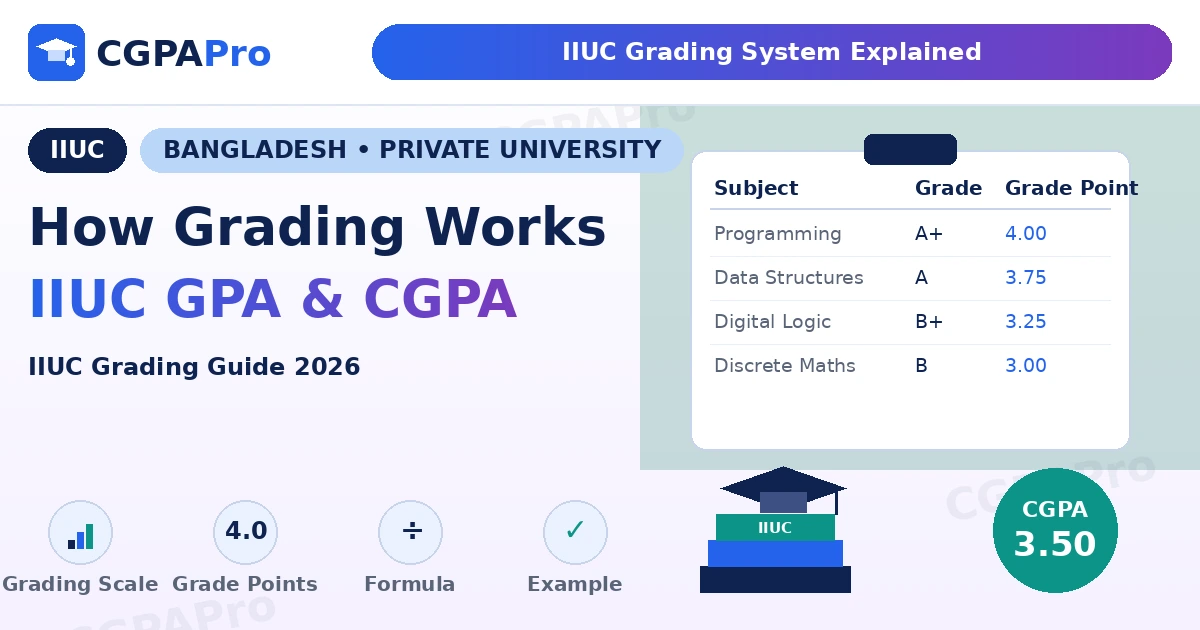
IIUC Grading System 2026: GPA & CGPA Guide for Students
Quick answer: IIUC — the International Islamic University Chittagong — grades every course on the UGC Bangladesh uniform 4.00 scale: 80% and above is A+ (4.00), 40–44% is D (2.00), and anything below 40% is F (0.00). Your semester GPA is your total grade points divided by the credits you attempted that semester; your CGPA is the same calculation stretched across every semester so far. You must score at least 2.00 GPA in every single semester, and you need a final CGPA of 2.50 or higher to graduate.
If you study at IIUC, those numbers are not abstract. They decide whether you keep your admission, whether you graduate on time, and how your transcript reads when you apply for jobs or an MS abroad. This guide walks through the official grading table exactly as the university publishes it, shows you how to calculate your GPA and CGPA by hand with a fully worked example, and clears up the confusions students actually ask about — is D a pass? what happens when you fail a course? and is IIUC the same as IIUI in Islamabad? (It is not.)
Read More: University of Chittagong Grading System 2026: GPA & CGPA Guide — IIUC’s public-university neighbour in Chittagong uses the same UGC scale; compare the two here.
Calculate Your IIUC GPA in Seconds
The fastest way to check your semester GPA is to enter your courses below — course name, credit hours, and the letter grade from your result — and let the calculator do the arithmetic:
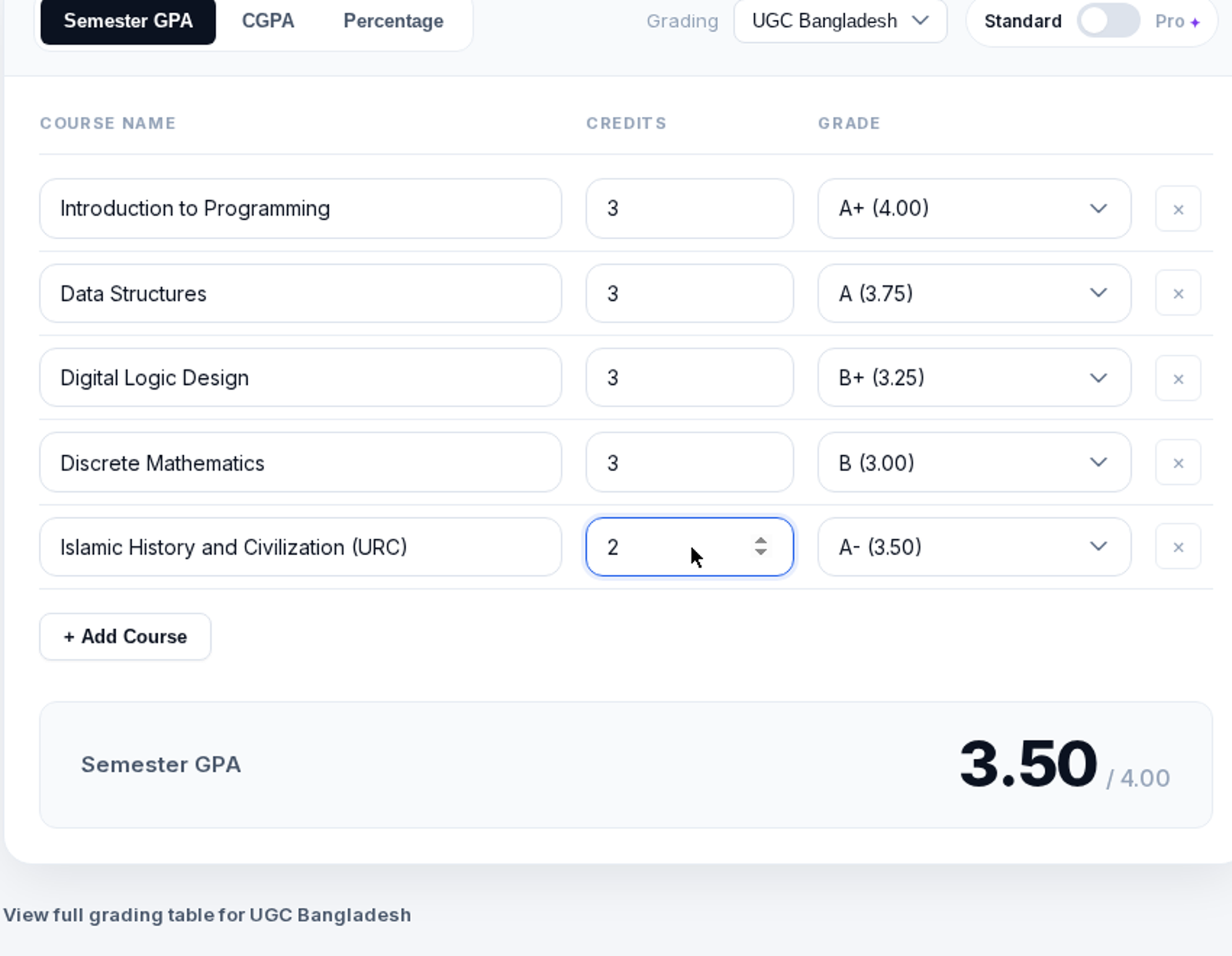
To use it: add one row per course, type the credit hours exactly as they appear on your registration (most IIUC theory courses are 3 credits, lab courses 1–2), pick your letter grade from the dropdown, and hit calculate. The result should match the GPA formula below — if it doesn’t, double-check that you entered credits, not marks, in the credit column. We’ll verify one full example together later in this guide.
The Official IIUC Grade Table (UGC Uniform Scale)
IIUC follows the uniform grading system introduced by the University Grants Commission of Bangladesh, which it has applied since the Autumn-2006 intake. Every department — EEE, CCE, Pharmacy, MBA, English, Economics and Banking — publishes the same table. Here it is:
| Marks (%) | Letter Grade | Grade Point | Remarks |
|---|---|---|---|
| 80 and above | A+ | 4.00 | Excellent |
| 75 to less than 80 | A | 3.75 | Very Good |
| 70 to less than 75 | A− | 3.50 | — |
| 65 to less than 70 | B+ | 3.25 | Good |
| 60 to less than 65 | B | 3.00 | — |
| 55 to less than 60 | B− | 2.75 | Satisfactory |
| 50 to less than 55 | C+ | 2.50 | — |
| 45 to less than 50 | C | 2.25 | Pass |
| 40 to less than 45 | D | 2.00 | — |
| Less than 40 | F | 0.00 | Fail |
A few things about this table that trip students up:
- The bands are strict. 79.8% is an A (3.75), not an A+ (4.00). Grades are not rounded up into the next band, so one mark can cost you a full quarter of a grade point.
- D is a pass. At 40–44% with 2.00 grade points, D clears the course — but remember it is still far below the 2.50 CGPA you need for your degree, so stacking D grades quietly builds a CGPA hole.
- Only F fails. Below 40%, you get F (0.00) and must clear the course later. The university also records an X grade for absence without permission, which counts the same as an F.
Your final marks are not decided by the final exam alone. IIUC computes your course grade from a composite of assignments, quizzes, class tests, case studies, and the mid-term examination, plus the semester-final exam. Students who treat the mid-term as “just practice” are the ones who end up surprised by a C where they expected a B+.
IIUC uses the same UGC 4.00 scale as most Bangladeshi universities, though a few private ones run their own scales — see our HEC vs UGC grading scales compared (Pakistan vs Bangladesh) for how the two countries’ systems differ.
How GPA Is Calculated at IIUC — Step by Step
IIUC defines GPA precisely: total grade points earned ÷ number of credit hours attempted in a given semester. Here’s the method:
- Convert each course’s marks to a letter grade using the table above (e.g. 73% → A−).
- Convert each letter grade to grade points (A− → 3.50).
- Multiply grade points by the course’s credit hours — this is your “quality points” for that course. A 3-credit A− course gives 3 × 3.50 = 10.50 quality points.
- Add all quality points across the semester’s courses.
- Add all credit hours across the semester’s courses.
- Divide total quality points by total credit hours. That number is your GPA, typically shown to two decimals.
If you want the general method explained with more practice problems, our SGPA formula guide walks through the same arithmetic in detail.
The Formula
In symbols, with Cᵢ as the credits of course i and Gᵢ as the grade points it earned:
GPA = Σ (Cᵢ × Gᵢ) / Σ Cᵢ
And for CGPA, the same idea across semesters — total quality points earned in all semesters so far, divided by all credit hours attempted so far:
CGPA = Total quality points (all semesters) / Total credit hours attempted (all semesters)
IIUC’s academic system notes that CGPA can equivalently be computed from semester GPAs weighted by semester credit hours — it gives the same answer, since both reduce to the same division.
Worked Example: Five Courses, Full Arithmetic
Take a realistic first-year semester at IIUC — four departmental courses plus one University Requirement Course (URC):
| Course | Credits | Marks | Grade | Points | Quality Points |
|---|---|---|---|---|---|
| Introduction to Programming | 3 | 84% | A+ | 4.00 | 3 × 4.00 = 12.00 |
| Data Structures | 3 | 76% | A | 3.75 | 3 × 3.75 = 11.25 |
| Digital Logic Design | 3 | 68% | B+ | 3.25 | 3 × 3.25 = 9.75 |
| Discrete Mathematics | 3 | 62% | B | 3.00 | 3 × 3.00 = 9.00 |
| Islamic History and Civilization (URC) | 2 | 71% | A− | 3.50 | 2 × 3.50 = 7.00 |
Now add them up:
- Total quality points = 12.00 + 11.25 + 9.75 + 9.00 + 7.00 = 49.00
- Total credit hours = 3 + 3 + 3 + 3 + 2 = 14
- GPA = 49.00 ÷ 14 = 3.50
Try the same five courses in the calculator above — you should get exactly 3.50. Notice how the 2-credit URC course pulls less weight than the 3-credit departmental courses: a high grade in a heavy course moves your GPA more than the same grade in a light one. That’s why protecting your 3-credit courses matters more than most students realize.
Extending It to CGPA
Say the next semester is weaker: 16 credits at a GPA of 3.25 gives 52.00 quality points. Add it to the semester above:
- Total quality points = 49.00 + 52.00 = 101.00
- Total credits = 14 + 16 = 30
- CGPA = 101.00 ÷ 30 = 3.37 (rounded to two decimals)
Your CGPA after two semesters is 3.37 — comfortably above the 2.50 degree floor, but already below the first semester’s 3.50. That downward pull is how CGPA inertia works: each new semester dilutes the last, which makes early high semesters valuable and late recoveries expensive.
GPA vs CGPA at IIUC: The Distinction That Actually Matters
At IIUC these two numbers are not interchangeable, because the university attaches a different rule to each:
- GPA describes one semester. The university requires you to score at least 2.00 GPA in every single semester (for students admitted Autumn-2017 onward). One bad semester below 2.00 is a warning; three in a row is dismissal.
- CGPA describes your whole degree. You need a final CGPA of 2.50 or higher to graduate (Autumn-2012 onward). You can scrape through semesters at 2.00 and still fail to graduate — that’s by design, not an accident.
Both rules come straight from the university: the grade table is published on IIUC’s official Academic System page, and the 2.00/2.50 minimums plus the dismissal clauses come from the Registrar’s 2019 general notice on grading, GPA/CGPA, and cancellation of admission.
Put simply: GPA keeps you enrolled this semester; CGPA hands you the degree. If you’re confused about the terminology itself, start with what CGPA actually means.
Academic Rules You Need to Know (Not Just the Table)
The grade table is only half the story. IIUC’s 2019 Registrar notice lays down rules that can end an academic career, and they’re worth reading closely:
- Minimum 2.00 GPA per semester (admitted Autumn-2017 onward) — every semester, no exceptions.
- Minimum 2.50 CGPA for the degree (admitted Autumn-2012 onward) — the final gate before graduation.
- Cancellation of admission (academic dismissal) happens if you: fail all courses in 3 consecutive semesters; score GPA below 2.00 in 3 consecutive semesters (Autumn-2017 onward); hold CGPA below 2.00 in 3 consecutive semesters (Spring-2017 and before); or fail the same course — with F, X, or Y — on your fourth attempt. That last rule means you get at most four chances at a single course.
- X = absent without permission. It counts as an F for GPA purposes, so missing an exam without authorization is as damaging as sitting it and failing.
- The maximum program duration for several programs is twelve semesters (six academic years) — so clearing backlogs slowly has a hard clock on it. Confirm the exact limit for your own department.
One caution: IIUC’s published notices don’t spell out exactly how a retaken course replaces or averages into your GPA, or whether passed courses can be improved by retaking. Those details live in your department’s program handbook — ask your academic adviser before planning a retake strategy. The general mechanics of how retakes move a CGPA are explained in our guide to retaking a course.
Read More: IIUM Grading System Malaysia 2026: GPA & CGPA Guide — not to be confused with IIUC: this is the other “International Islamic University,” in Malaysia, with its own grading rules.
IIUC Is Not IIUI or IIUM — A Quick Disambiguation
Search engines mix these up constantly, and so do students. They are four different institutions with four different grading systems:
- IIUC — International Islamic University Chittagong, Bangladesh (private). This article. UGC Bangladesh 4.00 scale.
- IIUI — International Islamic University Islamabad, Pakistan (public). Different country, different rules entirely.
- IIUM — International Islamic University Malaysia. Different grading bands (covered in our IIUM grading guide).
- CU (University of Chittagong) — the public university in Chittagong. Same UGC scale as IIUC, but a separate university with separate rules (see University of Chittagong grading guide).
Always double-check that the grading table you’re reading belongs to your university before you trust a calculator or a forum answer.
Common Mistakes IIUC Students Make
- Treating D as failure or F as nothing. D (40–44%) clears the course; F (<40%) does not. Students panic over a D they actually passed, and underestimate an F that now needs a full retake.
- Forgetting the 2.50 degree floor. Surviving every semester at 2.00 GPA doesn’t guarantee graduation — the CGPA floor is higher, and closing a gap from 2.3 to 2.5 in your final year takes far more marks than it looks like on paper.
- Ignoring mid-term weightage. Because grades are composite (assignments, quizzes, class tests, case studies, mid-term), a weak mid-term locks in a ceiling your final can’t always lift.
- Entering marks instead of credits in calculators. The calculator divides by credit hours — type “100” in the credit column by mistake and your GPA becomes nonsense.
- Using the wrong university’s scale. Generic online calculators often use the US 4.0 scale (A− = 3.67, B− = 2.67), which gives wrong answers for IIUC’s UGC bands. Always confirm the scale matches IIUC’s table above.
- Mixing up the 2.00 and 2.50 rules. 2.00 is per-semester survival; 2.50 is degree-level. Meeting one doesn’t guarantee the other.
Tips to Protect (and Raise) Your IIUC CGPA
- Guard your 3-credit courses. One B− in a 3-credit course hurts more than one B− in a 2-credit URC course. Allocate study time by credit weight, not just difficulty.
- Aim for band tops, not band middles. Since bands don’t round up, a 79 is as bad as a 75 and a 74 is nearly as bad as a 70. Know which band you’re sitting in before finals week and push the borderline courses first.
- Recover early, not late. CGPA inertia means a 3.5 in semester one is worth more than the same effort in semester seven. If your CGPA dipped, front-load the recovery.
- Never miss an exam without permission. An X grade scores exactly like an F — zero grade points — and burns one of your four attempts at the course.
- Plan retakes with your adviser. Because the retake-replacement mechanics aren’t public, get the written rule from your department before assuming a retake will erase the old grade.
- Keep a running spreadsheet. Track each semester’s quality points and credits yourself; it takes five minutes and removes all surprise at result time.
Keep a running spreadsheet. Track each semester’s quality points and credits yourself; it takes five minutes and removes all surprise at result time.
Frequently Asked Questions
Is a D grade a pass at IIUC?
Yes. D (40–44%, 2.00 grade points) is a passing grade and clears the course. But it contributes only 2.00 quality points per credit — dragging your CGPA toward the 2.50 degree floor instead of away from it. Too many D grades can keep you enrolled while leaving you ineligible to graduate.
What percentage do I need for A+ at IIUC?
80% and above. There is no rounding: 79.9% is an A (3.75), not an A+. If you’re sitting near 78–79 before the final exam, you know exactly how many marks you need to cross the line.
What happens if I fail a course (F) at IIUC?
The F earns zero grade points and you must clear the course. Officially, failing the same course (F, X, or Y) on the fourth attempt leads to cancellation of admission — so you effectively get up to four attempts. For exactly how a retake enters your GPA calculation, check your department’s program handbook, since the public notices don’t specify the replacement mechanics.
What’s the minimum CGPA to graduate from IIUC?
2.50 CGPA for students admitted Autumn-2012 onward. Separately, you must also score at least 2.00 GPA in every individual semester (admitted Autumn-2017 onward). The two rules are independent: a student can pass every semester and still fall short of the degree requirement.
Does the mid-term exam count toward my final grade at IIUC?
Yes. IIUC states that grades reflect assignments, quizzes, class tests, case studies, and the mid-term examination alongside the semester-final exam — not the final alone. Exact percentage splits vary by program, so ask your department if you want the precise breakdown.
Is IIUC the same as IIUI (Islamabad) or IIUM (Malaysia)?
No. IIUC is the International Islamic University Chittagong in Bangladesh. IIUI is a separate public university in Islamabad, Pakistan; IIUM is a separate university in Malaysia — each with its own grading system. Don’t apply another university’s grade table or CGPA rules to your IIUC transcript.
Final Words
IIUC’s grading system is simpler than it looks once you stop confusing the two numbers that matter: 2.00 keeps you enrolled each semester, 2.50 gets you the degree, and the UGC table tells you exactly how many marks buy each grade point. Learn the band edges, weight your effort by credit hours, treat the mid-term as seriously as the final, and keep one eye on your running CGPA from semester one — the students who do this are never surprised on result day. Run your courses through the calculator above, verify against the worked example, and you’ll know exactly where you stand.