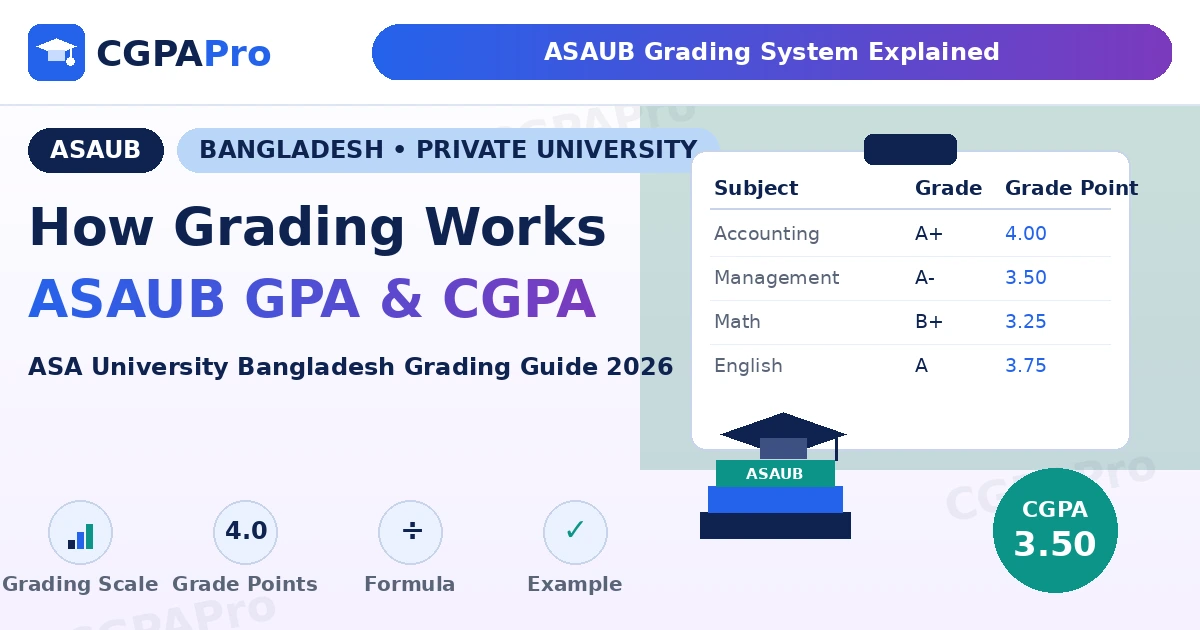
Quick answer: ASA University Bangladesh (ASAUB), Dhaka, uses the UGC uniform 4.00 grading scale — A+ (80%+) is 4.00, A (75–79%) is 3.75, down to D (40–44%) at 2.00, and F (below 40%) is 0.00. Your semester GPA is the credit-weighted average of your grade points. What makes ASAUB unusual is its retake policy: you may repeat any course you scored below a B in, and the higher grade fully replaces the old one in your CGPA. This guide gives you the verified official table, the worked math, and the rules the university’s own page states confusingly — checked against ASAUB’s Academic Rules and Regulations.
One clarification first, because it matters for search: “ASA University” also returns American institutions like Arkansas State University and Augusta University on Google. This article is about ASA University Bangladesh (ASAUB) — the private university in Shyamoli, Dhaka, founded by the NGO ASA (Association for Social Advancement). If you study at ASAUB in Dhaka, you’re in the right place.
Calculate Your ASAUB GPA in 30 Seconds
The fastest way to check your GPA is the free calculator on this site. It runs the exact UGC Bangladesh scale that ASAUB officially follows, so the numbers match the table below point for point:
- Open the CGPAPro GPA calculator.
- Add one row per course. Type the course name and credit hours, then pick the letter grade — not the marks. (Your ASAUB transcript shows letter grades only, no numerical marks, so this is exactly how the university sees your results.)
- Read your Semester GPA from the result. Add all your semesters’ courses the same way and it gives you the CGPA.
Here is a real example run, using the five courses from the worked example further down this page:
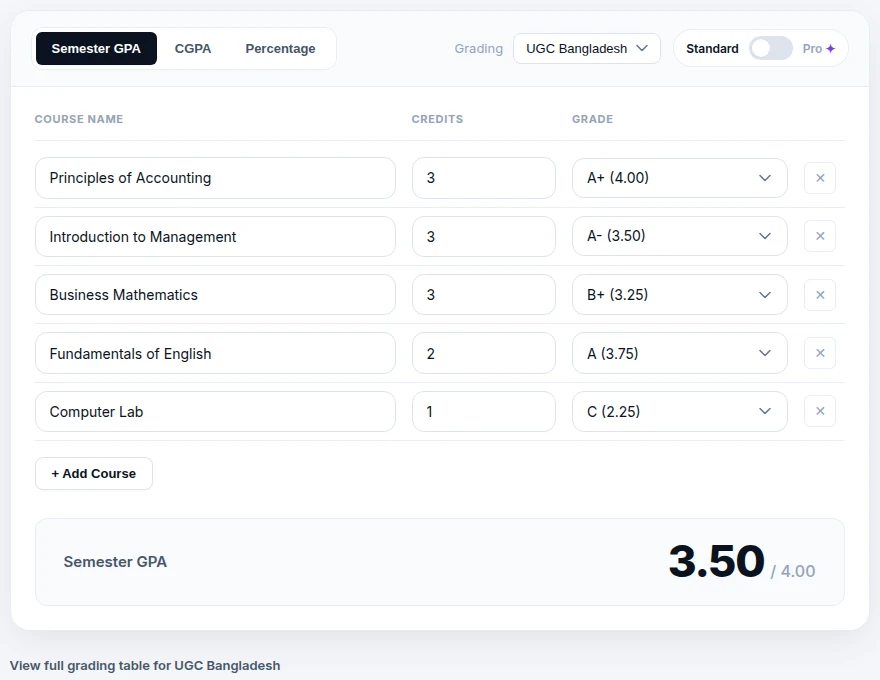
The calculator uses ASAUB’s official grade values, so this 3.50 is exactly what your ASAUB result sheet would show for these grades.
ASAUB Official Grade Table (Verified)
This table is taken directly from ASAUB’s Academic Rules and Regulations page, which states that the university follows “the letter grades and grade point system introduced by the UGC as a uniform grading system for public and private universities in Bangladesh.” The same table appears on ASAUB’s MA in English programme page, so it is consistent across departments.
| Marks (out of 100) | Letter grade | Grade point |
|---|---|---|
| 80% and above | A+ | 4.00 |
| 75% to less than 80% | A | 3.75 |
| 70% to less than 75% | A− | 3.50 |
| 65% to less than 70% | B+ | 3.25 |
| 60% to less than 65% | B | 3.00 |
| 55% to less than 60% | B− | 2.75 |
| 50% to less than 55% | C+ | 2.50 |
| 45% to less than 50% | C | 2.25 |
| 40% to less than 45% | D | 2.00 |
| Less than 40% | F | 0.00 |
Two things worth noticing. First, D — 40% — is the minimum passing grade. The university’s rules list A, B, C and D grades as passing; only F (below 40%) fails. Second, watch the bands: each one runs “to less than” the next boundary, so 79.5% is an A (75 to less than 80), and 80% is an A+. There are no gaps.
A note on Wikipedia’s ASAUB table
If you Google ASAUB’s grading system, the Wikipedia article on the university is one of the top results — and its grade table is wrong. It prints bands like “75% to less than 79%” and “70% to less than 74%”, which leave real gaps (where does 79.5% go? where does exactly 80% land?). The official ASAUB table above has full 5-point intervals with no gaps. If you ever copied the Wikipedia version, re-check your conversions against this one.
Grades that don’t touch your GPA
ASAUB also uses four non-graded marks, none of which enter the GPA calculation:
- I (Incomplete) — given when you miss the final exam with a valid reason; it converts to an F if you don’t clear it through a make-up exam within the deadline. (Missed the final without a valid reason? That’s a straight F.)
- W (Withdrawal) — for officially withdrawing from a course within the academic-calendar deadline.
- R (Retaken) — what your old grade becomes when you repeat a course and improve it. More on this in the retake section — it’s the most student-friendly part of ASAUB’s system.
- S (Satisfactory) — a marker for two-semester courses, not a GPA grade.
How ASAUB Computes GPA: The Formula
ASAUB runs on the North American trimester/credit-hour system (Spring, Summer and Fall semesters each year). Every course carries credit hours — typically 3 for a theory course, 1 for a lab — and one credit hour means at least 14 instruction hours over the semester.
GPA is the credit-weighted average of your grade points:
GPA = Σ (Grade point × Credit hours) ÷ Σ (Credit hours)
A quick honesty note: ASAUB’s rules page says the GPA “is computed in the following manner” but renders the formula as an embedded image that can’t be read as text. The credit-weighted formula above is the standard practice for this system — and it is exactly how the worked example below, and this site’s calculator, compute it. The university confirms the inputs: your transcript shows letter grades and grade points, and every course has credit hours.
Your CGPA is the same formula applied across all semesters: total grade points earned in every course you’ve taken, divided by total credit hours attempted. If you want the full conceptual breakdown, see How to Calculate SGPA: Formula & Examples 2026.
Worked Example: A Real ASAUB Semester, GPA 3.50
Let’s take a realistic first-semester BBA course load and run the numbers exactly the way ASAUB does. Watch the grade-point values — this is where most students slip up (B+ is 3.25, not 3.3; A− is 3.50, not 3.7).
| Course | Credits | Letter grade | Grade point | Points (credits × point) |
|---|---|---|---|---|
| Principles of Accounting | 3 | A+ | 4.00 | 3 × 4.00 = 12.00 |
| Introduction to Management | 3 | A− | 3.50 | 3 × 3.50 = 10.50 |
| Business Mathematics | 3 | B+ | 3.25 | 3 × 3.25 = 9.75 |
| Fundamentals of English | 2 | A | 3.75 | 2 × 3.75 = 7.50 |
| Computer Lab | 1 | C | 2.25 | 1 × 2.25 = 2.25 |
| Total | 12 | 42.00 |
GPA = 42.00 ÷ 12 = 3.50
Notice how the 1-credit Computer Lab with a C drags less than a 3-credit course would: it contributes only 2.25 of the 42.00 points. That’s the whole logic of credit weighting — and it’s why a single bad grade in a 3-credit core course hurts far more than the same grade in a 1-credit lab. If you run these exact five rows through the calculator screenshot above, you get 3.50, matching this hand calculation to the decimal.
Worked example 2: what a retake does to CGPA
Suppose in your next semester you take 12 more credits and earn 39.00 points (GPA 3.25). Your two-semester CGPA is (42.00 + 39.00) ÷ 24 = 3.375. Now suppose you retake that Computer Lab C and earn an A (4.00). Under ASAUB’s replacement rule (explained below), the C becomes an R and the A counts: your first semester recomputes to (42.00 − 2.25 + 4.00) = 43.75, and your CGPA becomes (43.75 + 39.00) ÷ 24 = 3.448. One repeated 1-credit lab lifted the CGPA by 0.07 — imagine what repeating a 3-credit C+ does.
ASAUB’s Retake Policy: The Most Generous Part of the System
This is the section most ASAUB students should bookmark, because the official page buries it in dense paragraphs — and most competing universities are stricter.
- You may repeat any course you passed with a grade below B — purely to improve the grade, on your coordinator/advisor’s advice. A C+, a C, even a B− qualifies.
- An F must be retaken within the next two semesters. (Remember: ASAUB runs three full semesters a year — Spring, Summer, Fall — so the clock runs faster than at two-semester universities.)
- The higher grade REPLACES the old one. This is the critical part: when you improve, the old lower grade is converted to an R (Retaken) on your transcript and only the higher grade counts toward CGPA. The grades are not averaged. Your transcript still shows both, but the R grade carries zero weight.
- No limit on retake attempts — but all retakes must finish within twice the normal duration of your program, and before you enroll in your internship, thesis, project or dissertation. No retakes after your final degree result is published.
- Repeat students pay full tuition fees for the repeated courses. Budget for it.
Strategic takeaway: if your CGPA is below where you want it, repeating a 3-credit C+ or B− you already understand is usually the highest-return move available — one course, familiar material, full replacement. Compare the general principles in How Retaking a Course Affects Your CGPA 2026.
Probation, Dismissal, and the 2.50 Line
ASAUB’s academic standing rules are stricter than its retake rules, and there’s an official contradiction you should know about.
- Probation: if your CGPA and/or semester GPA falls below 2.50, you’re placed on academic probation. You then get a maximum of three semesters to bring it back to 2.50 or above. Fail, and you’re dismissed.
- Dropout: failing to maintain the required 2.50 GPA for three consecutive semesters gets you dropped from the program (you may appeal for renewal of admission with strong evidence of changed circumstances).
- Re-admission after dismissal: possible only after three academic years, with documented evidence of improvement.
The contradiction: under “Degree requirements,” ASAUB’s own page lists both “passing of all required courses individually with minimum CGPA of 2.00” and “maintaining a CGPA of minimum 2.50 for both graduate and undergraduate programs.” These can’t both be the operative rule — and since 2.50 is the probation threshold cited everywhere else (the B.Pharm graduation page independently confirms a 163-credit degree with minimum CGPA 2.5), treat 2.50 as the real graduation line and confirm with your registrar if you’re near the boundary. A university page contradicting itself on the degree requirement is exactly the kind of thing a careful student should flag rather than assume away.
Attendance and How Your 100 Marks Are Split
Two rules that quietly decide a lot of grades:
- 75% attendance is mandatory. Fall below it and you’re barred from the final exam (you can appeal to the Controller of Examinations through your Dean with documents). Miss three consecutive classes without permission and you can’t attend the fourth without the Dean’s permission.
- Assessment split: continuous assessment — class tests, quizzes, presentations, assignments, attendance, viva — is 30%; the mid-term exam is 30%; the final exam is 40%. This split is confirmed on ASAUB’s MA in English page as well.
The practical reading: 60% of your grade is decided before the final exam. Students who treat the final as the whole course are playing a 40%-of-the-marks game. And with only 40% riding on the final, consistent coursework is the cheapest GPA insurance you have.
Small fees to know about: mid-term make-up exam registration is BDT 1,000 per course; final make-up is BDT 1,500 per course (within 7 working days of result publication); re-scrutiny of a final script is BDT 500 per script within the same window.
Degree Timeline: Don’t Let the Clock Run Out
You must complete your degree within twice the normal length of the program — a 4-year bachelor’s gives you 8 years from enrollment; a 2-year master’s gives you 4. Exceptions need Academic Council approval. Related tripwires: a semester drop (program withdrawal) is allowed only twice, and only after you’ve completed one semester; failing to register for three consecutive semesters counts as dropping out.
Common Mistakes ASAUB Students Make
- Using the broken Wikipedia table. Covered above — the misaligned “less than 79/74/69” bands have gaps. Use the official table in this article.
- Assuming retakes average the grades. At ASAUB they don’t — the higher grade replaces the old one (which becomes R). This single misunderstanding costs students retake opportunities they actually have.
- Trusting the “five letter grades” line. ASAUB’s rules page says students “may earn any of the five-letter grades” — then lists ten (A+ through D, plus F). It’s leftover text from before the UGC uniform scale; ignore the “five,” count the ten.
- Forgetting the transcript shows no marks. Your grade sheet lists letter grades, grade points and CGPA only. If you’re applying abroad and a form asks for “percentage,” you’ll need to convert — and converters vary, so say which scale you used. (For the common conversions, see How to Convert Percentage to CGPA 2026.)
- Ignoring the 60% before the final. With 30% continuous + 30% mid-term, the final is only 40%. Students who “start studying for finals” in week 12 have already forfeited most of the course.
- Confusing ASAUB with American “ASA” institutions. When researching scholarships or transfers, always write the full “ASA University Bangladesh, Dhaka” — “ASA University” alone will bury you in Arkansas and Augusta results.
Why Your CGPA Has Real Money Behind It
ASAUB’s tuition-fee waiver policy (published on the law faculty’s page) ties fee waivers to CGPA — the documented tiers sit in the 3.00–3.50 CGPA range for keeping a waiver. That’s the difference between paying full tuition and a reduced bill, semester after semester. Scholarship policies change, so check your faculty’s current waiver page — but the principle holds: at ASAUB, a 0.2 CGPA swing isn’t abstract, it’s cash.
Tips to Raise Your ASAUB CGPA
- Retake strategically, not emotionally. Rank your sub-B courses by (grade points recoverable × credit hours). A 3-credit C+ (2.50) repeated to a B+ (3.25) recovers 2.25 points — more than a 1-credit lab repeated from C to A (1.75 points).
- Bank the 30% continuous assessment. Quizzes, attendance and assignments are the most predictable marks in the 30/30/40 split. Treat them as guaranteed points, not optional extras.
- Protect the 75% attendance line. Being barred from a final turns a recoverable semester into an F and a forced retake within two semesters.
- Know your boundary marks. Because bands are 5 points wide, a 74.5% (A−, 3.50) vs 75% (A, 3.75) is a quarter-point swing on every credit of that course. If you’re near a boundary before the final, calculate exactly how many final-exam marks you need to cross it.
- Clear F grades on the two-semester clock. An F must be retaken within the next two semesters — and with three semesters a year at ASAUB, “two semesters” passes faster than you think.
FAQ: ASAUB Grading Questions Students Actually Ask
Does retaking a course at ASAUB average the old and new grades?
No — ASAUB replaces. When you repeat a course and score higher, the old grade is converted to R (Retaken) and only the higher grade counts in your CGPA. The transcript shows both grades, but the R carries no weight. This is confirmed in the university’s Academic Rules and Regulations.
Can I retake a course I already passed, just to improve my CGPA?
Yes, if your grade was below B — a B−, C+, C or D can all be repeated for improvement on your advisor’s advice. There is no cap on the number of retakes, but you must finish them within twice your program’s normal duration and before starting your internship/thesis. You pay full tuition for repeated courses.
What happens if my CGPA drops below 2.50?
You go on academic probation and get a maximum of three semesters to climb back to 2.50 or above. If you stay below 2.50 for three consecutive semesters, you’re dropped from the program. Treat 2.50 — not 2.00 — as your real floor, despite the contradictory line on the university’s degree-requirements list.
Why doesn’t my ASAUB transcript show my marks?
That’s official policy: ASAUB grade sheets show letter grades, grade points and CGPA only — no numerical marks. Keep your own record of marks from course teachers if you might need percentages later (for foreign applications, for example).
How many semesters do I get to finish my degree?
Twice the normal length of your program — 8 years for a 4-year bachelor’s, 4 years for a 2-year master’s, counted from enrollment. Note that ASAUB runs three semesters a year (Spring, Summer, Fall), so plan retakes against that faster clock.
Is a 3.50 CGPA good at ASAUB?
Yes — comfortably. It’s a full point above the 2.50 probation/graduation line, sits in the A− band, and lands in the range that keeps tuition-fee waivers alive (roughly 3.00–3.50 depending on faculty policy). For context on what CGPA bands mean generally, see Is 3.5 CGPA Good? 2026 Guide.
Where does ASAUB publish its official grading rules?
On the university’s own site: the Academic Rules and Regulations page carries the grade table and all the policies in this article, with the UGC uniform scale confirmed on the MA in English programme page. The B.Pharm graduation page independently confirms the 2.50 CGPA degree line.
Conclusion
ASAUB’s grading system is the standard UGC 4.00 scale with no surprises in the table itself — the surprises are all in the rules around it. The retake policy is genuinely generous (repeat anything below B, full grade replacement, no averaging), the probation line is a hard 2.50, and the university’s own page contradicts itself on the graduation requirement, so 2.50 is the number to live by. Run your numbers through the CGPAPro calculator before every semester’s registration: knowing exactly which course to retake, and what it’s worth in CGPA points, is the difference between hoping your grades improve and planning it.
For the bigger picture across the border, see HEC vs UGC Grading Scales: Pakistan vs Bangladesh 2026 — and if you’re comparing ASAUB with other Dhaka private universities, the University of Chittagong Grading System 2026 guide shows how a public university’s rules differ.