
Northern University Bangladesh Grading System 2026: GPA Guide
Quick answer: Northern University Bangladesh (NUB) uses the standard Bangladesh UGC uniform grading scale on a 4.00 system. Score 80% or above and you get an A+ (4.00); 75-79 is an A (3.75); the scale runs down through A-, B+, B, B-, C+, C and D (2.00) – and anything below 40% is an F (0.00). A D is a passing grade at NUB: earn a D or better and you are credited and promoted. This guide walks you through the official grade table, how your semester GPA and CGPA are actually computed, the retake and improvement rules, probation and dismissal triggers, and the real cost of failing a course – all verified against NUB’s own published documents.
Not the Northern University you were looking for? This article covers Northern University Bangladesh (NUB) – a private university in Dhaka, Bangladesh, whose official website is nub.ac.bd. It is not Northern University, Nowshera in Pakistan (northern.edu.pk), not National University Bangladesh (“NU”, nu.ac.bd), and not Northern State University in the USA. If your admission letter says nub.ac.bd, you are in the right place.
Domain note: you will see some older websites cite northern.edu.bd as NUB’s address. That domain does not resolve – every current official NUB document lives under nub.ac.bd (and department subdomains like textile.nub.ac.bd).
How to Calculate Your NUB GPA on the CGPAPro Calculator
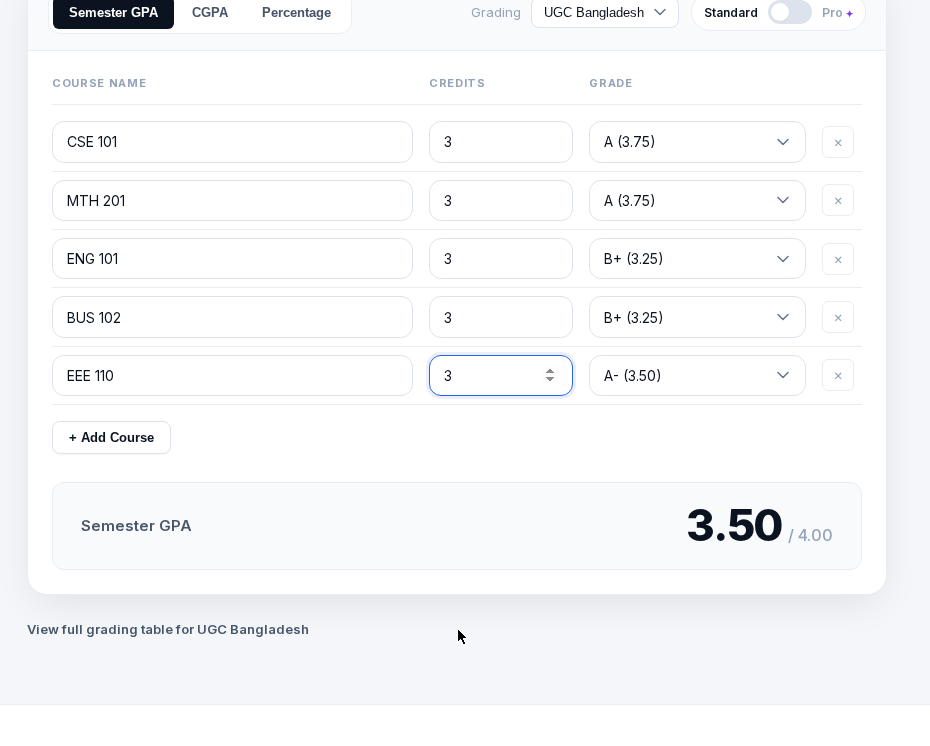
The fastest way to check where you stand is the free calculator on the CGPAPro homepage. It runs on the same UGC Bangladesh scale NUB uses, so the result matches what your department will compute:
- Open the CGPA/SGPA calculator on the CGPAPro homepage.
- Add one row per course. Type the course name (e.g. CSE 101), then <
Does NUB Use the UGC Grading Scale?
Yes – and this is stated explicitly, not inferred. The NUB De
Worked Example: A Real NUB Semester (GPA 3.50)
Take a first-year student who took five 3-credit courses in one semester:
Course Score Grade Grade Point Credits Quality Points CSE 101 76% A 3.75 3 3.75 x 3 = 11.25 MTH 201 78% A 3.75 3 3.75 x 3 = 11.25 ENG 101 67% B+ 3.25 3 3.25 x 3 = 9.75 BUS 102 66% B+ 3.25 3 3.25 x 3 = 9.75 EEE 110 72% A- 3.50 3 3.50 x 3 = 10.50 Totals 15 52.50 Semester GPA = 52.50 / 15 = 3.50. Notice how the two A grades (76% and 78%) did the heavy lifting – and notice how close this was: if that 67% in ENG 101 had been a 64%, the B+ would have become a B (3.00), quality points would drop to 51.75, and the GPA would land at 3.45. At NUB, three or four percentage points routinely decide a full 0.05-0.10 of GPA. That is why the continuous-assessment marks discussed above matter so much.
GPA vs SGPA vs CGPA at NUB
- Semester GPA (SGPA): the credit-weighted average for one semester, computed exactly as above.
- CGPA: the same calculation extended over all semesters completed so far – total quality points earned across every course, divided by total credits attempted. NUB’s academic rules frame standing, probation and graduation entirely in CGPA terms.
The terms get mixed up constantly: your “GPA” for Fall 2025 is one semester’s number; your CGPA is the running total. When NUB says you need a minimum CGPA of 2.00 to stay off probation, it means the cumulative figure – one bad semester at 1.80 does not automatically put you on probation if your cumulative is still above 2.00, but two or three of them will drag the cumulative under.
What Is the Passing Grade at NUB?
D (40-44%, 2.00) is a passing grade. NUB’s own documents are unambiguous: the English SA report labels D “D (Pass)”, and the Civil Engineering curriculum states that “if any student earns minimum ‘D’ grade in a course, s/he would be credited and promoted” – there is no “semester fail” status under the credit-hour system. Only F (below 40%, 0.00) fails a course.
But “passing” and “safe” are different things. Two thresholds matter:
- CGPA 2.00 – the minimum for acceptable academic standing university-wide. Fall below it and you are on probation.
- CGPA 2.25 – the minimum graduation requirement stated in the Civil Engineering curriculum (on the 4.00 scale). Whether 2.25 applies to every undergraduate program is not confirmed in the documents found – the university-wide floor is 2.00, so check your own department’s handbook for the graduation figure that applies to you.
A semester full of D grades keeps you promoted but parks your CGPA at 2.00 – exactly on the probation line, with zero margin. That is the trap: D passes the course but barely passes the degree.
Retake and Improvement Rules (Read This Before You Decide)
NUB’s retake policy is generous but tightly procedural. All of the following is verified from official NUB academic rules and the CE curriculum:
- F-grade retake is mandatory: a failed course must be repeated within the next 3 consecutive semesters, and prerequisite courses get priority.
- Improvement is allowed once per course – you get exactly one shot at improving any given course.
- Maximum 5 improvement courses in total (per the CE curriculum).
- The better grade stands: after a retake or improvement, the previous grade is marked ‘R’ (repeated) and excluded from GPA computation. Your old grade does not drag your CGPA down once replaced.
- Written permission is required from your Head of Department, with a copy to the Controller of Examinations, within 3 days of result publication. Miss the paperwork window and the retake does not count.
- Final-semester relief valve: if you get an F in your final semester, you may re-sit a maximum of 2 courses (exam on 100 marks, within 2 weeks of the next semester’s commencement) instead of waiting a whole semester.
The B vs A- discrepancy you need to know about: older official documents (the Textile department’s Academic Rules PDF, the Law department’s academic page, and the LLB Fall 2025 registration package) say improvement is allowed “only once if s/he earns up to ‘B’ grade” – meaning B, B-, C+, C and D can be improved, but B+ and above cannot. The newer Summer 2026 EEE registration package says improvement is allowed “only once if s/he earns up to ‘A-‘ grade” – a wider window that includes B+ and A-. No public source resolves which rule your batch follows. If you are sitting on a B+ or A- and wondering whether you can improve it, confirm with your department office before the 3-day permission window closes – this is the single most common unanswered question among NUB students, and no blog or university page currently settles it.
For comparison, other Dhaka private universities handle this differently – BUBT’s grading rules and Green University’s grading system each have their own improvement windows, so do not assume a friend’s university policy applies at NUB.
What Failing Actually Costs (Fees)
Retakes are not free, and the fee structure (from NUB’s 2024-2026 official documents – verify current figures with your accounts office, as these change by authority decision) is:
- First retake/improvement of a course: 70% of the regular tuition fee for that course – even if you hold a 100% tuition waiver, you still pay 70%.
- Repeating the same course again: full regular tuition fee.
- Special final exam: Tk. 1,000 per course (the Law department’s documents list Tk. 2,000 – departmental variance again).
- Final-semester special re-sit: Tk. 2,000 per course.
- Related fines: sitting the final with 50-70% attendance costs Tk. 1,000 per course; semester leave costs Tk. 1,000; late registration draws Tk. 500-1,000.
Put a number on it: fail two 3-credit courses and retake both, and you are paying 70% tuition twice plus the semester you lost. The cheapest retake is the one you never need.
Attendance: The 70% Rule
You need 70% attendance to sit the semester final. At 50-70% you may still sit, but only with your Dean/Head’s permission and a Tk. 1,000 fine per course. Below 50%, you are barred from the final – and with zero attendance you are barred from the mid-term too (unless the VC personally permits it). Since continuous assessment is 20-30% of your 100 marks, chronic absence hits you twice: once in the attendance column, once in the class-performance marks.
5 Common Mistakes NUB Students Make
- Assuming northern.edu.bd is the official site. It does not resolve. Academic rules, registration packages and fee structures all live under nub.ac.bd – bookmark the right domain before you trust any “official” PDF.
- Reading the grade table with the wrong boundaries. 79.5% is not an A – the bands are “to less than”, so 75% to less than 80% is A, and 79.9% is still A, but 80% is A+. One mark at a boundary is worth 0.25 grade points.
- Treating a D as “fine”. It passes the course but contributes 2.00 – exactly the probation line. Two semesters of D-heavy results and your CGPA is flirting with probation.
- Missing the 3-day improvement permission window. Results come out, you celebrate or sulk for a week, and then discover the Head-of-Department permission had to be filed within 3 days. Set a reminder for result day.
- Ignoring an X grade. An unauthorized absence feels less serious than an F, but it becomes an F automatically after two weeks of the next semester. Act on it immediately.
7 Practical Tips to Protect (or Rescue) Your NUB CGPA
- Front-load the semester. With 20-30% of marks decided before finals, treat every class test like a mini-final. A strong continuous-assessment score is the cheapest GPA insurance you can buy.
- Know your boundary courses. If you are sitting at 73-74% in a course, two extra marks buy you an A- (3.50) instead of a B+ (3.25) – a 0.25 swing per course. Prioritize revision where you are nearest a boundary.
- Use the improvement window deliberately. You get one improvement per course and five total – spend them on high-credit courses where a one-letter jump moves the needle most, not on 1-credit labs.
- Retake F courses on priority. The rules say prerequisite retakes come first, and the 3-consecutive-semester window is shorter than it feels. Delay compounds.
- Resolve the B+/A- question in writing. If you want to improve a B+ or A-, get your department’s answer on the “up to B” vs “up to A-” rule before the 3-day window – verbal assurances from seniors are not policy.
- Guard the 2.00 line like a cliff edge, not a finish line. Aim to keep every semester above 2.50; that buffer absorbs one bad course without pulling your cumulative under.
- Track it yourself. Departments publish results; they do not send you CGPA projections. Run your numbers through the CGPAPro calculator after every result – five minutes that prevents probation surprises.
Read More: Eastern University Grading System 2026 – another private university on the UGC scale, with a full worked CGPA example you can compare against your own.
Frequently Asked Questions
1. Is D a passing grade at Northern University Bangladesh?
Yes. D (40% to less than 45%, 2.00 grade points) is officially a pass – NUB’s documents state that earning a minimum D means you are credited and promoted. Only F (below 40%) fails a course. That said, a D contributes just 2.00 to your CGPA, which is exactly the probation threshold, so a D-heavy transcript is risky even though every course “passed”.
2. Can I improve a course where I got a B+ or A-?
Official NUB documents disagree, and this is genuinely unresolved in public sources. Older documents (Textile Academic Rules, Law department page, LLB Fall 2025 package) allow improvement only up to a B grade; the newer Summer 2026 EEE registration package allows it up to A-. Confirm with your department office – in writing, and before the 3-day post-result permission window closes.
3. If I retake a course, does my old grade still count in my CGPA?
No. The better grade is accepted and the previous one is marked ‘R’ (repeated), which is excluded from GPA computation. Only the improved grade affects your CGPA. Remember the limits: one improvement per course, maximum five improvement courses, all within three consecutive semesters.
4. What happens if I miss the final exam without permission?
You receive an X grade, not an F – but the X automatically converts to F if it is not replaced within two weeks of the next semester’s beginning. If you have a genuine medical or unavoidable reason, apply for a special final (I grade) within 7 days of the exam through your Head of Department with attested documents.
5. What CGPA do I need to graduate from NUB?
The Civil Engineering curriculum requires a minimum CGPA of 2.25 for graduation; the university-wide minimum for acceptable academic standing is CGPA 2.00 (below that = probation). Whether 2.25 applies to all programs is not confirmed in the documents located – check your department’s handbook for your program’s exact graduation figure.
6. How many chances do I get if I fail a course?
Effectively four attempts per course: the original plus retakes, with failed courses required to be repeated within the next three consecutive semesters. Failing the same course four times – or carrying F/X/Y grades into a fourth attempt – is a dismissal trigger. Retaking also costs 70% tuition the first time (even with a 100% waiver) and full tuition thereafter.
7. Is Northern University Bangladesh’s grading the same as National University (NU)?
No – and the names cause constant confusion. Northern University Bangladesh (NUB, nub.ac.bd) is a private university in Dhaka using the UGC uniform 4.00 scale described in this article. National University Bangladesh (“NU”, nu.ac.bd) is a separate, giant public affiliating university in Gazipur with its own system. Make sure any grading table you follow says NUB/nub.ac.bd, not NU.
Sources
- NUB Department of Civil Engineering curriculum, March 2024 (Grading System and Performance Evaluation; academic standing, retake, probation, dismissal) – NUB-published booklet.
- NUB Department of English Self-Assessment Report to the IQAC, December 2016 (Table 1.4: The grading system; evaluation split) – nub.ac.bd.
- NUB Academic Rules (Department of Textile Engineering official PDF) – textile.nub.ac.bd.
- NUB Registration Package Summer 2026 (EEE) – nub.ac.bd (improvement up to A-; dismissal rules; fees).
- NUB Registration Package LLB Fall 2025 – nub.ac.bd (academic rules; improvement up to B).
- Bangladesh UGC university listing for Northern University Bangladesh – ugc-universities.gov.bd/university-detail/110.
Policy note: where NUB’s own documents conflict (notably the improvement grade cap) or where a rule could not be verified (Y grade definition, university-wide graduation CGPA, Dean’s List criteria), this article says so explicitly rather than guessing. Academic rules are revised by semester – always confirm time-sensitive details (fees, permission windows, improvement eligibility) against your current program handbook or department office.
The Bottom Line
Northern University Bangladesh runs a clean, well-documented version of the national UGC scale: 80%+ is an A+, 40%+ passes, and everything is credit-weighted on 4.00. The scale itself is the easy part. What actually decides NUB transcripts is the machinery around it – the 20-30% of marks locked in before finals, the once-per-course improvement window with its unresolved B-vs-A- cap, the 3-day permission paperwork, the X-grade two-week clock, and the four-attempt limit per course. Students who learn those five mechanics in their first semester rarely need this guide again; students who discover them in their final semester usually wish they had found it sooner.
Special Grades: X, I, R (and Y)
Beyond A+-F, NUB uses four special grades. Three are clearly defined:
- X – absent without permission. Recorded when you miss an exam without approval. It is not immediately an F – but if it is not replaced within two weeks of the next semester’s beginning, it automatically converts to F. An unauthorized absence is therefore a two-week ticking clock, not a free pass.
- I – Incomplete. Given when a special final exam is approved on medical or unavoidable grounds. The special final must be held within 2 weeks of the next semester’s commencement; fail to appear and it becomes an F. To even qualify, you must apply to the Controller of Examinations within 7 days of the exam, through your Head, with attested documents.
- R – Repeated. The marker placed on your old grade after a retake/improvement. It is excluded from GPA computation – only the better grade counts.
- Y – undefined in the documents found. It appears in the dismissal rules (“F, X, Y grades in fourth attempts”) but no located NUB document defines what Y means. Do not guess – check your program handbook.
Probation and Dismissal: The Lines You Cannot Cross
- Probation: “All students are required to maintain a minimum CGPA of 2.00 to remain on acceptable academic standing.” A CGPA below 2.00 puts you on probation status.
- Dismissal after 3 consecutive semesters: a student on probation for 3 consecutive semesters below 2.00, with no hope of improvement in the authority’s judgment, may be dismissed. (For the Department of Pharmacy and other bi-semester departments, the window is 2 semesters.)
- Dismissal after 4 failed attempts: failing the same course four times is a dismissal trigger, as are F/X/Y grades on fourth attempts.
- Admission secured with fake information, or breaching university regulations, can also end studentship.
The practical math: you get four attempts maximum per course (the original plus three retakes, within the 3-consecutive-semester window). Plan retakes early – a course failed in semester 2 and ignored until semester 6 is outside the window and becomes a much bigger problem.
partment of Civil Engineering curriculum (published by NUB, March 2024) says: “The university adopts UGC grading system which is given below,” followed by the full table. An independent official document – the Department of English Self-Assessment Report submitted to NUB’s own IQAC (December 2016) – carries the identical table. Two official sources, ten years apart, same scale. That is about as confirmed as a grading policy gets.
One thing worth knowing: NUB’s scale is the uniform national one, but it is tougher than some private universities’ in-house scales. At NUB, 80% is already an A+ (4.00); at North South University, for example, you need 93%+ for an A. A 76% at NUB is an A (3.75) – the same 76% at several other private universities would be a B+ or lower. If you transferred from another university, recalibrate your expectations before you panic over a “low” percentage that is actually a strong grade.
The Official NUB Grade Table (2026)
This is the table as printed in NUB’s official documents. Two wordings of the bands exist – the English department document writes them as “75% to less than 80%” while the Civil Engineering curriculum prints “75-79”. The “to less than” wording is the precise one (there are no fractional marks at boundaries), so it is used below:
Numerical Score Letter Grade Grade Point Assessment 80% and above A+ 4.00 Exceptional 75% to less than 80% A 3.75 Excellent 70% to less than 75% A- 3.50 Very Good 65% to less than 70% B+ 3.25 Good 60% to less than 65% B 3.00 – 55% to less than 60% B- 2.75 Satisfactory 50% to less than 55% C+ 2.50 – 45% to less than 50% C 2.25 Pass 40% to less than 45% D 2.00 Pass Less than 40% F 0.00 Fail A real-student cross-check backs this up: an NUB BBA student’s overall result sheet (uploaded 2024) maps grades to exactly these points – A+ 4.00, A 3.75, A- 3.50, B+ 3.25, B 3.00, B- 2.75, C+ 2.50, C 2.25 – with a computed CGPA of 3.143. The numbers line up with the official table, course after course.
How Your 100 Marks Are Built (and Why It Differs by Department)
Before the grade table even applies, your course teacher has to turn your semester’s work into a single number out of 100 – and here NUB’s documents show real departmental variation, so check your own course outline:
- Civil Engineering (March 2024 curriculum): continuous assessment 20 marks (class tests, assignments, quizzes, case studies, class participation) + mid-term 30 + final 50 = 100.
- English department (2016 SA report): class attendance 5% + class performance 5% + class tests/quizzes 10% + assignments/presentations 10% + mid-term 30% + final 40% = 100%.
The practical takeaway: at NUB, the final exam is never the whole story – 30 to 50 percent of your grade is decided before finals week. Students who treat the mid-term and class tests as throwaway routinely end up a full letter grade below where their final-exam performance alone would have put them. A 70% final cannot rescue a semester where you scored near zero on the 30% continuous component.
Read More: IIUC Grading System 2026 – how another UGC-scale private university splits its 100 marks, and where the grading traps differ.
Step-by-Step: How NUB Computes Your Semester GPA
NUB runs on a credit-hour system (1 credit hour = 14 class-hours per semester, so a 3-credit course means 42 class-hours), and you register for 12-18 credits per semester under NUB’s academic rules. Your GPA is credit-weighted: a 3-credit course counts three times as much as a 1-credit lab. Here is the exact procedure:
- Convert each course’s percentage to a letter grade using the official table above (e.g. 77% → A, 68% → B+).
- Look up the grade point for each letter (A = 3.75, B+ = 3.25, and so on).
- Multiply each grade point by that course’s credit hours. This gives the course’s “quality points”.
- Add up all quality points, and separately add up all credit hours.
- Divide total quality points by total credit hours. That is your semester GPA.
The GPA Formula
NUB’s documents do not print the formula verbatim, but the credit-weighted method below is the standard practice across UGC-system private universities, and it is arithmetically consistent with real NUB result sheets:
Semester GPA = Sum (Grade Point x Credit Hours) / Sum (Credit Hours)
In words: multiply every course’s grade point by its credits, add those products, then divide by the total credits you took that semester.
strong>type the credit hours by hand into each credit field – the fields show a default “3” on screen, but the real value stays 0 until you type it.
- Pick your letter grade from the dropdown by matching the letter, not the number – selecting by value alone can grab the wrong grade (e.g. a value-match for 4.00 selects “A+ (4.00)” when you wanted “A (4.00)”).
- The calculator multiplies each grade point by its credits, totals everything, and divides – that is your semester GPA.
Read More: Stamford University Grading System 2026 – another Dhaka private university on the same UGC scale, with its own retake and probation rules explained.