Stamford University Grading System 2026: GPA & CGPA Guide
If you study at Stamford University Bangladesh and want to know exactly how your grades turn into a GPA — and what it takes to keep that GPA above the line that matters — this guide walks you through the whole thing using the university’s own published rules.
Quick answer: Stamford University Bangladesh uses the UGC-standard 4.00 grading scale: A+ (80%+) = 4.0, A = 3.75, A− = 3.50, B+ = 3.25, B = 3.0, B− = 2.75, C+ = 2.50, C = 2.25, D = 2.0, F = 0. Your semester GPA is the credit-weighted average of your grade points. You pass an individual course with a D (2.00), but you need a minimum CGPA of 2.50 to graduate — and a GPA below 2.50 puts you on academic probation for one semester.
Two numbers confuse Stamford students more than anything else: the 2.00 you need to pass a course and the 2.50 you need to get your degree. They are not the same thing, and mixing them up is the single most common grading mistake at this university. This article clears it up, shows you the official grade table straight from Stamford’s evaluation procedures, works through a complete semester example with real numbers, and covers retakes, probation, and the quirky rules most students never read — like the fact that an F doesn’t even appear in your GPA math (but still costs you).
How to Calculate Your SGPA on the CGPAPro Calculator
The fastest way to get your Stamford semester GPA right is to plug your courses into the free calculator on cgpacalculatorpro.com. It runs on the exact UGC Bangladesh scale Stamford uses, so the number you get will match the one on your official transcript.
Here’s the drill:
- Open the homepage calculator — it’s the CGPA/SGPA calculator on the main page, no sign-up needed.
- Add one row per course. For each course, type the course name (e.g. CSE 101), pick the letter grade exactly as it appears on your result (A+, A, A−, B+, B, B−, C+, C, D, F), and type the credit hours for that course. At Stamford most courses are 3.0 credits; lab and some special courses are 1.5 or other values — copy the number from your registration sheet, don’t guess.
- Enter grades by letter, not by marks. If you scored 76% in a course, that’s an A (3.75) on Stamford’s table — don’t enter 76 anywhere. The calculator converts letters to points automatically.
- Double-check the credit column. The number-one source of wrong results is a wrong credit value. A 3-credit course affects your GPA twice as much as a 1.5-credit course.
- Hit calculate. The tool multiplies each grade point by its credits, adds them up, and divides by total credits — exactly Stamford’s formula (more on it below).
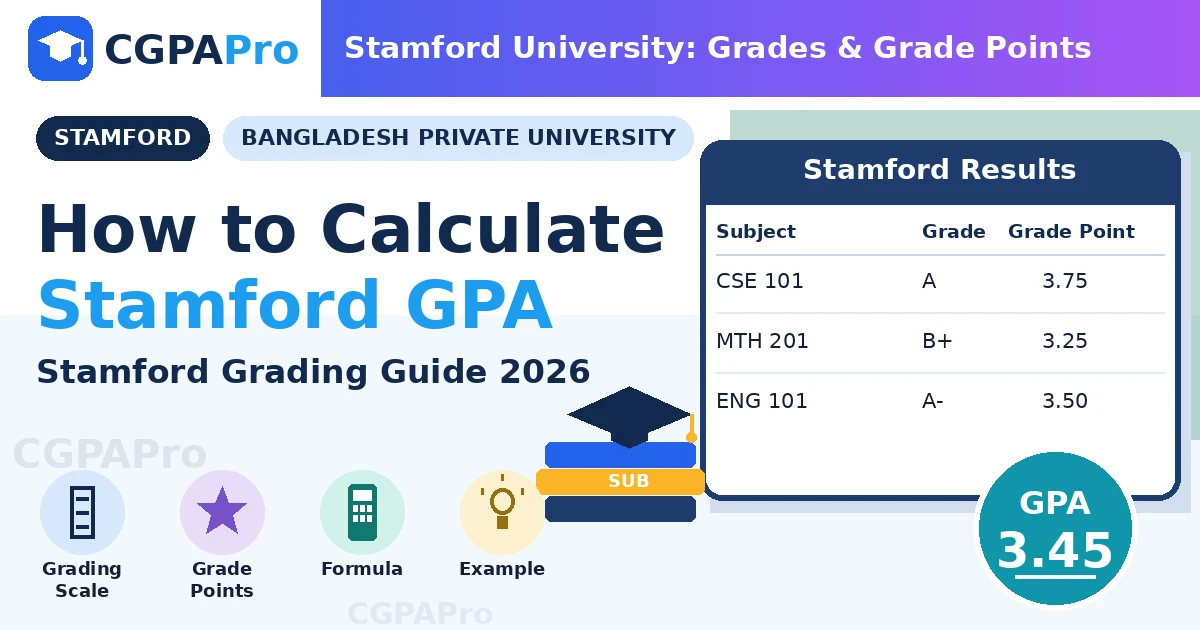
If you want to see how that math works by hand — and understand why one bad grade in a 3-credit course hurts more than you’d think — keep reading. The worked example below uses the same numbers you’ll see in the screenshot.

Read More: How to Calculate SGPA: Formula & Examples (2026) — the general step-by-step method that applies to every UGC-scale university.
The Official Stamford Grade Table (UGC Bangladesh Scale)
Stamford University Bangladesh publishes its grading policy on its official website under “Evaluation Procedures,” and it follows the standard University Grants Commission (UGC) 4.00 scale used across Bangladesh’s private universities. Every mark you earn in a course lands in one of these bands:
| Marks Range | Letter Grade | Grade Point |
|---|---|---|
| 80% and above | A+ | 4.00 |
| 75% to less than 80% | A | 3.75 |
| 70% to less than 75% | A− | 3.50 |
| 65% to less than 70% | B+ | 3.25 |
| 60% to less than 65% | B | 3.00 |
| 55% to less than 60% | B− | 2.75 |
| 50% to less than 55% | C+ | 2.50 |
| 45% to less than 50% | C | 2.25 |
| 40% to less than 45% | D | 2.00 |
| Less than 40% | F | 0.00 |
| — | I | Incomplete |
A few things worth noticing that students regularly miss:
- D is a pass. Letters A+ through D are passing grades at Stamford; only F fails. A D gives you 2.00 grade points and counts as earned credit.
- The band edges matter. There is no rounding up at Stamford’s published boundaries. 74.6% is an A− (3.50), not an A. 79.9% is an A (3.75), not an A+. That one stray mark is the difference between 3.50 and 3.75 — which, multiplied across 3 credits, can swing a semester GPA noticeably.
- I means Incomplete. It is not a grade and carries no points. It is typically issued in exceptional cases (documented illness, work travel) where course requirements were otherwise completed.
How Your Course Marks Are Actually Split at Stamford
Many students walk into the final exam believing it’s worth nearly everything. At Stamford, the final is only 40% of your course total. The official mark allotment, which applies to all programs, is:
- Class performance / participation (attendance): 5%
- Assignment, class tests, presentation, quizzes, continuous assessment: 25%
- Mid-term examination: 30%
- Final examination: 40%
That means 60% of every course is decided before you ever sit the final. Two details buried in the official procedures are worth your attention:
- Only your best class tests count. For a 3-credit course, the teacher must conduct at least four class tests and the best two are taken. For a 2-credit course, at least three tests with the best two counting. So one disastrous test doesn’t have to sink your continuous-assessment slice — but it does mean you should take every test, since the worst ones get discarded anyway.
- After the midterm, the first half of the course is done. Once the mid-term examination is over, that portion of the course is considered complete and is not carried into the semester final exam. Your finals test only the second half.
- Attendance carries real marks. Stamford’s attendance-marks table converts your attendance percentage directly into marks (out of 10): 90–100% gets 10, 85–89% gets 9, 80–84% gets 8, 75–79% gets 7, 70–74% gets 6, 65–69% gets 5, 60–64% gets 4, 55–59% gets 3, 50–54% gets 2, 45–49% gets 1, and below 45% gets 0. With margins as tight as they are between grades, a couple of free attendance marks can genuinely be the difference between a B+ and an A−.
The Formula Stamford Uses for GPA and CGPA
Stamford’s official evaluation page gives the GPA/CGPA formula directly. It is the standard credit-weighted average: multiply each course’s grade point by its credit hours, add those products together, and divide by the total credit hours.
In symbols:
GPA = Σ (Grade Point × Credit Hours) ÷ Σ (Credit Hours)
The university even publishes a worked example: a student gets 4.0 in a 3-credit course and 3.0 in a 1.5-credit course. The math goes:
(3 × 4.0 + 1.5 × 3.0) ÷ (3 + 1.5) = 16.5 ÷ 4.5 = 3.67
Notice the heavier course pulls more weight. The 3-credit course at 4.0 dominates the 1.5-credit course at 3.0, which is why the answer (3.67) sits much closer to 4.0 than to 3.0. This is the whole reason credit hours matter — and why you should never just average your grade points without them.
Worked Example: A Full Stamford Semester, Step by Step
Let’s run a realistic semester — five 3-credit courses, a mix of grades a typical Stamford undergraduate might earn — and compute the GPA exactly the way the university does.
Meet Rafi, a second-year BBA student. His Spring semester results:
| Course | Credits | Letter Grade | Grade Point | Points Earned |
|---|---|---|---|---|
| CSE 101 — Programming Fundamentals | 3.0 | A | 3.75 | 3.0 × 3.75 = 11.25 |
| ENG 101 — English Composition | 3.0 | B+ | 3.25 | 3.0 × 3.25 = 9.75 |
| MTH 201 — Calculus | 3.0 | A− | 3.50 | 3.0 × 3.50 = 10.50 |
| STA 202 — Statistics | 3.0 | A | 3.75 | 3.0 × 3.75 = 11.25 |
| ACC 101 — Principles of Accounting | 3.0 | B | 3.00 | 3.0 × 3.00 = 9.00 |
Step 1 — total the grade points earned:
11.25 + 9.75 + 10.50 + 11.25 + 9.00 = 51.75
Step 2 — total the credit hours:
3.0 + 3.0 + 3.0 + 3.0 + 3.0 = 15.0
Step 3 — divide:
51.75 ÷ 15.0 = 3.45
Rafi’s semester GPA is 3.45. That is a solid result — comfortably above the 2.50 probation line and within reach of the 3.50+ range universities and scholarship boards treat as first-class territory. This is the exact number you can reproduce in the calculator screenshot at the top of this article: same five courses, same letters, same credits.
GPA vs CGPA at Stamford — and Why Students Mix Them Up
Both terms appear on Stamford’s official pages, and the university itself defines them in plain language: GPA is the average of grade points for the courses completed in one semester; CGPA is the cumulative version — the same formula applied across every course you’ve completed so far, from your first semester to the current one.
Here’s the CGPA version of Rafi’s story. Suppose his first semester (15 credits) gave him the 3.45 above, and his second semester (16 credits) gave him a 3.20. His CGPA is not the average of 3.45 and 3.20. It’s credit-weighted across everything:
(15 × 3.45 + 16 × 3.20) ÷ (15 + 16) = (51.75 + 51.20) ÷ 31 = 102.95 ÷ 31 = 3.32
The practical takeaway: early semesters carry enormous weight because there are so few credits underneath them. A rough first semester is hard to erase later — your CGPA becomes more “anchored” with every completed semester. If you’re a fresher reading this in your first year, this is the single most valuable thing to understand about the whole system.
Read More: CGPA vs GPA vs SGPA: What’s the Difference? — a deeper breakdown of when each number matters (transcripts, scholarships, jobs).
What Happens When You Fail a Course at Stamford
Stamford’s rules on failure are unusually specific, and one of them surprises almost everyone:
- A course with grade D or higher counts as earned credit. You bank those credits toward your degree.
- A course with grade F earns zero credits and must be repeated.
- The F is not counted in the GPA calculation at all. This is the surprising part: unlike many universities where an F sits in the denominator dragging your average down, Stamford’s official policy states the F grade is excluded from GPA math. The course simply doesn’t contribute — but you also don’t get the credits, so you’re short until you retake and pass it.
Watch what that does to the numbers. Say a student takes four 3-credit courses and earns A (3.75), B+ (3.25), C (2.25), and F:
Grade points earned = (3.0 × 3.75) + (3.0 × 3.25) + (3.0 × 2.25) = 11.25 + 9.75 + 6.75 = 27.75
Credits counted = 3 + 3 + 3 = 9 (the failed 3 credits are excluded)
Semester GPA = 27.75 ÷ 9 = 3.08
The GPA looks okay on paper — 3.08 — but the student is still 3 credits behind and must repeat the failed course. Don’t mistake the F-exclusion for harmlessness: it protects your average, not your progress.
Retaking a Course: The Rules at Stamford
What the university says officially depends on the program page, so here is exactly what is published and what isn’t:
- Failed courses must be repeated. That’s explicit in the evaluation procedures: an F earns no credit, “in that case he/she will have to repeat the course.”
- Retake timing: Stamford’s BBA program page states that a student who fails a course gets the opportunity to improve the grade by retaking it in the subsequent semester/trimester, alongside other students. So you generally pick the course back up next term rather than waiting a year.
- Retaking to improve a passed grade: whether you can retake a course you passed but scored low in (say, a C) to raise the grade is not specified on Stamford’s public pages. Policies differ by department and program. If that’s your situation, check your program’s student handbook or ask your academic advisor before re-registering — don’t assume the university will automatically replace the old grade.
Read More: How Retaking a Course Affects Your CGPA (2026) — how grade replacement math works across Bangladesh’s private universities.
The 2.00 vs 2.50 Confusion — Read This Carefully
This is the question Stamford students ask most, and the official pages answer it in one breath — which is exactly why it’s confusing:
- 2.00 (a D) is the passing grade point in an individual course. Score 40% or above, and you earn the credits for that course.
- 2.50 is the minimum CGPA required to graduate. You can pass every single course with D’s and still not qualify for your degree.
Think of it as two gates in a row: first you must pass each course (gate one: 2.00), then your cumulative average across everything must clear 2.50 (gate two). A semester full of C’s and D’s gets you through the first gate and leaves you short of the second. That’s also why the probation rule kicks in at 2.50, not 2.00.
Academic Probation at Stamford: The Hard Rule
Stamford’s probation policy is short, blunt, and worth reading in full:
- If your GPA falls below 2.50, you are placed on academic probation.
- Probation lasts one semester only.
- If you don’t improve your grades within that semester, you will have to leave the university.
There is no second probation semester, no appeal window described in the published rules. One term to recover, or you’re out. If you land on probation, treat that semester as an emergency: cut non-essential commitments, protect attendance marks, and use every class test to bank continuous-assessment points — because with 60% of each course decided before finals, the recovery has to start in week one, not week twelve.
5 Mistakes That Tank a Stamford GPA
After looking at how Stamford’s system actually weights things, the classic self-sabotage patterns become obvious:
- Treating the final as 100%. It’s 40%. Students who coast until finals week are really competing for only 40% of each course — the other 60% (attendance, tests, mid-term) is already gone.
- Skipping class tests. The best-two rule means your worst tests are discarded — but only if you actually take them. Every test you skip is a free score you threw away.
- Ignoring attendance. Up to 10 free marks per course just for showing up. With grade boundaries this tight, 2–3 attendance marks can flip a letter.
- Averaging letter grades instead of credit-weighting. A B in a 3-credit course and an A in a 1.5-credit course do not average to an A−. Always multiply by credits first.
- Thinking a D means you’re safe. A D passes the course but scores only 2.00 — below the 2.50 graduation line. Stack up D’s and you graduate with nothing; you simply won’t graduate.
7 Practical Ways to Lift Your Stamford GPA
- Bank the attendance marks first. Easiest marks in the university. Show up, collect the 8–10 attendance marks, and you’ve already nudged every course a little higher.
- Take every class test, even ones you’re not ready for. The best-two rule discards your disasters. There is zero downside to sitting a test unprepared — but a skipped test can’t be your best two.
- Guard the 70% and 75% lines. Those are the A−/B+ and A/A− borders. If you’re sitting at 72% mid-semester, that’s your most valuable battleground: a 3-point swing changes your grade point from 3.50 to 3.75.
- Prioritise high-credit courses. When exam season squeezes you, put the extra hours into 3-credit courses before 1.5-credit ones. The weighted formula rewards exactly that.
- Don’t let the second half surprise you. The final only covers post-midterm material — which means it also assumes you can still use everything from the first half. Review fundamentals during finals prep.
- Take ORE 101 seriously. Stamford’s mandatory three-part orientation requires a minimum grade of 3.0 in each part, and it’s a degree prerequisite. Students who treat it as a formality can get an unpleasant surprise at the end.
- Run what-if numbers before you commit. Before each semester, plug your target grades into the CGPAPro calculator and see what your CGPA becomes under different scenarios. Knowing “I need two A’s and nothing below a B+ to hit 3.40” turns vague ambition into a concrete plan. For more recovery strategies, see how to improve your CGPA.
Frequently Asked Questions
What is the passing grade at Stamford University Bangladesh?
D (2.00 grade points, 40% and above) is the passing grade for an individual course — D and every grade above it count as earned credit. However, you need a minimum CGPA of 2.50 overall to graduate, so a D keeps you enrolled but doesn’t by itself keep you degree-eligible.
How do I calculate my CGPA at Stamford?
Multiply each course’s grade point by its credit hours, add up all the products, and divide by the total credit hours: GPA/CGPA = Σ (Grade Point × Credit Hours) ÷ Σ (Credit Hours). Note that failed (F) courses are excluded from the calculation entirely. The easiest way is the free calculator on cgpacalculatorpro.com, which uses the exact UGC scale.
Does an F count toward my GPA at Stamford?
No — Stamford’s official policy excludes the F grade from GPA calculation. But don’t mistake that for harmless: you earn zero credits for the failed course and must repeat it, so it delays your degree progress.
What happens if my CGPA drops below 2.50?
You go on academic probation for exactly one semester. If you don’t raise your grades within that semester, the university’s published rule is that you will have to leave. There is no second probation term.
Can I retake a course I failed?
Yes — and you must, since no credit is earned for an F. Per the university’s program pages, you get the chance to retake the course in the subsequent semester along with other students. Whether you can also retake a passed course to improve the grade is not publicly specified; check your program handbook or ask your advisor.
Is 3.5 CGPA good at Stamford University?
Yes — a 3.5+ CGPA places you well above the 2.50 graduation floor and is generally treated as first-class standing in Bangladesh. It keeps every door open: graduation, most scholarships, and postgraduate applications. See is 2.5 CGPA good? for how CGPA levels map to jobs and scholarships.
How does Stamford’s grading compare to other Bangladeshi private universities?
It follows the same UGC 4.00 scale most private universities use (A+ 4.00 down to D 2.00). Where Stamford is distinctive is the 2.50 graduation floor and the strict one-semester probation rule, plus the F-exclusion from GPA math. See HEC vs UGC grading scales for the regional comparison.
Conclusion
Stamford’s grading system rewards students who read the fine print: the 60% of marks decided before finals, the best-two class tests, the attendance marks that quietly add up, the 2.50 line that matters more than any single course grade, and the F rule that forgives your average but not your credit count. Run your own numbers through the CGPAPro calculator, compare them against the worked example in this guide, and if anything on your transcript looks off, talk to your advisor — the official evaluation procedures are public, and now you know what they actually mean.
Sources: Stamford University Bangladesh — Evaluation Procedures; Stamford University Bangladesh — Academic Information & Degree Requirements; BBA program page — graduation & retake policy.