If you’re studying at American International University-Bangladesh, your CGPA runs on a grading system with a quirk most students discover too late: there are two versions of it, and half the internet — including Wikipedia — still shows the old one. Get the version wrong and every CGPA you calculate for yourself is wrong too. This guide lays out the official, current AIUB grading system for 2026, with the real grade table, the GPA and CGPA formulas, full worked examples, and the retake and probation rules that actually decide your academic standing.
The AIUB Grading System in 30 Seconds
- AIUB currently uses Grading System V3 — it applies to every student enrolled from Spring 2016-2017 onward, which is effectively everyone studying today.
- V3 has no minus grades: A+ (90–100) = 4.00, A (85–89.99) = 3.75, B+ (80–84.99) = 3.50, B (75–79.99) = 3.25, C+ (70–74.99) = 3.00, C (65–69.99) = 2.75, D+ (60–64.99) = 2.50, D (50–59.99) = 2.25, F (below 50) = 0.00.
- Minimum CGPA to graduate: 2.50. Fall below it and you’re on probation — a stricter bar than BRACU, NSU or IUB, which all graduate students at 2.00.
- Fail a course and retake it: your first four retaken Fs are forgiven (the F becomes non-credited). From the fifth retaken course onward, both the F and the new grade count in your CGPA.
- I, W and UW grades carry no grade points and don’t enter the CGPA — but an I or UW left alone converts to an F.
How to Calculate Your AIUB CGPA Online (Fastest Way)
Doing this by hand once is good practice; doing it every semester is a waste of an evening. The fastest route is CGPAPro’s free CGPA calculator: add each course, enter its credit hours, pick the letter grade you earned, and it multiplies grade points × credits, sums everything, and divides by total credits — instantly, with your semester GPA and updated cumulative CGPA side by side.
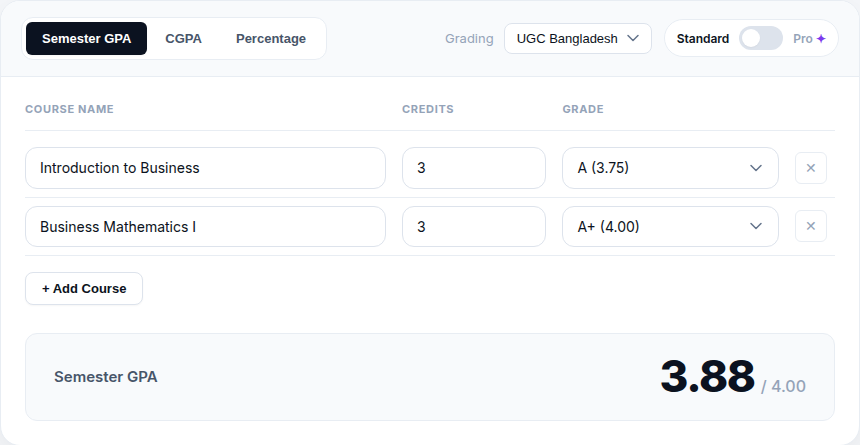
Because AIUB’s official scale is unusual (A = 3.75, B+ = 3.50, D+ = 2.50), double-check one thing when you use any calculator: make sure the grade-point mapping matches the official V3 table below, not the generic US scale where A = 4.0 and B+ = 3.3. A single mismatched grade point, multiplied across a 15-credit semester, can move your GPA by a tenth of a point — enough to matter at the probation line.
Official AIUB Grade Table 2026 (V3 — the One That Applies to You)
This is the table from AIUB’s official academic regulations page, confirmed in the Faculty of Science & Technology student handbook. If you enrolled in Spring 2016-2017 or later, this is your table — full stop.
| Marks (%) | Letter Grade | Grade Points |
|---|---|---|
| 90 – 100 | A+ | 4.00 |
| 85 – 89.99 | A | 3.75 |
| 80 – 84.99 | B+ | 3.50 |
| 75 – 79.99 | B | 3.25 |
| 70 – 74.99 | C+ | 3.00 |
| 65 – 69.99 | C | 2.75 |
| 60 – 64.99 | D+ | 2.50 |
| 50 – 59.99 | D | 2.25 |
| Below 50 | F | 0.00 |
| — | I (Incomplete) | excluded |
| — | W (Withdrawal) | excluded |
| — | UW (Unofficial Withdrawal) | excluded |
Three things jump out. First, D+ is worth exactly 2.50 — precisely the graduation and probation threshold, which means a D+ course neither lifts you above the line nor drags you under it; it just holds you there. Second, the D band is enormous: everything from 50 to 59.99 earns the same 2.25, so a 50 and a 59.99 are worth identically little. Third, A starts at 85, not 90 — AIUB is more generous at the top than the old system was.
V2 vs V3: Why Half the Internet Shows You the Wrong Table
Here’s the trap. AIUB previously used Grading System V2, which had minus grades and harsher cutoffs: A+ only from 94, an A- band at 86–89.99 worth 3.50, B+ at 82–85.99 worth just 3.25, and so on down to D- at 50–53.99 worth 1.00. V2 applied to students enrolled up to Fall 2016-2017. Wikipedia’s AIUB article still displays the V2 table as “the grading system,” and because it ranks well, students copy it into their own calculations.
The differences are not cosmetic — they move real CGPA:
- 89.5 marks: V2 → A- = 3.50. V3 → A = 3.75. A quarter of a grade point per credit.
- 84.5 marks: V2 → B+ = 3.25. V3 → B+ = 3.50.
- 91 marks: V2 → A = 3.75. V3 → A+ = 4.00. Under the current system, a 91 is a full A+.
- 55 marks: V2 → D = 1.50. V3 → D = 2.25. The current system is far kinder at the bottom.
On a single 3-credit course, using the wrong table on an 89.5 costs you 0.75 grade points (3 × 0.25) — and students who built spreadsheet calculators off the Wikipedia table have been undercounting their own CGPA for years. If your self-calculated CGPA has ever come out lower than the portal’s, a V2/V3 mix-up is the first thing to check.
How GPA Is Calculated at AIUB (Step by Step)
AIUB’s own handbook demonstrates the method with a first-semester example, and the formula is the standard credit-weighted average:
GPA = Σ (grade points × credit hours) ÷ Σ (credit hours attempted)
- Convert each course’s marks to a letter grade using the V3 table.
- Multiply the grade points by the course’s credit hours. That’s the course’s grade points earned.
- Add up all grade points earned. Add up all credit hours attempted (including Fs — they count at 0.00).
- Divide total grade points by total credits.
Courses graded I, W or UW are left out of both the numerator and the denominator entirely — they don’t help and they don’t hurt your GPA, which is exactly why the drop and incomplete rules matter so much (more on those below).
CGPA Formula: The Same Idea, Across Every Semester
CGPA = total grade points earned across all semesters ÷ total credit hours attempted across all semesters
Equivalently: CGPA = Σ (each semester’s GPA × that semester’s credits) ÷ Σ (all credits). AIUB’s academic year runs on three 15-week semesters — Spring (January–April), Summer (May–August), Fall (September–December) — and every one of them feeds the same cumulative pool. There is no reset, no “fresh start” semester. Your first-semester grades are still in your CGPA on graduation day.
Full Worked Example: A Real AIUB Semester
Take a typical 15-credit first semester — the same shape as the example in AIUB’s own handbook:
| Course | Credits | Marks | Grade | Points | Grade pts earned |
|---|---|---|---|---|---|
| Introduction to Business | 3 | 91 | A+ | 4.00 | 12.00 |
| English Reading Skills & Public Speaking | 3 | 87 | A | 3.75 | 11.25 |
| Business Mathematics I | 3 | 82 | B+ | 3.50 | 10.50 |
| Financial Accounting | 3 | 76 | B | 3.25 | 9.75 |
| Computer Fundamentals | 3 | 71 | C+ | 3.00 | 9.00 |
Total grade points: 12.00 + 11.25 + 10.50 + 9.75 + 9.00 = 52.50. Total credits: 15. Semester GPA = 52.50 ÷ 15 = 3.50.
Now extend it across semesters. Say semester two is 15 credits at GPA 3.20 (48.00 points) and semester three is 12 credits at GPA 3.67 (44.04 points). CGPA = (52.50 + 48.00 + 44.04) ÷ (15 + 15 + 12) = 144.54 ÷ 42 = 3.44. Notice how the 12-credit semester pulls less weight than the 15-credit ones — credit load, not just grades, decides how far any semester moves your CGPA. If you’re trying to plan a recovery, run the numbers first with the CGPA calculator instead of guessing.
The Retake Ladder: How AIUB Forgives Your First 4 Fs
This is the most consequential — and least explained — part of AIUB’s academic policy. When you fail a course, you must retake it in a future semester (preferably the next one), and what happens to the F depends on how many courses you’ve already retaken:
- Retaken courses 1–4 (undergraduate): the F becomes non-credited after you retake the course. It stops dragging your CGPA.
- Retaken course 5 onward (undergraduate): the CGPA is computed with both the F and the new grade. The F never leaves the math.
- For postgraduate programs the ladder is shorter: first 2 forgiven, both counted from the 3rd onward.
Watch what that means in numbers. A student stands at 48 credits and 150 grade points (CGPA 3.125) after an F in a 3-credit course. They retake it and earn a B (3.25 = 9.75 points):
- Within the first 4 retakes: F non-credited → (150 + 9.75) ÷ (48 − 3 + 3) = 159.75 ÷ 48 = 3.33. Nearly full recovery.
- 5th retake or later: both count → (150 + 0 + 9.75) ÷ (48 + 3) = 159.75 ÷ 51 = 3.13. The F’s ghost costs almost 0.2 CGPA points — permanently.
Two more retake rules from the official handbook deserve attention. First, you can also retake a course you passed if the grade was below the 2.50 GPA equivalent — a legitimate, documented CGPA-repair path most students never hear about. Any course may be retaken only once. Second, an FD grade — awarded by a disciplinary committee for violations — can never be replaced or removed by any retake. And note the hard ceiling: a maximum of 4 F grades in the undergraduate program (2 in graduate programs); excessive Fs push your CGPA under 2.50 and lead to termination.
Read more: How to Calculate SGPA: Formula & Examples (2026) — the semester-GPA math behind every retake decision, with worked examples you can adapt to AIUB’s scale.
GPA vs CGPA at AIUB: Why Both Numbers Matter
Your semester GPA measures one semester — it’s the number that tells you whether a particular term went well. Your CGPA is the running credit-weighted average across every semester, and it’s the number AIUB actually judges you by: probation, graduation, and scholarships all key off the CGPA, not any single semester’s GPA.
The practical consequence: a bad semester early hurts more than a bad semester late, because early credits form a larger share of a smaller total. A 2.80 GPA in a 15-credit first semester needs several strong semesters to dilute; the same 2.80 in your seventh semester barely moves a 100-credit CGPA. This is also why the retake ladder matters most early — forgiving an F in year one, when your credit base is small, saves far more CGPA than forgiving one in year four. For a deeper breakdown of the two numbers, see our SGPA guide.
7 Mistakes AIUB Students Make With the Grading System
- Calculating with the V2 table. Wikipedia’s minus-grade table is for pre-2017 enrolments. If your spreadsheet disagrees with the portal, this is suspect number one.
- Assuming A = 4.0. At AIUB, A is 3.75 — only A+ (90+) earns 4.00. Students targeting “straight As” are actually targeting a 3.75, not a 4.0.
- Ignoring an I grade. An Incomplete auto-converts to F if you don’t finish the work within four weeks of the semester ending — and an unresolved I blocks your registration for the next semester entirely.
- Sleeping through the 80% attendance rule. Drop below 80% attendance in a course and you can be assigned a UW — which converts to an F if you don’t file a drop in time.
- Thinking a W is free. A W doesn’t touch your CGPA, but it stays on your transcript, you paid tuition for those credits, and probation students need approval to drop at all.
- Wasting the retake ladder. Every retake of a passed-but-low course still consumes one of your four forgiven slots. Spend them on Fs, not on turning a C into a B.
- Aiming for “above 2.5” instead of a buffer. 2.50 is the probation line itself. One bad semester from 2.55 puts you under it. Treat 2.75 as your real floor.
Probation, the 2.50 Line & Graduation Rules at AIUB
AIUB’s line is simple and strict: CGPA below 2.50 = probation. The Office of Probation monitors probation students with special advising aimed at pulling grades back up. Compare that with BRACU or NSU, where the graduation floor is 2.00 — AIUB demands half a grade point more, every semester, for four years. For transfer students and freshmen choosing between private universities, that difference is worth weighing honestly.
To graduate, you need a minimum CGPA of 2.50 in both undergraduate and graduate programs, along with completing your program’s credit requirements. Let the CGPA slide under 2.50 through excessive Fs and the university can terminate your enrolment. And remember the F ceiling: more than 4 Fs as an undergraduate (2 as a graduate student) means every additional F is permanently baked into your CGPA math via the retake ladder.
The AIUB Scholarship: What 3.75 Really Demands
AIUB’s tuition-waiver scholarship (full or partial, for incoming and continuing students with one year of residency) requires a weighted average CGPA of 3.75 for the previous year — with two pieces of fine print that end more scholarship runs than the average itself:
- No grade lower than B+. A single B (3.25) disqualifies you even if your average clears 3.75. One 79 in one course can cost a full tuition waiver.
- No F, I or W grades. A strategic withdrawal to protect your average also kills the scholarship.
If you’re chasing the waiver, the practical target isn’t “3.75 average” — it’s “B+ or better in literally everything, with no gaps on the transcript.” Plan backwards from that with percentage-to-CGPA conversions when you’re estimating where you stand mid-semester.
8 Practical Tips to Protect and Lift Your AIUB CGPA
- Verify V3 is your table — then delete any V2-based spreadsheet. One wrong table poisons every projection you make.
- Guard the 80% attendance line in every course. Attendance is the cheapest grade insurance AIUB offers.
- Clear every I within the 4-week window. Put the deadline in your calendar the day the grade posts — an I silently becomes an F.
- Use the improvement-retake rule deliberately: a passed course below 2.50 GPA equivalent can be retaken once. A D (2.25) retaken to a B (3.25) on a 3-credit course adds 3.0 grade points to your pool.
- Save your four forgiven retakes for Fs. Don’t burn them polishing Cs into Bs early in your degree.
- Keep a 0.25 buffer above 2.50. Treat 2.75 as your personal probation line; the official one has no margin for a bad final.
- Front-load effort in early semesters. Credits earned early carry more weight per credit in your final CGPA — a strong first year is the highest-ROI studying you’ll ever do.
- Recalculate after every semester with the CGPA calculator and project what each remaining semester needs to average for your target — a 3.5, for instance, opens very different doors than a 3.0.
Read more: BRACU Grading System 2026: Grades, GPA & CGPA Guide — compare AIUB’s 2.50 bar and retake ladder with BRACU’s 2.00 floor and best-grade retake rule.
AIUB Grading FAQs
Which grading version applies to me — V2 or V3?
V3, unless you enrolled before Spring 2016-2017. V3 has no minus grades and starts A+ at 90. If you enrolled recently, every table with A-, B-, C- or D- grades does not apply to you.
I scored 89.5. Is that an A or an A-?
An A, worth 3.75 — under the current V3 system there is no A- grade at all. (Under the old V2 table it would have been an A- worth 3.50.)
Does a retaken F disappear from my CGPA?
For your first four retaken courses (undergraduate), yes — the F becomes non-credited. From the fifth retaken course onward, both the F and the new grade stay in the CGPA calculation permanently.
Can I retake a course I already passed?
Yes — official policy allows retaking a passed course if the grade was below the 2.50 GPA equivalent, and you may retake any course only once. Note it still uses one of your four forgiven-retake slots.
Does a W hurt my CGPA?
No. W carries no grade points and is excluded from the calculation. But it appears on your transcript, you still paid for the credits, and it disqualifies you from the tuition-waiver scholarship.
What happens if I ignore an Incomplete grade?
It automatically converts to an F if you don’t complete the requirements within four weeks of the semester ending — and an unresolved I blocks your final registration for the next semester.
Is a 2.5 CGPA safe at AIUB?
It’s the bare minimum: below 2.50 is probation, and 2.50 exactly is the graduation floor. Keep a buffer — and note the scholarship needs 3.75 with no grade below B+ and no F, I or W.
Final Word
AIUB’s grading system rewards students who read the fine print: the V3 table is kinder than the old one most of the internet still shows, the first four retaken Fs are genuinely forgiven, and passed courses below 2.50 can be retaken. But the 2.50 probation line is unforgiving, the fifth F onward never washes out, and an ignored I or UW quietly becomes an F. Calculate with the right table, guard your attendance, clear incompletes on time, and spend your retake ladder where it counts — your CGPA will thank you every semester until graduation.