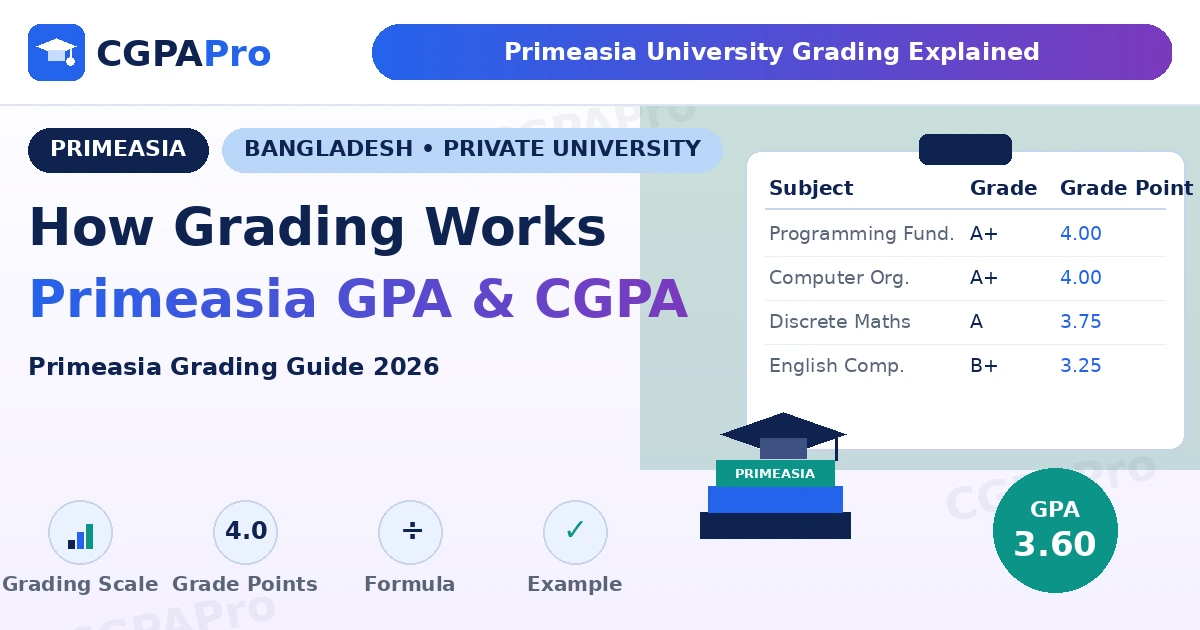
Short answer: Primeasia University in Dhaka follows the official University Grants Commission (UGC) of Bangladesh 4.00 grading scale — the same one its own B.Pharm syllabus prints in full: A+ is 4.00 for 80% and above, F is 0.00 for anything below 40%. Your semester GPA is the credit-weighted average of your grade points, and your CGPA is the credit-weighted average across all semesters. What surprises most students isn’t the scale itself — it’s the thresholds attached to it: the CGPA you need to keep a tuition waiver (2.25 or 2.50 depending on your program), the 2.50 CGPA floor for a B.Pharm degree, and the 20/30/50 mark split that decides your letter grade before the final exam even happens. This guide lays all of it out with the official table, a worked example with real numbers, and an honest list of what Primeasia simply doesn’t publish.
Primeasia University Grade Table 2026 (Official)
Primeasia’s B.Pharm (Hons) syllabus — the university’s own published curriculum document — reprints the grading table verbatim and states plainly that the grading system “as prescribed by the University Grants Commission, Dhaka is followed.” In other words, Primeasia does not run a custom scale; it runs the national UGC scale, and you can treat the table below as the university’s official reference:
| Numerical grade (marks) | Letter grade | Grade point |
|---|---|---|
| 80% and above | A+ | 4.00 |
| 75% to less than 80% | A | 3.75 |
| 70% to less than 75% | A− | 3.50 |
| 65% to less than 70% | B+ | 3.25 |
| 60% to less than 65% | B | 3.00 |
| 55% to less than 60% | B− | 2.75 |
| 50% to less than 55% | C+ | 2.50 |
| 45% to less than 50% | C | 2.25 |
| 40% to less than 45% | D | 2.00 |
| Less than 40% | F | 0.00 |
| — | I (Incomplete) | — |
| — | W (Withdrawal) | — |
Two details in that table deserve a second look, because they bite students every semester. First, the bands are exact and non-overlapping: 79.8% is an A, not an A+, and 74.9% is an A−, not an A. There is no rounding-up policy documented anywhere in Primeasia’s materials, so don’t assume your instructor will bump you. Second, the F grade starts at “less than 40%” — a 39.5 is still an F, worth 0.00 grade points. We’ll come back to what an F does to your GPA in the worked example section, because the math is uglier than most people expect.
A quick housekeeping note before we go further: this is Primeasia University (primeasia.edu.bd), the private university at Star Tower, Banani, Dhaka — not “Prime Asian University,” a separate institution with a different name and different policies. If you Google the name, the two get mixed up constantly; this guide is only about the former.
How to Calculate Your GPA at Primeasia (With a Real Screenshot)
The fastest way to check a semester GPA is the free calculator on this site — it uses the exact UGC Bangladesh scale above, so the numbers match Primeasia’s official table one-to-one. Fill in each course, its credit hours, and the letter grade you earned or expect:
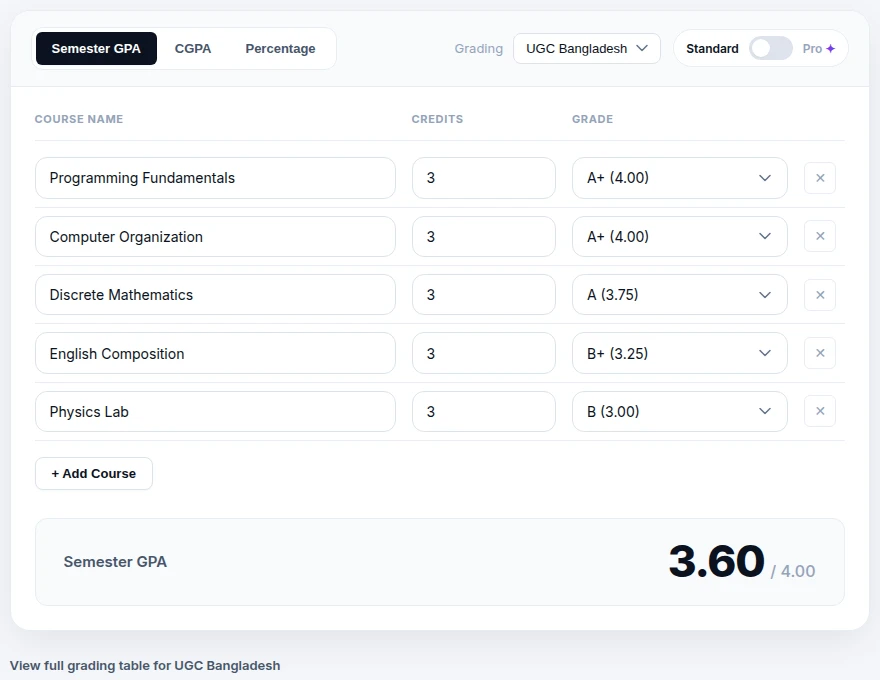
Screenshot: the homepage CGPA calculator filled with the worked example below — 5 courses, 15 credit hours, result Semester GPA 3.60/4.00. The calculator’s “UGC Bangladesh” scale is identical to Primeasia’s official table, so no conversion or caveat is needed.
One practical warning before you trust any online calculator for a Bangladeshi university: many generic “GPA calculators” ship with the American scale (A− = 3.67, B+ = 3.33, and so on). Primeasia uses A− = 3.50 and B+ = 3.25. Punching your grades into a US-scale calculator silently inflates or deflates your GPA — always check which scale the tool is using. The one above defaults to the UGC Bangladesh scale, which is the whole point.
The 20/30/50 Mark Split: Your Grade Is Half Decided Before Finals
The letter in the table above doesn’t come from a single exam. Per the university syllabus, a theory course’s 100 marks are split three ways:
| Component | Weight | What it covers |
|---|---|---|
| Class assessments | 20% | Class tests (10%), assignments (5%), attendance (5%) |
| Mid-semester exam | 30% | Syllabus covered up to mid-term |
| Final exam | 50% | Full semester coverage |
Practical and field-work courses are assessed differently — through class observation, viva voce, and quizzes rather than written finals. One credit of theory means one lecture hour per week for the semester (so a 3-credit theory course meets three hours a week); practical credits typically count at half the class-hour rate.
Why this matters: half of your grade exists before the final exam week. The 20% class-assessment bucket rewards the boring, consistent stuff — showing up (5% of your total is attendance alone), submitting assignments, taking class tests seriously. A student who banks a strong 18 out of 20 in class assessments and 26 out of 30 in the mid-semester walks into the final needing only about 36 out of 50 for an A+ (80 total). Flip it around: skipping class tests and blowing off assignments doesn’t just cost you 20 marks — it raises the bar on the only high-pressure exam of the semester. Students who track their running total mid-semester almost always plan their final-week studying better than students who don’t.
GPA Formula, Step by Step
Primeasia has not published its own formula document publicly, but the computation is the standard credit-weighted average every UGC-scale university in Bangladesh uses (and it’s the formula that makes the grade table above work):
Semester GPA = Σ (grade point × credit hours) ÷ Σ credit hours
- Convert each course’s letter grade to its grade point using the official table.
- Multiply each grade point by that course’s credit hours. This gives the course’s “quality points.”
- Add up all quality points.
- Divide by the total credit hours you took that semester.
Your CGPA is the same idea across your whole degree: total quality points earned in all semesters divided by total credit hours taken in all semesters. (Equivalent shortcut: the credit-weighted average of your semester GPAs.) Credits matter enormously here — a 3-credit course moves your GPA three times as much as a 1-credit lab. We’ll prove that in the worked example.
Worked Example: A Primeasia CSE Semester, 15 Credits
Let’s say a CSE student finishes a semester with these five courses. The grades are plausible, not cherry-picked — two strong subjects, one steady one, two average ones:
| Course | Credits | Grade | Grade point | Quality points |
|---|---|---|---|---|
| Programming Fundamentals | 3 | A+ | 4.00 | 12.00 |
| Computer Organization | 3 | A+ | 4.00 | 12.00 |
| Discrete Mathematics | 3 | A | 3.75 | 11.25 |
| English Composition | 3 | B+ | 3.25 | 9.75 |
| Physics Lab | 3 | B | 3.00 | 9.00 |
| Total | 15 | — | — | 54.00 |
Semester GPA = 54.00 ÷ 15 = 3.60.
Now watch what an F does. Swap that B in Physics Lab for an F (0.00) and the row contributes 0.00 instead of 9.00: total quality points drop to 45.00, and the GPA falls to 3.00 — a 0.60 collapse from a single failed 3-credit course. That is the cruel arithmetic of the credit-weighted formula: one zero in a heavy course erases two A+’s worth of effort. This is also why the retake question below matters so much to students.
And notice the credits lever: if that F had been in a 1-credit course instead, the damage would be one-third as large. When you’re choosing where to spend your limited study hours, weight your effort by credit hours — it’s the single highest-ROI study strategy in a credit system.
GPA vs CGPA: What Each Number Actually Decides
Students use the two interchangeably; universities don’t. At Primeasia:
- Semester GPA describes one semester only. It’s what you see on your grade sheet, and it’s the number departments usually reference for semester-level standing.
- CGPA is the running, credit-weighted average across every semester you’ve completed. It’s the number on your transcript, the number employers ask about, and — critically — the number Primeasia’s waiver policy uses.
If you want the full explainer on the terminology, what CGPA means and how it differs from GPA and SGPA walks through it with examples.
The Number That Actually Runs Your Wallet: Waiver CGPA Thresholds
Here’s the section no generic calculator page gives you — and, frankly, the most financially important table in this article. Primeasia’s official 2026 waiver policy (published on primeasia.edu.bd) sets a minimum CGPA you must hold to continue receiving your tuition waiver. Drop below it, and the discount goes away. The threshold depends on your program:
| Program | Minimum CGPA to keep waiver |
|---|---|
| MBA | 2.50 |
| B.Sc in EEE | 2.50 |
| CSE | 2.50 |
| CSIT | 2.50 |
| B.Pharm (Hons) | 2.50 |
| M.Pharm | 2.50 |
| BBA | 2.25 |
| ITHM | 2.25 |
| B.Sc in Textile | 2.25 |
| Ms in CSIT | 2.25 |
| Architecture | 2.25 |
| B.Sc in Microbiology | 2.25 |
| BMB | 2.25 |
| PHN (Public Health Nutrition) | 2.25 |
| LLB (Hons) | 2.25 |
| English | 2.25 |
Two patterns jump out. First, the engineering and pharmacy programs — MBA, EEE, CSE, CSIT, B.Pharm, M.Pharm — carry the stricter 2.50 line. Every other program holds at 2.25. Second, these waivers run 40–50% of tuition depending on program, so crossing the wrong side of the threshold is not an abstract academic problem — it’s tens of thousands of taka per semester. If you’re on a waiver in one of the 2.50 programs, treat 2.50 as your real graduation-scale floor every single semester, not just at the end of your degree. One F in a 3-credit course (see the worked example above: −0.60 on a 15-credit semester) can drag a borderline student straight under the line.
Graduation Requirements: What’s Verified and What Isn’t
Verified: for the B.Pharm (Hons) degree, the syllabus states a student must complete 154.0 credits with a CGPA of 2.50 or higher. That’s the only program-level graduation rule we’ve found in Primeasia’s published materials.
Not published (as of this writing): the minimum graduation CGPA for every other program, academic probation thresholds, Dean’s List criteria, and maximum time allowed to complete a degree. Primeasia simply hasn’t put these in a public document we could find — and inventing numbers here would be worse than useless. The honest move: check your current program handbook or confirm with your department office before planning anything (a final-year project, a light last semester, a job application) around a graduation threshold.
Retakes and Improvements: The Uncomfortable Honest Section
Every grading guide for a Bangladeshi private university gets asked the same questions: Can I retake a course I failed? Does the F stay on my transcript, or does the new grade replace it? Is there an improvement exam to raise a low grade? For Primeasia specifically, we could not find an official, published answer. No Primeasia academic ordinance, registrar notice, or program handbook page spells out the retake mechanics publicly.
What we can say with confidence: the general pattern across UGC-scale private universities in Bangladesh is that failed courses must be retaken (usually with a fee, in a later semester), and improvement exams — where they exist — let students raise grades below a certain level, sometimes with a cap on how high the new grade can go. For how retake math typically works, this guide on how retaking a course affects your CGPA walks through the mechanics with numbers. But the Primeasia-specific version of those rules — whether the old F is replaced or averaged, whether there’s a grade cap, what it costs — lives in your department office, not on the internet. Ask before you plan around it.
Common Mistakes Primeasia Students Make
- Using a US-scale calculator. A− is 3.50 here, not 3.67; B+ is 3.25, not 3.33. The wrong scale gives you a wrong GPA and a wrong plan.
- Ignoring the 20% class-assessment bucket. Attendance is 5% of every theory course. Chronic absence doesn’t just risk a fine or a warning — it directly shaves marks off your final grade band.
- Treating all courses as equal. In a credit-weighted system, a 3-credit course counts triple a 1-credit one. Study hours should follow credit hours.
- Confusing the waiver threshold with the graduation threshold. They’re different numbers (for most programs, the waiver line is the one that bites first). Know both.
- Assuming “less than 40%” has a safety net. A 39.5 is an F, worth 0.00 — and per the worked example, one F in a 3-credit course can cost 0.60 of semester GPA.
- Mixing up Primeasia and Prime Asian University. Different universities, different policies, different websites. Double-check any document’s header before trusting it.
Tips to Protect (and Raise) Your CGPA at Primeasia
- Track your running total after the mid-semester. With 50 of 100 marks already banked (20 class + 30 mid), you can compute exactly what final-exam score each letter grade needs. The calculator above makes this a two-minute exercise — plug in hypothetical grades and see the GPA move.
- Defend the 2.50/2.25 waiver line like a budget. If you’re on a waiver, compute your CGPA every semester before results lock in, and model what one bad grade would do. Surprises are for birthdays, not transcripts.
- Front-load effort into high-credit, high-yield courses. Core 3-credit theory courses are where CGPA is won and lost; labs and 1-credit courses matter, but proportionally.
- Never let a borderline 38–39 become an F. The gap between a D (2.00, contributes something) and an F (0.00, contributes nothing) is the single most expensive cliff in the grade table. A few extra marks in a course you’re failing are worth more per mark than anywhere else on the scale.
- If you’re considering a percentage-to-CGPA conversion (for foreign applications or scholarships), this percentage-to-CGPA conversion guide explains the honest way to do it on the UGC scale.
FAQ: Primeasia University Grading
What grading scale does Primeasia University use?
Primeasia follows the official UGC Bangladesh 4.00 scale: A+ (4.00) for 80% and above down to F (0.00) for below 40%. The university’s own B.Pharm syllabus reprints this table and states the UGC-prescribed system is followed.
How is CGPA calculated at Primeasia University?
By the standard credit-weighted formula: multiply each course’s grade point by its credit hours, add up those quality points, and divide by total credit hours. Your CGPA is the same calculation across all semesters combined. Primeasia hasn’t published its own formula document, so treat the mechanics as standard practice and confirm specifics with your department.
What CGPA do I need to keep my Primeasia tuition waiver?
Per the official 2026 waiver policy: 2.50 for MBA, EEE, CSE, CSIT, B.Pharm, and M.Pharm; 2.25 for BBA, ITHM, Textile, Architecture, Microbiology, BMB, PHN, LLB, and English.
What is the minimum CGPA to graduate from Primeasia?
Verified only for B.Pharm (Hons): 154 credits with a CGPA of 2.50 or higher. Other programs’ graduation floors aren’t in Primeasia’s published materials — check your program handbook.
Can I retake a failed course at Primeasia?
Primeasia hasn’t published its retake policy online. Across Bangladeshi private universities, failed courses are normally retaken with a fee, but whether the new grade replaces the F or is averaged, and what it costs at Primeasia specifically, needs confirmation from your department office.
How are marks divided in a Primeasia theory course?
20% class assessments (tests 10%, assignments 5%, attendance 5%), 30% mid-semester exam, 50% final exam. Practical courses use class observation, viva voce, and quizzes.
Is Primeasia University the same as Prime Asian University?
No — they are different institutions. This guide covers Primeasia University (primeasia.edu.bd, Banani, Dhaka). Don’t mix their policies or documents.
Sources & Honesty Notes
This guide is built on two verifiable sources: Primeasia University’s B.Pharm (Hons) syllabus (grade table, 20/30/50 mark split, B.Pharm graduation rule) and Primeasia’s official 2026 waiver policy page (per-program CGPA thresholds to continue a waiver). We deliberately left out retake mechanics, probation thresholds, Dean’s List criteria, and non-B.Pharm graduation floors because Primeasia hasn’t published them — and a guide that invents those numbers would be doing you a disservice. If your department has a current academic ordinance, it outranks everything here.
One last comparison for context: Primeasia’s table is byte-for-byte the same national scale used by IUBAT, ASAUB, and other UGC-governed private universities — see the IUBAT grading guide and the HEC vs UGC grading-scale comparison to see how the same scale plays out across institutions.