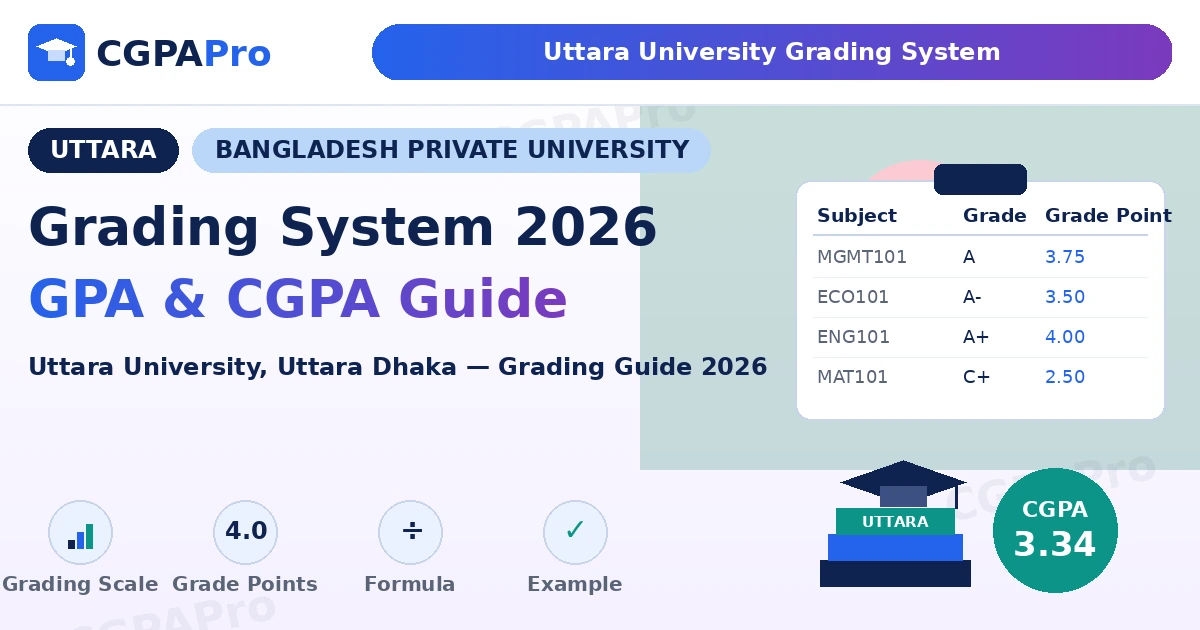
Here is the short version: Uttara University uses the UGC Bangladesh uniform grading scale on a 4.00 system — A+ (80–100 marks) earns 4.00, A (75–79) earns 3.75, A− (70–74) earns 3.50, and it steps down through B+, B, B−, C+, C, D (40–44, grade point 2.00) to F (below 40), which earns zero. Your semester GPA is the credit-weighted average of your grade points, and your CGPA is the same idea extended across every semester. This is all published on the university’s own Office of the Controller of Examinations page, and this guide walks you through the verified table, the exact formula, and two worked examples with real numbers.
One important warning before anything else, because this mix-up is genuinely hurting students: Uttara University (UU) is not United International University (UIU). They sound alike, both are private universities in Dhaka, and search engines happily show UIU’s CGPA calculators when you search “uttara university cgpa calculator” — but UIU runs a completely different scale (90–100 = A 4.00, fail below 55). If you are a UU student using a UIU calculator, your results will be wrong. If you actually study at UIU, we have a separate UIU grading guide for you. And if you meant Uttaranchal University in India — different country, different university entirely. This page is only for students of Uttara University, Dhaka, Bangladesh.
How to Check Your GPA and CGPA Online (2 Minutes)
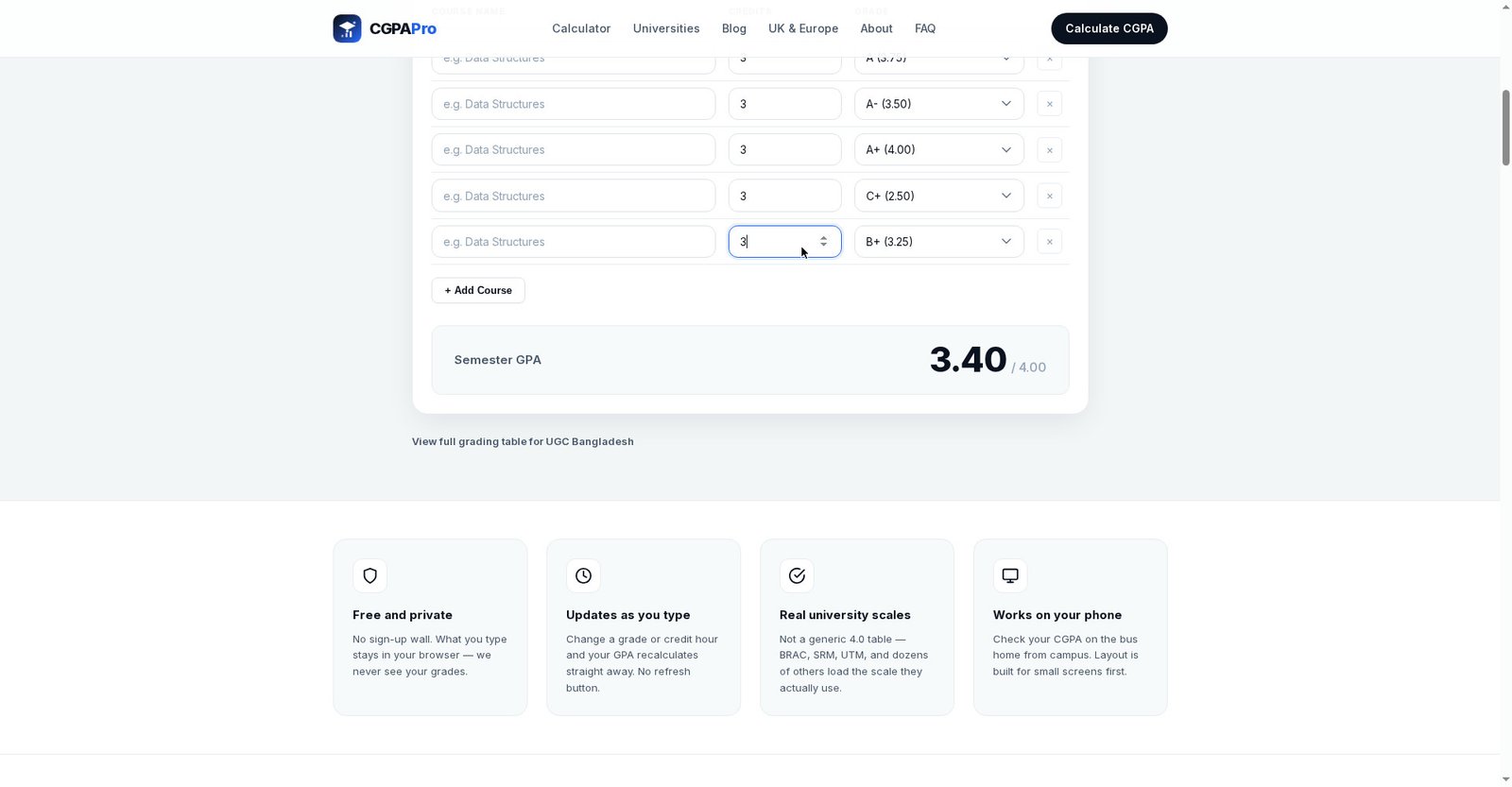
The fastest way to get an accurate number is to let a calculator do the weighting for you. CGPAPro’s free calculator is pre-set to the standard 4.00 scale that matches Uttara University’s official table — you just pick your grade for each course and enter the credit hours:
- Open the CGPAPro calculator (it works on your phone too).
- Add one row per course: type the course name, enter the credit hours (most UU theory courses are 3 credits, labs/sessional courses are usually 1.5), and select the letter grade from the dropdown.
- The calculator multiplies each grade point by its credits, adds everything up, and divides by total credits — the exact formula your department uses.
- Save or screenshot the result, and compare it against the worked examples below to make sure it matches.
Heads-up: the calculator’s dropdown must be set to the UGC Bangladesh scale (A+ = 4.00, A = 3.75, A− = 3.50, B+ = 3.25, B = 3.00, B− = 2.75, C+ = 2.50, C = 2.25, D = 2.00, F = 0.00). That is Uttara University’s official scale — don’t use any “90–100 = A” preset; that’s the UIU scale and it will inflate or deflate your number.
Uttara University Official Grading Table (2026)
The university’s Controller of Examinations states it plainly: “Uttara University follows UGC’s Grading Scale.” Here is the official table, exactly as published:
| Numerical Score (%) | Letter Grade | Grade Point |
|---|---|---|
| 80–100 | A+ | 4.00 |
| 75–79 | A | 3.75 |
| 70–74 | A− | 3.50 |
| 65–69 | B+ | 3.25 |
| 60–64 | B | 3.00 |
| 55–59 | B− | 2.75 |
| 50–54 | C+ | 2.50 |
| 45–49 | C | 2.25 |
| 40–44 | D | 2.00 |
| 00–39 | F | 0.00 |
A few things worth noticing. First, 40 is the magic line: 40–44 is a D (you pass, barely), and anything below 40 is an F that earns no credit and must be retaken. Second, the gaps between grades are not equal — moving from A (3.75) to A+ (4.00) is worth 0.25 points, but moving from B− (2.75) to B (3.00) is also 0.25, which is why small mark improvements in the middle of the table move your GPA more than you’d expect. Third, the EEE department’s grading page adds the non-numeric codes you’ll see on a grade sheet: I = Incomplete, W = Withdrawal, R = Repeat, Y = Audit. None of these carry grade points.
📖 Read More
- NSU vs IUB vs BRACU Grading Comparison 2026 — how Uttara University’s UGC scale compares to the private universities that use a different (90–100 = A) scale.
- Daffodil International University Grading System 2026 — another UGC-scale university guide with the same table format.
How Your Final Course Mark Is Calculated
Before your marks become a letter grade, they are built up from five components. The Department of EEE publishes this official breakdown, and it applies across the university’s assessment structure:
| Component | Weight |
|---|---|
| Class Attendance + Class Performance | 5% |
| Class Test + Assignment | 10% |
| Mid-Term Examination | 25% |
| Semester Final Examination | 50% |
| Viva Voce | 10% |
| Total | 100% |
This is why students who “only” missed a few classes can be surprised at result time. Let’s trace one realistic course — say, Microeconomics (ECO 101) — through the full pipeline:
- Attendance + class performance: 4 out of 5
- Class tests + assignment: 8 out of 10
- Mid-term exam: 18 out of 25
- Semester final: 36 out of 50
- Viva voce: 7 out of 10
Total: 4 + 8 + 18 + 36 + 7 = 73 out of 100. On the official table, 73 falls in the 70–74 band → A− (3.50). Now imagine the same student had skipped attendance entirely (0 out of 5): 69 out of 100 → B+ (3.25). Four attendance marks cost a quarter of a grade point on a 3-credit course — that’s 0.75 quality points gone from your GPA numerator. Showing up is, quite literally, worth grade points.
How to Calculate Your GPA and CGPA — Step by Step
Uttara University’s own formula (published by the EEE department) is:
CGPA = Σ (Credit Hours × Grade Points) ÷ Total Credit Hours
The semester GPA uses the same formula but only for one semester’s courses; the CGPA extends it across every course you’ve ever completed. Here’s the process:
- Convert each course’s marks to a letter grade using the official table above.
- Convert the letter grade to its grade point (A+ = 4.00, A = 3.75, and so on).
- Multiply the grade point by the course’s credit hours. This gives the course’s “quality points.”
- Add up all quality points (the numerator) and all credit hours (the denominator).
- Divide. That’s your GPA (one semester) or CGPA (all semesters).
Notice what’s NOT in the formula: failed courses contribute zero quality points but their credits still sit in the denominator, which is exactly why an F drags your average down so hard — and why retaking it (more on that below) is the single highest-leverage thing a UU student can do for their CGPA.
Worked Example 1: One Full Semester (SGPA)
Let’s follow a first-semester BBA student through five courses. Uttara University runs a tri-semester system (three semesters a year — for example, BSc EEE runs 12 semesters over 4 years), so each semester is short and every course counts.
| Course | Credits | Marks | Grade | Grade Point | Quality Points |
|---|---|---|---|---|---|
| Principles of Management | 3 | 78 | A | 3.75 | 11.25 |
| Microeconomics | 3 | 73 | A− | 3.50 | 10.50 |
| English Communication | 3 | 84 | A+ | 4.00 | 12.00 |
| Business Mathematics | 3 | 52 | C+ | 2.50 | 7.50 |
| Financial Accounting | 3 | 66 | B+ | 3.25 | 9.75 |
Each quality-point figure is grade point × credits: 3.75 × 3 = 11.25; 3.50 × 3 = 10.50; 4.00 × 3 = 12.00; 2.50 × 3 = 7.50; 3.25 × 3 = 9.75. Now add them up:
Total quality points = 11.25 + 10.50 + 12.00 + 7.50 + 9.75 = 51.00
Total credits = 3 + 3 + 3 + 3 + 3 = 15
SGPA = 51.00 ÷ 15 = 3.40
A 3.40 is a strong first semester — comfortably above the 2.00 graduation floor and the 2.00 probation line (explained below). Notice the villain of the story: Business Mathematics at C+ (7.50 quality points) is what keeps this student out of the 3.5+ range. That one course is the obvious candidate for grade improvement later.
Worked Example 2: CGPA Across Three Semesters
CGPA is not the average of your semester GPAs — it’s the credit-weighted average of everything, because semesters carry different credit loads. Our student continues:
| Semester | Credits | SGPA | Quality Points (Credits × SGPA) |
|---|---|---|---|
| Semester 1 | 15 | 3.40 | 51.00 |
| Semester 2 | 16 | 3.10 | 49.60 |
| Semester 3 | 14 | 3.55 | 49.70 |
Total quality points = 51.00 + 49.60 + 49.70 = 150.30
Total credits = 15 + 16 + 14 = 45
CGPA = 150.30 ÷ 45 = 3.34
Check the common mistake: a simple average of the three SGPAs would give (3.40 + 3.10 + 3.55) ÷ 3 = 3.35 — close here, but wrong, and the error grows when credit loads differ more. Always weight by credits. And note how semester 2 (the heavy 16-credit one with the lowest SGPA) pulls the CGPA down disproportionately — your heaviest semesters are where grade slips cost you the most.
GPA vs CGPA: What Each One Actually Does at Uttara University
Students mix these up constantly, so here’s the clean version:
- GPA (Grade Point Average) covers one semester only. It’s what the probation rule looks at: a semester GPA below 2.00 puts you on probation. It’s also the number the retake policy references (“a GPA of 2.00” may retake).
- CGPA (Cumulative Grade Point Average) covers your entire degree — every completed course divided by every credit attempted. It’s what the graduation requirement looks at (minimum 2.00 for the BSc EEE program) and what employers and foreign universities ask for on transcripts.
Think of GPA as the score of one match and CGPA as your career average. One bad semester hurts the CGPA, but it doesn’t define it — the worked example above shows a 3.10 semester absorbed into a 3.34 CGPA. That asymmetry is exactly what makes retakes and improvements worth doing: they repair the career average, not just one match.
Retake & Grade Improvement Rules (Verified)
This is the section most generic calculator sites get wrong or skip, so let’s go straight from the university’s published rules:
- Failed a course (F)? Retaking is not optional — the EEE department’s rules say a student earning an F is required to retake the course in the next semester to earn at least a passing grade, paying the full credit fees for that course. The Controller of Examinations page adds that students whose exams were cancelled for unfair means, or who failed to complete an “Incomplete” exam in time, also fall under retake rules.
- Passed but unhappy with the grade? You can voluntarily retake any course where you earned grade points of 3.00 or less (that’s B, B−, C+, C, or D), paying 100% of the course fees. This is entirely your choice — nobody forces it.
- How many times? Any course can be retaken/repeated a maximum of two times, and the grade sheet marks retaken courses with the word “Retake.”
- Timing: the retake must be done within the next two semesters after the results are published (or whenever the course is next offered). Apply with the prescribed form before the semester starts; tuition fee waivers do not apply to retakes.
- Which grade counts? The good news: “In case of a course retake, the transcript of a student shall show the grade which is higher.” Retaking can only help — it can never make your transcript worse.
- End-of-program safety net: even at the very end of your degree, if any single course sits below a 3.25 GPA or your CGPA is marginal (2.90–2.99 or 2.70–2.74), the EEE rules allow you to retake those courses — or resolve it through a discussion with the Controller of Exams.
A quick illustration of the leverage: our example student retakes Business Mathematics (3 credits, C+ = 2.50) and lifts it to a B (3.00). That’s 0.50 extra grade points × 3 credits = 1.50 quality points added to the numerator with no change in credits — on a 45-credit base, the CGPA moves from 3.34 to 3.37. Small move, but for a student hovering near a 3.00 or 2.00 threshold, retakes are the difference between a clean transcript and probation.
For a deeper walkthrough of how retakes ripple through your average, see our guide on how retaking a course affects your CGPA.
📖 Read More
- How to Improve Your CGPA in 2026 — realistic strategies (retakes, credit-load planning, grade targeting) that work under the UGC 4.00 scale.
Probation, Graduation & Dropout Rules (Verified)
- Probation: a semester GPA below 2.00 places you on probation. You then get a maximum of two semesters to pull your GPA back up. If you can’t reach a CGPA of 2.00 within those two consecutive semesters, you may be granted one additional chance based on the improvement you’ve shown — but if progress is still insufficient, the university may ask you to transfer to another degree program or dismiss you.
- Graduation: the published requirement for the BSc in EEE is a minimum CGPA of 2.00, with 158.5 credits completed and a maximum of 7 years to finish the degree.
⚠️ Please note: the 2.00 graduation CGPA is verified from the EEE program’s published rules. Different departments (Business, Law, Pharmacy, CSE) may set higher minimums — always check your own program’s handbook or confirm with your department chairman before planning around 2.00.
- Withdrawal: you can officially withdraw from courses (recorded as W) with the Dean/Chairman’s permission — but unofficially skipping enrollment for three consecutive semesters cancels your admission entirely, and you’d need re-admission to return.
- Incomplete (I): if you miss a mid-term or final for an accepted reason, you get an I on the grade sheet and one semester to sit the makeup exam. Miss that window and your previous marks are voided — you earn an F and must retake.
7 Common Mistakes Uttara University Students Make
- Using a UIU calculator. The single most expensive mistake. UIU’s scale (A at 90–100, fail below 55) produces a completely different GPA from UU’s UGC scale (A+ at 80–100, fail below 40). Always confirm the calculator’s grade table matches the official one above.
- Averaging SGPAs instead of weighting by credits. CGPA is credit-weighted. A 3.10 in a 16-credit semester hurts more than a 3.55 in a 14-credit one helps.
- Treating attendance as free. Attendance plus class performance is 5% of every course mark — 5 marks that decide whether you land at 69 (B+) or 74 (A−).
- Ignoring the viva (10%). The viva voce is a full tenth of your course grade. Students who prepare for it properly regularly pick up 8–9 of those 10 marks.
- Assuming a D “doesn’t count.” A D earns 2.00 grade points and keeps you eligible — but stack too many and your semester GPA slides toward the 2.00 probation line fast.
- Waiting too long to retake. Retakes must happen within two semesters of the result. Miss the window and the F stays anchored in your CGPA while you burn time you could have used to fix it.
- Confusing “may retake” with “must retake.” F grades: mandatory retake. Grades at 3.00 or below: optional improvement. Mixing the two up means either ignoring a mandatory retake or paying fees to retake a B+ you didn’t need to touch.
7 Practical Tips to Protect (and Lift) Your CGPA
- Bank the easy 15%. Attendance (5%) + class tests/assignments (10%) are the most controllable marks in the whole system. Treat them as guaranteed points, not bonuses.
- Target the grade boundaries, not perfection. Moving from 73 to 75 costs 2 marks but buys 0.25 grade points (A− → A). Moving from 83 to 88 buys nothing (still A+). Spend revision time where the boundary is nearest.
- Load heavy semesters with your strongest subjects. Since CGPA is credit-weighted, your 16-credit semesters deserve your best courses; put the notorious tough ones in lighter semesters.
- Retake strategically. The highest-leverage retakes are high-credit courses sitting at C+ or below — exactly where the “grade points ≤ 3.00” improvement rule lets you act voluntarily.
- Watch the 2.00 line from above. The moment a semester looks like it might dip under 2.00, talk to your department — probation gives you two semesters, but only if you use them deliberately.
- Don’t skip the viva. Ten percent of every course, and it’s the component most students underprepare for.
- Verify with the official table, not a friend’s screenshot. Grade tables get shared in class groups with errors. The authoritative source is the Controller of Examinations page — bookmark it.
Frequently Asked Questions
Is Uttara University the same as UIU (United International University)?
No. They are two different private universities in Dhaka. Uttara University follows the UGC Bangladesh uniform scale (A+ at 80–100, fail below 40); UIU uses its own scale (A at 90–100, fail below 55). Their CGPA calculators are not interchangeable — using a UIU calculator as a UU student will give you wrong results.
What is the passing grade at Uttara University?
D — 40 to 44 marks, grade point 2.00 — is the lowest passing grade. Anything below 40 is an F, which earns no credit and must be retaken.
What CGPA do I need to graduate?
The published minimum for the BSc in EEE program is a CGPA of 2.00. Other departments may require more, so confirm with your own program’s handbook — don’t assume 2.00 applies everywhere.
How do I calculate my CGPA at Uttara University?
Multiply each course’s grade point by its credit hours, add all the results together, and divide by your total credit hours. That’s the university’s official formula: CGPA = Σ(Credit × Grade Points) ÷ Total Credits. The two worked examples above show every step.
Can I retake a course I already passed?
Yes — if you earned grade points of 3.00 or less (B, B−, C+, C, or D), you may voluntarily retake the course by paying 100% of the course fees. The transcript shows whichever grade is higher, so a retake can never hurt you.
What happens if I get an F in a course?
You must retake it — usually in the next semester — paying the full credit fees. You can retake any course a maximum of two times, and “Retake” is noted on your grade sheet. An F contributes zero quality points while its credits stay in the denominator, so it drags your CGPA down until you clear it.
What is academic probation at Uttara University?
If your semester GPA falls below 2.00, you’re placed on probation and given a maximum of two semesters to raise it. If you still can’t reach a CGPA of 2.00 after that, you may get one more chance based on improvement shown — otherwise the university can ask you to transfer programs or dismiss you.
The Bottom Line
Uttara University’s grading system is one of the more transparent ones in Bangladesh: the official table is published, the formula is simple, and the retake rules genuinely favor the student (the higher grade counts, always). The traps are all avoidable — don’t use another university’s calculator, don’t average SGPAs by hand, bank the attendance and viva marks, and treat any F as an emergency to clear within two semesters. Do that, and the 4.00 scale works in your favor: with A+ starting at 80 rather than 90, strong students here reach the top of the scale sooner than their friends at NSU-style universities.
Run your numbers through the CGPAPro calculator with the official table above, and you’ll know exactly where you stand — no guesswork, no wrong-scale surprises.