
If you study at the International University of Business Agriculture and Technology (IUBAT) in Uttara, Dhaka, and you have ever typed your marks into a random online GPA calculator and gotten a number that looks nothing like your result sheet — you are not the one making the mistake. Most of those calculators quietly use the American 4.0 scale, and IUBAT does not use the American scale. It uses the UGC Bangladesh uniform grading system: A+ starts at 80%, not 90%, and every letter grade carries a grade point a quarter-step apart.
Here is the short version: IUBAT’s official table is A+ 4.00 (80%+), A 3.75 (75–79), A− 3.50 (70–74), B+ 3.25 (65–69), B 3.00 (60–64), B− 2.75 (55–59), C+ 2.50 (50–54), C 2.25 (45–49), D 2.00 (40–44), F 0.00 (below 40). Your semester GPA is the credit-weighted average of your grade points, and your CGPA accumulates the same way across every semester. Two IUBAT-specific quirks set it apart from the generic formula: F-grade credit hours are excluded from the CGPA calculation entirely (not weighted as zero), and good standing, probation, and graduation all hinge on a 2.50 CGPA line — higher than several other Bangladeshi private universities.
This guide walks through the official table with its percentage bands, how to compute your GPA step by step, a hand-verified worked example that matches the calculator screenshot below exactly, the improvement-exam-versus-retake decision (including the B+ grade cap most students don’t know about), the IUBAT-vs-IUB confusion that sends students to the wrong grade table, and the questions IUBAT students actually ask — answered from IUBAT’s own published rules.
Use the CGPAPro Calculator the Right Way
Before anything else, run your own numbers. The CGPAPro homepage calculator lets you pick the grading scale — for IUBAT work, always select UGC Bangladesh from the scale dropdown. That is exactly the scale IUBAT itself uses, so every value matches your university’s official table. If you use the default US-style scale instead, your A− will be counted as 3.67 instead of 3.50 and your B+ as 3.33 instead of 3.25 — small errors that quietly shift your semester GPA by a tenth or more.
Here is the screenshot, with our worked example already filled in (five courses, result 3.45 / 4.00 — the arithmetic is reproduced line by line in the worked-example section so you can check it):
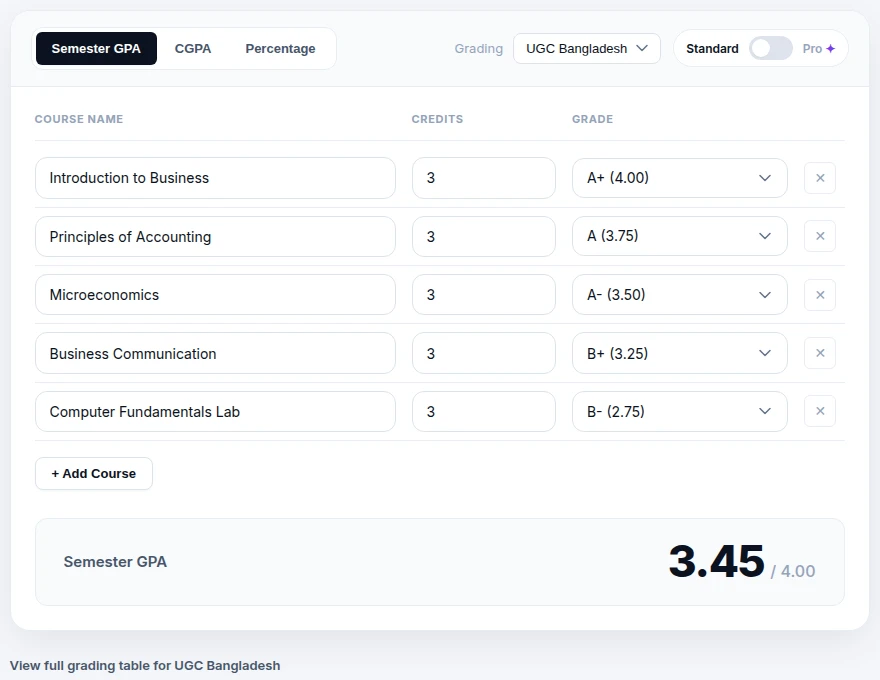
How to fill it in for your own semester:
- Set the scale dropdown to UGC Bangladesh (not the default US-style scale — the US one gives you 3.67 for A− and 3.33 for B+, which are wrong for IUBAT).
- Type each course name in the course-name box, its credit hours in the credits box, and pick the letter grade from the dropdown. Type the credit number yourself — the field may show a default value that isn’t actually registered until you type.
- Do not include any course where you got an F. IUBAT excludes F-grade credit hours from the SGPA/CGPA denominator (see the section on the F quirk below), so including an F as 0.0 gives you the wrong answer.
- Check the result against your hand calculation. If it disagrees, re-check your grade letters — most mismatches are one wrong letter grade, not broken math.
The Official IUBAT Grading Table
This is IUBAT’s published table, taken from the university’s own Academics page (“Academic Rules and Regulations” → Grading System). It is the same table as the UGC Bangladesh uniform grading system — IUBAT is a UGC-recognized private university and follows the Commission’s scale:
| Numerical Marks | Letter Grade | Grade Point | Status |
|---|---|---|---|
| 80% and above | A+ | 4.00 | Pass |
| 75% to less than 80% | A | 3.75 | Pass |
| 70% to less than 75% | A− | 3.50 | Pass |
| 65% to less than 70% | B+ | 3.25 | Pass |
| 60% to less than 65% | B | 3.00 | Pass |
| 55% to less than 60% | B− | 2.75 | Pass |
| 50% to less than 55% | C+ | 2.50 | Pass |
| 45% to less than 50% | C | 2.25 | Pass |
| 40% to less than 45% | D | 2.00 | Pass (with a catch — see below) |
| Less than 40% | F | 0.00 | Fail |
Three things about this table deserve your attention. First, the passing line is 40% — a D worth 2.00 — but a D only “passes” in the general sense. IUBAT’s academic rules set a course-level minimum of C for core, elective, departmental and English courses, and B− for thesis and practicum work. So if you earn a D in a core course like Financial Accounting, the course does not count as completed to standard, and you become eligible for an improvement exam or a retake — the distinction matters, and we unpack it in the retake section.
Second, note the band edges are hard: 74.6% is an A−, 75.0% is an A. If your teacher offers any re-check or remarking, the boundary cases (74–75, 79–80) are where a single mark is worth a full quarter grade point per credit hour. A 79% that moves to 80% is worth 0.25 grade points on every credit of that course — for a 3-credit course, that is 0.75 quality points, which can move a semester GPA by 0.05 or more.
Third, if you ever see an older IUBAT document showing A+ at 90–100% — that is a legacy scale (it appears in the university’s older MPH curriculum documents). The live, current table starts A+ at 80%. If your department’s handbook shows something different, the handbook wins — but verify rather than assume.
How GPA and CGPA Are Calculated at IUBAT
The formula is the standard credit-weighted average. For each course, multiply the grade point by the course’s credit hours — that gives you “quality points.” Add all quality points, add all credit hours, and divide:
Semester GPA = (sum of grade point × credit hours) ÷ total credit hours
CGPA = (sum of quality points across all completed semesters) ÷ total credit hours across all completed semesters
At IUBAT, two adjustments apply to the naive version of this formula that most generic calculators use:
- Failed courses (F) are excluded from both the numerator and the denominator. IUBAT’s academic rules state that F-grade credit hours are not counted in the SGPA/CGPA calculation. So an F contributes zero quality points and zero credits — it vanishes from the math rather than dragging it down as 0.0 × credits. This is why you should not enter an F into a generic calculator for IUBAT: the calculator will weight it as zero and understate your GPA.
- Retakes use only the higher grade. If you retake a course, only the better of the two grades enters the CGPA computation (the earlier grade stays on your transcript). When you retake, recalculate with the new grade replacing the old one — you do not add both.
IUBAT runs three semesters a year — Spring (January–April), Summer (May–August), Fall (September–December) — with a normal load of 12 credits per semester, a minimum of 3, and a maximum of 15. Your CGPA simply accumulates across all of them.
Worked Example: Exactly How 3.45 Happens
Take a realistic IUBAT semester: five courses, each 3 credits. The grades and the arithmetic, one line at a time:
| Course | Credits | Letter Grade | Grade Point | Quality Points |
|---|---|---|---|---|
| Introduction to Business | 3 | A+ | 4.00 | 3 × 4.00 = 12.00 |
| Principles of Accounting | 3 | A | 3.75 | 3 × 3.75 = 11.25 |
| Microeconomics | 3 | A− | 3.50 | 3 × 3.50 = 10.50 |
| Business Communication | 3 | B+ | 3.25 | 3 × 3.25 = 9.75 |
| Computer Fundamentals Lab | 3 | B− | 2.75 | 3 × 2.75 = 8.25 |
Total quality points: 12.00 + 11.25 + 10.50 + 9.75 + 8.25 = 51.75.
Total credit hours: 3 + 3 + 3 + 3 + 3 = 15.
Semester GPA = 51.75 ÷ 15 = 3.45 / 4.00.
This is exactly what the calculator screenshot above shows — same courses, same grades, same 3.45. If your own calculation disagrees with the calculator, walk the table row by row; the single most common error is reading a B+ as 3.33 (the American value) instead of 3.25.
Now the F-exclusion quirk in action, since this is the calculation competitors never show. Suppose the same student also took a 6th course, “Statistics,” 3 credits, and failed it (F, below 40%). The naive generic-calculator approach would add 3 × 0.00 = 0.00 quality points and 3 credits: 51.75 ÷ 18 = 2.875 → 2.88. But IUBAT’s rule excludes the F entirely: the semester GPA stays 51.75 ÷ 15 = 3.45. That is a difference of 0.57 — enormous. The F still hurts you (you must repeat the course when offered, you pay for it again, and it sits on your transcript), but it does not enter the GPA math. This is also why two IUBAT students independently built their own CGPA calculators on GitHub: the generic online ones give wrong answers the moment an F appears.
GPA vs CGPA: Which Number Goes Where
Your semester GPA (SGPA) covers one semester only. Your CGPA covers every completed semester, all weighted by credits. At IUBAT the CGPA is the number that matters for everything administrative: 2.50 is the good-standing line, the probation line, and the graduation line.
That 2.50 bar is worth underlining because it trips up freshmen who came from colleges where “pass” meant 2.00. At IUBAT, below 2.50 at the end of a semester puts you on academic probation. Fail to lift it back to 2.50 within two semesters and you are suspended — and suspended students may retake courses where they scored below B to repair their standing. Fail to exit suspension within two further semesters and you face academic dismissal. The ladder is: 2.50 good standing → probation (2 semesters to fix) → suspension (retake below-B courses, 2 semesters to fix) → dismissal. Knowing the ladder early is what keeps a single bad semester from becoming a career-ending one.
Read More:
The F Trap: The #1 IUBAT Calculator Mistake
The single biggest calculation mistake IUBAT students make is not a wrong grade point — it is treating a failed course as 0.0 × credits in the denominator. Every generic GPA calculator on the internet does this. IUBAT’s published rules say the opposite: F credit hours are not counted in the SGPA/CGPA calculation at all.
Concretely: if you failed one 3-credit course and passed 15 credits with a 3.45 on them, your IUBAT SGPA is 3.45, not 2.88. The generic calculator’s 2.88 is wrong for IUBAT. It is also wrong to drop the F from your planning — you still owe the university a repeat of that course, and you pay tuition for it again.
The fix is simple: when using any calculator for IUBAT, leave F-grade courses out of the entry entirely, and handle the repeat as a fresh course entry in the semester you retake it. When you retake, only the higher grade counts in the CGPA — but the F remains visible on your permanent record.
Improvement Exam vs Full Retake: The Decision Guide
No competitor article covers this, and it is the decision that costs IUBAT students real money. If you earn a D (or an F), you have two official paths, and they are very different:
The improvement exam is the cheaper, faster option — but only if you qualify. You are eligible if you have at least 80% attendance, have completed all other course requirements, and you take it as an improvement for the final exam only (no re-attending classes). D-grade students qualify for courses where the passing grade is C (which is most core, elective, departmental and English courses). IUBAT runs these centrally — improvement exam seat plans and notices are posted on iubat.edu every semester, so watch the notice board rather than waiting for someone to tell you.
The critical detail: the highest grade an improvement exam can award is B+ (3.25). No matter how well you write, the ceiling is fixed. So do the math before you pay the fee. If you currently hold a D (2.00) in a 3-credit course, a successful improvement to B+ adds (3.25 − 2.00) × 3 = 3.75 quality points to your totals. For a student carrying 60 completed credits, that lifts the CGPA by 3.75 ÷ 63 ≈ 0.06. Worth it if you are sitting at 2.47 and need 2.50 — pointless if you are at 3.8 chasing perfection.
The improvement exam fee is stated as Tk 4,000 per course in the Spring-2024 academic rules; a more recent Summer-2026 notice snippet suggests Tk 2,000. Fees change — confirm the current figure with the Accounts Section before you budget around either number. If you fail the improvement exam, you are back to a full course retake.
The full retake is the slower, more expensive option with no grade ceiling: you re-enroll, re-attend, and whatever grade you earn stands — an A+ is possible. Students with grades below B are officially allowed to retake courses specifically to improve their CGPA. A failed course (F) must be repeated whenever it is next offered. In every case, only the highest grade enters the CGPA; the lower grade remains on your transcript.
Rule of thumb: if a D-to-B+ jump clears your probation math, take the improvement exam — it is cheaper and faster. If you need an A to make the math work, or you failed (F), commit to the full retake. Always confirm the current fee and notice dates with the Controller of Examinations; notices move.
IUBAT vs IUB vs IBA: Don’t Use the Wrong Table
Search results for IUBAT grading are polluted with documents from similarly-named institutions, and using the wrong table guarantees a wrong CGPA. Check your university name against this list:
- IUBAT — International University of Business Agriculture and Technology, Uttara, Dhaka (iubat.edu). Founded 1991. Uses the table in this article: A+ 4.00 from 80%, A 3.75, A− 3.50, B+ 3.25, B 3.00, B− 2.75, C+ 2.50, C 2.25, D 2.00, F 0.00; probation and graduation at 2.50.
- IUB — Independent University, Bangladesh, Bashundhara R/A, Dhaka (iub.edu.bd). A different university with a different scale: A 4.00 from 90%, A− 3.70, B+ 3.30, B 3.00, B− 2.70, C+ 2.30, C 2.00, C− 1.70, D+ 1.30, D 1.00, F below 45%; probation below 2.00; graduation at 2.00. IUB’s “Green Book” PDFs rank for IUBAT-adjacent queries and are the #1 source of confusion.
- IBA — Institute of Business Administration, University of Dhaka. Not a university at all — it is an institute within Dhaka University, with its own grading conventions. If you are an IBA-DU student, this article’s table does not apply to you.
There are also irrelevant international results — a Dutch “IBA Services” site and Canada’s International Business University — that show up in “IUBAT grading” searches. If the page you are reading is not on iubat.edu or about the Uttara, Dhaka university, close it.
Common Mistakes IUBAT Students Make
- Using an American-scale calculator. A− = 3.50 at IUBAT, not 3.67; B+ = 3.25, not 3.33. Always select the UGC Bangladesh scale.
- Counting an F as 0.0 in the CGPA. IUBAT excludes F credit hours from the calculation entirely. Generic calculators get this wrong.
- Assuming a D passes everything. D is a general pass, but core, departmental and English courses require C, and thesis/practicum require B−. A D in a core course means an improvement exam or retake, not a pass.
- Assuming probation works like other universities. The 2.50 line is higher than IUB’s 2.00 — do not plan around the wrong university’s rules.
- Expecting more than B+ from an improvement exam. The B+ ceiling is official and fixed; if your plan needs an A, you need a full retake.
- Using an outdated percentage table. Older IUBAT documents show 90%+ for A. The current table starts A+ at 80%. If your handbook differs, the handbook wins — but verify rather than assume.
- Letting an Incomplete sit. An ‘I’ grade must be cleared within three weeks of the next semester’s start or it auto-converts to F — which you then must repeat.
Tips to Keep Your IUBAT CGPA Healthy
- Defend the band edges. The 79→80 and 74→75 boundaries are each worth 0.25 grade points per credit. If you are at 79%, a re-check request costs you nothing and can be worth a quarter point on every credit of that course.
- Keep your own spreadsheet. One column for credits, one for grade points, running totals for quality points and credits — and remember to exclude F courses from both columns. When a semester result looks off by 0.01–0.05, you will catch the arithmetic error instead of arguing with the Controller of Examinations empty-handed.
- Watch the improvement-exam notices. They are posted centrally on iubat.edu every semester with seat plans. Improvement exams run on a schedule — miss the notice window and you wait a full semester.
- Know your 2.50 buffer. Track your CGPA against 2.50, not 2.00. A semester at 2.30 feels “passing” and is actually probation territory.
- Use retakes surgically. You may retake any course where you scored below B to improve your CGPA — but each retake costs tuition and time. Target the retake that gives the biggest quality-point gain per taka: typically a D in a high-credit course, where the jump to a retaken grade is largest.
- Attend class. The 80% attendance requirement gates improvement-exam eligibility. Losing the improvement option because of attendance turns a cheap fix into a full-priced retake.
Read More:
Frequently Asked Questions
What is the grading scale at IUBAT?
IUBAT follows the UGC Bangladesh uniform grading system on a 4.00 scale: A+ 4.00 (80% and above), A 3.75 (75–79), A− 3.50 (70–74), B+ 3.25 (65–69), B 3.00 (60–64), B− 2.75 (55–59), C+ 2.50 (50–54), C 2.25 (45–49), D 2.00 (40–44), and F 0.00 (below 40). This is the university’s published table on iubat.edu/academics/.
Is 80% an A+ at IUBAT?
Yes. At IUBAT, A+ starts at 80% — not 90%. This surprises students coming from HSC backgrounds and students who confuse IUBAT with IUB (Independent University), where A requires 90%+. Older IUBAT documents used a 90%-based scale, but the current table starts A+ at 80%.
Does an F count in my IUBAT CGPA?
No — not in the math. IUBAT’s academic rules exclude F-grade credit hours from the SGPA/CGPA calculation entirely: the failed course adds neither quality points nor credits. Generic online calculators weight an F as 0.0 × credits and will understate your IUBAT GPA. The F still matters: you must repeat the course when offered, pay for it again, and it stays on your transcript.
What is the difference between an improvement exam and a retake at IUBAT?
An improvement exam covers only the final exam (no re-attending classes), requires 80%+ attendance, is capped at a maximum grade of B+, and costs less (Tk 4,000 per course per the Spring-2024 rules — confirm the current figure with the Accounts Section). A full retake means re-enrolling in the course with no grade ceiling. If you fail the improvement exam, you must do the full retake.
What CGPA do I need to graduate from IUBAT, and when am I on probation?
Both lines are 2.50: good standing requires a minimum CGPA of 2.50, dropping below it at semester end puts you on probation, and the degree requires a minimum CGPA of 2.50. Fail to clear probation within two semesters and you face suspension; fail to exit suspension within two more and you face dismissal. This 2.50 bar is higher than several other Bangladeshi private universities — do not plan around IUB’s 2.00.
Is IUBAT the same as IUB?
No. IUBAT (International University of Business Agriculture and Technology, Uttara, Dhaka, iubat.edu) and IUB (Independent University, Bangladesh, Bashundhara, iub.edu.bd) are completely different universities with different grading scales. IUBAT uses the UGC Bangladesh table (A+ from 80%, 2.50 graduation line); IUB uses its own scale (A from 90%, 2.00 graduation line). Using the wrong table guarantees a wrong CGPA.
Can I retake a course where I got a B?
IUBAT’s rules allow retakes for courses with grades below B (plain) to improve CGPA — so a B itself does not qualify, but a B−, C+, C, D or F does. Only the higher of the two grades counts in the CGPA; the earlier grade stays on your permanent record.
The Bottom Line
IUBAT grading is the UGC Bangladesh uniform scale, applied with hard percentage bands and a 40% passing line: A+ 4.00 down to F 0.00 in quarter-point steps, credit-weighted. The three numbers that run your academic life at IUBAT are 2.50 (good standing, probation, graduation), B+ (the improvement-exam ceiling), and zero (what an F contributes to your CGPA math — nothing at all, because it is excluded). Use a calculator set to the UGC Bangladesh scale, leave failed courses out of the entry, confirm retake and fee details against the current official notices, and double-check that any grade table you are reading belongs to IUBAT in Uttara — not IUB in Bashundhara. For everything IUBAT has not published — scholarship thresholds, honors classifications, current fees — the Controller of Examinations and the Accounts Section are the only authorities that count.
Sources: the official grading table and academic rules at iubat.edu/academics/; the Spring-2024 academic rules at iubat.edu/academic-rules-effective-from-the-beginning-of-spring-2024/; the legacy-scale reference in the IUBAT MPH curriculum (PDF).