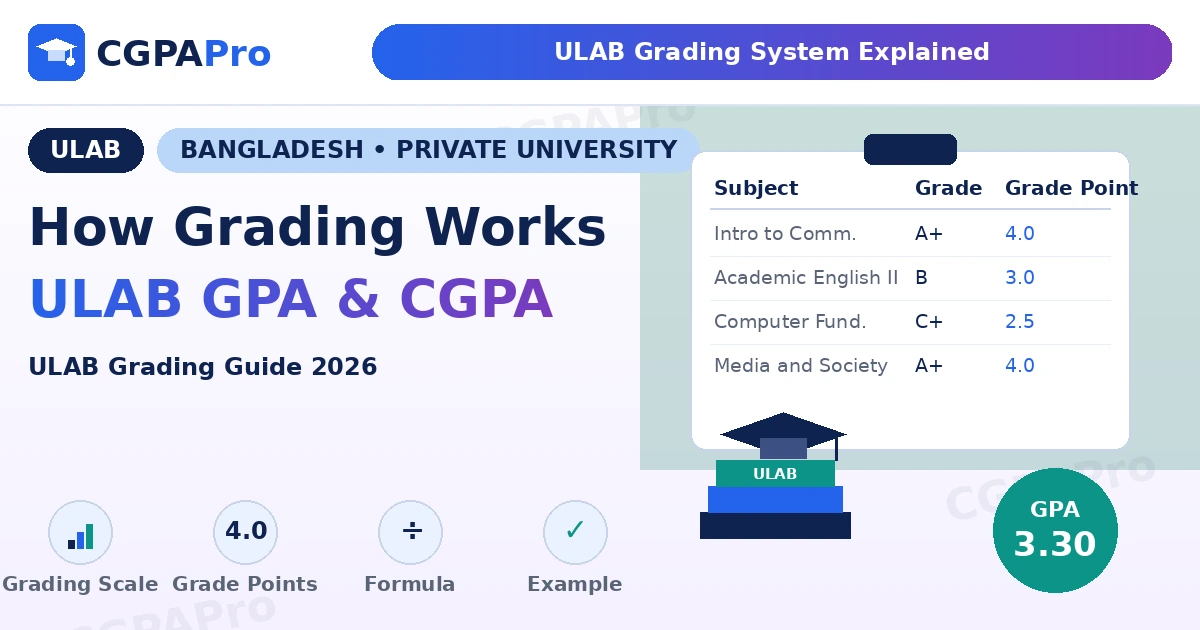
If you study at the University of Liberal Arts Bangladesh (ULAB) in Mohammadpur, Dhaka, and you have ever typed your grades into an online GPA calculator and gotten a number that doesn’t match your result sheet — this time, you are not the one making the mistake. Almost every generic GPA calculator for Bangladeshi universities quietly uses the UGC uniform scale (A+ = 4.00 from 80%, A = 3.75, A− = 3.50…), and ULAB does not use that scale. ULAB’s official grading table starts A+ at 95%, gives A+ and A the same 4.0 grade point, and grades D at 1.5 — numbers no generic calculator will produce for you.
Here is the short version: ULAB’s official table is A+ 4.0 (95%+), A 4.0 (90–94), A− 3.8 (85–89), B+ 3.3 (80–84), B 3.0 (75–79), B− 2.8 (70–74), C+ 2.5 (65–69), C 2.2 (60–64), D 1.5 (50–59), F 0.0 (below 50). Your term GPA is the credit-weighted average of your grade points, and your CGPA accumulates the same way across every term. What makes ULAB genuinely different from its peer universities: you may retake any course where you got a B or lower — but retaking permanently disqualifies you from the Summa Cum Laude honor, and the undergraduate probation line sits at 2.0 CGPA with three terms to recover.
This guide walks through the official table with its percentage bands, exactly where generic calculators get ULAB wrong (with a side-by-side comparison), a hand-verified worked example that matches the calculator screenshot below, the retake-versus-honors decision, the 2.0-vs-2.50 probation contradiction in ULAB’s own documents (flagged honestly), the ULAB-vs-IUB confusion that sends students to the wrong table, and the questions ULAB students actually ask — answered from ULAB’s published policies, most recently updated October 2026.
Use the CGPAPro Calculator the Right Way (Read This First)
Before anything else, run your own numbers — but understand the tool’s limits. The CGPAPro homepage calculator’s scale dropdown has a “UGC Bangladesh” option, and for ULAB that option is not ULAB’s official scale. It will give you ULAB’s exact answer only for the letters whose grade points match on both scales — A+ (4.0), B (3.0), and C+ (2.5). For every other letter (A, A−, B+, B−, C, D), the UGC dropdown computes different points than ULAB does, so use it as a framework and adjust those letters by hand with the official table below.
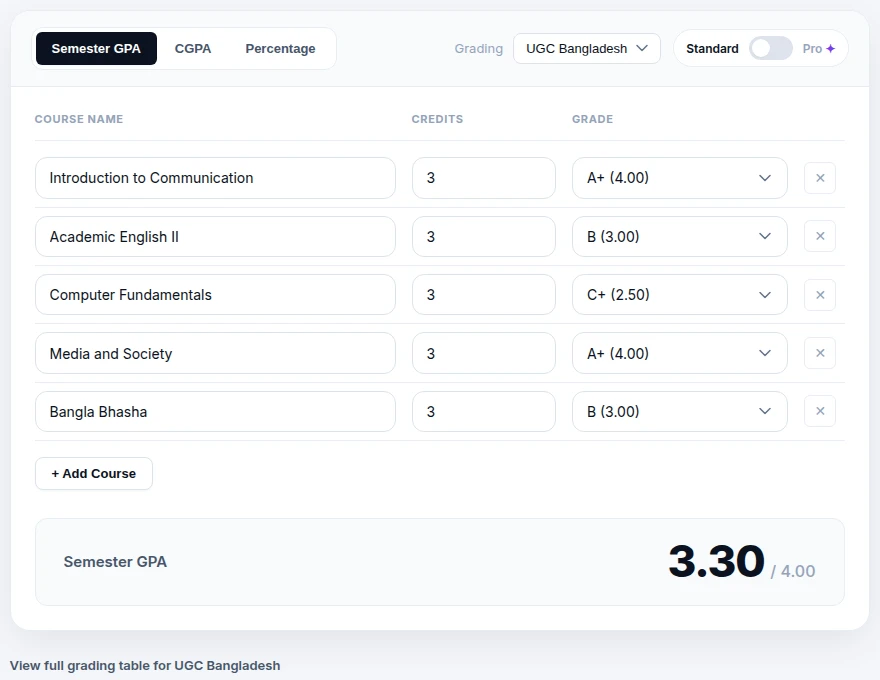
The screenshot shows our worked example entered into the calculator — five courses, result 3.30 / 4.00 — using only the three letters that match on both scales, so the number is exactly right for ULAB (the arithmetic is reproduced line by line in the worked-example section so you can check it):
How to fill it in for your own term:
- Enter each course name, its credit hours, and the letter grade. Type the credit number yourself — the field may show a default value that isn’t actually registered until you type.
- If your grades include only A+, B, or C+, the result is exact for ULAB. If they include A, A−, B+, B−, C, or D, the calculator will show ULAB’s official points only if you mentally substitute them: A− = 3.8 (not 3.50), B+ = 3.3 (not 3.25), A = 4.0 (not 3.75), C = 2.2 (not 2.25), D = 1.5 (not 2.00).
- Always cross-check one term’s result by hand using the official table before you trust a semester plan built on calculator output — the worked example below shows you exactly how.
The Official ULAB Grading Table
This is ULAB’s published table, taken from the General Academic Policy for Undergraduate (v3, dated 6 October 2026) and consistent across the Summer 2026 and Fall 2025 Undergraduate Handbooks. ULAB labels each grade with an official assessment word:
| Percentage of Marks | Letter Grade | Grade Point | Official Assessment |
|---|---|---|---|
| 95% and above | A+ | 4.0 | Outstanding |
| 90% to 94% | A | 4.0 | Superlative |
| 85% to 89% | A− | 3.8 | Excellent |
| 80% to 84% | B+ | 3.3 | Very Good |
| 75% to 79% | B | 3.0 | Good |
| 70% to 74% | B− | 2.8 | Average |
| 65% to 69% | C+ | 2.5 | Below Average |
| 60% to 64% | C | 2.2 | Passing |
| 50% to 59% | D | 1.5 | Probationary |
| Below 50% | F | 0.0 | Fail |
Special grades: I (Incomplete) 0.0, W (Withdrawn) 0.0, and AW (Administrative Withdrawal) 0.0. An ‘I’ converts to F automatically if it is not replaced with a regular grade within the following term. An AW is given for academic dishonesty — not for ordinary withdrawal.
Three things about this table deserve your attention. First, the famous quirk: A+ (95%+) and A (90–94%) are both worth 4.0. For CGPA math they are interchangeable — a 91% and a 97% contribute identically. But the letter still matters: the Vice-Chancellor’s Honors List requires ‘A’ in all subjects with a term GPA of 4.00, and tie-breaks use the count of A+/A grades. Chasing the extra 4–5 marks past 90% doesn’t lift your CGPA, but it can lift your honors standing.
Second, the band edges are hard: 84.6% is a B+, 85.0% is an A− — and that single step is worth 0.5 grade points (3.3 vs 3.8) per credit hour, the widest single gap in the table. ULAB has a formal grade-review process for exactly these boundary cases: request a recalculation from the course teacher within 7 days of result publication, then the Head of Department within the next 7 days, then the Controller of Exams (a fee applies, refunded if your grade improves) — all within 21 working days. The 84→85 and 89→90 boundaries are where a re-check can be worth real money in scholarship retention.
Third, note that C is officially labelled “Passing” and D is labelled “Probationary.” D (1.5, 50–59%) is the lowest letter that carries points; below 50% is an F and the course must be retaken. ULAB requires all courses for the degree to be passed — a standing F blocks graduation.
How GPA and CGPA Are Calculated at ULAB
The formula is the standard credit-weighted average. For each course, multiply the grade point by the course’s credit hours — that gives you “quality points.” Add all quality points, add all credit hours, and divide:
Term GPA = (sum of grade point × credit hours) ÷ total credit hours
CGPA = (sum of quality points across all completed terms) ÷ total credit hours across all completed terms
ULAB runs three terms a year — Spring (late January to April), Summer (late May to August), and Fall (mid-September to December) — each about 15 weeks. ULAB calls the per-term figure the TGPA (term grade point average); it is the number used for the VC’s and Dean’s Honors Lists. Your CGPA accumulates across all terms and is the number that matters for probation, graduation, scholarships, and the convocation honors (Summa/Magna/Cum Laude).
A note on assumptions: ULAB’s published policy does not state explicitly how failed courses enter the GPA math. The standard convention — and the one every calculator uses — is that an F counts as 0.0 grade points over its credit hours (it drags the average down). Treat this as a reasonable assumption, not a verified ULAB rule, and confirm with the Controller of Exams if an F is on your transcript. (For contrast, IUBAT officially excludes F credits from its CGPA math — a quirk that does not appear in ULAB’s published rules.) The worked example below contains no F, so the arithmetic is exact regardless.
Worked Example: Exactly How 3.30 Happens
Take a realistic ULAB term: five courses, each 3 credits — drawn from ULAB’s own course world (Academic English, Computer Fundamentals, and the compulsory GED course Bangla Bhasha all appear in ULAB’s published policies). The grades and the arithmetic, one line at a time:
| Course | Credits | Letter Grade | Grade Point | Quality Points |
|---|---|---|---|---|
| Introduction to Communication | 3 | A+ | 4.0 | 3 × 4.0 = 12.00 |
| Academic English II | 3 | B | 3.0 | 3 × 3.0 = 9.00 |
| Computer Fundamentals | 3 | C+ | 2.5 | 3 × 2.5 = 7.50 |
| Media and Society | 3 | A+ | 4.0 | 3 × 4.0 = 12.00 |
| Bangla Bhasha | 3 | B | 3.0 | 3 × 3.0 = 9.00 |
Total quality points: 12.00 + 9.00 + 7.50 + 12.00 + 9.00 = 49.50.
Total credit hours: 3 + 3 + 3 + 3 + 3 = 15.
Term GPA = 49.50 ÷ 15 = 3.30 / 4.00.
This is exactly what the calculator screenshot above shows — same courses, same grades, same 3.30. The example was chosen deliberately: A+ (4.0), B (3.0) and C+ (2.5) are the three letters whose points are identical on ULAB’s official scale and the calculator’s UGC Bangladesh scale, so no adjustment was needed. For your own transcript, convert any A, A−, B+, B−, C or D grades to ULAB’s official points from the table above before trusting a calculator total.
Why Generic Calculators Get ULAB Wrong (The Side-by-Side)
This comparison has never been published anywhere else, and it is the single most useful table for a ULAB student. Take three realistic marks and see what the two scales do with them:
| Marks | UGC-scale calculator says | ULAB’s official table says | Error |
|---|---|---|---|
| 92% | A+ 4.00 | A 4.0 | None in points — but the letter differs, and VC’s List tie-breaks count A+/A letters |
| 86% | A+ 4.00 | A− 3.8 | Calculator overstates by 0.20 per credit |
| 82% | A+ 4.00 | B+ 3.3 | Calculator overstates by 0.70 per credit — huge |
| 78% | A 3.75 | B 3.0 | Calculator overstates by 0.75 per credit |
| 73% | A− 3.50 | B− 2.8 | Calculator overstates by 0.70 per credit |
| 63% | B 3.00 | C 2.2 | Calculator overstates by 0.80 per credit |
| 55% | B− 2.75 | D 1.5 | Calculator overstates by 1.25 per credit |
| 42% | D 2.00 | F 0.0 — fail | Calculator calls it a pass; ULAB calls it a fail |
The pattern is consistent: the UGC-uniform scale overstates a ULAB student’s marks at nearly every band — sometimes by nearly a full grade point per credit. A student who enters their percentage marks into a UGC-scale calculator and sees 3.60 could actually be sitting at 2.90. That gap is the difference between keeping a scholarship and losing it. The fix is simple: convert percentages to ULAB letters first, using the official table, and only then compute — or use the calculator for the arithmetic but replace any A, A−, B+, B−, C or D points with ULAB’s official values.
Read More:
Retake a B? The Summa Cum Laude Price Tag
ULAB’s retake rule is unusually generous — and unusually costly at the top end. The official policy states that a student may retake a course if he or she receives a ‘B’ grade or lower in it. Most Bangladeshi private universities only allow retakes below B; ULAB explicitly includes the B itself. You re-register for the course, pay tuition and applicable fees again, and take your chances.
The price tag: any retake — for whatever reason — permanently excludes you from the Summa Cum Laude award (CGPA 3.95–4.00). You remain eligible for Magna Cum Laude (3.85–3.94) and Cum Laude (3.75–3.84). This exclusion also applies to courses transferred in from other universities.
So the decision framework is: if you are a 3.9+ student retaking a B to push for the Gold Medal or Summa, the retake itself kills the Summa — run that math before you pay. If you are at 3.4 retaking a B− to protect a scholarship that requires 3.50, the Summa was never in play anyway, and the retake is pure gain. And a failed course (F) is non-negotiable: you must repeat it, because no F can stand on a graduating transcript — students cannot graduate without passing all required courses, and mandatory GED failures must be retaken within two terms of enrollment.
One honest gap: ULAB’s published policy does not say whether the latest grade or the highest grade counts in the CGPA after a retake. Do not assume — confirm with your academic advisor or the Controller of Exams before paying for a retake, because the answer changes the entire cost-benefit calculation.
Probation and Dismissal: The 2.0 Rule (and a Contradiction You Should Know)
Under ULAB’s newest undergraduate policy (General Academic Policy v3, October 2026): a student is placed on probation if CGPA falls below 2.0, and gets a maximum of three terms to raise it to 2.0 or above — failing which, dismissal. A dismissed student who takes fresh admission is eligible for a course waiver for credits completed with grades of C or above.
Here is the contradiction, stated plainly because no competitor article mentions it: ULAB’s older documents — the 2015 General Academic Policy and the Graduate Handbook (Spring 2024) — say good standing means a minimum CGPA of 2.50, with probation below 2.50 and two terms to recover. The newest undergraduate document says 2.0 with three terms. The likeliest reading is that the graduate programs use 2.50 while undergraduates now fall under 2.0 — but ULAB has not published an explanation, so treat the October 2026 document as the undergraduate rule and verify against your own department’s handbook. Do not plan your academic life around the wrong number.
Related tripwires worth knowing: six or more unexcused absences in a course may result in a failing grade at the teacher’s discretion; failing the GED English courses three terms running blocks registration for everything else until you pass them; and every bachelor’s degree must be completed within eight years of first enrollment.
Honors, Scholarships, and the CGPA Numbers That Unlock Them
ULAB publishes exact CGPA bands for its honors — rare transparency, and genuinely useful for planning:
- Summa Cum Laude: 3.95–4.00 (no retakes, ever)
- Magna Cum Laude: 3.85–3.94
- Cum Laude: 3.75–3.84
- Gold Medal: highest CGPA among undergraduates (and separately among graduates)
- Vice-Chancellor’s Honors List (per term): one student university-wide; requires ‘A’ in all subjects with TGPA 4.00, minimum 4 courses / 12 credits, full course load the previous term → full tuition and registration fee benefit
- Dean’s Honors List (per term): one student per department; top TGPA holder, minimum 3 courses / 9 credits, at least three terms completed with TGPA ≥ 3.50 → full tuition fee waiver (final-term students ineligible)
Scholarship retention is equally explicit — admission waivers continue only if you hold the CGPA in the second column:
| Waiver level | Minimum CGPA to retain |
|---|---|
| 100% | 3.50 |
| 75–99% | 3.30 |
| 50–74% | 3.00 |
| 30–49% | 2.80 |
| Up to 29% | 2.50 |
Two things students routinely miss: ULAB gives a 10% scholarship to all female students automatically, and non-academic merit scholarships can be reduced or withdrawn for poor attendance or misconduct — the CGPA table is only half the retention story.
ULAB vs IUB vs IUBAT: Don’t Use the Wrong Table
Search results for ULAB grading are polluted with similarly-named institutions, and using the wrong table guarantees a wrong CGPA. Check your university name against this list:
- ULAB — University of Liberal Arts Bangladesh, Mohammadpur, Dhaka (ulab.edu.bd). This article’s table: A+ 4.0 from 95%, A also 4.0, A− 3.8, D 1.5 (Probationary), F below 50%; probation below 2.0 CGPA (undergraduate, per the October 2026 policy).
- IUB — Independent University, Bangladesh, Bashundhara R/A, Dhaka (iub.edu.bd). A different university with a different scale: A 4.0 from 90%, A− 3.70, B+ 3.30, B− 2.70, C+ 2.30, C 2.00 and so on; probation below 2.00. IUB’s “Green Book” PDFs rank for ULAB-adjacent queries and are the #1 source of confusion.
- IUBAT — International University of Business Agriculture and Technology, Uttara, Dhaka (iubat.edu). Yet another scale: the UGC uniform table (A+ 4.00 from 80%, A 3.75, A− 3.50…); probation and graduation at 2.50 CGPA.
There is also irrelevant international noise — MIT’s “u-lab” (Presencing Institute) — that shows up in “ULAB” searches. If the page you are reading is not on ulab.edu.bd or about the Mohammadpur, Dhaka university, close it.
Common Mistakes ULAB Students Make
- Using a UGC-scale calculator as-is. The single biggest error: entering marks into a UGC-uniform calculator and believing the number. At nearly every band it overstates ULAB grades — by up to 1.25 points per credit at the D/F boundary, where it even calls a fail a pass.
- Assuming 80% is an A+. At ULAB, 80–84% is a B+ (3.3). Students transferring from UGC-scale universities walk straight into this one.
- Retaking a B without knowing the Summa cost. ULAB lets you retake at B or lower — generous — but the retake permanently kills Summa Cum Laude. Decide with eyes open.
- Assuming an F is excluded from the CGPA. That exclusion is an IUBAT rule. ULAB’s published policy says nothing of the sort — assume an F drags your average as 0.0 until the Controller’s office tells you otherwise.
- Letting an Incomplete sit. An ‘I’ auto-converts to F if not replaced within the following term. The clock is real.
- Ignoring the 21-day grade-review window. Boundary marks (84→85, 89→90) are worth real scholarship money, and the review process — teacher, then HoD, then Controller of Exams with a refundable fee — closes 21 working days after result publication.
- Six unexcused absences. It can fail you in a course at the teacher’s discretion, regardless of your marks.
Tips to Keep Your ULAB CGPA Healthy
- Convert percentages to ULAB letters first. Never feed raw percentages into a UGC-scale calculator. ULAB letters first, then points, then math.
- Defend the 84→85 and 89→90 edges. At ULAB the B+→A− jump is 0.5 points per credit and A−→A is 0.2 — a re-check at those boundaries is the highest-value action in the grading system.
- Know your waiver number. If you hold a 100% waiver, your real target isn’t graduation — it’s 3.50, every term. Track TGPA against that line, not against 2.0.
- Use the “B or lower” retake rule surgically. Retakes cost full tuition and forfeit Summa. Target retakes where the quality-point gain is largest per taka — typically a D or C in a 3-credit course — and skip retaking a B unless the Summa was never your goal.
- Meet the 21-day review clock. If a result looks wrong at a boundary, start the teacher review within 7 days. Waiting is the only way to lose the option entirely.
- Protect your transcript from AW. Administrative Withdrawal is given for academic dishonesty — it sits at 0.0 and, unlike a W, signals misconduct. It is the one grade no retake can reframe.
Read More:
Frequently Asked Questions
What is the grading scale at ULAB?
ULAB’s official scale (General Academic Policy for Undergraduate v3, October 2026): A+ 4.0 (95% and above), A 4.0 (90–94), A− 3.8 (85–89), B+ 3.3 (80–84), B 3.0 (75–79), B− 2.8 (70–74), C+ 2.5 (65–69), C 2.2 (60–64), D 1.5 (50–59), F 0.0 (below 50%). Note this is not the UGC uniform scale — generic calculators will give different numbers.
Are A+ and A really both worth 4.0 at ULAB?
Yes. Both A+ (95%+) and A (90–94%) carry a 4.0 grade point, so they contribute identically to your CGPA. The letter still matters for the Vice-Chancellor’s Honors List (which requires ‘A’ in all subjects) and for tie-breaks, which count your A+/A grades.
Is 80% an A+ at ULAB?
No. At ULAB, 80–84% is a B+ worth 3.3 grade points. A+ starts at 95%. This is the single most common expectation error among students arriving from HSC backgrounds or UGC-scale universities.
Can I retake a course where I got a B at ULAB?
Yes — ULAB’s retake policy explicitly allows retaking any course where you received a ‘B’ grade or lower, which is more generous than most universities. You pay tuition and fees again. The catch: any retake permanently excludes you from the Summa Cum Laude award (3.95–4.00); you remain eligible for Magna Cum Laude.
When I retake a course, which grade counts toward my CGPA?
ULAB’s published policy does not state this — neither “latest grade” nor “highest grade” appears in the General Academic Policy. Do not assume; confirm with your academic advisor or the Controller of Exams before you pay for a retake, because the answer changes whether the retake is worth it.
What CGPA puts me on probation at ULAB?
Under the newest undergraduate policy (October 2026): probation below 2.0 CGPA, with three terms to recover to 2.0 or face dismissal. Older ULAB documents (including the graduate handbooks) state 2.50 with two terms — graduate students should follow their own handbook. If your department’s handbook shows something different, the handbook wins.
What does a D (Probationary) mean — did I pass?
D (1.5, 50–59%) is the lowest letter grade that carries points, and C is officially labelled “Passing.” ULAB’s documents do not spell out the practical consequences of the “Probationary” label beyond the grade point itself — but a D drags your average hard (1.5 vs the 2.0 probation line), and retaking a D is explicitly allowed. A failed course (F) must be repeated; you cannot graduate with standing Fs.
The Bottom Line
ULAB grading is its own system, and that is the entire point of this guide: a 95%-based table where A+ and A are both 4.0, an A− worth 3.8, and a D worth only 1.5 — numbers no UGC-uniform calculator will hand you. The four numbers that run your academic life at ULAB are 2.0 (the undergraduate probation line, three terms to recover), B (the retake threshold — retake anything at B or lower, but know it ends the Summa Cum Laude dream), 3.50 (the CGPA that keeps a 100% waiver alive), and 21 (the working days you have to challenge a boundary grade). Convert percentages to ULAB letters before you compute anything, verify retake and probation details against your own department’s handbook given the document contradictions, and double-check that any grade table you are reading belongs to ULAB in Mohammadpur — not IUB in Bashundhara. For everything ULAB has not published — retake grade accounting, the F-weighting rule, the meaning of “Probationary” — the Controller of Examinations is the only authority that counts.
Sources: the General Academic Policy for Undergraduate v3 (2026-10-06) at csd.ulab.edu.bd; the Undergraduate Handbook, Summer 2026; and the General Academic Policy and Code of Conduct v2 (2025), all on ULAB’s official domains.