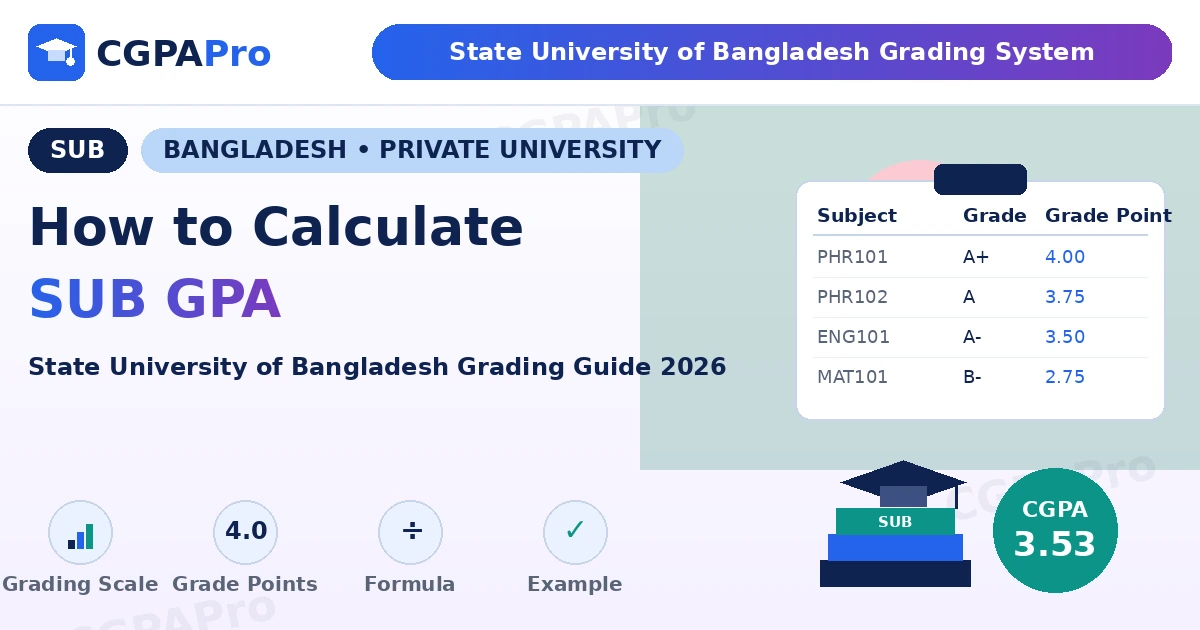
Here is the short version: State University of Bangladesh (SUB) uses the UGC Bangladesh uniform grading scale on a 4.00 system — A+ (80–100 marks) earns 4.00, A (75–79) earns 3.75, A− (70–74) earns 3.50, stepping down through B+, B, B−, C+, C, D (40–44, grade point 2.00) to F (below 40), which earns zero. Your semester GPA is the credit-weighted average of your grade points, and your CGPA is the same idea across every semester. This is not an assumption — the university’s own Vice-Chancellor has said on the record that SUB has “steadfastly adhered to a uniform grading system” since its inception, and this guide walks you through the verified table, the exact formula, and two worked examples with real numbers.
Before anything else, a note on the name, because this one trips people up constantly: this page is for State University of Bangladesh (SUB), Dhaka — the private university founded in 2002. It is not Stamford University Bangladesh (which also shortens its name to “SUB”), and it has nothing to do with any other “SUB” you might see in search results. The Stamford scale is a different grading document with different rules; if you study there, this table is not yours. And if you are a SUB student who landed here by way of a generic “Bangladesh CGPA calculator,” read the warning in the next section before trusting its default preset — many of those tools quietly hand private-university students the NSU-style scale (90–100 = A), which gives wrong grade points for SUB courses.
How to Check Your GPA and CGPA Online (2 Minutes)
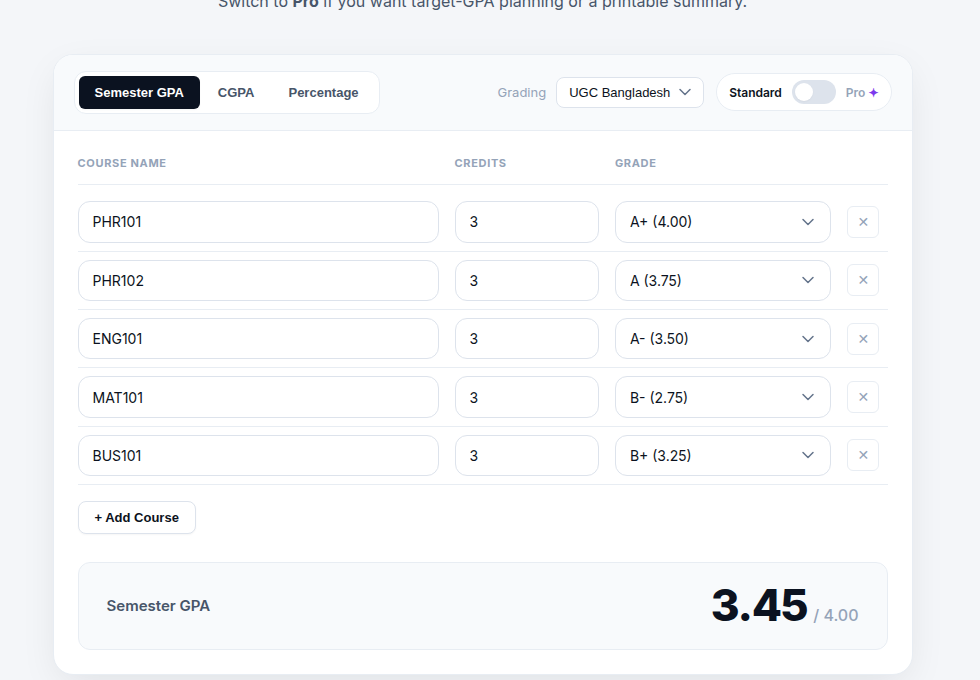
The fastest way to get an accurate number is to let a calculator do the credit-weighting for you. The CGPAPro calculator is set to the standard 4.00 scale that matches SUB’s official table — you just enter each course and its grade:
- Open the CGPAPro calculator (it works on your phone too).
- Add one row per course: type the course name, enter the credit hours (most SUB theory courses are 3 credits; lab/sessional courses are usually 1.5), and select the letter grade from the dropdown.
- The calculator multiplies each grade point by its credits, adds everything up, and divides by total credits — the exact UGC formula.
- Compare the result against the worked examples below to make sure it matches.
Heads-up: make sure the calculator’s scale is set to the UGC Bangladesh preset — A+ = 4.00, A = 3.75, A− = 3.50, B+ = 3.25, B = 3.00, B− = 2.75, C+ = 2.50, C = 2.25, D = 2.00, F = 0.00. If you use a site that defaults private universities to the “90–100 = A, 4.00” scale, your 78 (a genuine A at SUB, worth 3.75) will be recorded as a B+ worth 3.30 — nearly half a grade point stolen per course. That is the single most common way SUB students get a wrong CGPA from the internet.
SUB Official Grading Table (2026)
In an interview with The Business Standard, SUB’s Vice-Chancellor (Designate) was asked directly whether the university planned to introduce a uniform grading system. His answer: “Since our inception, we have steadfastly adhered to a uniform grading system at the State University of Bangladesh.” That “uniform grading system” is the UGC Bangladesh uniform grading guideline — the same 4.00 table used across the country’s public and private universities since the 2006–2007 session. Here it is, exactly as the UGC publishes it:
| Numerical Score (%) | Letter Grade | Grade Point |
|---|---|---|
| 80 and above | A+ | 4.00 |
| 75 to less than 80 | A | 3.75 |
| 70 to less than 75 | A− | 3.50 |
| 65 to less than 70 | B+ | 3.25 |
| 60 to less than 65 | B | 3.00 |
| 55 to less than 60 | B− | 2.75 |
| 50 to less than 55 | C+ | 2.50 |
| 45 to less than 50 | C | 2.25 |
| 40 to less than 45 | D | 2.00 |
| Less than 40 | F | 0.00 |
A few things worth noticing. First, 40 is the line that matters: 40 is a D (you pass), 39 is an F (you don’t — no credit, and the course must be retaken). Second, the boundaries are “less than” bands, not rounded ranges — 79.5 is an A, not an A+, because it is “less than 80.” Third, the UGC guideline also allows the non-numeric codes you’ll see on transcripts: I = Incomplete and W = Withdrawn. Neither carries grade points, so they don’t move your GPA up or down — they simply don’t count.
📖 Read More
- NSU vs IUB vs BRACU Grading Comparison 2026 — how SUB’s UGC scale compares to the private universities that use the different 90–100 = A scale (the one you should NOT use).
- Daffodil International University Grading System 2026 — another UGC-scale university guide in the same format as this one.
How Your Final Course Mark Is Built
Your letter grade doesn’t come from a single exam. Under the UGC-style system SUB follows, a course’s total of 100 marks is assembled from continuous assessment during the semester (class attendance, class tests, quizzes, assignments, presentations, viva) plus the mid-term and semester-final examinations. The exact weight of each component varies by department and is spelled out in your course outline — check yours rather than assuming a fixed split. What matters for the math is the pipeline: every component adds to a total out of 100, and that total is mapped onto the table above.
Trace one realistic course through the pipeline. Say a BBA student finishes the semester with 73 out of 100 in Microeconomics. On the official table, 73 sits in the “70 to less than 75” band → A− (3.50). Now imagine the same student had lost 4 marks on quizzes they skipped: 69 out of 100 → B+ (3.25). Four marks of skipped continuous assessment cost a quarter of a grade point — on a 3-credit course that’s 0.75 quality points gone from the GPA numerator. The quizzes you shrug off in week 4 are the GPA you miss in the transcript.
How to Calculate Your GPA and CGPA — Step by Step
The UGC formula is the same one SUB uses:
GPA / CGPA = Σ (Credit Hours × Grade Points) ÷ Total Credit Hours
Your semester GPA uses the formula for one semester’s courses only; your CGPA extends it across every course you have ever completed. Here is the process:
- Convert each course’s total marks to a letter grade using the official table above. Remember: “less than” boundaries — 79.9 is an A, not an A+.
- Convert the letter grade to its grade point (A+ = 4.00, A = 3.75, and so on down to D = 2.00, F = 0.00).
- Multiply the grade point by the course’s credit hours. This is the course’s “quality points.”
- Add up all quality points (the numerator) and all credit hours (the denominator).
- Divide. The result, usually rounded to two decimals, is your GPA (one semester) or CGPA (all semesters).
Notice what happens to a failed course: it contributes zero quality points, but its credits still sit in the denominator. That is why an F drags your average down far harder than a D — and why clearing an F is the single highest-leverage repair a SUB student can make to their CGPA.
Worked Example 1: One Full Semester (SGPA)
Let’s follow a first-semester B.Pharm student through five courses. SUB runs on a semester system with two semesters a year, and each course carries its own credit weight:
| Course | Credits | Marks | Grade | Grade Point | Quality Points |
|---|---|---|---|---|---|
| Pharmaceutical Chemistry | 3 | 82 | A+ | 4.00 | 12.00 |
| Anatomy & Physiology | 3 | 76 | A | 3.75 | 11.25 |
| English Composition | 3 | 71 | A− | 3.50 | 10.50 |
| Mathematics | 3 | 58 | B− | 2.75 | 8.25 |
| Principles of Business Administration | 3 | 67 | B+ | 3.25 | 9.75 |
| Total | 15 | 51.75 |
Check the band logic: 82 is “80 and above” → A+; 76 is “75 to less than 80” → A; 71 is “70 to less than 75” → A−; 58 is “55 to less than 60” → B−; 67 is “65 to less than 70” → B+. Quality points: 12.00 + 11.25 + 10.50 + 8.25 + 9.75 = 51.75. Divide by 15 credits:
SGPA = 51.75 ÷ 15 = 3.45
That 3.45 is solidly in the “first class” zone (3.00–4.00) — the band Bangladeshi employers and scholarship committees actually look for. Notice how the single B− in Mathematics (8.25 points) pulls the average down: replace it with a B (9.00) and the semester becomes 52.50 ÷ 15 = 3.50. One weak course, one retake-or-improve decision, and the headline number moves.
Worked Example 2: CGPA Across Four Semesters
CGPA is not the average of your semester GPAs — it is the credit-weighted average of everything. A 3-credit semester and an 18-credit semester do not count equally. Take the same student’s first four semesters:
| Semester | Credits | SGPA | Quality Points (SGPA × Credits) |
|---|---|---|---|
| Semester 1 | 15 | 3.45 | 51.75 |
| Semester 2 | 16 | 3.30 | 52.80 |
| Semester 3 | 15 | 3.60 | 54.00 |
| Semester 4 | 18 | 3.75 | 67.50 |
| Total | 64 | 226.05 |
51.75 + 52.80 + 54.00 + 67.50 = 226.05 quality points. Divide by 64 total credits:
CGPA = 226.05 ÷ 64 = 3.53
Two lessons hide in this table. First, semester 2’s dip to 3.30 was absorbed because semesters 3 and 4 were stronger and carried more credits — a good semester counts more when it carries more credits. Second, the plain average of the four SGPAs (3.45 + 3.30 + 3.60 + 3.75) ÷ 4 = 3.525 rounds to the same 3.53 here only by coincidence; with uneven credit loads the two methods diverge, and the transcript always uses the credit-weighted one.
GPA vs CGPA — What’s the Difference?
Students mix these up constantly, so here is the clean version:
- GPA (Grade Point Average) = one semester only. It tells you how that single semester went.
- CGPA (Cumulative GPA) = all semesters so far, credit-weighted. It is the number on your final transcript, the number employers ask for, and the number foreign universities convert.
A useful mental model: your GPA is a photograph of one semester; your CGPA is the whole film. Early semesters matter disproportionately — not because the formula favors them, but because there are fewer credits to dilute them. A 2.80 in your first 15-credit semester needs a lot of strong semesters to bury, which is exactly why the improvement strategies at the end of this guide start with repairing old damage, not just acing new courses.
Common Mistakes SUB Students Make
- Using the wrong scale preset. This is the big one, and it’s worth repeating. Some popular calculator sites split their tables into “public” and “private” university presets, and their private preset is the NSU/BRAC-style scale — 90–100 = A at 4.00, fail below 45. SUB is private but follows the UGC uniform scale. A SUB student with 78 marks has an A (3.75); the NSU preset calls that a B+ (3.30). Always check which scale the tool is applying before you trust its number.
- Carrying the HSC 5.00 scale into university math. Freshmen arrive from SSC/HSC, where GPA is out of 5.00 and A+ means 80+ at 5.00. At SUB, the scale is 4.00 and the letters map differently — your HSC “A” instincts will misread the table. The admission pages themselves quote both scales (B.Pharm requires a 3.50 on the 5.0 HSC scale for Chemistry/Biology), which is exactly why the confusion survives. Rule of thumb: anything from before university is the 5-scale; anything at SUB is the 4-scale.
- Forgetting that an F’s credits still divide. A surprising number of students compute their GPA as if a failed course simply vanishes. It doesn’t vanish from the denominator — 0 quality points over 3 credits is a live wound in your average until you retake and pass. Model the retake in your spreadsheet and watch the number move; that gap is your motivation.
- Treating all credits as equal. A 1.5-credit lab and a 3-credit theory course do not pull the average equally. Students pour effort into easy low-credit courses and neglect the heavy theory courses, then wonder why the GPA barely moves. Spend your study hours in proportion to credits.
- Misreading “first class.” In Bangladesh’s university convention, 3.00–4.00 is first class, 2.25–2.99 is second class, and 2.00–2.24 is third class. A 2.80 is not “almost first class” — it’s second class, and for BCS, government banks, and most scholarships the cutoffs are written in exactly these terms. Know which band you’re actually in.
How to Improve Your CGPA at SUB
Retake failed courses first. An F contributes 0.00 × credits. Turning that same course into even a D (2.00) adds 6 quality points per 3 credits — the single biggest swing available to most students. Under the UGC system, F-grade courses must be repeated to earn the degree, so this isn’t optional anyway; the question is only how fast you clear them. Our full guide to how retaking a course affects your CGPA walks through the math.
Target the band edges. The grade bands are 5 marks wide, and the “less than” boundaries create cliffs. If you’re sitting at 74, one more mark in the final takes you from A− (3.50) to A (3.75) — a 0.25 jump worth 0.75 quality points on a 3-credit course. When you know your running total mid-semester, you can see exactly which courses are one quiz away from the next band and allocate revision time there.
Protect continuous assessment. Attendance, quizzes, assignments, and presentations make up the non-final portion of your 100 marks, and they are the most controllable marks in the entire course. Final exams are high-variance; a quiz you prepare for over two evenings is nearly guaranteed marks. Students who treat the 30-ish percent of “small” marks as free points consistently land one band higher than their exam-only performance suggests.
Use improvement retakes where your handbook allows. Beyond mandatory F retakes, many UGC-system universities let students re-sit courses where they earned a low passing grade (often C or D) to lift it — but the exact eligibility, fee, and grade-replacement rule at SUB is not something I could verify from a published SUB source, so check your current program handbook or department office before planning around it. What is universal: never attempt an improvement retake without modeling it first. If a C+ (2.50) becomes a B (3.00) on a 3-credit course, you gain 1.5 quality points — real, but small next to clearing an F, so prioritize accordingly.
Front-load your effort each semester. Because CGPA is credit-weighted across everything, a weak semester early on needs multiple strong semesters to dilute. The cheapest CGPA points you’ll ever earn are the ones in the semester you’re in right now. More tactics in our complete guide to improving your CGPA.
Frequently Asked Questions
What is the passing mark at State University of Bangladesh?
The minimum passing grade is D, which covers 40 to less than 45 marks (grade point 2.00). Anything below 40 is an F — no credit earned, and the course must be repeated. Practically, treat 40 as the absolute floor and 45 (the C band) as the line where your GPA stops bleeding.
Does SUB use the same grading scale as NSU or BRAC University?
No — and this is the misconception this whole guide exists to kill. SUB follows the UGC uniform grading scale (80–100 = A+, 4.00; fail below 40), confirmed by the university’s own Vice-Chancellor. NSU, BRACU, IUB, AIUB and several other private universities use a North-American-style scale (90–100 = A, 4.00; fail below 45). Same city, same “private university” label, completely different numbers. Using the wrong one corrupts every calculation you make.
My HSC GPA was on a 5.00 scale. How does that relate to my SUB CGPA?
It doesn’t convert — they’re separate systems. SSC/HSC use the national 5.00 scale; SUB’s university courses use the UGC 4.00 scale. Your HSC grades matter for one thing only: admission (for example, B.Pharm requires specific HSC subject grades per the Pharmacy Council). Once you’re enrolled, only the 4.00 table in this guide governs your courses. Never try to “convert” your 5-scale HSC GPA into a university CGPA — there is no official formula, and any number you produce is fiction.
If I fail a course, what happens to my CGPA?
An F gives you 0.00 grade points, but the course’s credits remain in the denominator — so it actively drags your GPA down. The course must be retaken to earn the degree. Once you pass the retake, the new grade’s quality points enter the calculation. Because SUB hasn’t published its exact retake/replacement wording in a source I could verify, confirm with your department whether the old F remains visible on the transcript and how the two attempts combine — policies vary.
Is a 3.00 CGPA “first class” in Bangladesh?
Yes. The Bangladesh university convention is: 3.00–4.00 = first class, 2.25–2.99 = second class, 2.00–2.24 = third class. A CGPA of 3.00 is exactly the first-class threshold, and it’s the cutoff many employers, BCS circulars, and scholarship programs write into their requirements. It is not “average” — it’s the line that unlocks most opportunities.
How do foreign universities read a SUB CGPA?
Most credential evaluators (WES and similar) recognize the UGC Bangladesh 4.00 scale directly, so a SUB CGPA like 3.53 converts cleanly — no scale translation needed, because SUB is already on the international-style 4.0. What evaluators do look at is the transcript’s credit hours and the class standing: keep your own record of credits per course, because that’s what makes your conversion unambiguous.
The Bottom Line
State University of Bangladesh keeps it simple: one uniform UGC 4.00 scale, applied since the university’s founding, with 40 marks as the passing line and credit-weighted math doing the rest. The students who get burned are the ones who calculate with someone else’s scale — an NSU preset, an HSC habit, a generic calculator’s default. Now you have the verified table, the formula, and two worked examples to check any tool against. Run your own numbers through the CGPAPro calculator on the UGC Bangladesh setting, and if the result doesn’t match what you computed by hand here, trust the hand math — and the official table — first.
Note on sources: the grade table and the university’s uniform-scale position are verified from the UGC Bangladesh official guideline and SUB’s Vice-Chancellor’s published interview. Retake eligibility, probation thresholds, and the graduation CGPA minimum are not published in a SUB source I could access — always confirm those three with your program handbook or department office. Official site: sub.edu.bd.