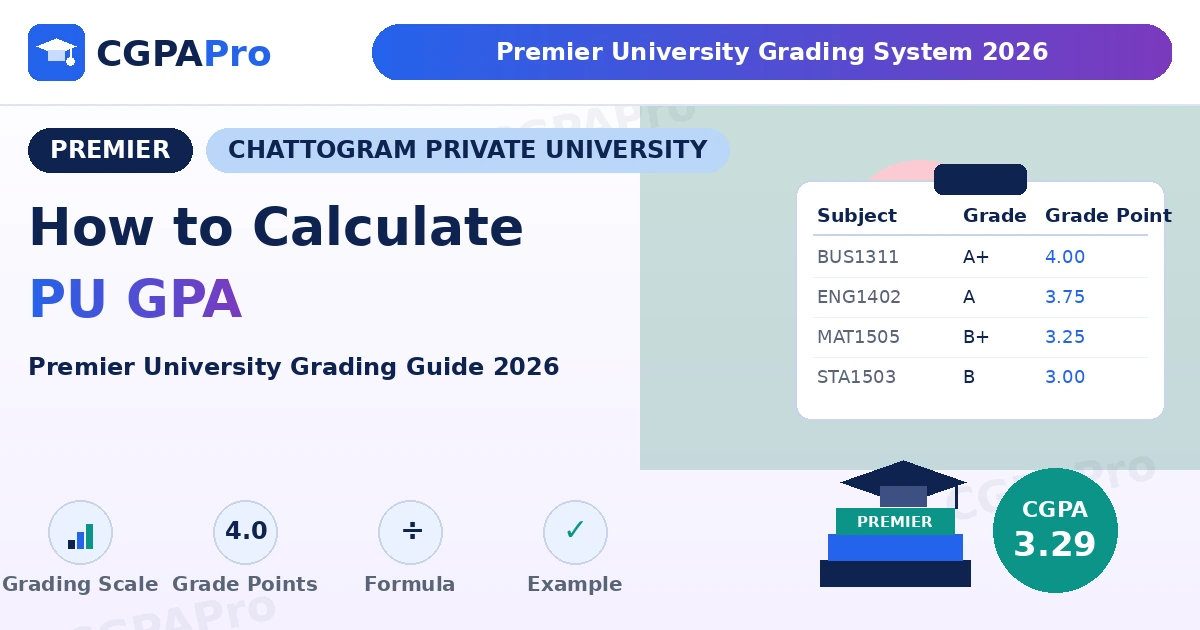
Quick answer: Premier University (PU) in Chattogram grades on the official UGC Bangladesh 4.00 scale — 80% and above earns an A+ (4.00), and anything below 40% is an F. Your semester GPA is the credit-weighted average of your grade points, and you need a minimum CGPA of 2.00 to graduate. This guide gives you the full official table, the exact 40/60 marks split, two fully worked examples, and the PU-specific rules that actually move your CGPA — including the retake-vs-recourse distinction, the twice-only retake cap, and an official rounding rule that can quietly push your CGPA up a notch.
If you searched for “Premier University” and landed here wondering whether this is the same as Prime University in Dhaka or Port City International University down the road in Chattogram — it is not. Premier University (puc.ac.bd) is the Chattogram private university established in 2002 under the Chattogram City Corporation, motto “Centre of excellence for quality learning.” Prime University (primeuniversity.edu.bd) is a different institution in Dhaka. And if you typed the wrong domain, note this: PU’s official website is puc.ac.bd, not premieruniversity.edu.bd — several third-party pages get this wrong.
The Official PU Grade Table
Premier University publishes its grading policy in its official curriculum documents (the BBA OBE document hosted on the university’s own admin.puc.ac.bd domain, page 83). The scale is the uniform UGC 4.00 scale — no institutional deviation:
| Marks Range | Letter Grade | Grade Point |
|---|---|---|
| 80% and above | A+ | 4.00 |
| 75% to less than 80% | A | 3.75 |
| 70% to less than 75% | A− | 3.50 |
| 65% to less than 70% | B+ | 3.25 |
| 60% to less than 65% | B | 3.00 |
| 55% to less than 60% | B− | 2.75 |
| 50% to less than 55% | C+ | 2.50 |
| 45% to less than 50% | C | 2.25 |
| 40% to less than 45% | D | 2.00 |
| Less than 40% | F | 0.00 |
At PU, A+ through D are passing grades; F is the failing grade. The minimum passing grade is therefore a D (40–44%). Note the band boundaries carefully: 79.9% is an A, not an A+. Those single percentage points at the boundary are where real GPA money is won and lost.
How Your 100 Marks Are Split
PU divides every course into 40% continuous assessment and 60% summative assessment. The official component weights are:
| Component | Weight | Type |
|---|---|---|
| Class Attendance and Participation | 10% | Continuous |
| Quiz | 10% | Continuous |
| Assignment and Presentation | 10% | Continuous |
| Class Test | 10% | Continuous |
| Mid Term | 20% | Summative |
| Final Examination | 40% | Summative |
The practical takeaway: 40% of your grade is decided before the final exam even begins. A student who treats attendance, quizzes, and assignments as throwaway marks walks into the final needing near-perfection to reach an A. If any assessment is missed, you can apply to the course teacher with proper evidence for a make-up — but the teacher decides case by case, so there is no automatic right to one.
The GPA & CGPA Formula (PU’s Official 4-Step Procedure)
PU’s documents spell out the calculation as a four-step procedure:
- For each course, multiply its credits (Ci) by the grade point earned (Gi) → Ci × Gi.
- Add up all the Ci × Gi values → total grade points earned.
- Add up all the credits → total credits.
- Divide total grade points by total credits.
In plain form: GPA = Σ (credits × grade point) ÷ Σ credits. The same formula gives your CGPA when applied across all semesters completed so far. If you want the general walkthrough, see our SGPA formula guide and what CGPA means.
Worked Example 1: One PU Semester (GPA 3.30)
Meet a fictional PU freshman, Tanvir, in his first BBA semester. Five courses, 3 credits each:
| Course | Marks | Grade | Grade Point | Credits | Quality Points |
|---|---|---|---|---|---|
| BUS 1311 Introduction to Business | 84% | A+ | 4.00 | 3 | 12.00 |
| ENG 1402 Basic English | 77% | A | 3.75 | 3 | 11.25 |
| MAT 1505 Introduction to Mathematics | 67% | B+ | 3.25 | 3 | 9.75 |
| STA 1503 Basic Statistics | 62% | B | 3.00 | 3 | 9.00 |
| PSY 1312 Introduction to Psychology | 52% | C+ | 2.50 | 3 | 7.50 |
Total quality points: 12.00 + 11.25 + 9.75 + 9.00 + 7.50 = 49.50
Total credits: 3 + 3 + 3 + 3 + 3 = 15
Semester GPA: 49.50 ÷ 15 = 3.30
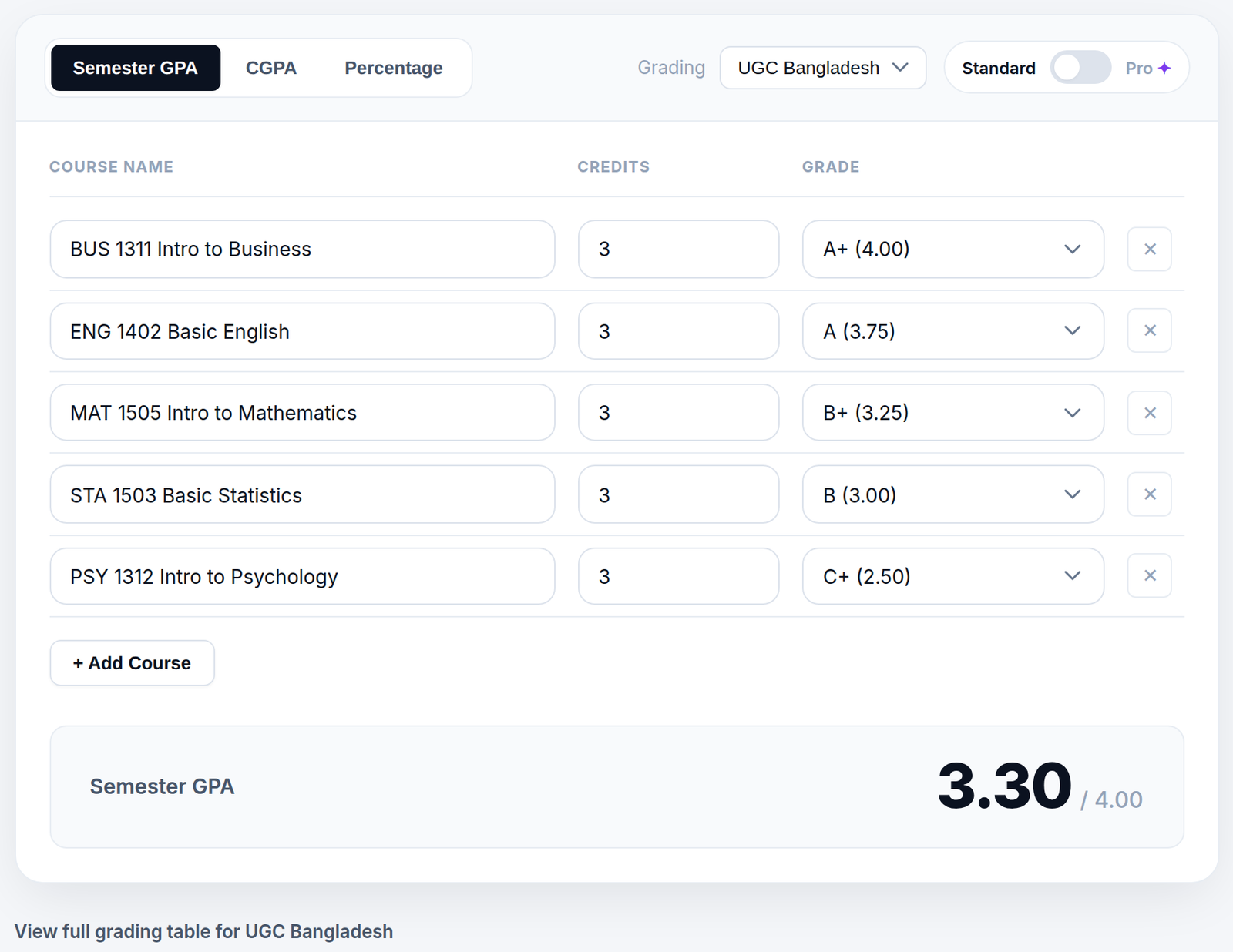
Notice the boundary work: 77% became an A (3.75) while 84% became an A+ (4.00), and 67% landed a B+ (3.25) — two marks lower and it would have been a B. At PU, the band edges do real work on your transcript.
Worked Example 2: CGPA Across Three Semesters — and PU’s Rounding Rule
Tanvir continues. His semester results:
| Semester | GPA | Credits | GPA × Credits |
|---|---|---|---|
| Semester 1 | 3.30 | 15 | 49.50 |
| Semester 2 | 3.60 | 15 | 54.00 |
| Semester 3 | 3.00 | 18 | 54.00 |
Total: 49.50 + 54.00 + 54.00 = 157.50 quality points
Total credits: 15 + 15 + 18 = 48
CGPA: 157.50 ÷ 48 = 3.28125
Now here is where PU’s own rule changes the answer. The official document states: “If the 3rd digit after decimal points is above ‘0’, grade will be rounded (ceiling) into the second digit after decimal. For example, 2.990 will be counted as 2.99 while 2.991 will be counted as 3.00 in CGPA calculation.”
The third decimal of 3.28125 is 1 — above zero — so it rounds up: Tanvir’s official PU CGPA is 3.29, not 3.28. Standard rounding would give 3.28; PU’s ceiling rule gives 3.29. Over a degree, that rule quietly adds real value.
This also shows the classic CGPA mistake: the simple average of the three GPAs is (3.30 + 3.60 + 3.00) ÷ 3 = 3.30, but the true credit-weighted CGPA is 3.29. Always weight by credits.
Retake vs Recourse: PU’s 40% Rule
This is the section most PU students misunderstand, because PU splits failed courses into two different procedures:
- Retake: If you earned an F but scored 40% or above excluding the final examination, you may sit only for the final examination again. You don’t redo the whole course — just the final.
- Recourse: If you earned an F with below 40% excluding the final examination, you must repeat the entire course.
Two hard limits apply:
- A course cannot be retaken more than twice.
- For any retake, you must obtain 40% or above marks excluding the final examination.
The strategic lesson: if you are failing a course, the marks you bank before the final decide whether your recovery costs you one exam or a whole semester. The 40%-excluding-final line is the most important threshold in this article after the graduation CGPA itself. For the general picture of how retakes move your numbers, read our guide on how retaking a course affects your CGPA.
Grade Improvement: Best Grade Counts
PU’s improvement provision is more generous than most universities’:
- You may re-course one or more courses for grade improvement.
- The best of the grades earned in a course on repeating is counted for CGPA calculation — not the average, not the latest.
- Courses with less than ‘B’ grade may register as ‘Improvement’ — so even a B− qualifies.
Because the best grade counts, improvement at PU is a low-risk move: your CGPA can only stay the same or go up. Spend improvement attempts on high-credit courses where a one-letter jump buys the most quality points. Our CGPA improvement playbook has the full strategy.
Withdrawing From a Course: The 6-Week Rule
You may withdraw from one or more courses with your Academic Advisor’s approval within 6 weeks of the commencement of the semester. Miss that window without approval and the course is recorded as an F.
Exceptional cases — serious illness, death of a parent — can earn a withdrawal after 6 weeks, but only on your advisor’s recommendation and only with proper documents and certificates. You also need a convincing reason to add or drop a course at all. The message is consistent: PU treats withdrawal as a formal, documented process, not a casual opt-out.
No Incomplete Grade — Miss the Final, Get an F
Here is PU’s harshest rule, stated plainly in the official document: there is no “I” (Incomplete) grade. If you are unable to sit for the final examination of a course, your grade is recorded as ‘F’, and you must retake or recourse the course.
Most universities let a documented emergency convert to an Incomplete with a make-up window. At PU, the emergency route runs through the make-up procedure (apply to the course teacher with evidence, decided case by case) before the exam — after it, the F stands. If you are ever in genuine trouble near finals week, talk to your course teacher immediately; the paperwork must happen before the exam, not after.
Graduation: CGPA 2.00 and the 7-Year Clock
PU’s official requirements:
- Minimum CGPA of 2.00 to graduate.
- Maximum 7 academic years to complete the program.
- For the BBA: 8 semesters, 132 total credits, ~15 credits per semester as the normal load.
- The internship/project work (8 weeks plus 3–4 weeks for the report) must earn a passing grade, and you must pass the viva voce.
The 2.00 line is the floor, not the target — employers, and any future scholarship or higher-study application, will read the whole number. Note that we could not find published probation or dismissal thresholds in PU’s public documents, so this article does not invent any: if your CGPA is sliding toward 2.00, talk to your academic advisor early.
Admission Snapshot
For context on who sits in PU classrooms: BBA admission requires a minimum GPA of 2.50 (or second division) in both SSC and HSC, or at least one 2.00 with an aggregate of 6.00 — plus a mandatory admission test. Sons and daughters of freedom fighters need an aggregate 5.00. Equivalent systems (GCE O/A levels, American High School Diploma, IB, SAT 1100) are accepted with documentation.
PUAIS: Where Your Grades Live
Premier University runs the Premier University Academic Information System (PUAIS) — the automated platform for course registration, tuition fee payments, grading, examination results, and convocation applications, maintained by the university’s IT office. Your GPA and CGPA are computed inside PUAIS, which is why the official rounding rule above matters: it is the system’s rule, applied to every transcript.
7 Common Mistakes PU Students Make
- Assuming an Incomplete exists. It doesn’t. A missed final is an F — the make-up application must reach your course teacher before the exam.
- Ignoring the 40%-excluding-final line. Your pre-final marks decide whether a failed course costs you one exam (retake) or a full repeat (recourse).
- Treating the 40% continuous assessment as optional. Attendance, quizzes, assignments, and class tests are 40 of your 100 marks. Throw them away and the final becomes nearly unwinnable.
- Withdrawing without advisor approval. No approval within 6 weeks means the course lands on your transcript as an F.
- Wasting the improvement provision on low-credit courses. Best-grade-counts makes improvement safe, but the CGPA leverage lives in 3-credit courses, not 1.5-credit labs.
- Averaging semester GPAs instead of weighting by credits. As Worked Example 2 showed, (3.30 + 3.60 + 3.00) ÷ 3 is not your CGPA.
- Forgetting the rounding rule. 3.28125 is officially 3.29 at PU. Check your PUAIS transcript against the rule — in your favor, for once.
5 Practical Tips to Raise Your PU CGPA
- Bank your 40% early. Attendance and participation (10%), quizzes (10%), assignments and presentations (10%), class tests (10%) — these are the most controllable marks in the course. Lock them in and the final becomes manageable.
- Use improvement where it pays most. Any course below B qualifies, and the best grade counts. Target 3-credit courses sitting at B− or C+.
- Protect the 40%-excluding-final floor. Even in a course going badly, staying above 40% before the final preserves the cheap retake route.
- Chase the band edges, not the middle. The difference between 69% and 70% is a full 0.25 grade points (B+ → A−). Know exactly where each of your courses sits.
- Calculate before you register. Run your planned courses through our free CGPA calculator with the UGC Bangladesh scale selected before the semester starts — know what each course needs to be.
Premier University Grading System — Frequently Asked Questions
Does Premier University use the UGC grading scale?
Yes. PU’s official curriculum documents publish the uniform UGC 4.00 scale (80%+ = A+, 4.00) with no institutional deviation. Select “UGC Bangladesh” in any calculator.
What is the minimum CGPA to graduate from Premier University?
2.00, per the university’s official documents. You also have a maximum of 7 academic years to finish.
What is the difference between retake and recourse at PU?
Both follow an F grade. Retake (F with 40%+ marks excluding the final): you sit only the final exam again. Recourse (F with below 40% excluding the final): you repeat the entire course. A course cannot be retaken more than twice.
Can I improve a grade I already passed at PU?
Yes — any course with less than a B can be registered as improvement, and the best grade earned counts toward your CGPA.
Does PU have an Incomplete (I) grade?
No. Missing the final examination means the course is recorded as F. Apply for a make-up to your course teacher with evidence before the exam if you have a genuine emergency.
How do I withdraw from a course at PU?
With your Academic Advisor’s approval, within 6 weeks of the semester’s commencement — otherwise the course is recorded as F. Late withdrawal is possible only in exceptional, documented circumstances.
How does PU round CGPA?
If the third decimal is above zero, the second decimal rounds up: 2.991 → 3.00, while 2.990 stays 2.99. So 3.28125 becomes an official 3.29.
Conclusion
Premier University’s grading system is the official UGC Bangladesh 4.00 scale — 80% and above for an A+, a D (40%) to pass, and your GPA as the credit-weighted average of your grade points. The table is simple; what decides your CGPA is everything around it: the 40% of marks decided before the final, the retake-vs-recourse fork at the 40%-excluding-final line, the twice-only retake cap, the best-grade-counts improvement rule, the 6-week withdrawal window, and the ceiling rounding rule that turns 3.28125 into 3.29. Calculate your own numbers on our free CGPA calculator with the UGC Bangladesh scale selected, and compare notes with fellow Chattogram students in our IIUC grading guide and the DIU-Dhaka grading guide.
Sources: Premier University BBA OBE curriculum document (admin.puc.ac.bd/Files/content/PUC_BBA_OBE_V_3.pdf) — grading scale, assessment split, GPA/CGPA procedure, withdrawal, incomplete, retake, recourse, improvement, dropout, graduation requirements; PU “Scope” page (math.puc.ac.bd) — PUAIS; Wikipedia — university identity facts.