If you study at Daffodil International University, your entire academic life runs on one table: the UGC uniform grading scale. It decides your letter grades, your semester GPA, your CGPA, your tuition waiver, and whether you land on the Dean’s List or on probation. This guide explains the complete DIU grading system — the official grade table, how your 100 marks are actually built up, the GPA/CGPA formula, retake and probation rules, waivers, and a fully worked example you can check against the calculator below.
Quick answer: DIU uses the UGC Bangladesh 4.00 scale. A+ (80%+) = 4.00, A (75–79%) = 3.75, A− (70–74%) = 3.50, B+ (65–69%) = 3.25, B (60–64%) = 3.00, B− (55–59%) = 2.75, C+ (50–54%) = 2.50, C (45–49%) = 2.25, D (40–44%) = 2.00, F (below 40%) = 0.00. Semester GPA = total (credits × grade points) ÷ total credits, rounded to two decimals.
Try it: calculate your DIU GPA right now
DIU follows the UGC Bangladesh grading scale, so pick the UGC Bangladesh grading option in the calculator, add your courses with their credit hours and grades, and your GPA appears instantly. Here is a real example — five first-semester courses filled in, giving a semester GPA of 3.44:
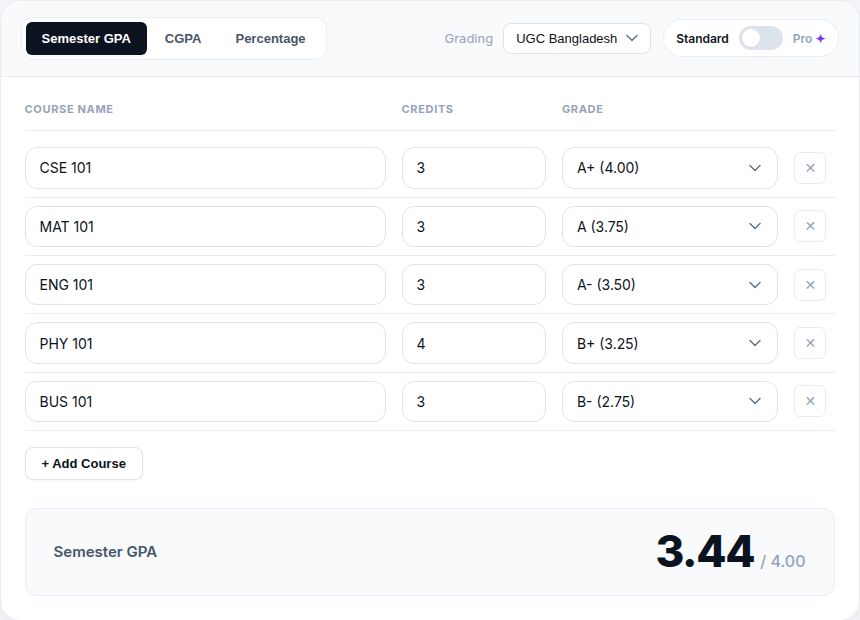
We will break down exactly how that 3.44 was calculated further down, so you can verify every number by hand.
The official DIU grading table (UGC uniform scale)
DIU does not invent its own grade boundaries. Per the university’s Academic Rules and Regulations, it follows the Uniform Grading System prescribed by the University Grants Commission (UGC) of Bangladesh. Every department — CSE, BBA, EEE, Pharmacy, English — uses this same table:
| Marks (out of 100) | Letter grade | Grade point | Remarks |
|---|---|---|---|
| 80% and above | A+ | 4.00 | Outstanding |
| 75% to less than 80% | A | 3.75 | Excellent |
| 70% to less than 75% | A− | 3.50 | Very Good |
| 65% to less than 70% | B+ | 3.25 | Good |
| 60% to less than 65% | B | 3.00 | Satisfactory |
| 55% to less than 60% | B− | 2.75 | Above Average |
| 50% to less than 55% | C+ | 2.50 | Average |
| 45% to less than 50% | C | 2.25 | Below Average |
| 40% to less than 45% | D | 2.00 | Pass |
| Less than 40% | F | 0.00 | Fail |
Two things students constantly get wrong here. First, D is a passing grade — 40% is enough to earn the credits, though a D drags your GPA and you can later improve it (more on retakes below). Second, the scale has no C−, D+, or E grades: it jumps straight from C (2.25) to D (2.00) to F. If your marks land at 44%, that is a D; at 39%, it is an F. There is no middle ground.
Where your 100 marks actually come from
At DIU, your final grade is not decided by the final exam alone. The official assessment breakdown for a standard course is:
| Component | Marks |
|---|---|
| Class attendance | 7 |
| Assignment | 5 |
| Presentation (mandatory) | 8 |
| Quizzes (best of 3) | 15 |
| Midterm examination | 25 |
| Semester final examination | 40 |
| Total | 100 |
This is the single most underrated fact in the DIU grading system. Thirty-five of your 100 marks are locked in before the final exam even starts — attendance, assignment, presentation, and quizzes. A student who collects 30 of those 35 needs only 50 out of the remaining 65 (midterm + final) to hit 80% and an A+. A student who skips quizzes and loses attendance marks needs near-perfection in the final to reach the same grade. The final exam is worth 40 marks, not 100 — plan your semester accordingly.
How to calculate your DIU GPA: the formula
DIU computes GPA as a credit-weighted average. Each course contributes (credit hours × grade point), and you divide by the total credit hours:
GPA = Σ (Course credits × Grade point) ÷ Σ (Course credits)
Official rules worth knowing:
- Only courses graded A+ through D count toward earned credits and the GPA. An F earns zero credits and contributes 0.00 grade points.
- Both semester GPA and CGPA are rounded to two decimal places for reporting.
- If you repeat a course, the higher grade is used in the GPA/CGPA calculation — but both attempts still appear on your grade report.
If the formula still feels abstract, our step-by-step SGPA guide walks through the same credit-weighted method with more examples.
Worked example: from marks to a 3.44 GPA
Take a realistic first semester — five courses, 16 credit hours. First, convert each course’s marks to a letter grade using the official table, then to grade points:
| Course | Credits | Marks | Grade | Grade point | Points earned |
|---|---|---|---|---|---|
| CSE 101 | 3 | 82 | A+ | 4.00 | 3 × 4.00 = 12.00 |
| MAT 101 | 3 | 77 | A | 3.75 | 3 × 3.75 = 11.25 |
| ENG 101 | 3 | 71 | A− | 3.50 | 3 × 3.50 = 10.50 |
| PHY 101 | 4 | 66 | B+ | 3.25 | 4 × 3.25 = 13.00 |
| BUS 101 | 3 | 58 | B− | 2.75 | 3 × 2.75 = 8.25 |
Total grade points = 12.00 + 11.25 + 10.50 + 13.00 + 8.25 = 55.00
Total credits = 3 + 3 + 3 + 4 + 3 = 16
Semester GPA = 55.00 ÷ 16 = 3.4375 → 3.44 (rounded to two decimals)
That is exactly the 3.44 the calculator screenshot above produced. Notice how the 4-credit PHY 101 pulls more weight than the 3-credit courses: its B+ (3.25) contributes 13.00 points, more than CSE 101’s A+ contributes at 12.00. Credits are leverage — a B+ in a 4-credit course beats an A+ in a 3-credit one.
Read more: How to Calculate SGPA: Formula & Examples (2026) — the same credit-weighted method applied to any university’s scale.
GPA vs CGPA at DIU (and why your CGPA barely moves)
Semester GPA covers one semester only. CGPA (Cumulative GPA) covers every course since you started: total grade points earned across all semesters ÷ total credits taken across all semesters.
Say the student above finished the semester with a 3.44 over 16 credits, and previously had a 3.20 CGPA over 32 credits:
New CGPA = (3.20 × 32 + 3.44 × 16) ÷ (32 + 16) = (102.40 + 55.00) ÷ 48 = 157.40 ÷ 48 = 3.28
One strong semester moved the CGPA by only 0.08, because the older 32 credits dominate the average. The lesson DIU seniors learn too late: protect your CGPA from the first year. Early semesters have fewer credits, so every grade counts more. A 2.60 in semester one takes three semesters of 3.60+ to fully erase.
Retake and grade improvement rules
This is where DIU is more generous than many students realize. The official policy:
- F grade → you must retake the course. The failed attempt earns no credits and contributes 0.00 to your GPA until cleared.
- D or C grade → you may retake for grade improvement. You do not have to live with a 2.00 dragging your average for four years.
- The higher grade counts. When a course is repeated, GPA and CGPA are calculated using the higher of the two grades — but both grades remain visible on your grade report/transcript.
- Course dropout (withdrawing properly) means retaking the course later rather than absorbing an F.
The strategic takeaway: retaking is most valuable for high-credit courses where you scored C or D. Improving a 3-credit C (2.25) to a B (3.00) adds 2.25 grade points to your numerator — the same effort in a 1-credit lab course adds almost nothing. And retake an F as early as possible: until you clear it, those credits sit in your record earning nothing.
Probation, honors, and awards: the numbers that matter
Beyond the grade table, DIU ties real consequences to your GPA:
- Academic probation: you must maintain a CGPA of at least 2.50. Fall below it and you are placed on probation — you then get a maximum of three semesters to bring it back above 2.50, or you are dropped from the program.
- Dean’s Honor List: a semester GPA of 3.75 puts you on the Dean’s List for that semester.
- VC’s Honor List: maintain a CGPA of 3.75 through your 3rd and 4th semesters and you earn a place on the Vice-Chancellor’s List with an individual citation.
- Chancellor’s Award: students reaching 3.90 receive the Chancellor’s award.
- Incomplete (I) grade: given only in special circumstances when you miss the final exam. You must complete the makeup exam after result publication, or the I automatically converts to an F.
Notice the gap between probation (2.50) and honors (3.75). Most DIU students live in the 2.75–3.50 middle band — safe from probation, but leaving real money and recognition on the table, because as the next section shows, GPA literally converts to tuition discounts.
Tuition waivers: your GPA is worth real money
DIU’s waiver policy awards result-based tuition fee waivers on semester final GPA — this is separate from admission-time waivers based on SSC/HSC results. Under the current policy, students in the engineering, science, and technology faculties earn:
| Semester GPA (out of 4.00) | Tuition waiver |
|---|---|
| 4.00 | 50% |
| 3.90 – 3.99 | 30% |
| 3.85 – 3.89 | 20% |
| 3.80 – 3.84 | 10% |
Humanities and Social Science faculties have their own bands (starting at 3.60 for a 10% waiver, up to 50% at 3.90+). Two practical notes: waiver bands and faculty groupings are revised periodically, so confirm the current policy with the accounts/admission office each year — and note that admission waivers (e.g., Golden GPA-5 in SSC+HSC → 50%) require you to maintain a minimum SGPA (typically 3.00–3.25) every semester, or the waiver lapses. Your GPA is not just a number on a transcript; at DIU it is a discount you renew twice a year.
Read more: Is 3.5 CGPA Good? Jobs, Scholarships & MS Abroad — what a 3.50 actually unlocks for Bangladeshi graduates.
Converting your DIU CGPA to percentage
Some job applications and foreign universities ask for percentage marks instead of CGPA. DIU’s official ordinance for engineering programs gives an exact conversion formula:
- For CGPA between 3.75 and 4.00: Equivalent marks = 79 + 84 × (CGPA − 3.75)
- For CGPA between 2.00 and 3.75: Equivalent marks = 44 + 20 × (CGPA − 2.00)
Example: a CGPA of 3.50 → 44 + 20 × (3.50 − 2.00) = 44 + 30 = 74%. A CGPA of 3.90 → 79 + 84 × 0.15 = 91.6%. Do not use the rough “multiply by 25” shortcut on official documents — the real formula is piecewise, and the two methods disagree by several percentage points in the middle of the scale. For the general conversion method, see our CGPA to percentage guide.
Common mistakes DIU students make
- Averaging grade points directly. (4.00 + 3.75 + 3.50 + 3.25 + 2.75) ÷ 5 = 3.45 looks close to the real 3.44 here — but with unequal credits the error grows fast. Always weight by credits.
- Ignoring the 35 pre-final marks. Attendance, assignment, presentation, and quizzes are the cheapest marks in the course. Losing them means needing ~90% on the final to recover an A.
- Thinking a retake erases the old grade. The higher grade is used in the calculation, but both attempts stay on your grade report. Plan retakes for impact, not embarrassment.
- Confusing B+ (3.25) with B− (2.75). A single plus/minus step at DIU is a 0.25–0.50 swing. The 65% boundary (B+ vs B) and 60% boundary (B vs B−) are the highest-leverage marks on the table.
- Letting an Incomplete lapse. An I grade silently becomes an F if you miss the makeup exam window — and then you are retaking the whole course.
- Forgetting the 2.50 probation line. Two bad semesters in a row can put you on probation before you notice. Check your CGPA every semester, not at graduation.
7 tips to raise your DIU GPA
- Bank the 35 marks first. Perfect attendance, submitted assignments, one solid presentation, and serious quiz prep. These are the most predictable marks you will ever earn.
- Study for the boundaries, not the average. Moving from 68% to 70% (B+ → A−) gains 0.25 grade points; moving from 71% to 74% gains nothing. Know where each of your courses sits.
- Weight your effort by credits. An extra hour on a 4-credit course is worth more GPA than an extra hour on a 1-credit lab. Allocate study time proportionally to credit hours.
- Retake F grades immediately and strategically improve C/D grades in high-credit courses — the higher grade replaces the lower one in your CGPA.
- Track your GPA after every midterm using the CGPAPro calculator with the UGC Bangladesh scale, so there are no surprises at result time.
- Aim for 3.80+, not just 3.00. That is where tuition waivers begin — a 10–50% fee discount is the highest-paid study outcome at DIU.
- Compare with peers’ scales carefully. A 3.50 at DIU (A− = 3.50) is not the same as a 3.50 at NSU or IUB, which use different tables — see how AIUB’s grading system (same UGC scale) compares.
Frequently asked questions
What is the passing grade at DIU?
D (40% marks, 2.00 grade points) is the minimum passing grade — you earn the course credits. Anything below 40% is an F: no credits, 0.00 points, and you must retake the course.
Does DIU replace my old grade when I retake a course?
For the GPA/CGPA calculation, yes — the higher of the two grades is used. But both attempts remain on your grade report. Employers and graduate schools reviewing a full transcript will see both.
Can I improve a C or D grade at DIU?
Yes. DIU’s policy explicitly allows grade improvement retakes for D and C grades (not just F grades). This is one of the most student-friendly parts of the system — use it on high-credit courses where a single retake moves your CGPA most.
What CGPA do I need to avoid probation at DIU?
You must maintain a CGPA of at least 2.50. Drop below it and you go on academic probation, with a maximum of three semesters to recover — otherwise you are dropped from the program.
How do I convert my DIU CGPA to a percentage?
Use DIU’s official piecewise formula: 79 + 84 × (CGPA − 3.75) for CGPA 3.75–4.00, and 44 + 20 × (CGPA − 2.00) for CGPA 2.00–3.75. A 3.50 CGPA equals 74%.
What GPA do I need for a tuition fee waiver at DIU?
Result-based waivers start at a 3.80 semester GPA (10% waiver) in engineering/science faculties, rising to 50% at a perfect 4.00. Humanities faculties start at 3.60. Admission-time waivers additionally require maintaining a minimum SGPA (usually 3.00–3.25) every semester.
Is a 3.5 CGPA good at DIU?
A 3.50 means consistent A− grades — comfortably above the 2.50 probation line and solid for most private-sector jobs in Bangladesh. It sits just below the 3.60+ waiver and honors territory, so it is “good but improvable”: one strong semester of A/A+ grades can push you into waiver range. Our full breakdown covers whether 3.5 CGPA is good for jobs, scholarships, and MS abroad.
The bottom line
The DIU grading system rewards students who understand its structure: 35 marks secured before finals, credit-weighted grades, generous retake rules that count your best attempt, and tuition waivers that turn a 3.80+ GPA into real money. The students who struggle are usually not the least capable — they are the ones who treated every course as “out of 100 on the final” and discovered the actual rules at graduation. Now you know them in your first year. Plug your current courses into the calculator above, find your boundary marks, and study where each hour moves your GPA most.
Grade tables and policies verified against DIU’s official Academic Rules and Regulations and UGC uniform grading guidelines. Policies are revised periodically — confirm current rules in your program handbook.