Leading University Grading System 2026: GPA & CGPA Guide
Quick answer: Leading University (LU), Sylhet, runs on the UGC Bangladesh uniform 4.00 grading scale — an A+ (4.00) starts at 80%, the passing floor is a D at 40% (2.00), and anything below 40 is an F worth nothing. Your semester GPA is your credit-weighted average of grade points; your CGPA is the same average across every semester you have completed. To graduate you need a CGPA of 2.50, and if you earned below a B in any course, LU lets you retake it once at the next semester final exam to improve — with a lifetime cap of 8 improvement courses for undergraduates. This guide gives you the exact official table straight from LU’s Academic Regulations, a two-minute online calculator, three fully worked examples with real numbers, and the retake, probation, and supplementary-exam rules no other guide explains.
How to Check Your GPA and CGPA Online (2 Minutes)
You do not need to do this math by hand every semester. The free calculator at cgpacalculatorpro.com has the UGC Bangladesh scale built in — the same scale Leading University uses. Here is the two-minute version:
- Open cgpacalculatorpro.com and keep the UGC Bangladesh grading scale selected (it is the default).
- Add one row per course: the course name, its credit hours, and the letter grade you earned (or expect).
- Read your semester GPA from the result panel. To get your CGPA, add every completed semester the same way.
One warning before you go further: several popular “CGPA Calculator Bangladesh” sites split their presets into “public” and “private” scales, and their “private” preset is the NSU/BRAC-style table where an A starts at 90. Leading University is private, but it does not use that table — LU’s own Academic Regulations print the UGC uniform scale and note that the uniform system “is provided by UGC.” Selecting the wrong preset quietly produces a wrong GPA. If you want to understand the differences between the two systems, our HEC vs UGC grading scale comparison walks through both.
Leading University Official Grading Table (2026)
Unlike the generic tables floating around the internet, the table below is taken directly from Leading University’s own Academic Regulations (AC-Regulations-of-LU.pdf), the official document published on lus.ac.bd. It is the UGC uniform grading system, binding on all public and private universities in Bangladesh:
| Numerical Score (%) | Letter Grade | Grade Point |
|---|---|---|
| 80 and above | A+ | 4.00 |
| 75 to less than 80 | A | 3.75 |
| 70 to less than 75 | A− | 3.50 |
| 65 to less than 70 | B+ | 3.25 |
| 60 to less than 65 | B | 3.00 |
| 55 to less than 60 | B− | 2.75 |
| 50 to less than 55 | C+ | 2.50 |
| 45 to less than 50 | C | 2.25 |
| 40 to less than 45 | D | 2.00 |
| Less than 40 | F | 0.00 |
A few things about this table that matter more than they look:
- A D is a pass. At 40–44% you earn the credit at 2.00 grade points. The only failing grade is F (below 40), which earns zero credit and 0.00 points. This single misunderstanding causes more student panic than anything else in the table.
- The band edges are hard. A 79.9 is an A (3.75), not an A+; a 74.9 is an A− (3.50). Borderline students should ask their course teacher how final totals are rounded before results are published, not after.
- Only letter grades and grade points appear on your transcript — not the numerical marks. Your numerical score is the raw material; the letter is the currency.
- Non-numeric codes: W (Withdrawal — you officially dropped the course; does not affect your CGPA), R (Retake), and I (Incomplete). These carry no grade points.
📖 Read More
- SUST Grading System 2026 — the same UGC-scale guide format for Shahjalal University of Science and Technology, Sylhet’s public university.
- HEC vs UGC Grading Scale: Pakistan vs Bangladesh 2026 — how Bangladesh’s 4.00 scale compares to Pakistan’s, and why the scales are not interchangeable.
Which “Leading University” Is This? (Read This First)
“Leading University” is one of the most polluted searches in Bangladeshi higher education, so let us settle it up front. This guide is about Leading University, Sylhet — the first Government-approved private university in Sylhet, established in 2001 under the Bangladesh Private University Act 1992, on lus.ac.bd. Its faculties include Business Administration, Modern Science (CSE, EEE, civil, architecture), Arts and Modern Language, Social Science (Law), and more. It is not any of these:
- Lusail University, Qatar (lu.edu.qa) — the biggest trap. Lusail’s grades page uses a scale where an A is 4.0 (90–100%). That scale does not exist at Leading University, Sylhet. If you land on a page mentioning Qatar and plug its numbers into your math, every result you produce is fiction.
- Any “Leading University” outside Bangladesh — the same name appears in other countries with completely different grading systems.
- Other Sylhet universities — SUST (public, different structure) and Metropolitan University share the city but not the regulations.
A quick sanity check whenever you open a “leading university grading” page: if the domain ends in .qa, or you see “90–100% = A = 4.0,” close the tab — you are at the wrong university. Your university’s official domain is lus.ac.bd.
Step-by-Step: How to Calculate Your LU Semester GPA
Leading University’s own regulations define GPA as “an expression for the average performance of a student in the course he/she has offered during a particular semester” — calculated by adding the quality points of all courses taken and dividing by the total credit hours offered. Here is the method:
- Convert each final score to a letter grade using the official table above.
- Look up the grade point for each letter (A+ = 4.00, A = 3.75, A− = 3.50, B+ = 3.25, B = 3.00, B− = 2.75, C+ = 2.50, C = 2.25, D = 2.00, F = 0.00).
- Multiply each course’s grade point by its credit hours. The result is called “quality points” — the weight the course carries in your GPA.
- Add up all quality points and add up all credit hours.
- Divide total quality points by total credit hours. That is your semester GPA.
The Formula
Semester GPA = Σ (Grade Point × Credit Hours) ÷ Σ (Credit Hours)
Cumulative GPA (CGPA) = Σ (all quality points from every completed semester) ÷ Σ (all credit hours from every completed semester)
Note that CGPA is not the simple average of your semester GPAs. A 15-credit semester and a 13-credit semester do not pull equal weight — the credits do the weighting. (Averages of averages are one of the most common GPA mistakes; there is a section on it below.)
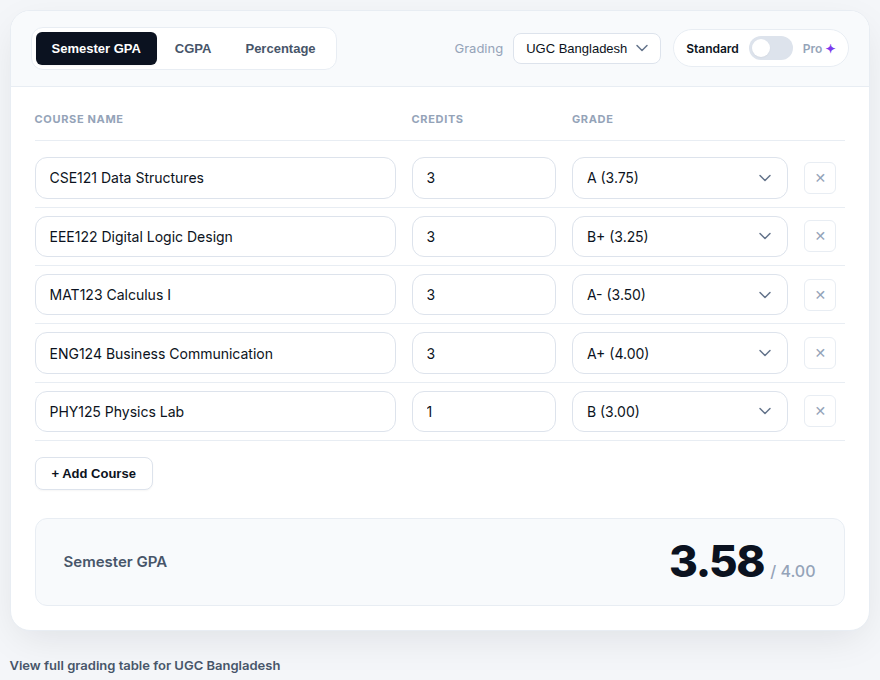
Worked Example 1: One Semester (Matches the Screenshot Above)
A sophomore at LU finishes her Fall semester with these five courses. Watch how each number is built — nothing is skipped:
| Course | Credits | Grade | Grade Point | Quality Points |
|---|---|---|---|---|
| CSE121 Data Structures | 3 | A | 3.75 | 3 × 3.75 = 11.25 |
| EEE122 Digital Logic Design | 3 | B+ | 3.25 | 3 × 3.25 = 9.75 |
| MAT123 Calculus I | 3 | A− | 3.50 | 3 × 3.50 = 10.50 |
| ENG124 Business Communication | 3 | A+ | 4.00 | 3 × 4.00 = 12.00 |
| PHY125 Physics Lab | 1 | B | 3.00 | 1 × 3.00 = 3.00 |
Total quality points = 11.25 + 9.75 + 10.50 + 12.00 + 3.00 = 46.50.
Total credit hours = 3 + 3 + 3 + 3 + 1 = 13.
Semester GPA = 46.50 ÷ 13 = 3.58.
This is the exact calculation shown in the calculator screenshot at the top of this article — same courses, same grades, same 3.58. Try it yourself with your own courses: the UGC Bangladesh calculator reproduces this math instantly.
Worked Example 2: Cumulative CGPA Across Two Semesters
Continuing the same student. Her first semester (Spring) was weaker:
- Semester 1: 15 credits, 50.00 quality points → GPA 3.33 (50.00 ÷ 15 = 3.333)
- Semester 2: 13 credits, 46.50 quality points → GPA 3.58 (the example above)
CGPA = (50.00 + 46.50) ÷ (15 + 13) = 96.50 ÷ 28 = 3.45.
Notice: the simple average of 3.33 and 3.58 is 3.455 — close, but not equal to the true 3.45, and the gap widens when credit loads differ more. Always weight by credits. The SUST calculator on our site follows the same UGC scale and credit-weighted math, and if you ever need to sanity-check percentage inputs, our percentage-to-CGPA conversion guide covers the pitfalls.
Worked Example 3: How Much Does a Retake Actually Move Your CGPA?
Students constantly over- or under-estimate what a retake is worth. Here is the exact arithmetic. Suppose you have completed 60 credits at a 2.85 CGPA:
- Total quality points so far = 60 × 2.85 = 171.00
- You retake one 3-credit course where you originally earned a C+ (2.50 → 7.50 quality points) and this time earn an A (3.75 → 11.25 quality points)
- Gain in quality points = 11.25 − 7.50 = 3.75; new total = 174.75
- New CGPA = 174.75 ÷ 60 = 2.91
One strong retake moved the CGPA by 0.06 — from 2.85 to 2.91. The general rule: retaking a 3-credit course from grade point g_old to g_new with C total credits moves your CGPA by exactly 3 × (g_new − g_old) ÷ C. This is why the biggest CGPA jumps come from improving high-credit courses with your worst grades first — which connects directly to the improvement-budget strategy in the tips section below.
GPA vs CGPA — What Each One Is For at LU
- Semester GPA measures one term. It is what you track month to month.
- CGPA measures everything completed. It is the number that decides your degree (2.50 minimum), your probation status, and your scholarship eligibility.
- CGPA ≥ 2.00 = good academic standing. Below 2.00 = probation.
- CGPA ≥ 2.50 = degree eligible (confirmed by LU’s Academic Council for both undergraduate and Master’s programs).
The Retake and Improvement Rules (No Other Guide Covers These)
This is where Leading University’s Academic Regulations contain details that almost no student knows until they need them. The rules distinguish three different situations:
1. You failed (F) — retake
Retake the course in the next semester and complete it within two consecutive semesters. Your continuous assessment marks (attendance, quizzes, assignments, mid-term) from the original attempt stay valid. If you obtained an F, LU allows you to appear at the improvement examination twice for that F.
2. You passed but earned below B — improvement
Students who obtained below letter grade B in a course may retake it to improve. The critical, rarely stated detail: B− (2.75) is below B and qualifies; B (3.00) does not. You must appear at the next immediate Semester Final Examination, and you get one chance only — if you cannot improve, the earlier grade is retained. The lifetime caps are strict: maximum 8 improvement courses for undergraduates, 2 for Master’s students.
3. Final-semester rescue — supplementary examination
If you dropped or failed courses in your final semester, LU permits a supplementary examination covering a maximum of 12 credits: 30 marks for performance evaluation plus 70 marks for a comprehensive written exam (100 total per course). The fee is 20% higher per credit than the regular rate, and the exam is held about 15 days after the final-semester result is published. If you dropped or failed more than 12 credits, you need special permission and must re-register for the semester at the regular fee.
And one rule that should be framed: a W (withdrawal) does not affect your CGPA at all — but only if the withdrawal is official, done through the registrar within the announced window.
Probation, Attendance, and Staying Enrolled
LU publishes a clear ladder, and it is worth reading it as a ladder:
- Good standing: CGPA of 2.00 or above. Nothing to worry about academically.
- Probation: CGPA below 2.00. You are given a maximum of three semesters to raise it back to 2.00.
- Dismissal: fail to reach 2.00 within those three semesters and you are dismissed from the university.
- Degree: CGPA 2.50 or above on graduation — higher than the survival line, so do not confuse the two.
- Attendance floor: fall below 50% attendance and you may be debarred from the mid-term and final examinations; three consecutive absences can get you dropped from a course entirely. Attendance also carries a 5% weight in your course evaluation — free marks, if you show up.
Note also the program-specific dual rule some departments publish (e.g. EEE): CGPA ≥ 2.00 in all university courses plus CGPA ≥ 2.50 in core and advanced courses. Your program’s curriculum document may add requirements like this — the 2.50 graduation figure is the floor, not the whole story. Check your program handbook.
Common Mistakes LU Students Make
- Using the “private university” preset on generic calculators. Several Bangladesh calculator sites use an NSU/BRAC-style private scale (A = 4.0 from 90%). LU is private but follows the UGC uniform scale (A+ = 4.00 from 80%). Always select the UGC Bangladesh scale for LU courses.
- Averaging semester GPAs instead of credit-weighting. CGPA = total quality points ÷ total credits. The simple average of your semester GPAs is wrong whenever credit loads differ.
- Treating 2.00 as the graduation target. 2.00 keeps you enrolled; 2.50 earns the degree. Graduating requires the higher number.
- Assuming a D is a fail. D (40–44%, 2.00 points) is a pass that earns credit. Only F earns nothing.
- Spending improvement attempts carelessly. You get 8 for your entire undergraduate degree. Burning one on a B− in a 1-credit course is a waste; save them for your worst grades in your highest-credit courses (see Worked Example 3 for the math).
- Missing the retake window. Improvement happens at the next immediate semester final — one chance. Failed courses must be retaken in the next semester and completed within two consecutive semesters. Deadlines are part of the rule.
- Ignoring attendance until it is too late. Below 50% and you may not sit the exam at all — no GPA math can recover from that.
Tips to Raise Your CGPA at Leading University
- Budget your 8 improvements like money. Rank every course where you earned below B by (credit hours × grade-point gap to a realistic improved grade) and spend attempts from the top. A 4-credit C improved to a B− moves your CGPA roughly four times more than a 1-credit improvement.
- Chase the band edges. Because LU’s grade bands are 5 points wide with hard edges, the highest-return study effort is on the course where you are sitting at 73 or 78 — two or three marks change your grade point by a full 0.25.
- Protect the 5% attendance weight. It is the easiest 5 marks of your final score, and it doubles as insurance against the 50% debarment line.
- Clear F grades immediately. A retaken-and-passed F replaces 0.00 with real points, and your continuous assessment marks carry over — do not let a failed course sit for two semesters.
- Track a running CGPA, not just semester results. Use the free UGC-scale calculator at the start of each semester with your target grades to see exactly what each course is worth — then study accordingly.
Frequently Asked Questions
1. I passed with a C+ — can I retake the course to improve my CGPA?
Yes. LU’s improvement rule covers any course where you obtained below letter grade B — C+ (2.50) qualifies. You get one chance at the next immediate semester final exam, and the attempt counts against your lifetime cap of 8 improvement courses (undergraduate) or 2 (Master’s). If your retake score is not better, the earlier grade is retained.
2. What CGPA do I need to graduate from Leading University?
A minimum CGPA of 2.50 for both undergraduate and Master’s degrees, per LU’s Academic Council. Note this is higher than the 2.00 required for good academic standing — 2.00 keeps you enrolled, 2.50 earns the degree. Some programs (e.g. EEE) additionally require 2.50 in core and advanced courses; check your program handbook.
3. Is a D grade a pass or a fail at Leading University?
A pass. D (40–44%) earns you the credit at 2.00 grade points. F (below 40%) is the only failing grade — it earns no credit and contributes 0.00 to your quality points, and the course must be retaken.
4. Does a W (withdrawal) affect my CGPA?
No. An official withdrawal carries no grade points and does not enter the CGPA calculation. Make sure the withdrawal is done officially through the registrar within the announced window — an unofficial absence is not a W.
5. How many times can I retake a failed course?
Failed courses must be retaken in the next semester and completed within two consecutive semesters. For F grades specifically, LU permits appearing at the improvement examination twice. Continuous assessment marks from your earlier attempt remain valid.
6. Is a B− eligible for grade improvement?
Yes — this is the detail most students get wrong. B− (2.75) is below B (3.00), so it qualifies under LU’s “below letter grade B” improvement rule. A B (3.00) itself does not qualify.
7. What happens in my final semester if I fail a course?
LU offers a supplementary examination: final-semester students who dropped or failed up to 12 credits may take it about 15 days after the result is published (30 marks performance + 70 marks written per course, fee 20% higher per credit). More than 12 failed/dropped credits requires special permission and re-registration.
The Bottom Line
Leading University’s grading system rewards students who understand its structure: the UGC uniform scale is generous at the top (A+ from 80%), the D is a genuine pass, and the improvement rules give you a real — but limited — second chance. The numbers that matter most are 2.00 (stay enrolled), 2.50 (graduate), 8 (your improvement budget), and the band edges where a few marks change your grade point by 0.25. Run your own numbers on the free UGC Bangladesh calculator, spend your improvement attempts where the math says they count, and check your program handbook for any department-level additions to these rules.