SUST’s grading system is simple on paper and surprisingly easy to get wrong in practice. Shahjalal University of Science and Technology (SUST), Sylhet — one of Bangladesh’s top public universities — uses an absolute, percentage-based grading scale on a 4.00 maximum, set by the university-wide Ordinance for the Semester System for Bachelor Degrees (approved at the 126th Academic Council meeting and in force since 2014). If you study there, this guide gives you everything: the official grade table, the exact GPA and CGPA formulas, how retakes and F grades really work, SUST’s unusual CGPA rounding rule, and a fully worked example with real numbers.
Quick answer: At SUST, your semester GPA is the credit-weighted average of grade points earned in that semester. Your CGPA is the credit-weighted average of all courses across all semesters. Grades run A+ (4.00) down to F (0.00) — and there is no D grade at SUST, despite what several online calculators claim. The minimum passing grade is C− (2.00), and you need a final CGPA of at least 2.00 to graduate.
How to calculate your SUST GPA in seconds
The fastest way to check your semester GPA is our free SUST CGPA calculator. Choose “Semester GPA”, add each course with its credit hours from your registration slip, pick the letter grade you earned (A+ at 80%+ down to F below 40%), and the tool computes your GPA instantly. The screenshot below shows a real semester filled in with the worked example from this article:
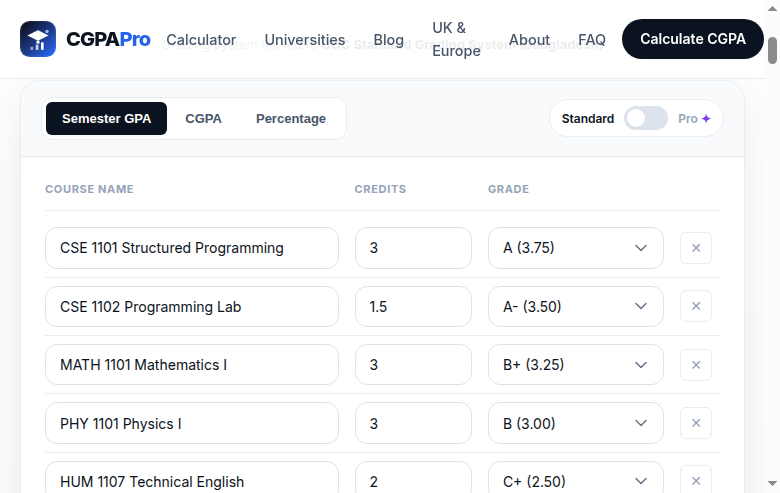
One honest note before you use it: our calculator page currently labels the 2.00 grade band “D”. The official SUST grade for that band is C− — SUST has no D grade at all. We’re correcting the label on the calculator page; until then, treat any “D” you see there as C−. The numbers are identical, so your GPA comes out right either way.
The official SUST grade table
This is the grading scale straight from SUST’s official curriculum documents published by the Office of the Registrar (verified across multiple department ordinances, including Geography & Environment 2023–24, SWE, English, and the IICT institute ordinances — the table is identical everywhere):
| Marks (percentage) | Letter grade | Grade point |
|---|---|---|
| 80% and above | A+ | 4.00 |
| 75% to less than 80% | A | 3.75 |
| 70% to less than 75% | A− | 3.50 |
| 65% to less than 70% | B+ | 3.25 |
| 60% to less than 65% | B | 3.00 |
| 55% to less than 60% | B− | 2.75 |
| 50% to less than 55% | C+ | 2.50 |
| 45% to less than 50% | C | 2.25 |
| 40% to less than 45% | C− | 2.00 |
| Less than 40% | F | 0.00 |
Three things about this table deserve your full attention.
1. There is no D grade at SUST. This is the single most repeated error online about SUST. Two of the most visible SUST calculator tools — including a popular open-source GitHub calculator — list “D (2.00)” for the 40–44 band. The official ordinance is unambiguous: 40% to less than 45% is C−, grade point 2.00, and below 40% is F. If a tool or blog tells you SUST awards a D, it is wrong.
2. Grades are awarded from the rounded-up marks of each course. The ordinance’s wording is “awarded from the roundup marks of individual courses” — so a 74.6 doesn’t get silently truncated to 74; it rounds up, and that rounded figure determines your letter grade. In a borderline case (say 74.5 vs 75), this rounding is the difference between an A− and an A — worth 0.25 grade points times the course credits.
3. 40% is the hard line. C− (40–44%) passes; anything below 40% is an F, which carries 0.00 and, as we’ll see below, consequences well beyond the math.
SUST’s GPA formula, step by step
The ordinance defines GPA in section 7.2.1 as “the weighted average of the grade points obtained in all the courses completed by a student in a semester.” In plain language:
GPA = Σ (grade point × credit hours) ÷ Σ (credit hours), calculated over one semester’s completed courses.
Here’s the procedure, in order:
- List every course you completed this semester with its credit hours (from your registration slip — typically 12 to 30 credits per semester; more on that below).
- Convert each course’s final percentage to a letter grade using the official table above. Remember: 74.5 rounds up, and there is no D — 40–44% is C−.
- Convert each letter grade to its grade point (A+ = 4.00, A = 3.75, …, C− = 2.00, F = 0.00).
- Multiply each course’s grade point by its credit hours. These are your quality points.
- Add up all quality points and divide by the total credit hours of the semester.
Worked example: a real SUST semester
Meet Tanvir, a first-year CSE student. His first semester (Level 1, Semester I) has five courses. His marks are in, and he wants his GPA:
| Course | Credits | Marks | Grade | Grade point | Quality points |
|---|---|---|---|---|---|
| CSE 1101 Structured Programming | 3.0 | 76 | A | 3.75 | 3 × 3.75 = 11.25 |
| CSE 1102 Programming Lab | 1.5 | 71 | A− | 3.50 | 1.5 × 3.50 = 5.25 |
| MATH 1101 Mathematics I | 3.0 | 68 | B+ | 3.25 | 3 × 3.25 = 9.75 |
| PHY 1101 Physics I | 3.0 | 62 | B | 3.00 | 3 × 3.00 = 9.00 |
| HUM 1107 Technical English | 2.0 | 53 | C+ | 2.50 | 2 × 2.50 = 5.00 |
Total quality points: 11.25 + 5.25 + 9.75 + 9.00 + 5.00 = 40.25
Total credits: 3.0 + 1.5 + 3.0 + 3.0 + 2.0 = 12.50
GPA = 40.25 ÷ 12.50 = 3.22
Notice how the 3-credit courses carry the most weight: Tanvir’s B in Physics (3 credits) pulls harder than his C+ in Technical English (2 credits), and his A− in the 1.5-credit lab counts less than the A in the 3-credit theory course. When you’re deciding where to spend revision time, always weight your effort by credit hours.
GPA vs CGPA at SUST
GPA covers one semester. CGPA is the same credit-weighted average computed over every course from every semester so far, per ordinance 7.2.2 — “the weighted average of every course of previous semesters along with the present semester.” You can also think of it as the credit-weighted average of your previous CGPA and your current GPA; the math is identical when credits are the weights.
One SUST-specific rule students rarely know: if you take a second major, SUST computes a separate CGPA for your second-major courses. Your main CGPA is untouched by the second major.
SUST’s unusual final-CGPA rounding rule. This one appears in no competitor article we could find, but it’s in the ordinance (7.2.2, for clearing graduates): if the third decimal digit of your final CGPA is nonzero, the second digit is incremented by one. In other words, SUST always rounds the second decimal up — not to the nearest, up. A computed CGPA of 3.741 becomes 3.75, and even 3.741 → 3.75 while 3.740 stays 3.74. Under standard rounding, 3.744 would become 3.74; at SUST it becomes 3.75. If your CGPA sits just below a threshold — say 2.99x for scholarships or 3.74x for Distinction — run the exact rule, because it can push you over the line.
How your marks break down: the 10/30/60 split and the attendance traps
Your final percentage in a course isn’t one exam. A typical SUST theory course breaks down as:
- Class attendance: 10%
- Assignments + mid-semester exams: 30% (at least two mid-semester exams must be held, and at least half of this component’s marks must come from the mids)
- Final examination: 60%
This split can vary slightly by department — the English department’s curriculum, for example, uses 10/20/70 — so treat 10/30/60 as the typical case and check your own department’s ordinance. But the attendance component has two traps that are identical everywhere and cost students grades every semester:
Trap 1 — below 60% attendance means zero attendance marks. SUST’s attendance-marks table gives 10 marks for 95%+, sliding down to 3 marks for 60–64% — and 0 marks below 60%. That’s a full 10% of your course grade gone before the final exam.
Trap 2 — below 50% attendance bars you from the exam entirely. If your attendance in a course falls under 50%, you are not allowed to sit that course’s final examination. An exam you can’t sit means an F — 0.00, must repeat, on your record forever.
A student sitting at 58% attendance who “studies harder” has already lost 10 course marks; a student at 48% has lost the entire course. Track your attendance from week one.
The F grade: what it really does to you
At SUST you get an F if you fail a course (below 40%) or if you’re absent in its final exam — no separate “absent” grade; absence in the finals is an automatic F.
Here’s the paradox students misunderstand: the F is not counted in the GPA calculation. The ordinance says an F-graded student’s “grade will not be counted for GPA” — its credits are excluded from the GPA math entirely, so it doesn’t drag your semester GPA down the way a 0.00 would.
But that mathematical mercy comes with a heavy price:
- You must repeat the course — there’s no graduating around it.
- The F stays on your academic record permanently, even after you pass the repeat.
- Any F makes you permanently ineligible for Distinction, university awards, and scholarships.
So an F barely dents the semester GPA number you see on screen, but it can silently close doors that never reopen. Never skip a final exam.
Retakes, incompletes, and improvement — the real rules
Incomplete courses first. SUST’s ordinance requires you to register your incomplete (failed or not-yet-cleared) courses before any current-level courses. If an incomplete course isn’t offered in a given semester, you take it the next time it is offered. Students with incomplete courses are not eligible for Distinction.
If the course is discontinued, your discipline can let you take an equivalent course from the current syllabus instead. For clearing graduates, the department may suggest a suitable equivalent to finish credit requirements.
Registration load: 12 credits minimum, 30 credits maximum per semester (except clearing graduates). Plan your repeats inside that window — a 30-credit cap means a heavy repeat semester can force you to drop an elective.
Improvement exams exist — but the rules aren’t public. The ordinance disqualifies from Distinction anyone who “has upgraded her/his GPA through improvement,” and result sheets for “course improvement” are provided for in the graduate regulations, so improvement is a real mechanism at SUST. But who may sit them, which grades are eligible, and any caps on the number of courses were not found in any published SUST ordinance we reviewed. Be skeptical of any blog that states SUST improvement rules as fact — the details aren’t published. Two things are certain, though: improvement can raise your GPA, and doing it disqualifies you from Distinction forever. Know the tradeoff before you apply.
Graduation, Distinction, and the 6-year clock
To graduate you need:
- A final CGPA of at least 2.00.
- Completion within 6 years / 12 semesters — this is the maximum duration.
- The required credit total for your program (e.g., GEE’s B.Sc. (Honours) carries 144.50 graduating credits against a 140-credit minimum; engineering programs run higher).
Distinction is awarded when your degree CGPA is 3.75 or above — but it’s disqualified by any of these: not being a regular student (a semester drop, incomplete courses in any semester, or a break of study), any F grade, or GPA upgraded through improvement. (The graduate-program ordinance variant adds drug addiction and disciplinary action to the disqualifiers.)
One thing we won’t tell you: probation, suspension, and dismissal thresholds. Those words — “probation,” “suspension,” “dismissal,” “warning” — do not appear anywhere in the 13,000+ lines of the official undergraduate ordinance we reviewed. No standing thresholds exist in any SUST source we checked, so we won’t invent any. If someone quotes a SUST “probation CGPA” at you, ask for the ordinance reference — it isn’t in the public documents.
Your answer-script appeal right
Almost no student knows this, and no competitor article mentions it: as a clearing graduate at SUST you can appeal to the Controller of Examinations for re-examination of your answer scripts for up to 2 theory courses, within 2 weeks of result publication, on payment of the Academic-Council-determined fee. Two new examiners evaluate; your grade changes only if the new total or average differs from the old one by at least 10%. Result corrections in general are accepted within 3 months of publication. If your final-year result looks wrong, this right is in the Graduate Program Ordinance — use it.
Common mistakes SUST students make
- Believing there’s a D grade. 40–44% is C− (2.00), not D. Every “D” in an unofficial calculator is a myth borrowed from other universities’ scales.
- Thinking an F “doesn’t count.” It doesn’t enter GPA math — but it stays on your record, forces a repeat, and permanently kills Distinction, awards, and scholarships.
- Ignoring attendance until it’s too late. Below 60% = zero of the 10 attendance marks. Below 50% = barred from the exam = automatic F.
- Assuming standard rounding on the final CGPA. SUST rounds the second decimal up whenever the third decimal is nonzero — 3.744 becomes 3.75, not 3.74.
- Improving a grade without knowing the cost. Improvement raises your GPA but permanently disqualifies Distinction — and the eligibility rules aren’t even published, so confirm with your department before relying on it.
- Registering new courses while incompletes are pending. The ordinance makes incomplete courses register first; plan your semesters around them or the 12–30 credit window gets tight.
Tips for maximizing your SUST CGPA
- Weight effort by credits. A 3-credit course at B+ contributes 9.75 quality points; a 2-credit course at A contributes only 7.50. Prioritize high-credit courses in your revision schedule.
- Chase the attendance 10. 95%+ attendance is a guaranteed 10% of your course grade — the cheapest marks in the entire semester.
- Bank the mids. With 30% (typically) riding on assignments and at least two mid-semester exams, strong mids mean your final only needs to defend, not rescue, your grade.
- Know your borders. Because grades come from rounded-up marks, 74.5→75 (A−→A) and 79.5→80 (A→A+) are worth real grade points. If you’re near a boundary, one extra mark is worth more than five elsewhere.
- Never be absent in a final. Absence = automatic F = repeat + permanent Distinction ban. Even a bad exam is infinitely better than no exam.
- Convert CGPA to percentage carefully. The widely used formula (CGPA × 25) − 5 is a common Bangladesh/UGC-style conversion cited by third-party sites — it is not SUST-official. Use it only when a form explicitly asks for it, and label it accordingly.
Frequently asked questions
Is there a D grade at SUST?
No. SUST has no D grade. The 40% to less-than-45% band is C− (2.00), and anything below 40% is F. Several online calculators wrongly show “D (2.00)” — this is incorrect per SUST’s official ordinance.
What is the minimum passing grade at SUST?
C− (2.00), earned at 40% to less than 45%. Below 40% is an F.
Does an F affect my SUST GPA?
Not mathematically — F grades are excluded from the GPA calculation. But you must repeat the course, the F stays on your record permanently, and it permanently disqualifies you from Distinction, awards, and scholarships.
How is CGPA calculated at SUST?
CGPA is the credit-weighted average of every course across all semesters: Σ (grade point × credits) ÷ Σ (credits). One extra rule: if the third decimal of your final CGPA is nonzero, the second decimal rounds up (3.741 → 3.75).
What CGPA do I need to graduate from SUST?
A minimum final CGPA of 2.00, completed within 6 years (12 semesters), with your program’s required credit total.
What is the Distinction requirement at SUST?
An overall degree CGPA of 3.75 or higher, as a regular student, with no semester drops, no incomplete courses, no break of study, no F grades, and no GPA improved through improvement exams.
Can I improve a passed course at SUST?
Improvement exams exist at SUST, but the eligibility rules, caps, and fees are not published in any public ordinance — check with your department and the Controller of Examinations. Know that improving disqualifies you from Distinction permanently.
How many credits can I take per semester at SUST?
Between 12 and 30 credits per semester (clearing graduates excepted). Incomplete courses must be registered before any current-level courses.
Conclusion
SUST’s grading system rewards students who read the fine print. The official scale is absolute and percentage-based — A+ at 80% down to F below 40% — with C− as the lowest passing grade and no D anywhere in the book. Your GPA and CGPA are pure credit-weighted averages, but the edges matter more than the averages: the always-round-up CGPA rule, the F that doesn’t touch your GPA math yet ends your Distinction hopes, the attendance floor that can bar you from an exam, and the improvement option that trades GPA points for Distinction eligibility.
Run your numbers through the SUST CGPA calculator after every result, weight your effort by credit hours, and never let attendance decide your grade for you. And if you’re comparing Bangladesh’s engineering and science universities, read our KUET guide, CUET guide, and BUET guide next.
Sources: SUST Office of the Registrar — Curriculum for Undergraduate Session 2023–2024, Dept. of Geography & Environment (containing the university-wide Ordinance for the Semester System for Bachelor Degrees); SUST Graduate Program Ordinance (approved by the Academic Council); IICT/PGDIT institute ordinance, sust.edu.