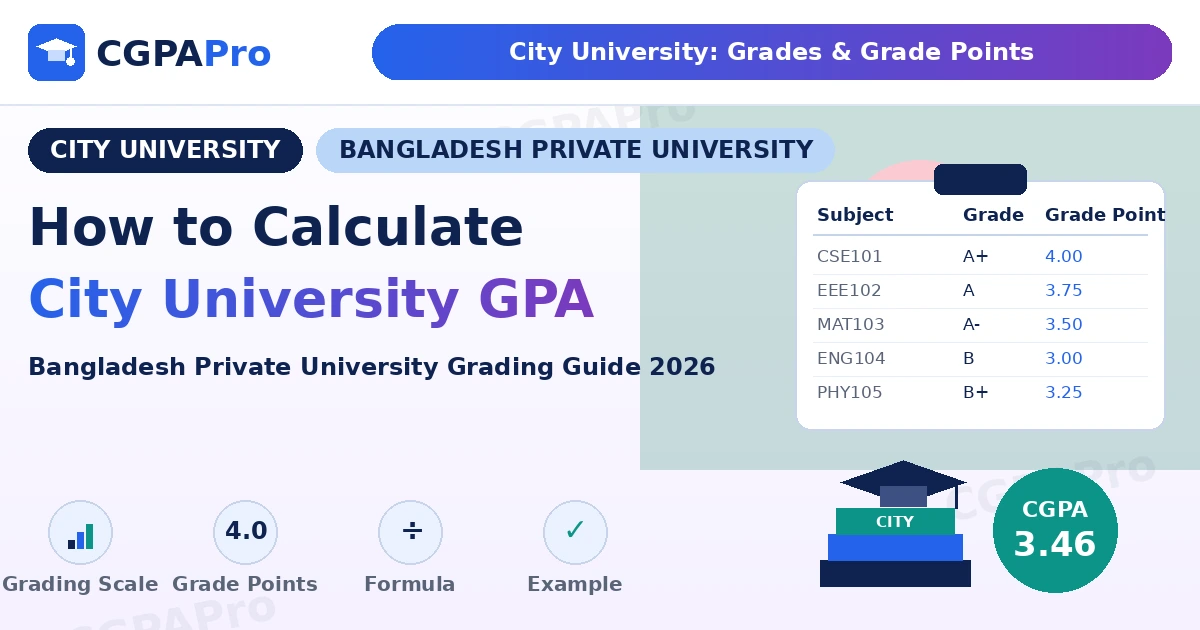
City University Grading System 2026: GPA & CGPA Guide
Quick answer: City University (Bangladesh) runs on the UGC Bangladesh uniform 4.00 grading scale — the same system binding every public and private university in the country. An 80 gets you an A+ (4.00), the passing floor is a D at 40% (2.00), and anything below 40 is an F that earns no credit. Your semester GPA is your credit-weighted average of grade points, and your CGPA is the credit-weighted average of everything you have completed. This guide gives you the exact official table, a step-by-step method, two fully worked examples, and the credit-transfer rules City University publishes on its own website.
How to Check Your GPA and CGPA Online (2 Minutes)
You do not need to do this math by hand every semester. The free calculator at cgpacalculatorpro.com has the UGC Bangladesh scale built in — the same scale City University uses. Here is the two-minute version:
- Open cgpacalculatorpro.com and pick the UGC Bangladesh grading scale from the scale selector.
- Add one row per course: the course name, its credit hours, and the letter grade you earned (or expect).
- Read your semester GPA from the result panel. To get your CGPA, add every completed semester the same way.
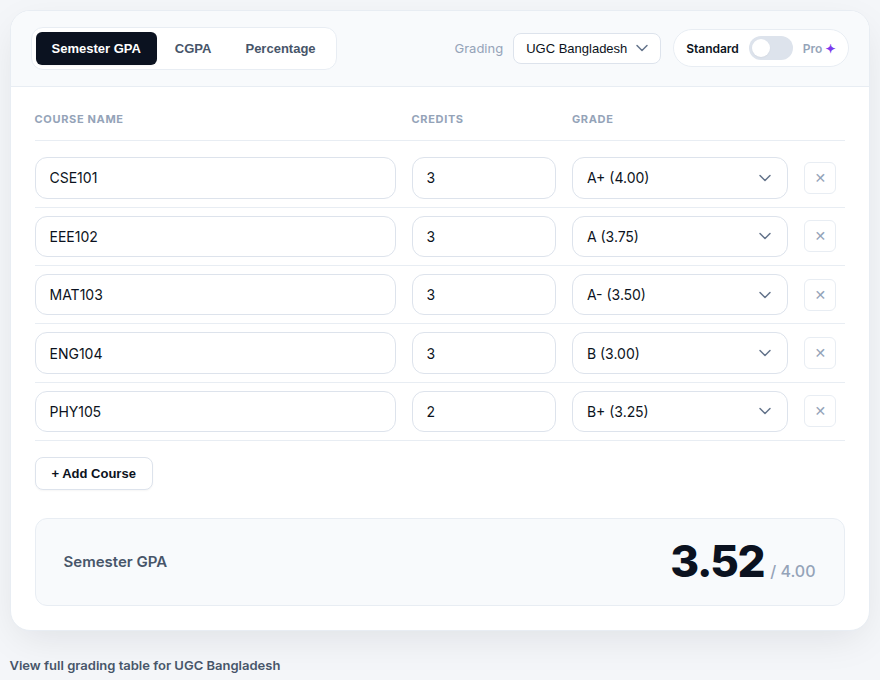
The free calculator at cgpacalculatorpro.com with the UGC Bangladesh scale: 5 courses, 49.25 quality points over 14 credits = Semester GPA 3.52/4.00 — the same worked example calculated above.
One warning before you go further: many generic “CGPA Calculator Bangladesh” pages split their scales into “public” and “private” presets, and their “private” preset is the NSU/BRAC-style scale where an A starts at 90. City University is private, but it does not use that scale — its own academic rules reference a 4-point scale, and the UGC uniform scale is binding on it. Using the wrong preset silently gives you a wrong GPA. More on the traps below.
City University Official Grading Table (2026)
City University does not publish a separate grading table on its website — and that is normal in Bangladesh. The UGC Bangladesh uniform grading guideline sets one compulsory 4.00 scale for every public and private university in the country, effective from the 2006–2007 session. City University’s own academic rules confirm it runs a 4-point scale (the credit-transfer section references “a 4-point scale” twice) — the same table World University of Bangladesh and every other UGC-bound private university uses. Here is the official table, exactly as the UGC publishes it:
| Numerical Score (%) | Letter Grade | Grade Point |
|---|---|---|
| 80 and above | A+ | 4.00 |
| 75 to less than 80 | A | 3.75 |
| 70 to less than 75 | A− | 3.50 |
| 65 to less than 70 | B+ | 3.25 |
| 60 to less than 65 | B | 3.00 |
| 55 to less than 60 | B− | 2.75 |
| 50 to less than 55 | C+ | 2.50 |
| 45 to less than 50 | C | 2.25 |
| 40 to less than 45 | D | 2.00 |
| Less than 40 | F | 0.00 |
Two non-numeric codes also appear on transcripts under the UGC system: I (Incomplete — coursework unfinished, resolved later) and W (Withdrawal — you officially dropped the course). Neither carries grade points, and neither counts toward your CGPA. But do not treat a W casually: too many withdrawals stretch your degree timeline and can affect scholarship eligibility.
The single most important row in that table for a struggling student is the D. A D (40–44) is a pass — it earns you the credit, at 2.00 grade points. An F (below 40) earns nothing: no credit, 0.00 points, and you must retake the course to graduate.
Which “City University” Is This? (Read This First)
“City university grading system” is one of the most polluted searches in Bangladeshi higher education, because at least five different institutions share the name. This guide is about City University, Bangladesh — the private university founded in 2002 by Alhaj Mockbul Hossain, with its campus at Khagan, Birulia, Ashulia (Savar), Dhaka, offering CSE, EEE, Textile Engineering, Pharmacy, BBA, Law, English and more. It is not any of these:
- City University of Hong Kong (CityUHK) — the biggest trap. CityUHK uses a 4.3 scale where an A+ is worth 4.3. That scale does not exist at City University Bangladesh. If you land on a Hong Kong page and plug 4.3 into your math, every number you produce is fiction.
- The City University, Pakistan (cityuniversity.edu.pk) — a different university in a different country’s system.
- City University of Seattle (USA) — American credit system, different entirely.
- City, University of London (UK) — UK degree classifications, not GPAs.
- CETEP / Lead City University (Nigeria) — also unrelated.
A quick sanity check whenever you open a “city university grading” page: if the domain ends in .hk, or you see “4.3” anywhere, close the tab — you are at the wrong university. The official site of your university is cityuniversity.ac.bd (older directories sometimes still list cityuniversity.edu.bd — same university, ac.bd is the current canonical domain).
📖 Read More
- State University of Bangladesh Grading System 2026 — the same UGC-scale guide format for another Bangladeshi private university.
- Uttara University Grading System 2026 — another private university running the identical UGC 4.00 table.
How Your Final Course Mark Is Built
Your transcript shows a letter grade, but that letter comes from a numerical score out of 100 — and the score itself is assembled from several components across the semester. The typical Bangladeshi private-university pattern is some mix of class attendance, quizzes or class tests, assignments and presentations, a midterm exam, and a final exam. The exact weight each component carries varies by department and even by course at City University, so this guide will not invent a fixed breakdown for you — check your course outline at the start of each semester, because that outline is the contract.
What matters for your GPA math is the final number. A 79.6 and a 79.4 are both an A (3.75) — the band you land in decides your grade points, and bands have hard edges. A 74.9 is an A− (3.50), not an A. This is why borderline students should always ask their course teacher how the final total is rounded before results are published, not after.
How to Calculate Your GPA and CGPA — Step by Step
The formula is the same one the UGC system uses everywhere:
Semester GPA (SGPA) = Σ (Course Credits × Grade Points) ÷ Total Credits
Step by step:
- Convert each course’s marks to a grade point using the official table above. 82 → A+ → 4.00. 63 → B → 3.00.
- Multiply each grade point by the course’s credit hours. This gives that course’s quality points. A 3-credit course at A (3.75) contributes 11.25 quality points.
- Add up all the quality points and add up all the credit hours.
- Divide total quality points by total credits. That is your SGPA, usually rounded to two decimals.
For CGPA, do the same thing across semesters — but weight by credits, not by averaging the SGPAs:
CGPA = Σ (Semester Credits × Semester GPA) ÷ Total Credits Completed
Averaging your semester GPAs directly is the classic error: a 15-credit semester and a 9-credit semester do not count equally. Always go back to quality points.
Worked Example 1: One Full Semester (SGPA)
Let’s follow a first-semester CSE student through five courses — the same example shown in the calculator screenshot above:
| Course | Credits | Marks | Grade | Grade Point | Quality Points |
|---|---|---|---|---|---|
| CSE101 — Programming Fundamentals | 3 | 82 | A+ | 4.00 | 12.00 |
| EEE102 — Basic Electrical Engineering | 3 | 77 | A | 3.75 | 11.25 |
| MAT103 — Mathematics I | 3 | 72 | A− | 3.50 | 10.50 |
| ENG104 — English Composition | 3 | 63 | B | 3.00 | 9.00 |
| PHY105 — Physics Lab | 2 | 68 | B+ | 3.25 | 6.50 |
| Total | 14 | 49.25 |
Check each conversion against the table: 82 is “80 and above” → A+ (4.00) ✓; 77 falls in 75–79 → A (3.75) ✓; 72 in 70–74 → A− (3.50) ✓; 63 in 60–64 → B (3.00) ✓; 68 in 65–69 → B+ (3.25) ✓.
Quality points: 3 × 4.00 = 12.00; 3 × 3.75 = 11.25; 3 × 3.50 = 10.50; 3 × 3.00 = 9.00; 2 × 3.25 = 6.50. Total = 12.00 + 11.25 + 10.50 + 9.00 + 6.50 = 49.25. Total credits = 3 + 3 + 3 + 3 + 2 = 14.
SGPA = 49.25 ÷ 14 = 3.5179… = 3.52
Notice how the 2-credit lab counts less than the 3-credit theory courses: the B+ in Physics Lab (6.50 points) moves the needle less than the B in English (9.00 points), even though B+ is the better grade. Credits are weights — always.
Worked Example 2: CGPA Across Two Semesters
CGPA is the credit-weighted average of everything completed. Take the same student’s first two semesters:
| Semester | Credits | SGPA | Quality Points |
|---|---|---|---|
| Semester 1 | 15 | 3.40 | 51.00 |
| Semester 2 | 14 | 3.52 | 49.28 |
| Total | 29 | 100.28 |
Quality points: 15 × 3.40 = 51.00; 14 × 3.52 = 49.28. Total = 100.28 over 29 credits.
CGPA = 100.28 ÷ 29 = 3.4579… = 3.46
Now watch the trap: the plain average of the two SGPAs is (3.40 + 3.52) ÷ 2 = 3.46 — which happens to round the same here only because the credit loads are close (15 vs 14). With a 18-credit semester and a 9-credit semester, the naive average would be visibly wrong. Always weight by credits.
GPA vs CGPA — What’s the Difference?
GPA (Grade Point Average) usually means one semester’s average — your SGPA. CGPA (Cumulative Grade Point Average) is the running average across all completed semesters, weighted by credits. Employers and foreign universities ask for your CGPA; your department’s probation and Dean’s List decisions also run on CGPA, not a single good semester.
One practical consequence: early semesters matter disproportionately. A weak first year sits in the denominator of every CGPA you ever compute afterward, and you need progressively better semesters just to drag the average back up. Conversely, protecting a strong start is the cheapest way to keep a high CGPA — it is mathematically easier to keep a 3.50 than to recover one.
Common Mistakes City University Students Make
1. Using CityUHK’s 4.3 scale. The most expensive mistake on this list. Search results for “city university grading system” are dominated by City University of Hong Kong, where A+ = 4.3. Your university’s scale tops out at 4.00. A transcript computed on the 4.3 scale is wrong everywhere it matters.
2. Picking the “private university” preset on generic calculators. Some calculator sites offer a “private university” scale where an A starts at 90 and anything below 45 fails. That is the NSU/BRAC-style scale — City University does not use it. City follows the UGC uniform table (A starts at 75, fail below 40). Always select the UGC Bangladesh scale.
3. Carrying the HSC 5.00 scale into university. In SSC and HSC, GPA runs on a 5.00 scale (A+ = 5.00). At City University, the ceiling is 4.00. Freshmen who mentally convert “I was a 5.00 student, so I’ll be a 4.00 student” are comparing different rulers — the percentages behind the grades are what matter, and university bands are unforgiving.
4. Averaging semester GPAs instead of weighting by credits. Covered above — always go back to quality points.
5. Counting I and W grades in the math. Incomplete and Withdrawal carry no grade points and no credits in the CGPA calculation. But they are not free: retaking an incomplete costs you a semester’s time, and a transcript full of Ws raises questions.
6. Thinking a D is a fail. D (40–44, 2.00) earns the credit. It is not a good grade — it drags your CGPA — but it is a pass. The fail is F, below 40, which earns nothing and must be retaken.
7. Ignoring credit weights when choosing where to invest effort. An extra 5 marks in a 3-credit course moves your SGPA more than the same effort in a 1-credit lab. Effort is finite; allocate it where the credits are.
Credit Transfer Rules at City University
This is the section no generic calculator page gives you, because it comes from City University’s own published academic rules (Academic Rule & Procedure, verified October 2026). If you are transferring into City University from another university, these are the actual gates:
- Minimum 2.50 CGPA on a 4-point scale at your previous university to be considered for admission as a transfer student.
- Maximum 35% of the degree’s total credit hours can transfer in (through grade transfer, exemption, or a mix). In exceptional cases, the Equivalence Committee can extend this to 40% on the Dean’s recommendation.
- At least a B grade in a course for its grade to transfer. In some cases, a C+ (per City University’s standard) may be considered for transfer or exemption.
- One course mapping to two or more City University courses: the average grade is shown on your City University transcript.
- The Equivalence Committee judges whether your previous university’s curriculum, evaluation system, and grading standard are comparable — and its decision is final. You will need official catalogs and transcripts from every institution attended.
The 2.50 floor is worth internalizing even if you never transfer: it is the university’s own line for “good academic standing” in a transfer context, and a useful personal red line. If your CGPA is drifting toward 2.50, treat it as an early warning, not a target.
How to Improve Your CGPA at City University
City University does not publish its retake, improvement-exam, or probation rules in any source accessible online, so treat the following as standard UGC-system practice and confirm the details with your department office — policies differ between programs:
- Retake F grades first. An F contributes 0.00 points while still occupying credits in your denominator. Under standard UGC-system practice, the retake grade replaces the F in CGPA computation — and the math in our retaking guide shows exactly how much one retaken course can lift you.
- Target high-credit, near-boundary courses. A course sitting at 73 (A−, 3.50) is two marks from an A (3.75) — and if it is a 3-credit course, that jump is worth 0.75 quality points, more than most lab courses contribute in total.
- Front-load effort in the semester’s first half. Quizzes, assignments, and the midterm are the marks you control most directly; students who bank 70% of the available internal marks before the final walk in needing far less from the hardest exam of the term.
- Never skip the “easy” 40%. Attendance and assignment marks are the cheapest grade points in every course. Losing them is how 74s become 69s.
For the full playbook — including the exact arithmetic of how many A-grades you need to move from any CGPA to your target — see our CGPA improvement guide.
📖 Read More
- How Retaking a Course Affects Your CGPA — the exact math of replacing an F or D grade.
- How to Improve Your CGPA — semester-by-semester recovery strategies with numbers.
Frequently Asked Questions
Q: Does City University use a 4.00 or a 4.30 scale?
A: 4.00. City University Bangladesh follows the UGC Bangladesh uniform grading system, which tops out at A+ = 4.00. The 4.30 scale belongs to City University of Hong Kong — a different university. Do not mix them.
Q: Is City University’s grading the same as NSU, BRAC, or IUB?
A: No. Those universities use their own scales (typically A from 90). City University uses the UGC uniform table (A+ from 80, A from 75). Same country, different rulers — which is why the “private university” preset on generic calculators is dangerous for City students.
Q: What is the passing mark at City University?
A: 40%. That earns a D (2.00 grade points) and the course credit. Below 40 is an F: no credit, 0.00 points, and the course must be retaken.
Q: Can I transfer credits to City University from another university?
A: Yes, within limits published on the university’s own site: you need at least a 2.50 CGPA on a 4-point scale, you can transfer at most 35% of the degree’s credits (40% in exceptional cases), and each transferred course needs at least a B (C+ sometimes considered). The Equivalence Committee’s decision is final.
Q: My HSC GPA was 5.00. Why is my university GPA out of 4.00?
A: SSC/HSC in Bangladesh run on a 5.00 scale; universities run on the UGC 4.00 scale. They are different systems — a 5.00 in HSC does not convert to a 4.00 at university. Compare percentages, not scale numbers.
Q: Is a 3.00 CGPA good at City University?
A: A 3.00 is a solid B average — comfortably above the 2.50 line the university itself uses for transfer admission, and a respectable result for most private-sector jobs in Bangladesh. For competitive scholarships or foreign MS applications, aim for 3.50+.
Q: What happens to my CGPA if I get an F?
A: The course contributes 0.00 grade points but its credits stay in your CGPA denominator, which pulls the average down hard. Retake it: under standard UGC-system practice the new grade replaces the F in the calculation. Confirm your department’s exact retake rule before planning around it.
The Bottom Line
City University (Bangladesh) grades on the UGC uniform 4.00 scale: A+ from 80%, D passing at 40%, F below 40 earning nothing. Compute your SGPA as total quality points divided by total credits, and your CGPA the same way across every completed semester — never by averaging averages. Dodge the two big traps (Hong Kong’s 4.3 scale and the “private university” NSU-style preset), respect the 40% floor, and keep an eye on the 2.50 line the university itself treats as the good-standing threshold. Run your own numbers any time on the free CGPAPro calculator with the UGC Bangladesh scale selected.
Sources & honesty note: the grade table is the official UGC Bangladesh uniform grading guideline (binding on all Bangladeshi universities); the credit-transfer rules are from City University’s own Academic Rule & Procedure page (cityuniversity.ac.bd, verified October 2026). City University does not publish a separate grading table, retake/improvement rules, probation thresholds, or graduation CGPA minimum online — where this article describes standard UGC-system practice instead of verified City policy, it says so. Confirm department-specific rules with your program office.