Port City International University Grading System 2026: GPA & CGPA Guide
Quick answer: Port City International University (PCIU), Chittagong, uses the UGC Bangladesh uniform 4.00 grading scale — an A+ (4.00) starts at 80% marks, the passing floor is a D at 40% (2.00), and anything below 40% is an F worth zero grade points. Your semester GPA is the credit-weighted average of your grade points; your CGPA is the same average across all completed trimesters (PCIU counts transfer credits toward the degree but not toward the CGPA). To graduate you need a CGPA of 2.50, and if your trimester GPA falls below 2.50 you get exactly one trimester of probation before the university asks you to leave. One more thing that surprises almost every new student: PCIU’s official result sheets and transcripts print letter grades and grade points only — no numerical scores at all. This guide gives you the exact official table from PCIU’s own Rules & Grading System page, the improvement-exam rules no other guide explains in plain English, three fully worked examples, and the honest flags (yes, the official page has a typo) so nothing in your own calculation goes wrong.
One note on the name before we start. This guide is about Port City International University in Chittagong, Bangladesh (PCIU, portcity.edu.bd) — not the University of Port Harcourt (UNIPORT) in Nigeria, which dominates generic “Port City grading” search results with a completely different 5.0 scale, and not “PICU,” a misspelling that has spread through a few university directories. If you landed here from a search, you are in the right place.
How to Check Your GPA and CGPA Online (2 Minutes)
You do not need to do this math by hand every trimester. The free calculator at cgpacalculatorpro.com has the UGC Bangladesh scale built in — the same scale PCIU uses. Here is the two-minute version:
- Open cgpacalculatorpro.com and keep the UGC Bangladesh grading scale selected (it is the default).
- Add one row per course: the course name, its credit hours, and the letter grade you earned (or expect).
- Read your semester GPA from the result panel. To get your CGPA, add every completed trimester the same way.
A warning first, because this is where PCIU students quietly lose points on calculator sites: several popular “CGPA Calculator Bangladesh” pages split their presets into “public” and “private” scales, and their “private” preset is the NSU/BRAC-style table where an A starts at 90. PCIU is private, but it does not use that table — the university’s own Rules & Grading System page prints the UGC uniform scale. Selecting the wrong preset produces a wrong GPA. Our HEC vs UGC grading scale comparison walks through both systems if you want to understand the difference.
PCIU Official Grading Table (2026)
The table below is taken directly from PCIU’s official Rules & Grading System page. It is the UGC uniform scale: A+, A, A−, B+, B, B−, C+, C and D are passing grades; F is failing.
| Marks Range | Letter Grade | Grade Point | Interpretation |
|---|---|---|---|
| 80% and above | A+ | 4.00 | Outstanding |
| 75% to less than 80% | A | 3.75 | Excellent |
| 70% to less than 75% | A− | 3.50 | Very Good |
| 65% to less than 70% | B+ | 3.25 | Good |
| 60% to less than 65% | B | 3.00 | Satisfactory |
| 55% to less than 60% | B− | 2.75 | Above Average |
| 50% to less than 55% | C+ | 2.50 | Average |
| 45% to less than 50% | C | 2.25 | Below Average |
| 40% to less than 45% | D | 2.00 | Pass |
| Less than 40% | F | 0.00 | Fail |
| — | I | — | Incomplete |
| — | W | — | Withdraw |
Two honest flags on the official page itself, because they trip up students who copy the table:
- The official table prints the B− row twice. The “55% to less than 60% / B− / 2.75” row appears two times in a row on the live page — a genuine copy-paste typo on the university’s own site. I have reproduced the table above once, as intended. Do not double-count it when you audit your own record.
- The page contradicts itself on the Incomplete grade. The table lists I for Incomplete, but the body text says “Grade ‘T’ is incomplete.” Neither is explained further. Until PCIU fixes this, treat an incomplete-grade entry with care and confirm with your department which code appears on your result sheet.
PCIU publishes trimester results within a maximum of one week from the last examination — and remember, what you get is the letter grade plus the grade point. No numerical score appears on the result sheet or the transcript, and the university does not hand out a consolidated score or a marks break-up. More on what that means for foreign applications later.
How PCIU Builds Your Marks (Evaluation Breakdown)
Understanding the grade table is only half the battle — you also need to know where your marks come from. PCIU publishes the exact assessment split on the same official page, and it is the same for all programs:
- First half: Case/assignment 5%, class test 5%, midterm 30%, attendance 10%
- Second half: Case/assignment 5%, class test 5%, trimester final 40%
- Total: 100%
A few details that matter in practice:
- For a 3-credit course you sit at least 4 class tests, and your best 3 count. For a 1- or 2-credit course it is at least 3 tests with the best 2 counting. That means one bad class test does not have to hurt you — but two bad ones will.
- The midterm portion is considered completed once the midterms are over; it is not carried into the trimester final. You cannot “make up” a missed midterm in the final exam — a missed component scores zero.
- Attendance carries real weight. PCIU converts attendance percentage into marks on a sliding scale: 90–100% earns 10 marks, then one mark drops for roughly every five percentage points (85–89% → 9, 80–84% → 8, and so on down to below 50% → 0). In a tight race between a B+ and an A−, ten attendance marks are often the difference.
- You also need your admit card: no student sits the midterm or trimester final without it, admit cards go only to dues-cleared students, and you must collect yours at least two days before exams begin.
Step-by-Step: How to Calculate Your PCIU GPA
The EEE and CSE syllabi print the rule plainly: “GPA or CGPA is the average of the grade points obtained in all the courses passed/completed by a student” — and it is credit-weighted. The formula:
Semester GPA = Σ (grade point × credit hours) ÷ Σ (credit hours)
- Convert each course’s letter grade to its grade point using the official table above.
- Multiply the grade point by the course’s credit hours. That is the course’s quality points.
- Add up all quality points and divide by the total credit hours.
- Repeat the same calculation across every completed trimester to get the CGPA.
Worked Example: A 16-Credit PCIU Semester
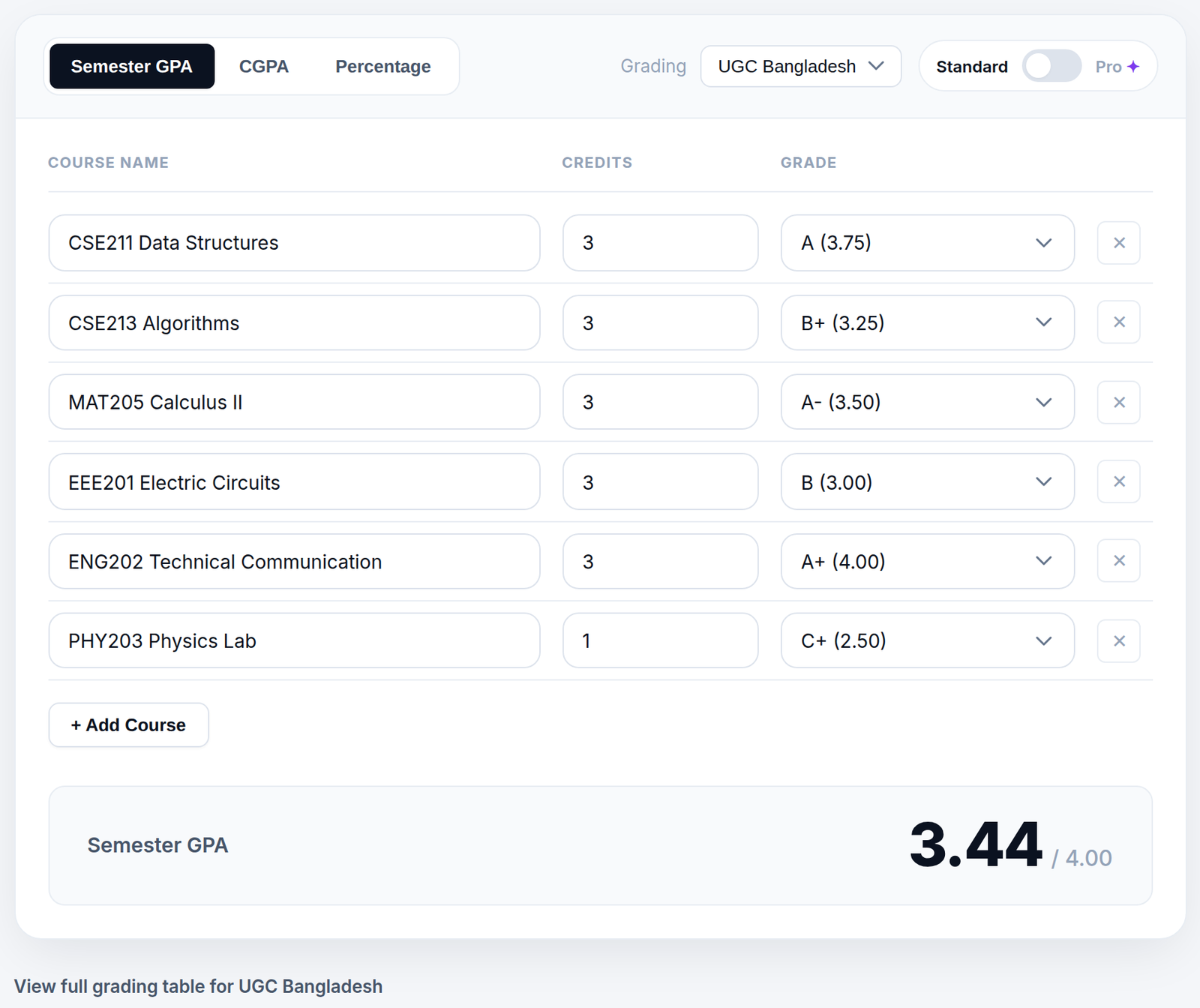
Here is a realistic third-trimester engineering semester, grade by grade. The same numbers are filled into the calculator screenshot at the top of this guide, so you can check your own work against it.
| Course | Credits | Grade | Grade Point | Quality Points |
|---|---|---|---|---|
| CSE 211 — Data Structures | 3 | A | 3.75 | 3.75 × 3 = 11.25 |
| CSE 213 — Algorithms | 3 | B+ | 3.25 | 3.25 × 3 = 9.75 |
| MAT 205 — Calculus II | 3 | A− | 3.50 | 3.50 × 3 = 10.50 |
| EEE 201 — Electric Circuits | 3 | B | 3.00 | 3.00 × 3 = 9.00 |
| ENG 202 — Technical Communication | 3 | A+ | 4.00 | 4.00 × 3 = 12.00 |
| PHY 203 — Physics Lab | 1 | C+ | 2.50 | 2.50 × 1 = 2.50 |
Total quality points = 11.25 + 9.75 + 10.50 + 9.00 + 12.00 + 2.50 = 55.00
Total credits = 16
Semester GPA = 55.00 ÷ 16 = 3.44
Notice two things. First, the A+ in a 3-credit course contributed 12.00 points — a high grade in a heavy course moves the needle far more than the same grade in a 1-credit lab. Second, this student sits at 3.44, comfortably above the probation line but still short of a 3.50. That is exactly the situation where PCIU’s improvement-exam system (below) becomes worth pricing out.
GPA vs CGPA at PCIU (and the Transfer-Credit Trap)
Students mix these up constantly, so here is the clean version:
- Semester (trimester) GPA covers one trimester only — the weighted average of that trimester’s courses.
- CGPA covers every course you have completed at PCIU, weighted by credits, from your first trimester to your latest.
The transfer-credit trap: PCIU’s examination policy states that a transfer student’s grades and transferred grade points are not incorporated into the CGPA — only the “transfer credit hours” appear on the record. Your CGPA is computed purely on courses you completed at PCIU. That is good news if you transferred in with weak grades from elsewhere, and bad news if you transferred in with strong ones you were counting on.
If the distinction still feels fuzzy, our CGPA vs GPA vs SGPA explainer breaks it down with more examples.
Improvement Exams: PCIU’s Most Misunderstood System
This is the section no other guide covers properly, and it is the one PCIU’s own FAQ admits students struggle with most. The university literally writes: “Most of the students of PCIU are facing problems about our examination system.” Here is the system decoded, straight from the official Examination Policy:
Who is eligible
The Examination Policy says students with grades from “D” to “B+” may register a course as “Improvement” — once only. But the official exam FAQ answers the same question with “Students those who got ‘Grade B’ or less may apply for improvement.” Those two statements are not identical (one includes B+, the other stops at B). This is a genuine contradiction on the university’s own pages, and it matters because a B+ student planning an improvement exam needs to know whether they are allowed in. Confirm your eligibility with the Controller of Examinations before you pay.
The rules that actually govern it
- Fee: Tk. 600 per credit hour. A 3-credit improvement costs Tk. 1,800.
- Once only: each course can be registered as improvement exactly one time.
- 6-credit cap: you may register at most 6 credit hours of improvement in a single semester.
- Flexibility: you may choose to appear for the midterm, the semester final, or both — in the same semester.
- Incomplete courses are excluded: an Incomplete may be registered as a “repeat,” not as an improvement.
- Exam-slot clash bonus: if two of your exams land in the same slot, you may attend the improvement exam without fee — a real student question from the FAQ with a real answer.
What the policy does NOT say (read this before paying)
Two things students usually assume are not stated anywhere on PCIU’s public pages: whether the improved grade replaces the old one (or the higher of the two counts), and how improved or repeated courses appear on the transcript. Do not assume the new grade automatically wins — ask the Controller of Examinations for the current rule before you spend Tk. 600 a credit on it. The FAQ’s fee and eligibility questions show students are already paying without clear answers; go in with the question written down.
Common Mistakes PCIU Students Make
- Using a calculator with the wrong scale preset. The NSU/BRAC-style “private” tables start an A at 90. PCIU starts an A+ at 80. One wrong preset selection can move your computed GPA by a quarter point.
- Assuming an improvement grade automatically replaces the old one. PCIU’s published rules do not say that. Confirm the replacement rule first — it changes whether the fee is worth it.
- Expecting numerical scores on the transcript. There are none. If you are filling out a foreign university or scholarship form that demands “percentage marks,” you will need the official grading table (printed above) to show what each letter means — because PCIU will not give you a number.
- Assuming the graduation bar is 2.00. Many Bangladesh universities set it there. PCIU does not: the certificate and the degree both require a CGPA of 2.50 (confirmed in the exam FAQ and the EEE/CSE syllabi, which require 145.5 and 154.5 credit hours respectively at CGPA 2.50).
- Missing the scrutiny window. If you believe a paper was mis-evaluated, you have exactly 7 days from result publication to apply for re-examination, at Tk. 1,000 per course, non-refundable. Day 8 is too late.
- Ignoring attendance until it is too late. Below 50% attendance earns zero of the 10 attendance marks, and departments may bar you from sitting exams on attendance grounds. Those 10 marks are the cheapest marks in the course.
- Copying the official table’s B− row twice. It is a typo on the page, not a policy. If your spreadsheet has two B− rows, delete one.
Probation, F-Grade Repeats, and the 2.50 Bar
PCIU’s academic rules are unusually blunt about probation, which is exactly why students should read them:
- Probation: any student — undergraduate, graduate, or postgraduate — with a GPA below 2.50 is placed on probation for one trimester only. Fail to improve within that trimester and you must leave the university. There is no second probation trimester in the published rules.
- F grade: you must repeat the course paying the full course fee — attending all classes, class tests, the midterm and the final as a regular student. A course may be repeated no more than three times, and until the grade improves you cannot take further courses.
- Graduation: minimum CGPA 2.50 for the certificate, confirmed across the exam FAQ and program syllabi. Plan every semester so the 2.50 line stays below you, not above you.
Tips for Keeping Your PCIU GPA Healthy
- Target the attendance marks first. 90% attendance is 10 free marks toward every course total — the highest return on the least effort in the entire assessment scheme.
- Use the class-test drop rule deliberately. With the best 3 of 4 counting in 3-credit courses, one bad test is survivable. Two bad tests are not. Treat the fourth test as insurance, not as optional.
- Price improvement exams like an investment. At Tk. 600/credit with a 6-credit semester cap, improving two B grades to A− can lift a semester GPA by 0.2+ — but only if the improved grade actually replaces the old one. Get that rule confirmed before paying.
- Check results on day one. Results land within a week of the last exam, and the Tk. 1,000 scrutiny application expires 7 days after publication. Mark the calendar the day results drop.
- Clear dues early. No admit card without cleared dues, and cards must be collected two days before exams. A fee-office queue on the last day is a preventable disaster.
- Keep the official grading table saved. Because transcripts carry no numerical scores, you will need the letter-to-marks table every time a job, scholarship, or foreign application asks for percentages. If you plan on higher studies abroad, our guide to improving your CGPA shows how to plan semesters around target numbers.
FAQ: Real Questions PCIU Students Ask
These are the actual questions PCIU’s own exam FAQ says students ask — the university admits most of its students have problems with the examination system, so these are not guesses.
What is the fee for an improvement exam at PCIU?
Tk. 600 per credit hour — so Tk. 1,800 for a standard 3-credit course. You may take at most 6 credit hours of improvement in one semester, and each course can be improved only once. (Exam-slot clashes are the exception: if two exams land in the same slot, the improvement attendance is free.)
Who is eligible for an improvement exam?
This is where the university’s own pages disagree: the Examination Policy says grades from “D” to “B+” may register for improvement, while the exam FAQ says “Grade B or less.” If you earned a B+, confirm your eligibility with the Controller of Examinations before paying — the pages genuinely contradict each other.
What is the minimum CGPA to get my PCIU certificate?
2.50. The official exam FAQ states the minimum CGPA for the certificate is 2.50, and program syllabi (EEE 145.5 credits, CSE 154.5 credits) require completing the full credit load at CGPA 2.50.
What happens if my GPA drops below 2.50?
You are placed on academic probation for one trimester only. If you do not lift your GPA within that trimester, the rules say you must leave the university. This is stricter than many universities’ multi-semester probation ladders — treat the 2.50 line as a hard floor.
Why does my PCIU transcript have no numerical scores?
University policy: results are published as letter grade + grade point only, and transcripts carry no numerical scores and no consolidated score break-up. For foreign applications (WES and similar), keep PCIU’s official grading table — the one printed above — with your application so evaluators can map each letter to its marks range. WES uses its own conversion scale, so check the current WES guidance for Bangladesh rather than assuming a 1:1 mapping.
What happens if I fail a course (F grade)?
You must repeat the course paying the full course fee, attending everything as a regular student. A course can be repeated at most three times. Until the failed grade is improved, you cannot register further courses — so an F in an early trimester can jam your entire study plan if you let it sit.
How do I get my admit card and exam clearance?
Clear all dues first (admit cards go only to dues-cleared students), then collect your card at least two days before exams begin. No admit card, no exam hall — for the midterm or the final.
Conclusion
PCIU runs a standard UGC-scale grading system with an unusually transparent — and unusually strict — set of rules around it. The table itself is the national uniform scale, but the improvement-exam mechanics, the one-trimester-only probation, the 2.50 graduation bar, and the letter-grades-only transcripts are all PCIU-specific details that decide real outcomes: whether a B+ is worth Tk. 1,800 to improve, whether a 2.45 trimester ends your enrollment, and what you can actually send to a foreign university. Run your numbers through the free GPA calculator, keep the official grading table saved for transcript season, and when in doubt about the D-to-B+ question, ask the Controller of Examinations — the website contradicts itself, and a Tk. 600-per-credit decision deserves a straight answer.