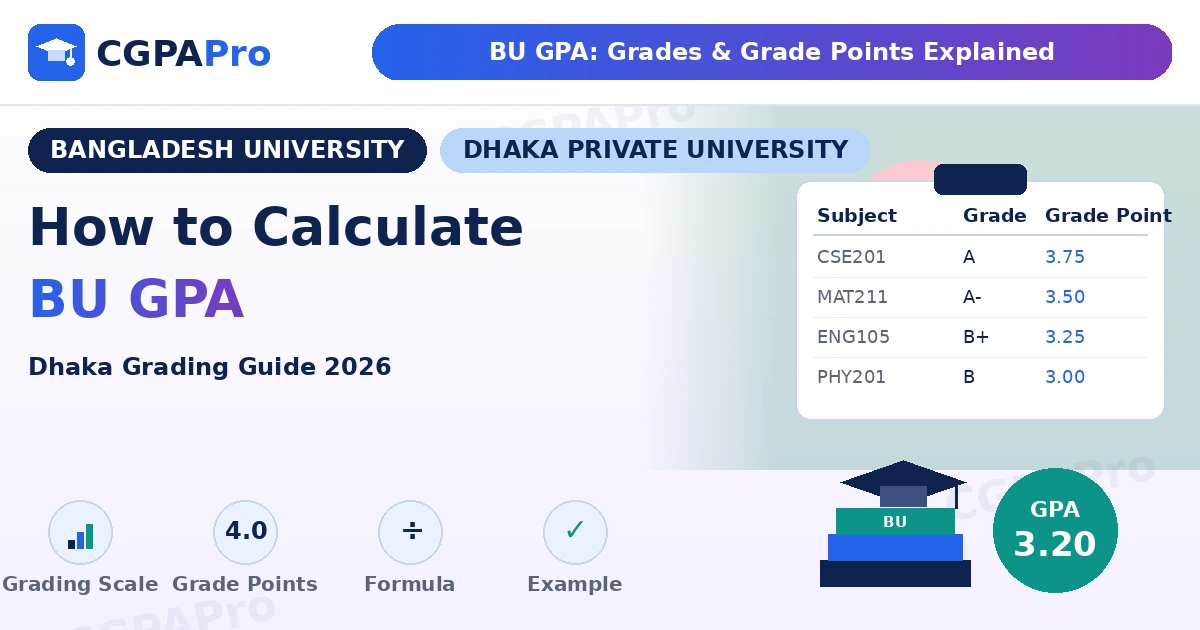
Searching for “BU grading system” and getting results about Boston University? Or reading a table that says the Bangladesh University of Business and Technology? Stop. This guide is about Bangladesh University — the private university at 15/1 Iqubal Road, Mohammadpur, Dhaka-1207, founded in 2001, official site bu.edu.bd. Different university, different rules. Below is the official grading system for Bangladesh University for 2026: the exact UGC grade table the university publishes, the GPA and CGPA formulas, worked examples with real numbers, and the retake, improvement, and probation rules students keep tripping over.
Calculate your BU GPA in under a minute
Bangladesh University doesn’t have its own dedicated calculator page on this site — the homepage cgpacalculatorpro.com calculator is the one to use. That’s fine, because the homepage calculator runs on the UGC Bangladesh scale, and Bangladesh University’s official grade table follows the UGC scale exactly. Same bands, same 0.25 steps — the numbers you get will match the university’s own computation precisely.
Open the calculator, pick the “UGC Bangladesh” grade scale, add each course with its letter grade and credit hours, and it spits out your GPA. Below is what a typical 15-credit BU semester looks like — the same five courses as Worked Example 1 in this article, computed to GPA 3.20:
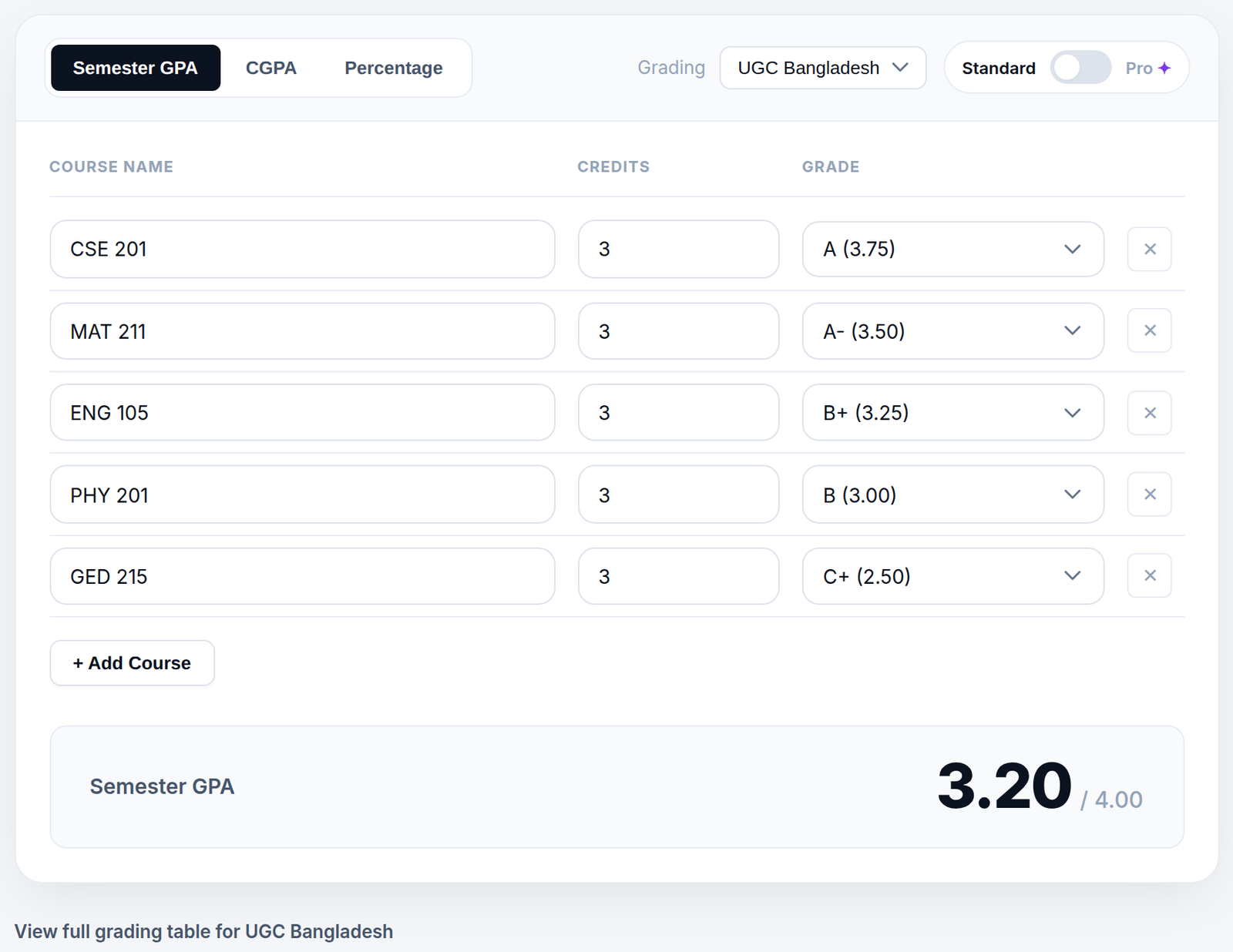
Screenshot: a 15-credit semester computed on the homepage calculator (UGC Bangladesh scale — identical to BU’s official table), giving 3.20. Honest note: cgpacalculatorpro.com has no dedicated Bangladesh University calculator page; the homepage generic calculator is the official-scale equivalent.
BU official grading table (2026)
This is the grade table from Bangladesh University’s published academic policy — the UGC uniform scale:
| Marks (%) | Letter grade | Grade point |
|---|---|---|
| 80–100 | A+ | 4.00 |
| 75–79 | A | 3.75 |
| 70–74 | A− | 3.50 |
| 65–69 | B+ | 3.25 |
| 60–64 | B | 3.00 |
| 55–59 | B− | 2.75 |
| 50–54 | C+ | 2.50 |
| 45–49 | C | 2.25 |
| 40–44 | C− | 2.00 |
| Below 40 | F | 0.00 |
Notice the 40–44 band: it’s C− at 2.00, not D. That’s a genuine quirk of this university’s table. Most students coming from other private universities assume there’s a D band in there somewhere. There isn’t — the official table has no D at all. And here’s a flag worth knowing: elsewhere in the university’s policy text, the GPA/CGPA formula section lists “D” among passing grades. That’s legacy wording that contradicts the official table. The table is authoritative: C− 2.00 is the floor, anything below 40 is F.
Alongside letter grades, the policy defines three non-numerical grades: P (Pass), I (Incomplete), and W (Withdrawal). None of them carry grade points, and F/I/W credits don’t count toward graduation requirements or the GPA.
How the marks split across the semester
Before the grade points, it helps to know where the marks come from. Every theory course at BU totals 100 marks, split three ways:
- 20% continuous assessment — attendance, assignments, quizzes, presentations, class tests.
- 30% midterm — 1.5 hours, conducted by the department itself.
- 50% final — 2 hours, conducted centrally by the Controller of Examinations.
One thing students underestimate: the final exams are coded. Your answer script is coded so the examiner can’t identify whose paper they’re marking, scripts are evaluated inside the university, and results get uploaded to the software quickly. Whatever you think about the difficulty of the questions, the marking side is deliberately anonymized.
On the credit side, a 3-credit theory course means 2 lectures a week at 1.5 hours each; a 2-credit theory is 1 lecture a week; a 1.5-credit lab is one 3-hour lab session per week.
BU vs the other “BUs”: a disambiguation you probably need
Bangladesh University is its own institution — private, Mohammadpur, Dhaka. It is not:
- BUBT — the Bangladesh University of Business and Technology. Different private university, different campus, and we have a separate BUBT grading system 2026 guide for it. If you study at BUBT, read that one instead.
- BUET — the Bangladesh University of Engineering and Technology, a public engineering university. Different world entirely.
- The University of Dhaka — public, completely separate grading and examination culture.
- Boston University — if you searched “BU grading system” and landed on a page about a university in Massachusetts (yes, one well-known site ranks exactly that page for this search), that’s the wrong country. This article is the one about the Dhaka university.
The letters match, nothing else does. Make sure you’re reading the guide for the university you’re actually enrolled at.
GPA and CGPA formulas at Bangladesh University
The university’s definitions are straightforward:
- Earned grade points = grade point × credit hours (per course).
- GPA = average of earned grade points across the courses of one semester = total earned grade points ÷ total credit hours attempted that semester.
- CGPA = average across all completed semesters = total earned grade points over every semester ÷ total credit hours completed.
Two details matter here. First, your transcript shows the letter grade and grade points only — not your numerical marks. An examiner’s 67 and another student’s 69 both show up as B+ 3.25; the difference dies at the transcript. Second, CGPA is computed from total points and total credits, not by averaging your semester GPAs. A 3.00 in a 18-credit semester and a 3.60 in a 12-credit semester do not average to 3.30 — the credit weights pull the result toward the heavier semester. Worked Example 2 below shows exactly how that works.
Worked Example 1: term GPA
Take a real-looking first-year semester: five courses, 3 credits each — 15 credits total. Here’s the student’s result:
| Course | Grade | Point | Credits | Earned points |
|---|---|---|---|---|
| CSE 201 | A | 3.75 | 3 | 11.25 |
| MAT 211 | A− | 3.50 | 3 | 10.50 |
| ENG 105 | B+ | 3.25 | 3 | 9.75 |
| PHY 201 | B | 3.00 | 3 | 9.00 |
| GED 215 | C+ | 2.50 | 3 | 7.50 |
| Total | 48.00 | |||
GPA = 48.00 ÷ 15 = 3.20. Clean, exact, no rounding drama. (This is the same computation shown in the calculator screenshot above — try it yourself on the homepage calculator to confirm.)
Worked Example 2: CGPA across semesters
Now say the same student had a rough first year: 30 credits completed at a 2.60 GPA. That’s 30 × 2.60 = 78.00 earned points. Add the current semester: 15 credits at 3.20 = 48.00 points.
Total earned points = 78.00 + 48.00 = 126.00. Total credits = 30 + 15 = 45. CGPA = 126.00 ÷ 45 = 2.80.
Notice this is not the average of 2.60 and 3.20 (which would be 2.90). The first year carried twice the credit weight, so it drags the CGPA toward 2.60. The rule to remember: CGPA is always weighted by credits. Every point you’ve ever earned counts — and every credit you’ve ever attempted dilutes or concentrates it.
Reality check: is your target GPA actually reachable?
Students often set a CGPA goal without checking the math, so here’s the honest version. Our example student has 30 credits at 2.60 (78.00 points) and wants a CGPA of 3.20 after 45 credits. The required next-semester GPA: (3.20 × 45 − 78.00) ÷ 15 = (144.00 − 78.00) ÷ 15 = 66 ÷ 15 = 4.40. That’s above the maximum possible 4.00 — literally impossible.
So what’s the actual ceiling? Even a perfect 4.00 across the next 15 credits gives (78.00 + 60.00) ÷ 45 = 138.00 ÷ 45 = 3.07. That’s the honest number to aim at: 3.07 is an outstanding semester away, but 3.20 isn’t on the table this term. Set targets the arithmetic supports.
Retake math: the F that never leaves the page
Fail a course at BU and you don’t just move on — the F must be repeated, on payment of the retake fee. You can retake a failed course only once. Here’s the part students get wrong:
- The retake grade is substituted for the F in the CGPA computation — the 0.00 stops dragging the average.
- But the transcript shows both: the original F stays printed, right next to the retake grade. The CGPA math forgets the F; the transcript never does.
Numbers make it concrete. Suppose a student has 60 credits at 2.50 — that’s 150.00 earned points, including a 3-credit F (0.00 points) on one course. They retake it and earn a B (3.00): the substitution replaces the F’s 0.00 with 3.00 × 3 = 9.00 points.
New total = 150.00 + 9.00 = 159.00 points. CGPA = 159.00 ÷ 60 = 2.65. One retake, 3 credits, and the CGPA climbs from 2.50 to 2.65 — because the substituted 9 points act on the whole 60-credit base. That’s why retaking F’s early, when your total credits are still small, pays off the most. For the full mechanics of how retakes move your CGPA, see our guide on how retaking a course affects your CGPA.
Improvement exams: the C+ ceiling you can’t cross
If you scored C+ or below on a course, BU lets you sit an improvement exam: you re-register with the next batch, pay the improvement fee, and take another shot. Two hard limits:
- Not for labs. Improvement is not allowed for laboratory, practical, sessional, or viva-voce courses — theory only.
- The C+ line is the line. A B− (2.75) looks like a grade worth improving, but 2.75 is above C+ (2.50), so improvement is not allowed. This is where the policy’s internal wording gets sloppy: the retake section loosely mentions “C, D, or F” as improvable grades, while the dedicated Improvement section clearly says “C+ and below.” Go with “C+ and below” — and note that under either phrasing, a B− cannot be improved. If you want to lift a B−, your only tool is earning more A’s elsewhere. Our guide to improving your CGPA covers the strategies that actually work.
GPA vs CGPA: the section students keep confusing
GPA is one semester. CGPA is your entire academic record, every semester folded together. That sounds simple, but three confusions are endemic:
- “My CGPA is the average of my semester GPAs.” Only if every semester had the same number of credits. They almost never do. Use total points ÷ total credits.
- “My transcript hides the F.” No — at BU the F stays on the transcript next to the retake grade; only the CGPA computation substitutes it.
- “Retakes don’t count because I already failed it.” The retake grade counts fully in the CGPA — that’s the whole point of the substitution rule.
If the distinctions still feel fuzzy, our explainer on CGPA vs GPA vs SGPA breaks them down side by side.
Rules that bite: attendance, makeup, re-checking, withdrawal
The grade table is only half the story. These are the administrative rules that actually derail students:
- Attendance floor: 70%. You need minimum 70% attendance in each course to sit the semester final. The authority can condone shortfalls, but don’t count on it — this is the single most common reason students get barred from finals.
- Missed an exam? If you miss a midterm or final due to serious illness, a death in the family, or an accident, you can apply for a makeup exam through your Head of Department with documentary proof, pay the prescribed fee, and the Controller of Examinations approves it. Documented emergencies only.
- Think the marking was wrong? Re-checking is available: file a written appeal to the Controller within 3 weeks of the result’s publication, pay the fee, and the HoD arranges a re-check. If there’s an error, the grade gets corrected.
- Grade corrections are possible within 1 year, but only for computation errors, and only with the Head of Department’s approval. Not for “I think I deserved more.”
- Withdrawal (W) is assigned when you officially drop a course within the academic calendar’s drop date. It doesn’t touch your GPA, and the credits don’t count toward graduation.
- Incomplete (I) is granted only for documented illness or causes beyond your control — and it has a fuse: if you don’t make it up by the end of the next term, it converts to an F (0.00). An unresolved I silently becomes the worst grade on your record.
- Unfair means can get your result withheld or you expelled; you have 1 month to appeal to the Vice Chancellor.
Academic standing and the 2.25 graduation floor
To graduate from Bangladesh University you need a minimum CGPA of 2.25 on the 4.00 scale. That’s noticeably lower than the 2.50 bar several other Dhaka private universities set — one genuine piece of good news for BU students.
But the probation ladder below it is real. Graduate programs require a minimum 2.25 CGPA to stay in good standing. For undergraduates: if your CGPA sits between 1.00 and 2.00 after your first two semesters, you’re placed on probation for the next two semesters. Fail to raise it to 2.00 in that window and you’re dismissed. And if you need time away, the university allows a leave of absence of up to 3 semesters — once only, and only if you’re in good academic standing.
Common mistakes BU students make
- Confusing BU with BUBT — or Boston University. The “BU grading system” search results include Boston University and our own BUBT guide. Each institution’s table and rules differ. Verify you’re reading the right university before planning around it.
- Assuming a D exists. It doesn’t. The 40–44 band is C− (2.00), and below 40 is straight F. The policy text’s stray mention of “D” is legacy wording — the table rules.
- Averaging semester GPAs instead of weighting by credits. Worked Example 2: 2.60 and 3.20 don’t average to 2.90 when the credit loads differ. Always go back to total points ÷ total credits.
- Thinking a retake erases the F from the transcript. It doesn’t — the F stays printed next to the retake grade. Only the CGPA math substitutes it.
- Trying to improve a B−. B− is 2.75, improvement is for C+ (2.50) and below. The department will simply refuse. Put the energy into the next semester’s courses instead.
- Ignoring an Incomplete. An I you never resolve converts to F at the end of the next term. If you have an I on your record, calendar the deadline the day you receive it.
Tips that actually move your BU GPA
- Midterms decide the grade before the finals. Continuous assessment (20%) plus the midterm (30%) is half your total before you ever sit the final. A strong midterm means you can walk into the final needing, say, 35 out of 50 for an A+ — pressure off, margin wide. A weak midterm means you need near-perfection from a 2-hour central exam. The strategy writes itself: front-load effort.
- Exams are coded — that’s your fairness guarantee. Scripts are coded so examiners can’t identify students. Grading is anonymous by design, so the lever you control is preparation, not impression. Don’t game what you can’t game.
- Front-load your easy wins, retake F’s early. The retake-substitution math rewards acting fast: a substituted 9 points on a 60-credit base moves the needle far more than the same substitution on a 120-credit base. F’s are heaviest when your total credits are fewest.
- Know your admissions numbers if you’re applying. Per the official admissions page (bu.edu.bd/admissions), B.Pharmacy requires a combined SSC+HSC GPA of 8.00 with minimum 4.00 in each, Physics, Chemistry, Biology and Mathematics in HSC, and minimum GPA 3.50 each in Chemistry and Biology; masters programs require minimum 2.00 CGPA (or 40% marks) in honors.
- Guard the 70% attendance line. All the GPA math in this article is irrelevant if you’re barred from sitting the final. Track your attendance per course, not in aggregate.
FAQ: Bangladesh University grading
Is Bangladesh University public or private?
Private — established 2001, located at 15/1 Iqubal Road, Mohammadpur (Adabar), Dhaka-1207. It’s not BUET (public engineering), not the University of Dhaka (public), not BUBT (a different private university — see our BUBT grading guide), and definitely not Boston University.
What is the minimum CGPA to graduate from Bangladesh University?
2.25 on the 4.00 scale. That’s the degree requirement for undergraduates, and graduate programs also require minimum 2.25 CGPA for good standing. It’s a lower bar than the 2.50 several other Dhaka private universities set — but falling into the 1.00–2.00 range after your first two semesters still lands you on two-semester probation, and failing to reach 2.00 in that window means dismissal.
Can I improve a B− at Bangladesh University?
No. Improvement exams are for courses with C+ and below only. B− is 2.75, which sits above the C+ (2.50) cutoff, so you’re not eligible. Note the policy’s retake section also mentions “C, D, or F” loosely, but under either phrasing a B− can’t be improved. Improvement also excludes lab, practical, sessional, and viva-voce courses.
Does the F stay on my transcript after a retake?
Yes — it stays printed. At BU, the retake grade is shown on the transcript along with the original F. What changes is the CGPA computation: the retake grade is substituted for the F. So a future employer reading the transcript sees the failure; the CGPA just stops counting it. And remember: a course can be retaken only once.
How many times can I retake a failed course?
Once. The university’s policy allows a single retake per course, on payment of the retake fee. Fail it twice and there’s no third attempt under the published rules — which is one more reason to take the retake seriously.
What happens if I miss the final exam?
If the absence is due to serious illness, a death in the family, or an accident, you can apply for a makeup exam through your Head of Department with documentary proof and the prescribed fee, subject to the Controller of Examinations’ approval. Miss it for any other reason and there’s no makeup — which is also why the 70%-attendance and documentation habits matter. Alternatively, if you have a documented emergency mid-term, an Incomplete (I) may be granted — but resolve it before the end of the next term, or it converts to F.
The short version
Bangladesh University runs on the UGC uniform scale with one quirk worth memorizing: 40–44 is C− (2.00), and there is no D. GPA is earned points per semester over credits attempted; CGPA is the same math over your whole record — always weighted by credits, never a simple average. Retake an F and the CGPA forgets it, but the transcript doesn’t; improvement is C+ and below, theory courses only, no B− upgrades. You need 2.25 to graduate, 70% attendance to sit finals, and the 20/30/50 split means your midterm is doing half the work before the final ever starts. Plug your real courses into the homepage calculator — same scale, same numbers — and you’ll know exactly where you stand.