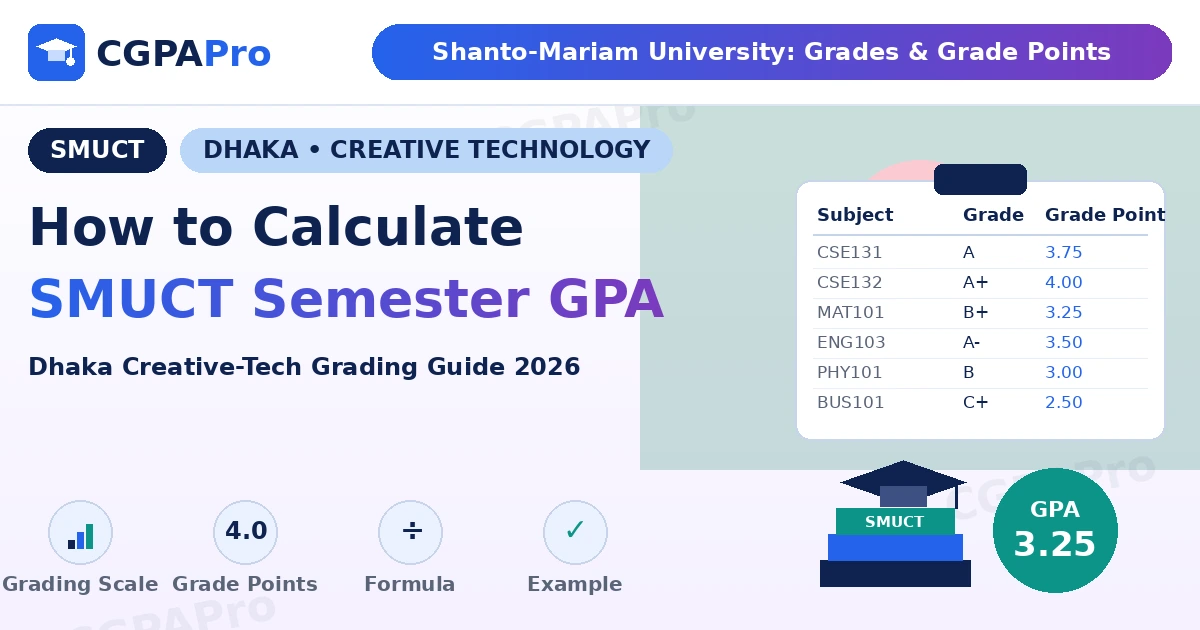
Quick answer: Shanto-Mariam University of Creative Technology (SMUCT), Dhaka, uses the UGC uniform 4.00 grading scale — A+ (80%+) is 4.00, A (75–79%) is 3.75, down through D (40–44%) at 2.00, and F (below 40%) is 0.00. Your semester GPA is the credit-weighted average of those grade points: multiply each course’s grade point by its credits, add them up, and divide by total credits. One SMUCT-specific twist matters before you calculate: some faculties run on 6-month semesters while Business and Humanities run on 4-month trimesters, so “semester GPA” means different things depending on your department. This guide gives you the full table, a real 3.25 worked example, and the official admission and transfer thresholds from SMUCT’s own pages.
One clarification first, because it genuinely confuses students. “SMUCT” in search results sometimes pulls up Saint Mary’s University (Canada) grading pages, and “University of Creative Technology” can point to UCTC in Chittagong — a different institution. This article is about Shanto-Mariam University of Creative Technology (SMUCT), the private creative-technology university in Dhaka founded in 2003 by Md. Imamul Kabir Shanto (official site: smuct.ac.bd). If you study fashion design, CSE, architecture, fine arts, music, or BBA in Dhaka, you’re in the right place.
Calculate Your SMUCT GPA in 30 Seconds
The fastest way to check your GPA is the free calculator on this site. It runs the exact UGC Bangladesh scale that SMUCT follows, so the numbers match the table below point for point:
- Open the CGPAPro GPA calculator.
- Add one row per course. Type the course name and its credit hours, then pick the letter grade — not the marks. Like most Bangladeshi universities, SMUCT’s transcript shows letter grades, so this mirrors how the university sees your results.
- Read your Semester GPA from the result. Add all your terms’ courses the same way and it gives you the CGPA.
Here is a real example run, using the six courses from the worked example further down this page:
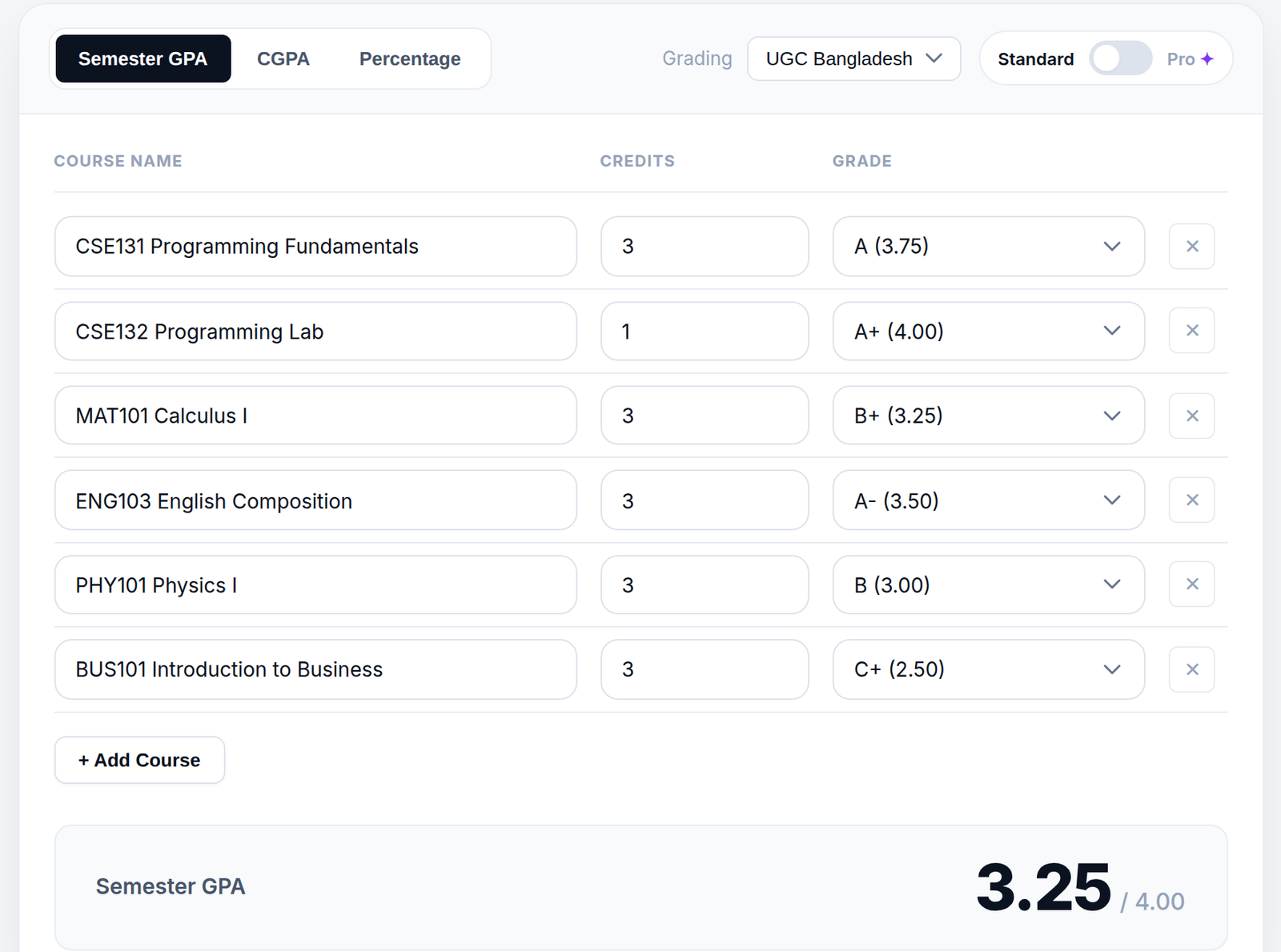
The calculator uses the same grade values SMUCT follows, so this 3.25 is exactly what your result sheet would show for these grades.
SMUCT’s Grade Table
Here is the honest sourcing situation: SMUCT does not publish a standalone grade table on its website. Its pages confirm it is a UGC-regulated private university — the admission page maps O/A-level grades onto the same 4.00 framework (B = 4.00 GPA, C = 3.00) — and the SMUCT-specific grade reference used by students online carries the UGC uniform table. The table below is that UGC uniform 4.00 scale, which is identical across World University of Bangladesh, Britannia University, ASA University Bangladesh, and every other UGC-regulated private university that does publish its table. If your program handbook ever shows a different row, your handbook wins — but every available source agrees on this:
| Marks (out of 100) | Letter grade | Grade point |
|---|---|---|
| 80% and above | A+ | 4.00 |
| 75% to less than 80% | A | 3.75 |
| 70% to less than 75% | A- | 3.50 |
| 65% to less than 70% | B+ | 3.25 |
| 60% to less than 65% | B | 3.00 |
| 55% to less than 60% | B- | 2.75 |
| 50% to less than 55% | C+ | 2.50 |
| 45% to less than 50% | C | 2.25 |
| 40% to less than 45% | D | 2.00 |
| Less than 40% | F | 0.00 |
Three things about this table trip up students every semester:
- D is a passing grade. 2.00 is not failure — it is the minimum pass. F (below 40%) is the only failing grade.
- Your GPA is rounded to two decimals on the result sheet. A 3.246 shows as 3.25, not 3.24. Small rounding differences are why manual calculations sometimes disagree with the i-EMS portal — the math is the same, the display is rounded.
- The plus/minus gap matters. A 79% (A, 3.75) and an 80% (A+, 4.00) are one mark apart but a quarter grade-point apart. Borderline marks are where grade improvement plans pay off most.
Grades that don’t touch your GPA
Most Bangladeshi universities also use non-credit grades: I (Incomplete — coursework unfinished for a documented reason), W (Withdraw — you dropped the course by the deadline), and R (Retaken, in some systems). These carry no grade points and are excluded from GPA math. SMUCT does not publish its own incomplete/withdrawal policy online, so confirm the exact rules with your department or the registrar’s office before you plan around them — never assume a W is free on every program.
Semesters vs Trimesters at SMUCT: Know Your Calendar
This is the part of SMUCT’s system that no generic CGPA guide tells you. SMUCT does not run one academic calendar — it runs two, and which one you are on decides what “semester GPA” even means for you. The university’s own International Students Enrollment Policy states this directly:
| Calendar | Faculties | Sessions |
|---|---|---|
| Semester (2 per year, 6 months each) | Design & Technology; Engineering & Technology; Fine & Performing Arts; LLB | Winter: January–June; Summer: July–December |
| Trimester (3 per year, 4 months each) | Business; Humanities & Social Sciences | Spring: January–April; Summer: May–August; Fall: September–December |
Why this matters for your GPA math: a BBA student completes three graded terms a year while a CSE student completes two, so their CGPAs accumulate at different speeds. When someone asks “what’s your semester GPA,” a BBA student means a 4-month term. Don’t compare your per-term numbers with a friend in another faculty without adjusting for this — compare CGPA instead.
It also matters for design and creative students in particular. SMUCT is a design-first university, and in programs like Fashion Design & Technology, Interior Architecture, and Fine Arts, a big share of your marks comes from studio projects, juries, and portfolio reviews rather than written exams. The exact split (attendance, studio work, midterm jury, final review) is set in each program’s course outline, not published on the website — but the result still lands in the same grade table above. A “B+ in Studio Design” multiplies out exactly like a “B+ in Physics”: grade point times credits.
How SMUCT Computes GPA: The Formula
The math is a weighted average. Each course contributes grade points in proportion to its credit hours — a 3-credit course moves your GPA three times as much as a 1-credit lab:
Semester GPA = (sum of grade point × credit hours for each course) ÷ (total credit hours)
Quality points are the product of grade point and credits for one course. Add all quality points, divide by all credits, and you have the GPA. CGPA is the same formula applied across every term you’ve completed: add up all quality points from all terms, divide by all credits from all terms.
Worked Example: A Real SMUCT Semester, GPA 3.25
Meet a second-year CSE student — she took six courses in her Winter semester. Here’s the full calculation, exactly the way the registrar’s system does it:
| Course | Credits | Grade | Grade point | Quality points |
|---|---|---|---|---|
| CSE131 Programming Fundamentals | 3 | A | 3.75 | 11.25 |
| CSE132 Programming Lab | 1 | A+ | 4.00 | 4.00 |
| MAT101 Calculus I | 3 | B+ | 3.25 | 9.75 |
| ENG103 English Composition | 3 | A- | 3.50 | 10.50 |
| PHY101 Physics I | 3 | B | 3.00 | 9.00 |
| BUS101 Introduction to Business | 3 | C+ | 2.50 | 7.50 |
Total credits: 3 + 1 + 3 + 3 + 3 + 3 = 16
Total quality points: 11.25 + 4.00 + 9.75 + 10.50 + 9.00 + 7.50 = 52.00
Semester GPA = 52.00 ÷ 16 = 3.25
Notice what actually moved the needle here. The A+ in the 1-credit lab contributed only 4.00 quality points, while the C+ in the 3-credit business course cost 7.50 points where an A would have given 11.25. One low grade in a heavy course hurts more than one perfect grade in a light course helps. When you plan a semester, your improvement energy belongs on the high-credit courses you’re weakest in.
To extend this to CGPA: suppose her previous semester was 15 credits with 46.50 quality points (GPA 3.10). CGPA = (52.00 + 46.50) ÷ (16 + 15) = 98.50 ÷ 31 = 3.18. That’s how each new term dilutes or lifts your cumulative average depending on whether it beats your running CGPA.
GPA vs CGPA: Which Number Opens Doors at SMUCT
Your GPA measures one term. Your CGPA measures everything — and it’s the CGPA that SMUCT’s own policies use as a gatekeeper:
- 2.50 CGPA — the floor for graduate admission. SMUCT requires a minimum 2.50 CGPA at bachelor’s level for its master’s programs, and its credit-transfer policy requires overall CGPA ≥ 2.50 too.
- 3.00 CGPA — skips the admission test. Transfer applicants with CGPA ≥ 3.00 may be exempted from admission tests.
- B grade — the transferable grade. Individual courses transfer only if you earned at least a B.
So the CGPA ladder at SMUCT is concrete: stay above 2.50 to keep every door open, reach 3.00 to skip entrance tests, and keep every transferred course at B or better. A 3.25 — like the worked example — sits comfortably above all three thresholds.
Common Mistakes SMUCT Students Make
- Counting marks instead of grade points. GPA uses the letter grade’s point value, not your percentage. 79% and 75% are both A = 3.75. Students who average their percentages get a number the university never uses.
- Forgetting the F still counts. An F gives 0.00 grade points but its credits still sit in the denominator. A 3-credit F drags like an anchor — retake it as soon as your department allows.
- Comparing semester students with trimester students. A BBA friend’s “semester GPA” covers 4 months; your CSE one covers 6. Compare CGPAs, not term GPAs.
- Chasing the A+ in a 1-credit lab while a 3-credit course slides to C+. The worked example shows the math: heavy courses dominate. Allocate study hours by credit weight.
- Assuming retake rules from another university. SMUCT does not publish its retake or probation policy online — rules about how many times you can repeat a course and whether the new grade replaces the old one vary by department. Ask your program coordinator; don’t guess from what a friend at another university told you.
Tips to Raise Your SMUCT CGPA
- Attack high-credit courses first. In the worked example, lifting BUS101 from C+ (2.50) to B+ (3.25) would add 2.25 quality points — more than perfecting any 1-credit course could.
- Protect the B in transferable courses. If you ever plan to transfer credits (or apply elsewhere), a B is the minimum that travels. Treat B as your floor, not your target.
- Use the 3.00 test-exemption threshold as a milestone. If you’re applying to SMUCT as a transfer student, a 3.00+ CGPA skips the admission test entirely — that’s a concrete, near-term target.
- Design students: treat studio courses like exams. Jury and portfolio grades convert to the same grade points as written exams. A B+ in a 3-credit studio course is worth exactly as much as a B+ in a 3-credit theory course — budget your studio hours accordingly.
- Check i-EMS against your own math. Run every result sheet through the calculator. If your number and the portal’s differ by more than a rounding error, talk to the registrar — data entry mistakes happen.
FAQ: SMUCT Grading Questions Students Actually Ask
Is SMUCT the same as Saint Mary’s University?
No. SMUCT is Shanto-Mariam University of Creative Technology, a private university in Dhaka, Bangladesh (smuct.ac.bd). Saint Mary’s University is in Halifax, Canada, and its grading pages (4.30 scale, A+ = 4.30) have nothing to do with SMUCT. If a grade table you found mentions “4.30,” you’re on the wrong university’s page.
Which SMUCT programs run on semesters and which on trimesters?
Per SMUCT’s own International Students Enrollment Policy: Design & Technology, Engineering & Technology, Fine & Performing Arts, and LLB run on 6-month semesters (Winter: Jan–Jun, Summer: Jul–Dec). Business and Humanities & Social Sciences run on 4-month trimesters (Spring: Jan–Apr, Summer: May–Aug, Fall: Sep–Dec).
What SSC/HSC GPA do I need to get into SMUCT?
Minimum GPA 2.50 at each of SSC and HSC (or Second Division). If one exam is between 2.00 and 2.49, your combined SSC+HSC total must be at least 6.00. O/A-level applicants need five O-levels and two A-levels with B grades in four subjects and C in three. These are from SMUCT’s official admission guideline.
What CGPA do I need for a master’s at SMUCT?
A minimum 2.50 CGPA at bachelor’s level for most master’s programs. Transfer applicants with CGPA ≥ 3.00 may be exempted from admission tests, and individual courses transfer only with a B grade or better and overall CGPA ≥ 2.50 — from SMUCT’s International Students Enrollment Policy.
Is a 3.25 CGPA good at SMUCT?
Yes — solidly good. It’s above the 2.50 graduate-admission floor, above the 3.00 admission-test-exemption line, and in B+/A- territory on the UGC table. It keeps scholarships, transfer options, and master’s applications open. The next meaningful milestone is 3.50, which puts you in A- average territory.
How do retakes work at SMUCT — does the new grade replace the old one?
SMUCT does not publish its retake policy online, so don’t take another university’s rules as yours. Across Bangladeshi private universities the common pattern is that the latest grade counts toward CGPA and F grades remain visible on the transcript — but SMUCT’s exact limits (how many courses per term, how many attempts, fee rules) live in your program handbook. Ask your department before planning a retake strategy.
Where is SMUCT’s official grade table published?
As of 2026, SMUCT does not publish a standalone grade table on its website. The applicable scale is the UGC uniform 4.00 system (A+ 4.00 … F 0.00), confirmed by the university’s own 4.00-based admission-grade mapping and consistent with every UGC-regulated private university that does publish its table. If your program handbook shows different values, follow the handbook and let us know.
Conclusion
SMUCT’s grading system is the UGC uniform 4.00 scale wrapped around an unusual two-calendar structure: know whether your faculty runs semesters or trimesters, convert every letter grade to its point value, weight by credits, and you can reproduce your GPA to the decimal. The worked example’s 3.25 shows how ordinary grade combinations — one A+, a couple of B-range grades, one C+ — land in a healthy, door-opening range. Keep your CGPA above 2.50, aim for 3.00 to skip admission tests, protect the B on any course you might transfer, and verify anything unpublished — retakes, probation, mark splits — in your program handbook rather than on a random forum.
Sourcing note: SMUCT’s admission thresholds, calendar structure, and transfer rules above are from smuct.ac.bd pages checked October 2026. The grade table is the UGC uniform 4.00 scale (the university does not publish its own separate table); retake, probation, and assessment-split rules are not published by SMUCT online and are flagged as handbook-check items in this guide.
Official references: SMUCT Admission Guideline · SMUCT International Students Enrollment Policy · SMUCT CSE Admission Requirements