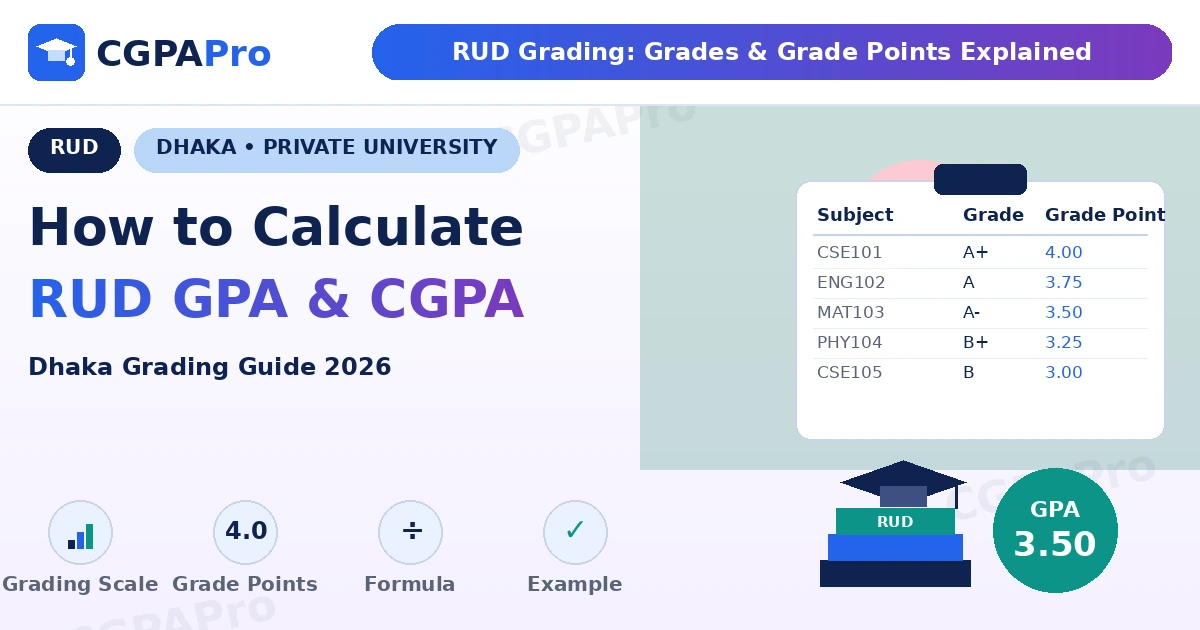
If you are studying at the Royal University of Dhaka (RUD) and want a straight answer, here it is: RUD is a private university, but it does NOT use the strict private-university grading scale. Instead, RUD follows the UGC uniform grading scale, where A+ = 4.00 starts at just 80% – not 90%. That single fact changes everything about how you should calculate your GPA, because most generic CGPA calculators online will quietly put you on the wrong scale and give you a wrong answer. This guide walks you through RUD’s official grading system for 2026, the exact GPA formula RUD uses, a fully worked SGPA example, the per-course assessment breakdown, and a graduation checklist – all verified against official pages on royal.edu.bd.
How to Calculate Your GPA with the CGPAPro Calculator
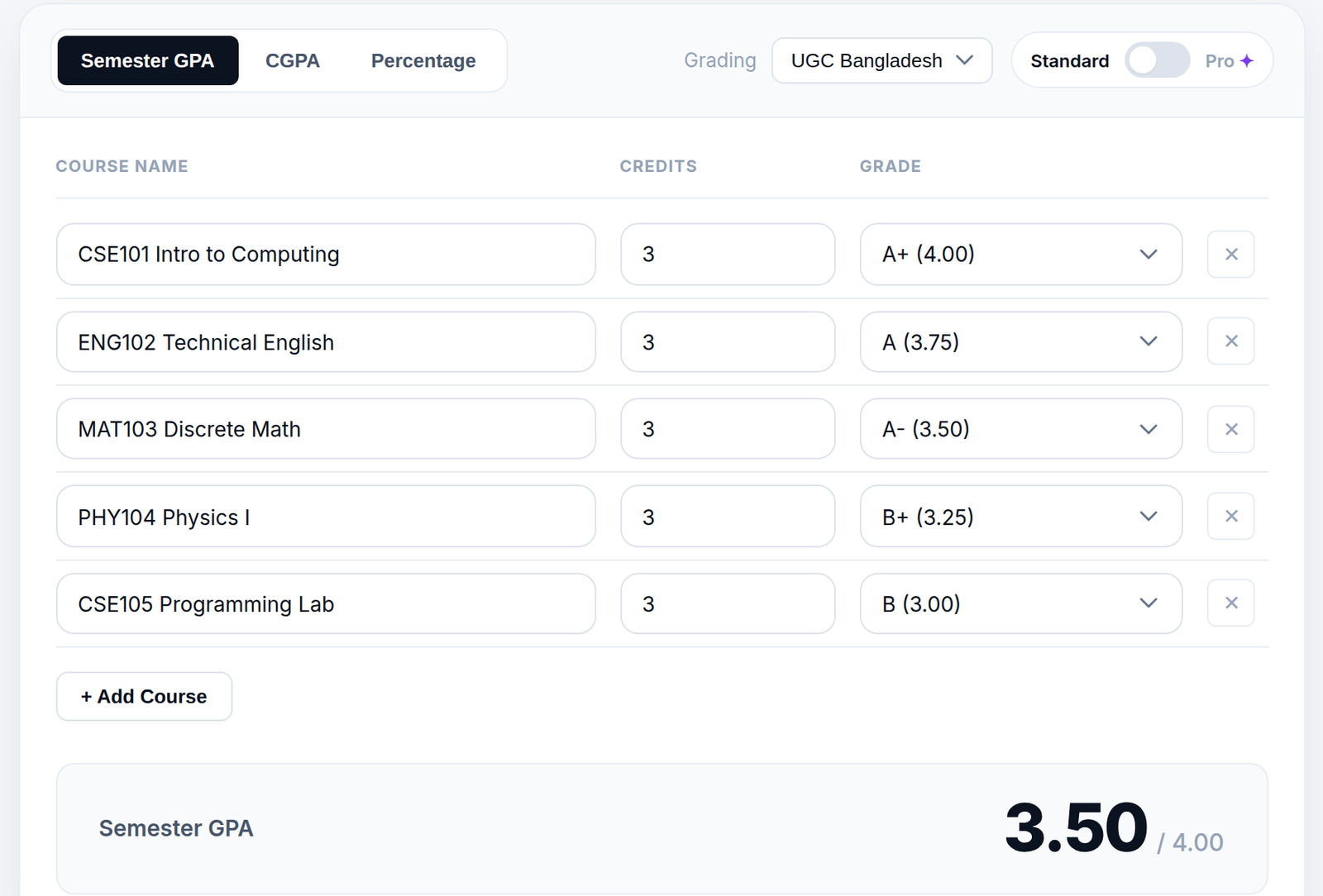
The fastest way to get an accurate number is to use a calculator that is set to the right scale. On the CGPAPro GPA calculator, choose the UGC Bangladesh (uniform) grading scale – the one where A+ = 4.00 begins at 80%. Then enter each course’s credit hours (most RUD courses are 3 credits) and your letter grade, and the tool computes the weighted average for you. The screenshot above shows the worked example from this article: five courses at 3 credits each, coming out to an SGPA of 3.50.
One warning before you trust any calculator result: double-check which scale it is using. If a calculator’s table shows A starting at 90% with A = 4.00 and no A+, that is the NSU/BRAC-style strict scale, and it will understate an RUD student’s GPA. More on that trap below – it costs students real confusion every semester.
RUD’s Official Grading Table (Verified)
RUD publishes the same grading table on every program page, from B.Sc in CSE to BA in English to the M.Sc programs. In its own words, the university says its grading system “is as per with national and international standards, which is also in sharp compliance of the University Grants Commission’s guidelines.” It goes on to state that A+, A, A-, B+, B, B-, C+, C, and D are the passing grades, while F is the failing grade.
Here is the official table, reproduced exactly from royal.edu.bd (verified 2026-10-21 and confirmed identical across six royal.edu.bd program pages):
| Numerical Grade | Letter Grade | Grade Point |
|---|---|---|
| 80% and above | A+ | 4.00 |
| 75% to less than 80% | A | 3.75 |
| 70% to less than 75% | A- | 3.50 |
| 65% to less than 70% | B+ | 3.25 |
| 60% to less than 65% | B | 3.00 |
| 55% to less than 60% | B- | 2.75 |
| 50% to less than 55% | C+ | 2.50 |
| 45% to less than 50% | C | 2.25 |
| 40% to less than 45% | D | 2.00 |
| Less than 40% | F | 0.00 |
The crucial row is the first one. On this scale, 80% already earns you a 4.00. On the strict private-university scale used by North South, BRAC, and IUB, 80% gets you nowhere near a 4.00 – you would need 90% or more for an A worth 4.00. RUD’s own BBA syllabus puts it in writing: “RUD follows the following Letter Grade and Grade Point system introduced by the UGC as a uniform grading system for all public and private universities.” So the next time someone tells you “private universities in Bangladesh all use the strict scale,” you have official proof that RUD is the exception.
A quick note on context: RUD is a nonprofit private university established under the Private University Act, 1992. Its founder is Dr. Momtaz Begum; the UGC approved its academic programs on July 30, 2003, and the Ministry of Education followed on August 30, 2003. It runs a city campus at Banani, Dhaka, and a permanent campus at Bashghari, Bhairab, with English as the medium of instruction in all programs.
Step-by-Step: How to Calculate Your SGPA at RUD
RUD’s own syllabus gives the GPA formula in this exact phrasing:
GPA = Sum of (Credit Earned x Grade Points) / Total Credit Attend
In plain English, the process is:
- Convert each course’s percentage to a letter grade and grade point using RUD’s official table above. A 78% becomes A = 3.75; a 66% becomes B+ = 3.25.
- Multiply each grade point by that course’s credit hours. This gives you “quality points” per course. A 3-credit course at A- (3.50) earns 10.50 quality points.
- Add up all the quality points across the semester.
- Add up all the credit hours you attempted that semester.
- Divide total quality points by total credits. The result is your Semester GPA (SGPA), on the 4.00 scale.
Notice the formula weights by credit hours – a 3-credit course swings your SGPA three times as hard as a 1-credit lab. When you are short on study time, prioritize the courses with the most credits first.
Worked Example: 5 Courses to an SGPA of 3.50
Let us run a full semester for a B.Sc in CSE student: five 3-credit courses, 15 credits total, graded on RUD’s official scale.
| Course | Credits | Grade | Grade Point | Quality Points |
|---|---|---|---|---|
| CSE101 – Intro to Computing | 3 | A+ | 4.00 | 3 x 4.00 = 12.00 |
| ENG102 – Technical English | 3 | A | 3.75 | 3 x 3.75 = 11.25 |
| MAT103 – Discrete Math | 3 | A- | 3.50 | 3 x 3.50 = 10.50 |
| PHY104 – Physics I | 3 | B+ | 3.25 | 3 x 3.25 = 9.75 |
| CSE105 – Programming Lab | 3 | B | 3.00 | 3 x 3.00 = 9.00 |
| Total | 15 | 52.50 |
Adding up: 12.00 + 11.25 = 23.25; 23.25 + 10.50 = 33.75; 33.75 + 9.75 = 43.50; 43.50 + 9.00 = 52.50. Then:
SGPA = 52.50 / 15 = 3.50
That 3.50 is worth pausing on: it sits exactly on the First Class boundary used across Bangladeshi universities. One more B+ instead of a B anywhere in that semester would have dropped the student below it. Small grade movements matter – which is exactly why using the right scale matters.
GPA vs SGPA vs CGPA: What Each Means at RUD
These terms get mixed up constantly, so here is the clean version as it applies at RUD:
- SGPA (Semester GPA) – your weighted average for one semester only, computed with RUD’s formula above.
- GPA – the same weighted-average idea, used as the general term in RUD’s own documents (its syllabus writes “GPA” where most students say “SGPA”).
- CGPA (Cumulative GPA) – the weighted average across all completed semesters: total quality points earned in your whole degree divided by total credits attempted so far.
Practically speaking: your SGPA decides how a single semester went; your CGPA is the number on your transcript that employers and graduate schools look at. Every new semester’s quality points get folded into the CGPA pot, so early weak semesters dilute slowly – the more credits you have already completed, the harder it is to move your CGPA in either direction.
The Private-University Scale Trap (Read This Before Using Any Calculator)
This is the section that will save you the most grief. Bangladesh effectively has two competing 4.00-point systems, and generic tools almost always default private-university students to the wrong one:
- The UGC uniform scale (RUD, and most public universities): A+ = 4.00 at 80% and above.
- The strict private scale (NSU, BRAC, IUB style): A = 4.00 at 90% and above, with grade bands shifted upward.
Watch what happens with the same 78% score:
- At RUD (correct scale): 78% = A = 3.75
- On the strict NSU scale (wrong for RUD): 78% = B+ = 3.30
That is a 0.45 grade-point gap per course – on a single 3-credit course, the difference between 3.75 and 3.30 swings your SGPA noticeably. Run a whole semester on the wrong scale and your “GPA” is fiction. Students have literally reported facing problems in getting jobs because of grading-system differences between universities – national reporting has documented that “one university’s B+ is another’s A-.” You can read a direct comparison of the strict-scale universities in our NSU vs IUB vs BRACU grading comparison, and the broader UGC-vs-other-systems context in our HEC vs UGC grading scale guide.
The wider national picture supports RUD’s choice: the UGC has been pushing a uniform grading system for all universities (it came up under the draft Private University Act-2025), precisely because identical student performance currently converts to different GPAs depending on where you study. RUD is already where the UGC wants everyone to be.
Read More: If you also study at – or are comparing – other private universities, see our NSU vs IUB vs BRACU grading comparison 2026 to understand exactly how the strict scale differs from RUD’s UGC uniform scale.
Where Your 100 Marks Come From: RUD’s Assessment Breakdown
Most students only look at the final exam. At RUD, the final is worth just 40 of the 100 marks – 60% of your grade is decided before you ever sit down for it. RUD’s official “Evaluation Procedures” for each course (3 credit hours, 100 marks total):
| Component | Marks |
|---|---|
| Class Attendance | 10 |
| Assignment / Term Paper | 10 |
| Class Test / Presentation / Viva Voce | 10 |
| Midterm Examination (50-mark exam, scaled to 30) | 30 |
| Final Examination (50-mark exam, scaled to 40) | 40 |
| Total | 100 |
Both the midterm and the semester final run 120 minutes. RUD describes the system as “continuous evaluation” – attendance, tests, homework, assignments, and the final all count.
Walkthrough: How Many Marks Do You Need on the Final to Secure a B+?
Say you want a B+ (65% and above). Before the final, you have already earned: attendance 8/10, assignment 9/10, class test 8/10, midterm 25/30. Add them: 8 + 9 + 8 + 25 = 50 marks out of 60.
You need 65 total. 65 – 50 = 15 marks. The final is out of 40, so you need just 15/40 – about 37.5% – on the final to lock in your B+. That is the power of banking the continuous-assessment marks: strong attendance and assignments can carry you even on a bad exam day.
Flip it around for a cautionary case: suppose you skipped classes and coasted – attendance 4/10, assignment 5/10, class test 5/10, midterm 18/30. That is 32/60 before the final. For the same B+, you now need 33 of 40 on the final – 82.5%. Possible, but you have left yourself no margin. The 30 non-exam marks are the cheapest grade points in your entire degree.
“Will I Graduate?” – RUD’s Degree Checklist
This is the question that keeps final-year students up at night, and RUD’s own program pages answer it with four concrete requirements for the B.Sc in CSE/CSIT (147 credit hours over 4 years / 12 semesters):
- 147 credits completed. Every required and elective credit hour in your program, done.
- Project/thesis grade of at least C. The 3.0-credit project or thesis must earn a C or better – a D on the thesis will not do.
- Pass every course individually. D (2.00) is a passing grade, F is not. But no course can be left failed.
- Minimum GPA of 2.00 overall. Your final CGPA must be at least 2.00 on the 4.00 scale.
So yes: D grades do NOT block your graduation, as long as your overall GPA stays at or above 2.00 and every course is passed. The two real killers are an F you never clear and a thesis below C.
For postgraduate programs, the bars are higher: the M.Sc in CSE requires 66 credits of graduate coursework (up to 30 credits waivable, but at least 36 must be taken at RUD) with a minimum GPA of 3.0 – see RUD’s M.Sc in CSE page. The M.Sc in Library Management and Information Science requires 56 credits with a minimum CGPA of 2.00.
Tri-Semester CGPA Planning: Spring, Summer, Fall
Unlike universities on a two-semester calendar, RUD runs three semesters per academic year: Spring (January to April), Summer (May to August), and Fall (September to December). Each semester is four months: 14 weeks of instruction plus 2 weeks for registration and examinations.
What this means for your CGPA strategy:
- Pace yourself to about 12 credits a semester. 147 credits over 12 semesters averages roughly 12.25 credits per semester – about four 3-credit courses. Overloading to 15+ every term burns students out; the tri-semester system is designed so you do not have to.
- Use Summer as your recovery term. A rough Spring? Summer gives you a full third semester to repair the damage before Fall, instead of waiting half a year like students on two-semester systems. Retaking or re-attempting weak subjects in Summer is the smartest CGPA move you can make.
- Spread heavy courses across all three terms. Do not stack all your programming, math, and lab courses into one semester. Balance each term with a mix of heavy and lighter courses so no single semester can tank your CGPA.
- Remember every semester counts equally. A 3-credit course in Summer weighs exactly the same as one in Fall. There is no “minor semester” discount – treat Summer with the same seriousness.
For a structured approach to lifting a weak CGPA term by term, see our guide on how to improve your CGPA.
Read More: Planning a comeback after a bad semester? Our CGPA improvement guide walks through retake math, credit-load strategy, and realistic semester targets.
Retake, Probation, and Dean’s List: What RUD Actually Publishes
Here is where honesty matters more than completeness: RUD does not publish a retake/repeat policy, academic probation rules, or Dean’s List cutoffs. We searched royal.edu.bd’s program pages and the wider web – none of these exist in any official RUD document. That is a genuine information gap, and you should know about it rather than stumble into it.
What this means for you in practice:
- Got an F or a grade you want to improve? There is no published rule on whether the new grade replaces the old one, whether both appear on the transcript, or what the retake fee is. Ask your program coordinator or the registrar’s office directly before assuming anything.
- Worried about probation? No probation CGPA threshold is published by RUD. Do not assume the rules from another university apply to you.
- Chasing a Dean’s List or merit scholarship? No cutoff is published. Confirm with your department whether one exists at all.
A strong warning: you will find detailed retake and probation rules on the internet for Bangladeshi universities – including official-looking ones from the University of Rajshahi (ru.ac.bd). Those belong to a different institution and may not apply to RUD. Copy-pasting another university’s policy onto your RUD transcript is exactly how students get blindsided. When in doubt, the registrar’s office is the only authoritative source.
RUD vs RU: Do Not Confuse the Two
A quick but important disambiguation, because search engines mix these up constantly: Royal University of Dhaka (RUD) is a private university in Dhaka – website royal.edu.bd. The University of Rajshahi (RU) is a public university in Rajshahi – website ru.ac.bd. Different cities, different ownership, different grading and retake rules. If you land on an ru.ac.bd page while looking for RUD policies, you are reading another university’s rulebook. Everything in this article applies only to RUD (royal.edu.bd).
Common Mistakes RUD Students Make
- Using the strict private scale on a generic calculator. The number-one error. RUD uses the UGC uniform scale – always select it (or verify the table shows A+ = 4.00 at 80%) before trusting any result.
- Ignoring the 30 non-exam marks. Attendance, assignments, and class tests are 30% of your course grade – the easiest marks you will ever earn, and the most commonly wasted.
- Treating Summer as a throwaway semester. It counts fully toward your CGPA. A casual Summer can undo a strong Spring.
- Assuming retake rules from other universities. RUD publishes none. What works at RU or NSU may not work at RUD.
- Confusing RUD with the University of Rajshahi. Check the domain: royal.edu.bd, not ru.ac.bd.
- Averaging letter grades instead of weighting by credits. An A in a 3-credit course and a C in a 3-credit course do not average to a B in any meaningful sense – use quality points and the real formula.
Tips to Maximize Your GPA at RUD
- Lock in the free 30. Show up, submit every assignment, and take every class test seriously. These marks cost far less effort per point than exam marks.
- Know your final-exam target before the exam. Use the walkthrough method above: subtract your secured marks from your target grade’s lower bound, and you know exactly what the final must deliver. Studying with a number in mind beats studying blind.
- Protect your thesis. It needs at least a C, and it carries 3 credits. Start early and meet your supervisor regularly – a weak thesis grade is disproportionately painful.
- Front-load effort in the first 14 weeks. With continuous evaluation, marks are being banked from week one. Cramming only helps the final’s 40 marks.
- Recalculate after every result. Plug each semester’s grades into the CGPAPro calculator on the UGC uniform scale so you always know exactly where your CGPA stands and what the next semester must deliver.
Frequently Asked Questions
Which grading scale does the Royal University of Dhaka use?
RUD uses the UGC uniform grading scale: A+ = 4.00 at 80% and above, F below 40%. It is published on every program page at royal.edu.bd, and RUD’s BBA syllabus confirms it follows “the Letter Grade and Grade Point system introduced by the UGC as a uniform grading system for all public and private universities.” It does not use the strict private scale (A = 4.00 at 90%) used by NSU, BRAC, and IUB.
Is a D grade a pass at RUD?
Yes. RUD’s official statement lists A+ through D as passing grades; only F is failing. You can graduate with D grades as long as every course is passed individually and your overall GPA is at least 2.00 – but remember the project/thesis needs a minimum of C.
What GPA do I need to graduate from RUD?
For the B.Sc in CSE/CSIT: complete 147 credit hours, earn at least C on the project/thesis, pass every course individually, and hold a minimum overall GPA of 2.00. M.Sc in CSE students need a minimum GPA of 3.0; M.Sc in Library Management and Information Science students need a minimum CGPA of 2.00.
Does RUD allow retakes or grade improvement?
RUD publishes no retake, repeat, or improvement policy on royal.edu.bd – no grade-replacement rule, no fee schedule, nothing. This is not published by RUD, so do not rely on other universities’ rules. Ask your program coordinator or the registrar’s office for the current practice.
How do I convert my RUD CGPA to a percentage for job applications?
There is no official RUD conversion formula. Employers in Bangladesh commonly multiply CGPA by 25 (so 3.50 x 25 = 87.5%), but this is a rough convention, not an official rule – say so on applications if asked. For the reverse direction, our percentage-to-CGPA conversion guide explains the standard methods and their limits.
Is Royal University of Dhaka the same as the University of Rajshahi?
No. Royal University of Dhaka (RUD) is a private university in Dhaka at royal.edu.bd. The University of Rajshahi (RU) is a public university in Rajshahi at ru.ac.bd. They have different grading policies, retake rules, and administrations – make sure any policy page you read is on the right domain.
What happens if my CGPA falls below 2.00?
RUD does not publish an academic probation or dismissal policy, so there is no official threshold to quote. If your CGPA is slipping toward 2.00, talk to your program coordinator early – and use the tri-semester calendar to your advantage by planning a lighter, high-focus Summer term to recover.
The Bottom Line
RUD’s grading system is refreshingly straightforward once you know the one fact that matters: private university, UGC uniform scale, A+ at 80%. Use the right scale, bank your 30 continuous-assessment marks, plan across all three semesters, and check the four graduation requirements before your final year. And for the things RUD simply does not publish – retakes, probation, Dean’s List – go straight to the registrar instead of the internet. Your transcript will thank you.