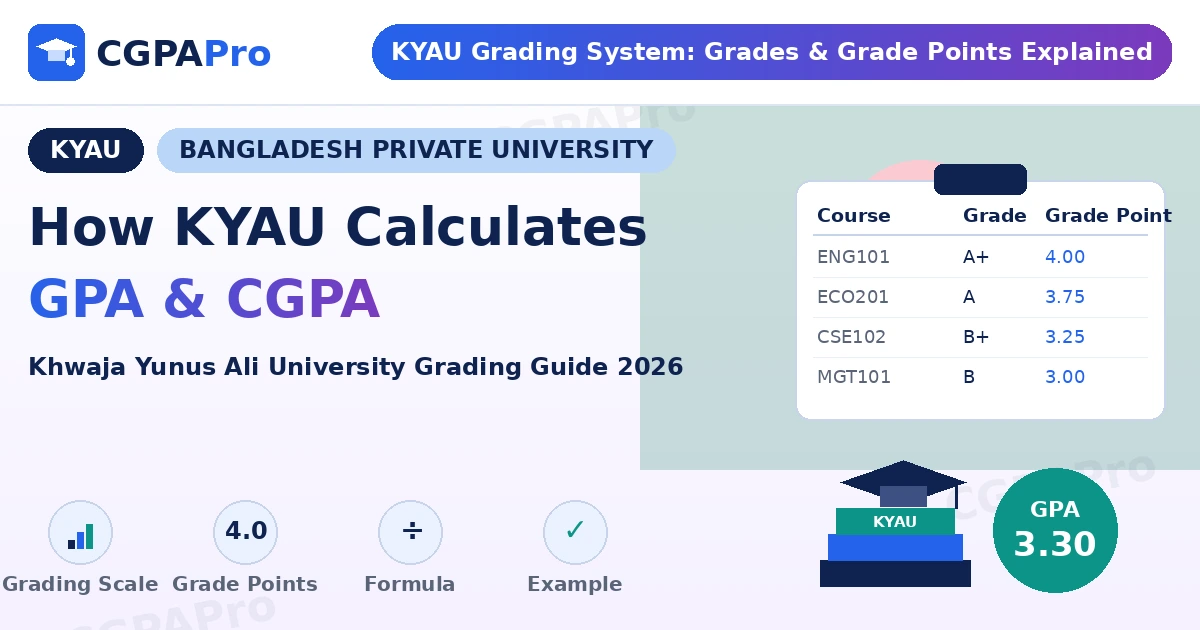
Khwaja Yunus Ali University Grading System 2026: GPA & CGPA Guide
If you’re studying at Khwaja Yunus Ali University (KYAU) in Enayetpur, Sirajganj — or you’re thinking of applying — there’s one number you need to understand before anything else: your grades here are decided by continuous evaluation, not a single final exam, and passing your courses is not the same as qualifying for your degree. KYAU’s own Academic Policy sets the passing grade point at 2.00 per course, but demands a minimum CGPA of 2.50 to actually graduate.
That 2.50 line surprises a lot of students. This guide lays out the whole system exactly as KYAU’s Office of the Controller of Examinations publishes it: the official letter grades, the grade-point scale, how continuous evaluation really works, the step-by-step GPA and CGPA formulas, and fully worked examples with real numbers. I’ll also flag the things KYAU doesn’t publish — and tell you honestly where the gaps are.
How to Calculate Your KYAU GPA (Quick Answer)
Your GPA for one semester is your total grade points divided by your total credits:
GPA = Σ (grade point × credit hours) ÷ Σ credit hours
Example: five 3-credit courses with grades A+ (4.00), A (3.75), B+ (3.25), B (3.00), and C+ (2.50) give you 49.50 grade points over 15 credits — a semester GPA of 3.30. (D is a passing grade at KYAU, worth 2.00 points; F is failing and worth 0.)
Worked example: five 3-credit courses at A+ (4.00), A (3.75), B+ (3.25), B (3.00) and C+ (2.50) give 49.50 grade points over 15 credits — a semester GPA of 3.30. You can verify this instantly on the CGPAPro calculator set to the UGC Bangladesh scale (the same letter grades KYAU uses, A+ down to D). Note: KYAU doesn’t have its own dedicated calculator page on this site yet, so use the homepage calculator.
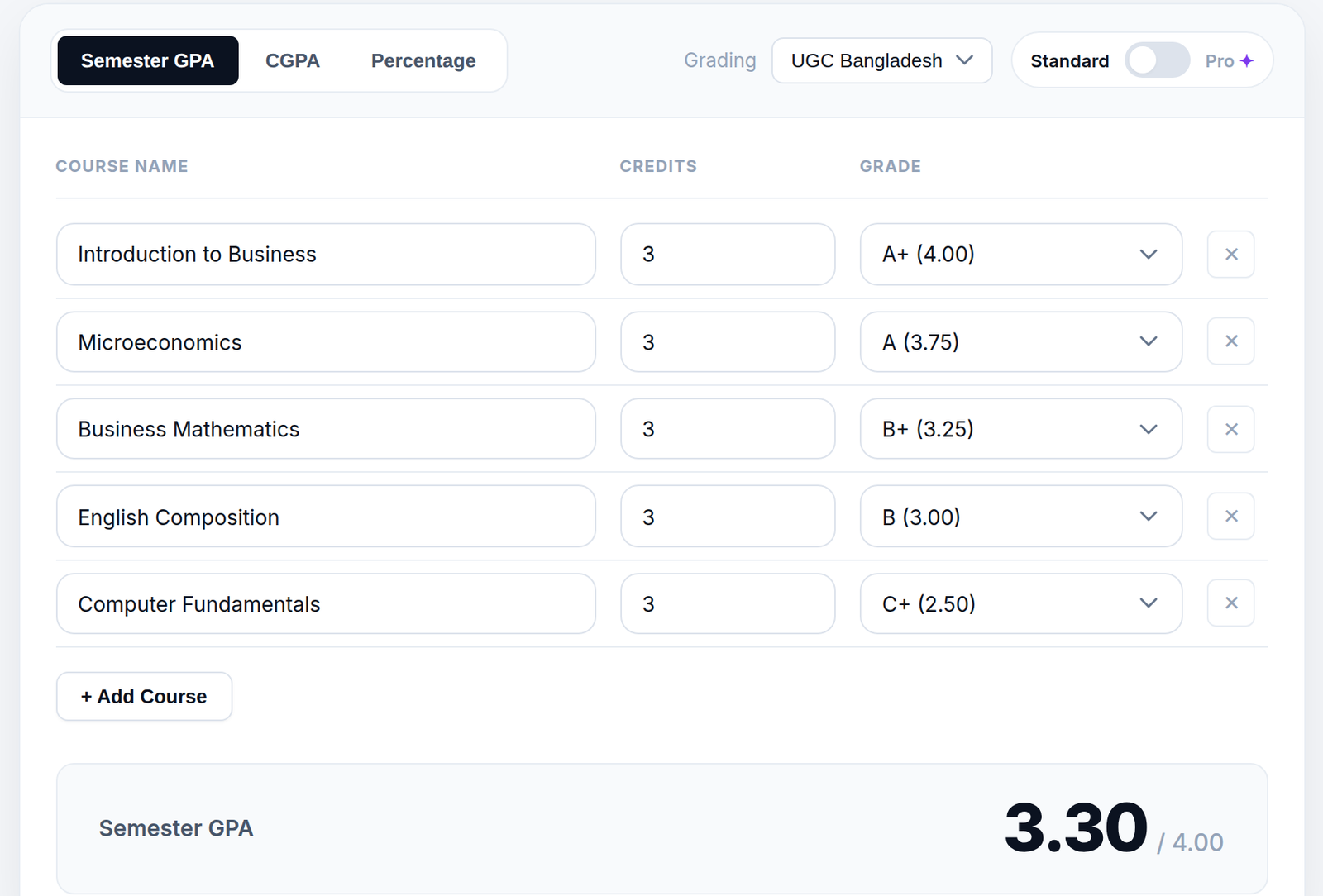
You can do the same math yourself in under a minute with the CGPA calculator — just pick each course grade and its credit hours, and it handles the division.
KYAU’s Official Grading System (From the Academic Policy)
The most reliable information about how KYAU grades you comes from one place: the university’s Academic Policy, maintained by the Office of the Controller of Examinations on kyau.edu.bd. Here is what it actually says, word for word in the relevant parts:
A student’s performance in a course is measured through continuous evaluation — class participation, attendance, assignments, class tests, mid-term examinations, and the final examination. Performance is evaluated with a Letter Grade (LG) and a Grade Point (GP). The passing grades are:
A+, A, A−, B+, B, B−, C+, C, and D — while F is the failing grade. Grade I means incomplete, and grade W means withdrawal.
Two details in the policy deserve your attention, because they work differently than students often assume:
- Numerical scores are cumulated and converted to letter grades at the end of the semester. Your course grade isn’t set by the final exam alone — every quiz, assignment, and attendance mark feeds into a cumulative numerical score that becomes a letter grade only when the semester closes.
- A separate Examination Committee finalizes your grades. For mid-term and final examinations, KYAU forms a committee of 3 or 5 members — a head plus teachers from the department (one may come from outside the department). This committee proposes the question setters and examiners from an approved panel, moderates the examination questions, and finalizes the grade sheet. Your grade isn’t one lecturer’s private decision; it’s a committee-reviewed document.
The Official Grade Table: Letter Grades and Grade Points
KYAU publishes the letter grades, but — and I’m being straight with you here — the Academic Policy page does not publish the numerical grade-point value attached to each letter or the mark bands. Those values come from the UGC uniform 4.00 scale used across Bangladesh’s private universities, which the site’s homepage calculator also implements:
| Letter Grade | Grade Point | Marks (%) | Status at KYAU |
|---|---|---|---|
| A+ | 4.00 | 80–100 | Pass |
| A | 3.75 | 75–79 | Pass |
| A− | 3.50 | 70–74 | Pass |
| B+ | 3.25 | 65–69 | Pass |
| B | 3.00 | 60–64 | Pass |
| B− | 2.75 | 55–59 | Pass |
| C+ | 2.50 | 50–54 | Pass |
| C | 2.25 | 45–49 | Pass |
| D | 2.00 | 40–44 | Pass (minimum passing grade) |
| F | 0.00 | Below 40 | Fail |
| I | — | — | Incomplete |
| W | — | — | Withdrawal |
Notice something important: KYAU’s official list has no C− grade. It goes C (2.25) straight to D (2.00). And D, at 2.00, is exactly the minimum passing grade point the policy names for every program with a major or concentration. Before you rely on the mark bands above for a borderline score, check your own department’s program handbook — universities sometimes adjust the band edges, and the handbook is the final word.
How Continuous Evaluation Actually Works at KYAU
Most Bangladeshi students grew up with a system where the final exam was nearly everything. KYAU doesn’t work that way. The policy breaks your assessment into two continuous streams:
Throughout the semester: attendance, class tests, assignments, presentations, and the mid-term examination. Miss class tests or skip assignments and you’ve already surrendered marks before the final is even scheduled.
End of semester: comprehensive final examinations, project reports, viva voce, and practical examinations where the program requires them.
All of those numerical scores get cumulated and converted into your letter grade at the end. Practically, this means a 40% final exam can’t rescue a semester where you scored 30% on everything else — and conversely, strong coursework cushions a bad final-exam day. If you want the full walkthrough of this style of calculation, see how to calculate SGPA with formulas and examples.
Step-by-Step: Calculating Your Semester GPA
Here’s the exact process, using a real KYAU-style semester. Say you took five 3-credit courses and earned:
- CSE 111 — A+ (4.00) × 3 credits = 12.00
- ENG 101 — A (3.75) × 3 credits = 11.25
- PHY 101 — B+ (3.25) × 3 credits = 9.75
- MAT 101 — B (3.00) × 3 credits = 9.00
- ACC 101 — C+ (2.50) × 3 credits = 7.50
Step 1: Add the grade points: 12.00 + 11.25 + 9.75 + 9.00 + 7.50 = 49.50.
Step 2: Add the credit hours: 3 + 3 + 3 + 3 + 3 = 15.
Step 3: Divide: 49.50 ÷ 15 = 3.30. That’s your semester GPA.
Two things students get wrong here: first, they average the five GPAs (which would give 3.30 here too — but only because every course has equal credits; with mixed credit hours, averaging gives the wrong answer). Second, they forget that an F still contributes its credits to the divisor while adding zero points — a 3-credit F in the semester above would drag the GPA from 3.30 down to 2.75. For the full treatment of failed courses, see how failed subjects and backlogs affect your CGPA.
Calculating Your CGPA (Cumulative)
CGPA is the same idea, extended across every semester you’ve completed:
CGPA = Σ (all grade points earned) ÷ Σ (all credits attempted)
Worked example across three semesters:
- Semester 1: 15 credits, 49.50 points (GPA 3.30)
- Semester 2: 18 credits, 59.40 points (GPA 3.30)
- Semester 3: 15 credits, 48.75 points (GPA 3.25)
Total points: 49.50 + 59.40 + 48.75 = 157.65. Total credits: 15 + 18 + 15 = 48. CGPA = 157.65 ÷ 48 = 3.28 (rounded to two decimals).
Notice that CGPA is not the average of your semester GPAs (which would be 3.28 here by luck of similar credit loads, but drifts whenever semesters carry different credits). Always weight by credits.
GPA vs CGPA at KYAU
Your GPA describes one semester. Your CGPA describes your entire degree so far. KYAU’s degree rule cares about the second one: you need a CGPA of 2.50 or higher to graduate, no matter how many individual semesters you cleared.
This creates the trap I mentioned at the top. KYAU’s policy says the passing grade point in a course is 2.00 — a D keeps you moving forward semester to semester. But a transcript full of D’s and C’s lands you at a CGPA of 2.00–2.30, which is below the 2.50 degree line. You passed everything and still don’t qualify for the degree. The fix is arithmetic, not panic: figure out exactly what you need, which is what the next section does.
The 2.50 Graduation Floor: Do the Rescue Math
Say you’re entering your final year with 105 completed credits and a CGPA of 2.20 — below the line, with 30 credits left to take. What semester GPA do you need to graduate?
Step 1: Current points: 105 × 2.20 = 231.00.
Step 2: Points needed at the end: 135 total credits × 2.50 = 337.50.
Step 3: Gap: 337.50 − 231.00 = 106.50 points, over 30 credits.
Step 4: Required GPA: 106.50 ÷ 30 = 3.55.
A 3.55 means mostly A’s with some B+’s — ambitious, but a real target you can plan around instead of guessing. And here’s the uncomfortable corollary: if the required number ever comes out above 4.00, no perfect semester can save the CGPA — at that point, the honest options are retaking low-grade courses (if your department allows it) or extending your degree timeline. Run your own numbers on the CGPA calculator by adding your completed semesters as single “courses” with your current CGPA and credit totals.
What the Policy Doesn’t Say (Honest Gaps)
A good guide tells you where its own sources stop. KYAU’s published Academic Policy does not specify:
- The numerical grade-point value and mark band for each letter (covered above via the UGC uniform scale — confirm against your program handbook).
- Retake and grade-improvement rules — whether a retake replaces the old grade or averages with it.
- Probation rules and dismissal thresholds.
- Dean’s List or honors criteria.
- Whether I (incomplete) and W (withdrawal) credits count toward the CGPA divisor (at most Bangladeshi universities they don’t, but KYAU doesn’t say).
If you’re writing an assignment or planning retakes, the Controller of Examinations office is the authority — not a blog post, including this one. For the general mechanics of how retakes move a CGPA, this retake guide walks through both the replacement and averaging models with numbers.
Common Mistakes KYAU Students Make
- Ignoring coursework because “the final is what counts.” It isn’t — attendance, class tests, and assignments are part of continuous evaluation, and the committee converts cumulated scores.
- Treating D as “safe.” D passes the course at 2.00, but a pattern of D’s keeps your CGPA under the 2.50 degree floor.
- Averaging semester GPAs instead of weighting by credits. An 18-credit semester counts more than a 12-credit one.
- Assuming the grade table of another university. KYAU has no C− grade and its own published letter set — don’t copy a friend’s NSU or BRACU table.
- Not checking the program handbook for mark bands. The UGC scale above is the standard reference, but your department’s handbook wins any disagreement.
Tips to Stay Above the 2.50 Line
- Front-load effort into high-credit courses. A 4-credit core course moves your GPA more than two 2-credit electives combined.
- Protect your attendance and class-test marks. They’re the cheapest points in continuous evaluation — nearly free if you just show up prepared.
- Know your number every semester. After each result, compute the GPA you need next semester to stay on track for 2.50+. Students who check once a year discover the gap too late.
- Talk to the course teacher before grades finalize. The Examination Committee finalizes grade sheets — legitimate, documented concerns (a mis-totaled script, a missed attendance mark) have a formal path while the committee is still working.
Frequently Asked Questions
Is D a passing grade at Khwaja Yunus Ali University?
Yes. KYAU’s Academic Policy lists D among the passing grades, and the minimum passing grade point per course is 2.00 on the 4.00 scale. But remember: passing courses with D’s won’t get you to the 2.50 CGPA required for the degree.
What CGPA do I need to graduate from KYAU?
A minimum CGPA of 2.50 on the 4.00 scale, plus completion of all required credit hours of your program. Undergraduate programs run about four years.
How are grades decided — is it just the final exam?
No. KYAU uses continuous evaluation: class participation, attendance, assignments, class tests, mid-terms, and finals all feed into cumulated numerical scores that are converted to letter grades at semester’s end. End-of-semester components include comprehensive finals, project reports, viva, and practicals.
Who finalizes my grades?
An Examination Committee of 3 or 5 members (a head plus department teachers, possibly one external) moderates the questions and finalizes the grade sheet for mid-term and final examinations.
What do I and W mean on my KYAU transcript?
I means incomplete and W means withdrawal. They are not failing grades — F is the only failing grade — though KYAU’s published policy doesn’t spell out exactly how they interact with CGPA math.
What is the difference between GPA and CGPA?
GPA covers one semester; CGPA covers your whole degree. KYAU’s graduation requirement (2.50) applies to your CGPA.
Where can I calculate my KYAU GPA online?
The CGPAPro calculator handles the full credit-weighted calculation — enter each course’s grade and credit hours and it computes GPA and CGPA instantly.
Conclusion
KYAU’s system is straightforward once you see the two numbers that matter: 2.00 to pass a course, 2.50 to earn the degree. Everything else — the continuous evaluation, the cumulated numerical scores, the committee-finalized grade sheets — is the machinery that turns your semester’s work into those numbers. Track your CGPA every semester, weight by credits, and never let a comfortable string of D’s lull you into missing the graduation floor. That’s the whole game at Khwaja Yunus Ali University.