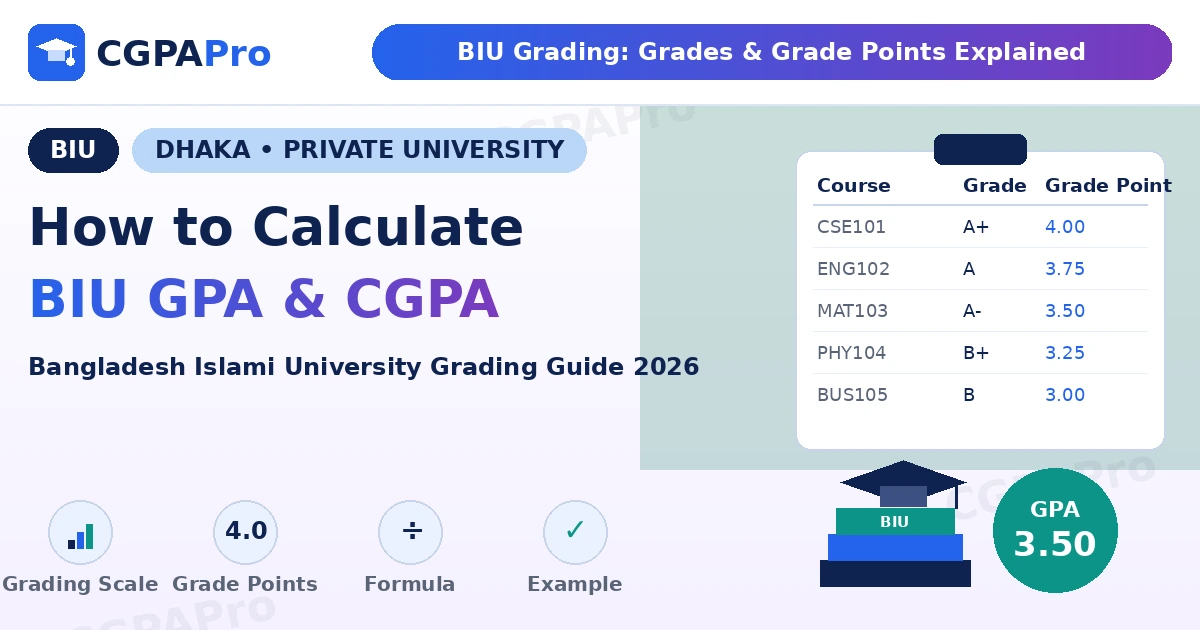
Short answer: Bangladesh Islami University (BIU) is a private university in Dhaka that uses the UGC Bangladesh uniform 4.00 grading scale: A+ (4.00) for 80% and above, A (3.75) for 75-79%, A- (3.50) for 70-74%, B+ (3.25) for 65-69%, B (3.00) for 60-64%, B- (2.75) for 55-59%, C+ (2.50) for 50-54%, C (2.25) for 45-49%, D (2.00) for 40-44%, and F (0.00) below 40%. Semester GPA is the credit-weighted average of your course grade points, and CGPA is the same idea extended across every semester you have completed. Note that BIU itself does not publish a grade table on its website, so the table below follows the national UGC standard that every UGC-approved private university uses, and you should always confirm against your program handbook.
How to calculate your BIU GPA with the CGPAPro calculator
The fastest way to see your semester GPA is to type your courses into the CGPAPro CGPA calculator and let it do the math. Here is exactly how to do it for a BIU semester:
- Open the calculator and select the UGC Bangladesh grade scale from the scale dropdown. This is the scale BIU follows, and it is the one this entire guide uses.
- Click + Add Course once for every course you took this semester. If the calculator opens with sample rows already filled in, remove those first so they do not pollute your result.
- For each row, type the course code, type the credit hours, and pick the letter grade you earned from the dropdown. The calculator fills in the correct grade point automatically.
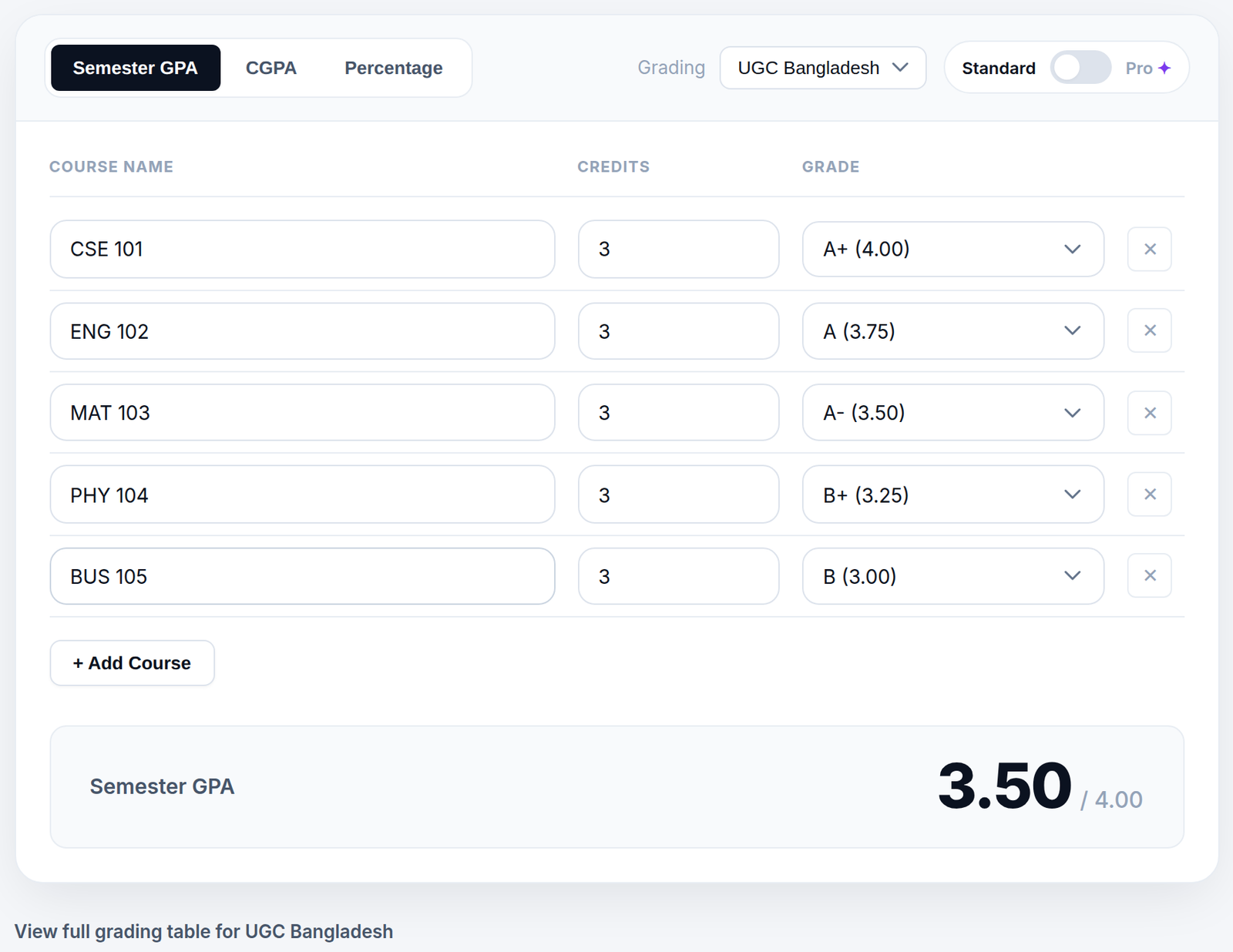
- Read your Semester GPA at the bottom. The screenshot below shows a real five-course semester: CSE 101 (A+), ENG 102 (A), MAT 103 (A-), PHY 104 (B+), BUS 105 (B), all 3 credit hours, for a Semester GPA of 3.50 out of 4.00.
This is the same worked example we calculate by hand later in the article, so you can cross-check the calculator against the manual math.
The BIU grading scale: the official UGC Bangladesh table
BIU is approved by the University Grants Commission of Bangladesh, and like almost every UGC-approved private university it uses the uniform national 4.00 scale. The scale is identical in the official academic documents of IUBAT and other private universities, and it matches the “UGC Bangladesh” option in the CGPAPro calculator exactly:
| Marks (%) | Letter grade | Grade point |
|---|---|---|
| 80% and above | A+ | 4.00 |
| 75% to less than 80% | A | 3.75 |
| 70% to less than 75% | A- | 3.50 |
| 65% to less than 70% | B+ | 3.25 |
| 60% to less than 65% | B | 3.00 |
| 55% to less than 60% | B- | 2.75 |
| 50% to less than 55% | C+ | 2.50 |
| 45% to less than 50% | C | 2.25 |
| 40% to less than 45% | D | 2.00 |
| Less than 40% | F | 0.00 |
Two things in this table trip students up every semester. First, the A+ band starts at 80%, not 90% or 97%. If you scored 82 in a BIU exam and your friend at North South University scored the same 82, you may well hold an A+ (4.00) while he holds a B+ (3.50) – different scales, different points. Second, D (40-44%) is a passing grade worth 2.00 points. It is weak, but it is not a fail; the course counts toward your earned credits. F below 40% earns zero points and zero credit, so you must retake it.
Which “Islamic University” do you mean? (read this before trusting any grade table)
Searching for BIU’s grading rules has a trap built into it: three different Bangladeshi universities share the word “Islamic” in their names, and Google mixes them up freely.
- Bangladesh Islami University (BIU) – the private university in Dhaka this article is about. Website biu.ac.bd.
- Islamic University (IU) – a public university in Kushtia/Shantidanga. When a grading website says “Islamic University grading system,” it almost always means this public one, not BIU. Their rules do not apply to you.
- International Islamic University Chittagong (IIUC) – a different private university in Chattogram. It also follows the UGC uniform scale, but its retake and probation rules are its own.
There is also the International Islamic University Malaysia (IIUM), which has signed an MoU with BIU – a foreign partner, not a campus. If a grade table you found online mentions a “Scale 2” or US-grade column (as some aggregator pages do), double-check the institution name at the top of the page before using it for BIU planning.
Semester GPA formula, step by step
Your semester GPA is a credit-weighted average. Every course contributes its grade point multiplied by its credit hours:
Semester GPA = (sum of grade point x credit hours for each course) / (total credit hours)
The steps, in order:
- Convert each letter grade to its grade point using the table above.
- Multiply each grade point by that course’s credit hours. This is the course’s grade points.
- Add all the course grade points together.
- Add all the credit hours together.
- Divide the total grade points by the total credit hours.
Failed courses (F) count as zero grade points but their credits still sit in the denominator, which is why one F drags a semester down so hard. Withdrawn or incomplete courses carry no grade points and are handled per your department’s rules.
Worked example 1: one semester at BIU (3.50)
Take a typical five-course semester, all courses 3 credit hours:
| Course | Grade | Grade point | Credits | Grade points |
|---|---|---|---|---|
| CSE 101 | A+ | 4.00 | 3 | 12.00 |
| ENG 102 | A | 3.75 | 3 | 11.25 |
| MAT 103 | A- | 3.50 | 3 | 10.50 |
| PHY 104 | B+ | 3.25 | 3 | 9.75 |
| BUS 105 | B | 3.00 | 3 | 9.00 |
| Total | 15 | 52.50 |
Semester GPA = 52.50 / 15 = 3.50. This is exactly the result the calculator screenshot at the top of this article shows. If your hand calculation and the calculator disagree, re-check the credit hours first – a lab course worth 1 credit entered as 3 credits is the usual culprit.
CGPA: the cumulative picture (worked example 2)
CGPA uses the same formula, but across every semester you have finished. One common mistake is averaging the semester GPAs directly (3.40 + 3.60 + 3.20 divided by 3). That only works when every semester has identical credit hours. The correct method re-weights everything by credits:
CGPA = (total grade points earned across all semesters) / (total credit hours across all semesters)
Suppose three finished semesters:
- Semester 1: 3.40 GPA over 15 credits = 51.00 grade points
- Semester 2: 3.60 GPA over 15 credits = 54.00 grade points
- Semester 3: 3.20 GPA over 14 credits = 44.80 grade points
Total grade points = 51.00 + 54.00 + 44.80 = 149.80. Total credits = 44. CGPA = 149.80 / 44 = 3.40 (rounded to two decimals). Notice the naive average of the three GPAs would also give 3.40 here by coincidence, but with unequal credits the two methods diverge – always use the credit-weighted version. If you are still fuzzy on the terminology, our full guide to what CGPA means walks through every term.
Failed a course? How an F moves your CGPA (worked example 3)
Nothing teaches the weighting formula like watching an F do its damage. Take the same semester as Worked Example 1, but with PHY 104 failed:
| Course | Grade | Grade point | Credits | Grade points |
|---|---|---|---|---|
| CSE 101 | A+ | 4.00 | 3 | 12.00 |
| ENG 102 | A | 3.75 | 3 | 11.25 |
| MAT 103 | A- | 3.50 | 3 | 10.50 |
| PHY 104 | F | 0.00 | 3 | 0.00 |
| BUS 105 | B+ | 3.25 | 3 | 9.75 |
| Total | 15 | 52.50 |
Semester GPA = 43.50 / 15 = 2.90. One F turned a 3.50 semester into a 2.90 semester. Now retake PHY 104 and earn a B (3.00): the F is replaced in the CGPA computation by the new grade, giving 12.00 + 11.25 + 10.50 + 9.00 + 9.75 = 52.50 / 15 = 3.50 again. The retake recovers 0.60 of semester GPA – which is exactly why clearing failed courses early is the single highest-leverage move for a damaged CGPA. Our guide to CGPA with failed subjects and backlogs covers the full mechanics.
BIU admission gates, and what they mean for your CGPA planning
BIU publishes its admission requirements openly on biu.ac.bd, and they matter for CGPA planning because they set the academic floor the university expects:
- BBA, BA (Hons), LLB (Hons): at least 2nd division in both SSC and HSC, or minimum GPA 2.50 in each exam. If either exam is as low as 2.00, the combined total must reach at least 6.00.
- O-level students: at least five O-level subjects plus two A-level subjects; of the seven, four subjects need a B grade (GPA 4.0) and three need a C (GPA 3.5).
- Direct admission: SAT 1100+, GMAT 450+, or TOEFL 550+ skips the admission test for BBA, LLB (Hons), and BA (Hons).
- MBA (Regular): any recognized bachelor’s degree.
- Application form: Tk. 300 from the admission office.
The practical takeaway: BIU admits students with a 2.50 entry GPA, which means the university expects you to grow academically while you are here. Employers and scholarship committees, though, judge the CGPA you leave with – not the GPA you entered with. A student admitted at 2.50 who graduates at 3.25 has a completely different profile from one who drifts at 2.60. If money is part of the equation, read our guide to scholarships with low CGPA before assuming a weak start disqualifies you.
GPA vs CGPA at BIU: why both numbers matter
Your semester GPA measures one term only. Your CGPA measures your entire degree. They interact in one way students constantly misjudge: the further along you are, the harder each new semester finds it to move your CGPA. After 90 completed credits, a perfect 4.00 semester of 15 credits moves a 3.00 CGPA to only about 3.14 – the denominator is just too heavy. The flip side is equally true: early semesters are cheap leverage. A 3.80 in your first two semesters buys you a cushion that survives a rough third semester, which is why the recovery math in Worked Example 3 matters most when you act on it fast.
What BIU has not published (honesty box)
To keep this guide honest: BIU does not publish the following rules on its website, and this article will not invent them for you:
- Retake/improvement policy: how many times a course can be retaken, which grade counts, and whether the F stays visible on the transcript.
- Academic probation and dismissal: the CGPA thresholds and the number of semesters you get to recover.
- Graduation CGPA floor: the minimum CGPA required to graduate (the UGC norm is 2.00, but BIU has not published its own figure).
- Dean’s List or honors: whether BIU awards them and at what CGPA.
- Incomplete and withdrawal grades: how I and W grades are awarded and converted.
If any of these decide your next move – a retake, a withdrawal, a graduation check – confirm with your department or the registrar before acting. Grade rules in handbooks change between batches, and the handbook always wins over any online guide, including this one.
Common mistakes BIU students make with grades
- Using the wrong scale. Online “CGPA to percentage” tools default to US or Indian scales. An A- on the UGC scale is 3.50; on some US 4.0 variants it is 3.70. Always select the UGC Bangladesh scale before trusting any converter.
- Averaging semester GPAs instead of re-weighting by credits. A 12-credit semester and an 18-credit semester do not pull equally. Weight by credits or your “CGPA” will be wrong by enough to matter.
- Forgetting that D is passing. Students retake a D course they already passed, spending a semester’s fees to fix a grade that already counts toward the degree. Unless your department requires a minimum grade in core courses, a D is banked credit – spend the retake slot on an F instead.
- Reading Scholaro’s “Islamic University” page as BIU. That table belongs to the public Islamic University in Kushtia. The scale happens to be the same UGC table, but the institution-specific rules around it are not BIU’s.
- Counting the admission GPA as CGPA. Your SSC/HSC 2.50 got you in the door; it has zero mathematical relationship to your university CGPA, which starts from your first BIU course.
Tips to keep your BIU CGPA healthy
- Front-load effort into high-credit courses. A 4-credit core course moves your GPA more than a 2-credit elective. Rank your study time by credit weight, not by which subject you like.
- Clear F grades in the very next semester. As Worked Example 3 showed, a single retake can recover 0.60 of semester GPA. Every semester you delay, more completed credits dilute the recovery.
- Know your band edges. The UGC table’s cliffs are steep: 79% is A (3.75), 80% is A+ (4.00); 69% is B+ (3.25), 70% is A- (3.50). One mark near a boundary is worth 0.25 grade points times the course credits – that is where re-checking requests and extra-credit work pay off most.
- Track your CGPA every semester, not just at graduation. Run your courses through the calculator the week results come out. Catching a slide at 3.10 is a study-plan problem; catching it at 2.40 is a recovery project.
- Protect the early semesters. Because CGPA denominators grow, a strong first year is the cheapest CGPA insurance you will ever buy. Treat semester one like it counts double – mathematically, it nearly does.
Frequently asked questions
What is the grading system of Bangladesh Islami University?
BIU follows the UGC Bangladesh uniform 4.00 scale: A+ (4.00) for 80% and above down to F (0.00) below 40%, with A 3.75, A- 3.50, B+ 3.25, B 3.00, B- 2.75, C+ 2.50, C 2.25, and D 2.00 in between. The university does not publish its own separate grade table.
Is Bangladesh Islami University the same as Islamic University?
No. Bangladesh Islami University (BIU) is a private university in Dhaka (biu.ac.bd). Islamic University (IU) is a public university in Kushtia. International Islamic University Chittagong (IIUC) is yet another, separate private university. Make sure any grade table you use names BIU specifically.
How is CGPA calculated at BIU?
Multiply each course’s grade point by its credit hours, add those products across every completed semester, and divide by the total credit hours. For example, 149.80 total grade points over 44 credits gives a CGPA of 3.40.
What CGPA is needed to graduate from BIU?
BIU has not published its graduation CGPA requirement online. The UGC norm for private universities is a minimum CGPA of 2.00, but confirm the exact figure with your department or the registrar, since program handbooks can set higher floors.
Does a retake replace the F in my CGPA at BIU?
BIU has not published its retake policy online. At most UGC private universities, the new grade replaces the old one in the CGPA calculation, but the F may remain visible on the transcript. Confirm with your department before registering a retake.
What GPA do I need to get admitted to BIU?
For BBA, BA (Hons), and LLB (Hons): at least 2nd division in SSC and HSC, or GPA 2.50 in each. Direct admission is available with SAT 1100+, GMAT 450+, or TOEFL 550+. Details are on the official admission page at biu.ac.bd.
Is a 3.0 CGPA good at BIU?
A 3.00 CGPA (a straight B average) is solid and keeps most doors open. Competitive scholarships, top graduate programs, and many employers look for 3.25-3.50 and above, so 3.00 is a good base to build on rather than a finish line. See our guide to whether a 2.5 CGPA is good for the full breakdown of what different CGPA bands unlock.
Conclusion
Bangladesh Islami University keeps grading simple: one national UGC 4.00 scale, one credit-weighted formula for both semester GPA and CGPA. The math is the easy part – the expensive mistakes are using the wrong scale, averaging GPAs instead of weighting by credits, and trusting a grade table meant for a different “Islamic University.” Run your numbers through the CGPAPro calculator with the UGC Bangladesh scale selected, check the worked examples in this guide against your own results, and when a rule is not published – retakes, probation, graduation floors – ask your department before you act. Your handbook always has the final word.