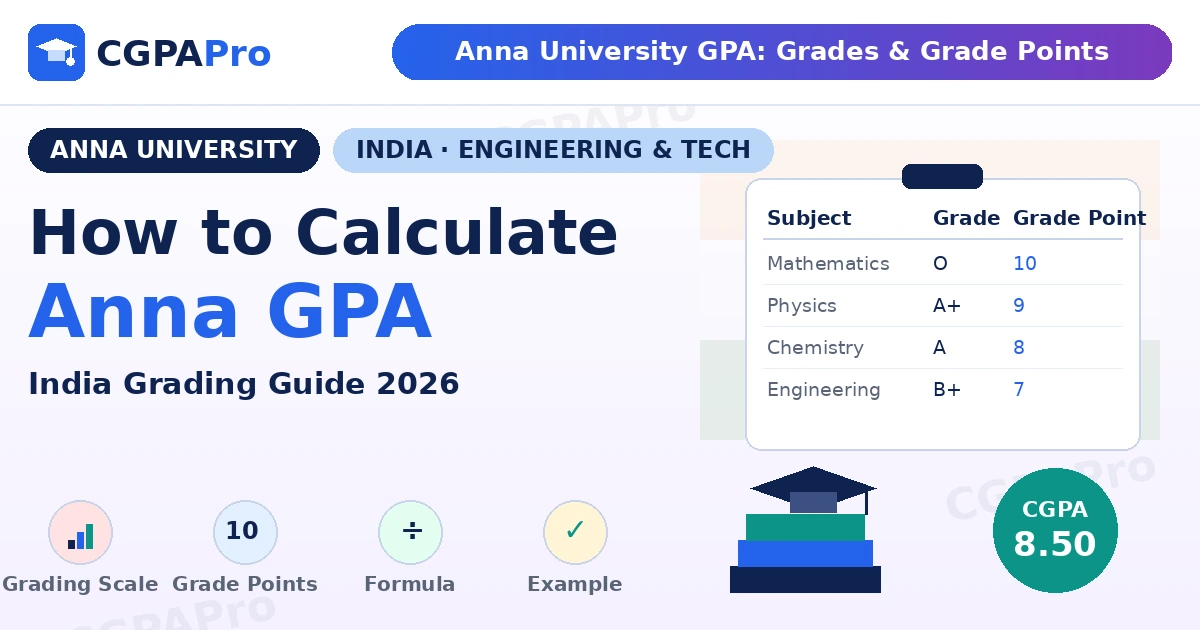
If you study at Anna University — or at one of the hundreds of affiliated engineering colleges across Tamil Nadu that run its examinations — one number follows you from your first semester to your placement interview: your CGPA. Anna’s grading system looks simple from the outside (a 10-point scale, letters from O down to C), but it has traps that catch students every single year: the five-mark-wide B band that makes 55 a cliff edge, the difference between an RA and an SA that decides whether your distinction survives, and the percentage-conversion formula that half the internet gets wrong.
This guide walks through the official Anna University grading system for 2026: the verified grade table with marks bands and grade points, the GPA and CGPA formulas straight from the university’s academic regulations, what RA, SA and W actually do to your average, the official CGPA-to-percentage rule, the degree-classification criteria (including the three-part test for First Class with Distinction), and a full worked calculation. It also answers the questions Anna University students actually ask, and flags the mistakes other websites keep repeating.
The Quick Answer
Anna University uses a 10-point grading scale. Your marks in each course become a letter grade — O (10 points) down to C (5 points) — and your GPA is the credit-weighted average of one semester’s grade points. Your CGPA is the same calculation across every semester combined, reported to two decimal places. Fail a course and you get a U/RA grade (Re-Appearance) worth 0 points — an arrear you must clear later. Miss too many classes and you get SA (Shortage of Attendance), which bars you from the exam entirely. The university prints your percentage on the consolidated grade sheet using % of Marks = CGPA × 10, and awards First Class with Distinction only if your CGPA is at least 8.50 and you passed everything in your first appearance.
Use the Anna University GPA/CGPA calculator below to plug in your own grades — then read on for the full rules, because the details are where this system bites.
How to Calculate Your Anna University GPA Online
- Open the Anna University GPA calculator.
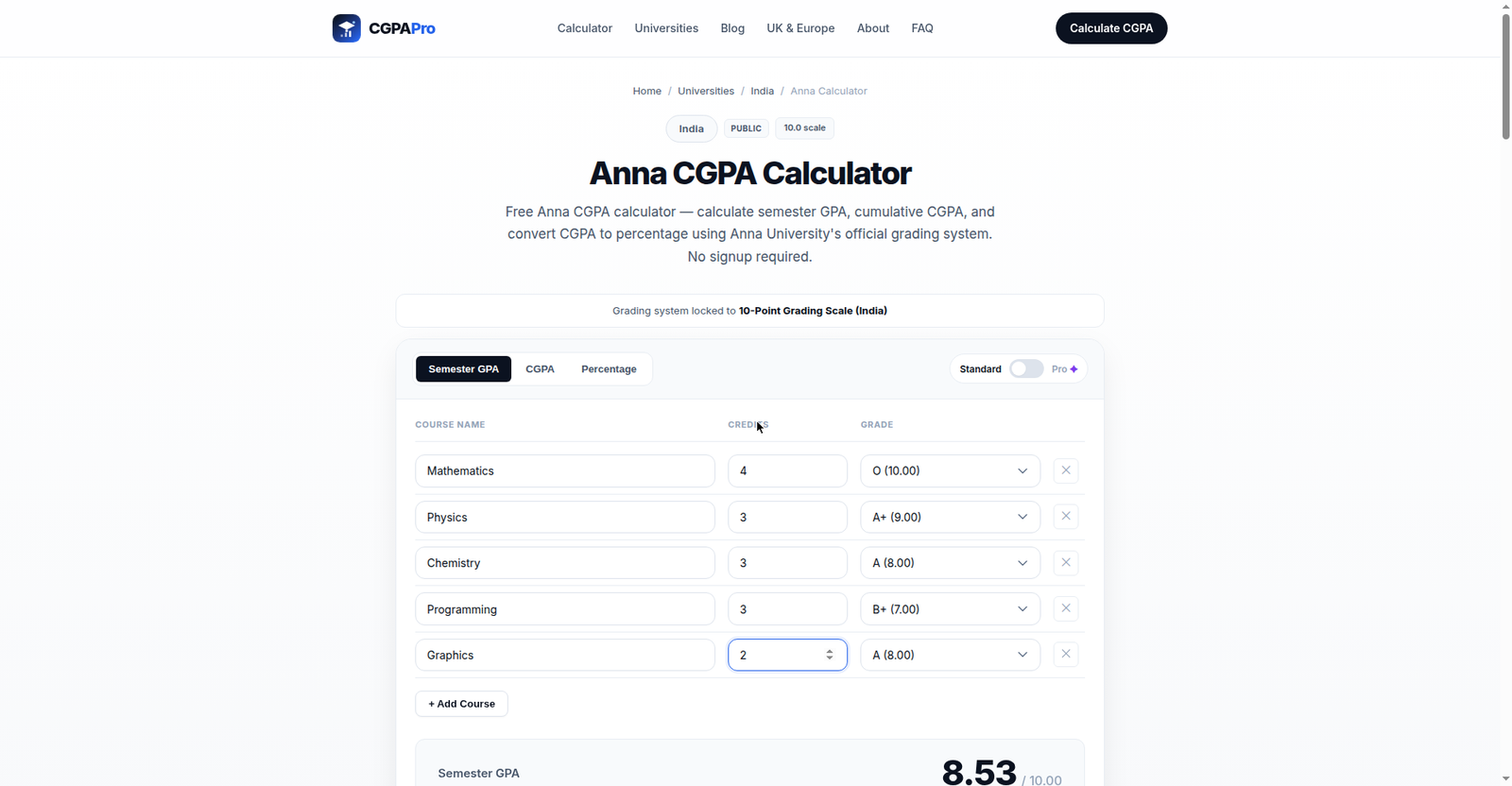
- Add each subject: enter the subject name, its credit value (from your course registration or grade sheet), and the letter grade you received.
- The calculator converts each grade to its Anna University grade point, multiplies by the credits, and adds everything up.
- Click calculate — your semester GPA appears instantly. Add more semesters to build your cumulative CGPA.
The Official Anna University Grading Table
Here is the grade table as it appears in Anna University’s academic regulations — verified against the university’s own published documents (R2021 for affiliated institutions and the R2023 University Departments regulations):
| Marks (%) | Grade | Grade Point | Description |
|---|---|---|---|
| 91 – 100 | O | 10 | Outstanding |
| 81 – 90 | A+ | 9 | Excellent |
| 71 – 80 | A | 8 | Very Good |
| 61 – 70 | B+ | 7 | Good |
| 56 – 60 | B | 6 | Average |
| 50 – 55 | C | 5 | Satisfactory |
| Below 50 | U (RA) | 0 | Re-Appearance — fail, must reappear |
| — | SA | 0 | Shortage of Attendance — barred from exam |
| — | W | 0 | Withdrawal from the course |
Three things about this table deserve your attention, because this is where other websites quietly get it wrong.
First, the B and C bands are narrow — and older sources print them wider. The official bands are B = 56–60 and C = 50–55. Several older websites (and some stale college circulars) still show “B = 50–60” from superseded regulations, with no C band at all. That is wrong for current regulations. A student scoring 52 is not a B student under the current rules — that student has a C worth 5 points, not 6. On a 4-credit core subject, that one-band error swings the course contribution by 4 full grade points (24 vs 20). If the table your calculator uses says B = 50–60, it is out of date.
Second, the fail grade has two names. University Departments and older regulations call it U (Reappearance); affiliated-college regulations and result sheets commonly show it as RA (Re-Appearance). They mean exactly the same thing: you failed the course and must reappear for it. Do not let the two labels confuse you into thinking one is worse than the other.
Third, under the newest regulations the top grade is not always O. The R2023 regulations for Anna University’s own departments (CEG, ACT, MIT) rename the top grade to S (still 10 points, still 91–100) and the withdrawal grade to WC. If you are in a university department and your grade sheet says S, it is the same Outstanding grade as O everywhere else. Affiliated-college students (the large majority) will see O.
The 55-Mark Cliff: Why Anna’s Boundaries Are Tighter Than They Look
Anna University’s scale is deceptively compressed at the bottom. Look at the widths: O spans 10 marks, A+ spans 10, A spans 10, B+ spans 10 — and then B spans only 5 marks (56–60) and C spans only 6 (50–55). The bottom half of the passing scale is squeezed into 11 marks total.
That compression makes the 55/56 boundary the most expensive line in the whole table. A student scoring 55 gets a C worth 5 points; a student scoring 56 gets a B worth 6. On a 4-credit subject like Engineering Mathematics, that single mark is worth 4 grade points (4 × 5 = 20 vs 4 × 6 = 24) — the same weight as the difference between an A and a B+ on a full course. And the 50/49 line is even starker: 50 is a pass, 49 is an arrear worth zero, and the course stays on your record until you clear it.
Practical advice from students who have lived with this table: after results, check your boundary subjects first. A 54 or 55 in a high-credit theory paper is exactly where a revaluation request earns its keep — one extra mark there can be worth more than an entire grade jump in a 1-credit lab.
Anna University GPA and CGPA Formulas
Anna University’s academic regulations define the two measures as credit-weighted averages:
GPA (one semester):
GPA = Σ (Credits of each course × Grade Point earned) ÷ Σ (Credits of the semester’s courses)
CGPA (all semesters):
CGPA = Σ (Credits × Grade Point) for all courses across all completed semesters ÷ Σ (all credits), computed to two decimal places
A course’s contribution is simple: credits × grade point. A 3-credit subject with an A+ gives 3 × 9 = 27. Add up every course in the semester, divide by the semester’s total credits, and you have your GPA. Do the same thing with every semester’s courses lumped together and you have your CGPA — not an average of your semester GPAs, but a fresh credit-weighted calculation across everything.
One more official detail worth knowing: grades earned in additional courses that are not mandatory for your degree (extra electives beyond the curriculum, NCC credits and the like) are printed on your grade sheet but are not counted in the CGPA. If you complete an Honours or Minor degree, those extra courses do count.
Worked Example: A Real First-Year Calculation
Here is a full calculation using a realistic first-year course load and typical credit values. Watch the arithmetic once and you will never need a formula again.
Semester 1 (each row: subject — credits — grade — grade points — total points):
- Engineering Mathematics — 4 credits — O — 10 — 40
- Engineering Physics — 3 credits — A+ — 9 — 27
- Engineering Chemistry — 3 credits — A — 8 — 24
- Programming in Python — 3 credits — B+ — 7 — 21
- Engineering Graphics — 4 credits — A — 8 — 32
- Communicative English (lab) — 2 credits — O — 10 — 20
Total credits = 19. Total grade points = 164.
GPA = 164 ÷ 19 = 8.63. In the first semester, the CGPA equals the GPA.
Semester 2: the student earns 136 grade points across 16 credits (for example: 4 cr A+ = 36, 3 cr A = 24, 3 cr O = 30, 4 cr B+ = 28, 2 cr A+ = 18) → GPA = 136 ÷ 16 = 8.50.
CGPA after two semesters = (164 + 136) ÷ (19 + 16) = 300 ÷ 35 = 8.57.
Notice the trap this example quietly demonstrates: the average of the two GPAs would be (8.63 + 8.50) ÷ 2 = 8.565, which rounds to 8.57 here — but only because the credit loads are close. When one semester carries 19 credits and another carries 24, averaging GPAs gives the wrong answer. Always go back to total grade points over total credits. And notice where this student stands: 8.57 clears the 8.50 distinction line — but only if every one of those courses was passed in the first appearance, as the next section explains.
RA vs SA vs W: The Grades That Decide Your Degree Class
Anna University has three special grades, and students mix them up constantly. Here they are, plainly:
U / RA — Re-Appearance (the arrear). You wrote the exam but scored below 50. The course is not cleared; you must reappear for it in a later semester. It carries 0 grade points. Per the university’s regulations, re-appearance grades are excluded from the GPA/CGPA calculation — they sit outside the average entirely until you clear the course, at which point the new grade enters the calculation. (This is the single most common calculator error online: most generic tools count an RA as 0 points with its credits in the denominator, which drags your computed GPA below your official one. If a calculator does that, its arrear handling is wrong.)
SA — Shortage of Attendance. You did not have the required attendance, so you were barred from writing the end-semester exam. It also carries 0 points, appears only on the result sheet, and — this is the part students miss — an SA counts as an appearance for degree-classification purposes. That means one SA anywhere in your degree permanently disqualifies you from First Class with Distinction, no matter how high your CGPA climbs afterwards. Attendance is not just a discipline issue at Anna University; it is a degree-class issue.
W / WC — Withdrawal. You withdrew from the course. Zero points, and under the newest regulations a withdrawal also counts as an appearance for classification purposes. Withdraw strategically and only after checking what it does to your distinction eligibility.
The practical upshot: an RA costs you time and a re-exam, but it does not poison your GPA the way students fear — once cleared, only the new grade counts. An SA costs you the distinction itself, permanently. That asymmetry is the most under-explained fact in Anna University’s entire grading system.
Degree Classification: The Three-Part Distinction Test
At the end of the programme, Anna University classifies your degree from your CGPA. The criteria come straight from the university’s academic regulations:
| Classification | Requirement |
|---|---|
| First Class with Distinction | CGPA ≥ 8.50 and every course passed in the FIRST appearance and never prevented from appearing in any end-semester exam (no SA) |
| First Class | CGPA ≥ 6.50 |
| Second Class | CGPA below 6.50 |
Read the distinction row carefully — it is a three-part test, and most websites quote only the first part. A CGPA of 9.2 with one cleared arrear is First Class, not Distinction. A CGPA of 8.9 with a single SA in semester three is First Class, not Distinction. The university is explicit: “passed the examination of all the courses in the first appearance itself” and “should not have been prevented from appearing for any end semester examination.” If you are aiming for distinction from day one, the rule is simple: no arrears, no attendance shortages, no withdrawals — ever.
Completing an Honours degree also earns classification under First Class with Distinction, and Minor-degree students are classified under whichever band their CGPA and appearance record qualify for.
CGPA to Percentage: The Official Rule (and the Myths)
This is the question Anna University students ask most, and the internet answers worst. Here is what the university’s own regulations say, in the section on grade sheets:
% of Marks = CGPA × 10
That is the official conversion, printed by the university itself on your consolidated grade sheet. A CGPA of 8.57 becomes 85.7%. It is simple, it is current, and it comes from the regulations — not from a calculator blog.
Now the myths, corrected:
Myth 1: “Percentage = (CGPA − 0.5) × 10.” Several calculator sites present this as Anna University’s “official” formula. It is not in the university’s academic regulations. The official rule is CGPA × 10 — full stop.
Myth 2: “Multiply by 9.5.” The 9.5 multiplier belongs to CBSE’s old Class 10 system, not to Anna University. Using it understates your percentage (8.57 × 9.5 = 81.4% instead of 85.7%) — a costly error on a placement form.
Myth 3: “Just use CGPA × 10 for everything.” Mostly true — but with one caveat: some employers and higher-study applications ask for a certified percentage from your college examination office rather than a self-conversion. For the form, use CGPA × 10; for an attested document, ask your college.
Absolute or Relative? The Grading Nobody Explains
Here is something almost no student-facing article mentions: under Anna University’s newest regulations, grading for most courses is customised — effectively relative. The regulations state that grades are awarded based on the average marks obtained and the relative performance of students in a particular course, with the final grade decided in the Academic Monitoring Committee meeting. The fixed mark bands (91–100 = O, and so on) are published as the absolute reference for certain course categories — OCC, SLC and VAC courses, plus NPTEL/SWAYAM courses, which use their own published ranges.
What this means in practice: your letter grade reflects where you stand relative to your batch, moderated by the committee — not a raw, unchangeable mapping of your mark. Two students with the same mark in different courses can legitimately receive different grades. Your official grade sheet is the final word, and that is the grade you should enter into any calculator.
GPA vs CGPA at Anna University: The Distinction That Matters
Students mix these up constantly, so here it is plainly. Your GPA describes one semester only — it is what appears on your semester grade sheet alongside the list of courses and grades. Your CGPA describes your whole degree: every course from semester one onwards, credit-weighted, to two decimal places. Degree classification, distinction, and most placement shortlists run on the CGPA.
Because the CGPA is credit-weighted across everything, early semesters carry a weight students underestimate. A weak first year sits in a small denominator, so it moves the CGPA a lot — but it also means a strong second year moves it back just as fast. The arithmetic is most responsive right now, in your earliest semesters. A single arrear-heavy semester early on is far easier to dilute than the same performance in your final year.
Common Mistakes Anna University Students Make
1. Using an outdated grade table. The most common error on the internet: tables that show B = 50–60 with no C band, carried over from superseded regulations. Current rules: B = 56–60, C = 50–55. Always match the table to your regulation (R2017/R2021/R2023), not to a random calculator site.
2. Counting RA credits at zero in the GPA. Re-appearance grades are excluded from the GPA/CGPA calculation — they do not sit in the denominator at 0 points. Generic calculators that include them understate your official GPA. Enter only cleared courses.
3. Averaging semester GPAs instead of going back to grade points. (8.63 + 8.50) ÷ 2 only works when both semesters carry identical credit loads. Total grade points ÷ total credits — every time.
4. Using the wrong percentage formula. Official: CGPA × 10. Not (CGPA − 0.5) × 10, not × 9.5. On a placement form, the wrong multiplier can cost you four percentage points.
5. Treating SA as “just an attendance issue.” A shortage-of-attendance grade counts as an appearance for classification and permanently ends any chance of First Class with Distinction. It is the most expensive non-academic grade in the system.
6. Confusing O with S, or RA with U. Different regulations use different letters for the same grades (O/S = Outstanding, RA/U = Re-Appearance, W/WC = Withdrawal). The points are identical. Match the letter your own grade sheet uses.
Practical Tips for Protecting Your CGPA
Guard the 55/56 and 49/50 boundaries. Anna’s bottom bands are the narrowest in the table. In the final weeks, identify every subject where you are within a few marks of 56 or 50 — those are the highest-value marks in the whole semester.
Never let attendance slip. This cannot be said too often: an SA does not just cost you a semester’s exam, it permanently disqualifies you from distinction. No grade is worth that trade.
Clear arrears in the very next attempt. An RA excluded from your GPA still blocks your degree until cleared, and every semester it sits uncleared is a semester your CGPA cannot include its repaired grade. Clear it fast, and clear it well — the new grade enters the average at full weight.
Plan backwards from 8.50. If distinction is your target, work out what each remaining semester must deliver — remembering the first-appearance rule means you cannot afford a single arrear along the way. Run “what if I get an A in this subject?” scenarios through the Anna University calculator before the semester starts.
Keep your regulation handy. R2017, R2021 and R2023 differ in letter naming and fine print. When this guide says “check your regulation,” it means the PDF your college follows — a two-minute check beats a semester of wrong assumptions.
Frequently Asked Questions
What does RA mean in Anna University? Will it affect my CGPA?
RA (Re-Appearance, shown as U in some regulations) means you failed the course — scored below 50 — and must reappear for it. It carries 0 grade points and, per the university’s regulations, is excluded from the GPA/CGPA calculation until you clear it. So it does not drag your computed average down the way students fear — but it blocks your degree until cleared, and any arrear permanently disqualifies you from First Class with Distinction.
What is the difference between RA and SA?
RA means you wrote the exam and failed (below 50 marks). SA means you had a shortage of attendance and were barred from writing the exam at all. Both carry 0 points, but the SA is worse for your degree class: it counts as an appearance for classification purposes, so even one SA anywhere in your degree permanently ends your distinction eligibility. An RA, once cleared in a later attempt, at least lets the repaired grade enter your CGPA.
How do I convert my Anna University CGPA to percentage officially?
Use % of Marks = CGPA × 10. That is the conversion in the university’s own academic regulations, and it is what the university prints on your consolidated grade sheet. Ignore sites quoting (CGPA − 0.5) × 10 or × 9.5 — neither is in the regulations. For attested documents, get the certified percentage from your college examination office.
What CGPA do I need for First Class with Distinction at Anna University?
Three conditions, all required: (1) CGPA of at least 8.50, (2) every course passed in the first appearance — no arrears ever, and (3) never prevented from appearing in any end-semester exam (no SA). Miss any one of the three and the classification drops to First Class (CGPA ≥ 6.50).
Is Anna University grading absolute or relative?
Under the newest regulations, most courses use customised grading based on average marks and relative performance, finalised by the Academic Monitoring Committee — effectively a moderated relative system. Fixed absolute mark bands are published for specific course categories (OCC, SLC and VAC courses, plus NPTEL/SWAYAM courses, which use their own published ranges). Your official grade sheet is the final word either way.
What happens to my CGPA when I clear an arrear?
The cleared course enters the GPA/CGPA calculation with the grade you earned in the re-appearance — the earlier RA simply drops out of the picture, since RA grades are excluded from the average. Clearing an arrear with a strong grade genuinely repairs your CGPA. But note: the distinction is already gone (first-appearance rule), so the repair buys you a better First Class, not a Distinction.
Is 8.0 CGPA good at Anna University?
Yes — 8.0 is comfortably First Class territory and clears most placement shortlist cutoffs, which commonly sit between 6.5 and 8.0 depending on the company. It falls short of the 8.50 distinction line, though, and some top-tier recruiters do filter at 8.5. For a fuller discussion of what different CGPA levels mean for jobs and further study, see our guide on whether 3.5 CGPA is good — the same logic applies on the 10-point scale.
Conclusion
Anna University’s grading system rewards students who read the fine print. The table is published, the formulas are simple arithmetic, and the classification rules are explicit — the distinction test, the RA exclusion, the official ×10 conversion. The students who get hurt are the ones running on internet folklore: outdated B bands, the (CGPA − 0.5) × 10 myth, and the belief that an SA is just an attendance problem.
Learn the real grade boundaries, calculate your GPA honestly every semester with only cleared courses in the average, know exactly where you stand against the 8.50/6.50 lines, and guard your attendance like your distinction depends on it — because it does.
Start by running your current grades through the Anna University GPA/CGPA calculator — two minutes now can change how you plan the rest of your semester.
Sources: Anna University Academic Regulations 2023 (Revision 1, 2024), B.E./B.Tech. University Departments — Clauses 20 (grading), 21 (GPA/CGPA, % = CGPA × 10) and 22 (degree classification), via cac.annauniv.edu; affiliated-institution regulation grade tables (R2021) via college-published regulation documents; 2008 regulations (RA/I/W exclusion from GPA/CGPA). Grade bands verified against university-issued documents; autonomous colleges may publish minor variations — confirm against your own regulation.