Manarat International University Grading System 2026
Short answer: Manarat International University (MIU), Dhaka follows the UGC uniform 4.00 grading scale. Score 80% or above and you get an A+ (4.00); 40–44% is a D (2.00); anything below 40% is an F (0.00). Your semester GPA is total grade points divided by credits attempted, and you need a CGPA of at least 2.00 to graduate. The parts most MIU students get wrong are the retake rule (improvement is allowed only for grades below B), the withdrawal window (weeks 4–6), and the fact that your SGPA is directly tied to tuition waivers worth real money.
This guide walks through MIU’s official grade table, the GPA and CGPA formulas with hand-checked worked examples, the probation and dismissal ladder, retake and withdrawal rules, and the scholarship slabs that turn your SGPA into taka. Everything below is drawn from MIU’s own published pages — where a rule could not be verified against an official source, I say so instead of guessing.
How to Calculate Your MIU GPA with the CGPAPro Calculator
Because Manarat uses the UGC Bangladesh uniform scale, you can compute your MIU semester GPA in about a minute with the free CGPAPro CGPA calculator set to the Bangladesh (UGC) grade scale:
- Open the calculator and add one row per course.
- Type the course name (e.g. CSE 101) and its credit hours.
- Pick the letter grade from the dropdown — the grade points fill in automatically from the UGC scale.
- The calculator totals your grade points and divides by total credits: that’s your semester GPA.
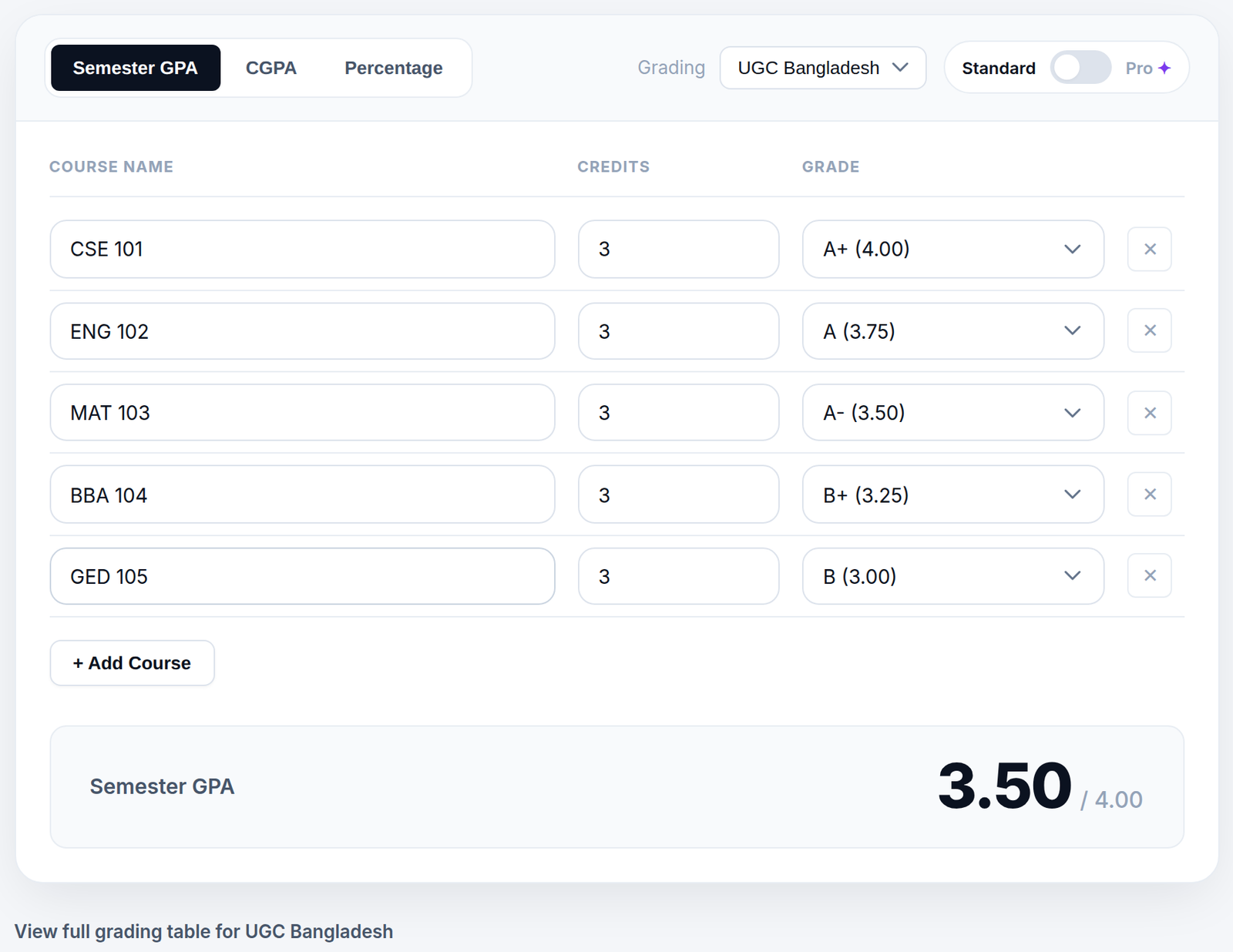
Here is the exact worked example from this article, computed on the live calculator:
Official MIU Grading Table (Verified)
The table below is MIU’s official university-wide grading system, published on the university’s own website (Department of Islamic Studies program page, manarat.ac.bd domain). It is the standard UGC uniform 4.00 scale:
| Marks (%) | Letter Grade | Grade Point | Remarks / Status |
|---|---|---|---|
| 80 and above | A+ | 4.00 | Excellent |
| 75 – 79 | A | 3.75 | Very Good |
| 70 – 74 | A− | 3.50 | — |
| 65 – 69 | B+ | 3.25 | Good |
| 60 – 64 | B | 3.00 | — |
| 55 – 59 | B− | 2.75 | Satisfactory |
| 50 – 54 | C+ | 2.50 | — |
| 45 – 49 | C | 2.25 | Pass |
| 40 – 44 | D | 2.00 | — |
| Below 40 | F | 0.00 | Fail |
| — | I | — | Incomplete |
A few things worth noticing. First, MIU has a D band (40–44%, 2.00 points) — several Bangladeshi private universities stop at C, so students transferring in are sometimes surprised. Second, the remark column is official MIU wording: a B− is “Satisfactory,” a C is a plain “Pass.” Third, this is a marks-based table: your final percentage in each course is what maps to the letter, so every attendance mark, class test, and presentation point feeds the same 100% total.
GPA Formula at MIU (Step by Step)
MIU’s official definition: Grade Point Average (GPA) = total grade points earned ÷ number of credit hours attempted in that semester. Step by step:
- For each course, multiply its grade point by its credit hours. (A 3-credit course with an A+ gives 4.00 × 3 = 12.00 grade points.)
- Add up all the grade points from every course in the semester.
- Add up all the credit hours you attempted.
- Divide total grade points by total credit hours.
Work it the other way too: if you know the GPA you need, multiply it by your total credits to get the grade-point target for the semester, then plan your courses around it.
CGPA Formula and the 2.00 Graduation Floor
MIU’s official definition: Cumulative GPA (CGPA) = total grade points earned ÷ total credit hours attempted at MIU up to that semester. The single most important number on this page: a graduating student must obtain a CGPA of at least 2.00, or no degree is awarded.
Practically, that means the D band (2.00) is the thinnest ice in the university. A student who scrapes through every course with D grades sits exactly on the graduation floor with zero margin — one F, and the math below 2.00 starts working against them immediately. If your CGPA is hovering near 2.00, read the probation section below before you plan your next semester.
Worked Example 1: Semester GPA = 3.50
Take a realistic MIU semester: five 3-credit courses.
| Course | Credits | Letter Grade | Grade Point | Points × Credits |
|---|---|---|---|---|
| CSE 101 | 3 | A+ | 4.00 | 12.00 |
| ENG 102 | 3 | A | 3.75 | 11.25 |
| MAT 103 | 3 | A− | 3.50 | 10.50 |
| BBA 104 | 3 | B+ | 3.25 | 9.75 |
| GED 105 | 3 | B | 3.00 | 9.00 |
| Total | 15 | 52.50 |
GPA = 52.50 ÷ 15 = 3.50. Notice how the single A+ does the heavy lifting — it contributes 12 of the 52.50 points. This is the example shown in the calculator screenshot above.
Worked Example 2: CGPA Across Three Semesters = 3.23
| Semester | Grade Points | Credits | Semester GPA |
|---|---|---|---|
| Semester 1 | 45.00 | 15 | 3.00 |
| Semester 2 | 48.00 | 15 | 3.20 |
| Semester 3 | 52.50 | 15 | 3.50 |
| Total | 145.50 | 45 |
CGPA = 145.50 ÷ 45 = 3.23. Two lessons hide in this table. First, CGPA is credit-weighted, not a simple average of semester GPAs — though with equal credits each semester it happens to match (3.00 + 3.20 + 3.50) ÷ 3 = 3.23. Second, early semesters anchor you: that 3.00 in semester 1 still drags even after a 3.50 semester. For the full mechanics, see how to calculate SGPA with formulas and examples.
GPA vs SGPA vs CGPA at MIU
MIU’s official pages use all three terms, and the distinction matters because money is attached to one of them:
- GPA — the weighted average for one semester (MIU’s published definition).
- SGPA (Semester GPA) — the same semester figure, but this is the term MIU uses in its scholarship and waiver policies. When the pharmacy department page says “required CGPA/SGPA at MIU,” the SGPA is the semester number being checked.
- CGPA — the cumulative figure across all semesters at MIU; the 2.00 graduation floor applies here.
The practical takeaway: at MIU you are effectively playing two games — keep the CGPA above 2.00 to stay and graduate, and push the SGPA to 3.50+ if you want the semester scholarship money. The full comparison is at CGPA vs GPA vs SGPA explained.
Retake and Grade Improvement Rules (Read This Before You Decide)
This is the section MIU students search for most — and where the official rules are strictest:
- F grade: you must retake the course, on payment of the retake fee, in the next available semester. No choice in the matter.
- Improvement retakes: allowed only for grades below B — that means B−, C+, C, and D. A B or higher cannot be improved, no matter how much you want those extra 0.25 points.
- One retake only per course, and the retake cancels the earlier grade automatically — MIU replaces rather than averages. (Your transcript shows an R against the retaken course, so the history isn’t hidden, but the old grade no longer counts.)
- Apply at least 3 weeks before the semester starts, through the Coordination Committee.
- No improvement of in-course test marks or viva-voce marks, and no retake for a course you never attended.
- No retakes after graduation. If you want to fix a grade, you must formally withhold your graduation first.
The strategic point: because retakes replace rather than average, one targeted retake of a D (2.00) turned into a B+ (3.25) on a 3-credit course adds 3.75 grade points to your CGPA numerator — the single highest-ROI move available to a struggling student. The general playbook is at how retaking a course affects your CGPA.
Read more: How Retaking a Course Affects Your CGPA (2026 Guide) — grade-replacement math, when a retake is worth the fee, and the improvement-vs-moving-on decision framework.
Course Withdrawal: The Week 4–6 Window
MIU’s withdrawal rule is precise, and timing is everything:
- Before week 4: dropping a course counts as a normal drop — clean, no record issue.
- Weeks 4–6: dropping counts as an official Withdrawal. It does not affect your GPA — but it is on the books.
- After week 6 / ghosting: if you simply stop showing up without officially withdrawing, MIU assigns zero (0) points in the GPA. That is worse than an F in most systems, because there is no retake structure designed around it — you just cratered your semester.
Decision framework: if you are sitting at 30% with the final worth 40%, even a perfect final only gets you to 70% — a B at best, and only if the final is literally perfect. A week-5 withdrawal protects your GPA; staying and failing hands you an F plus a mandatory paid retake. Students dealing with failed courses should also read how to calculate CGPA with failed subjects and backlogs.
Incomplete Grades and Attendance Marks
Incomplete (I): if you complete at least 60% of a course but miss the semester-end exam for a compelling reason, the instructor can assign an I. You must finish the remaining work within the next academic year, or the I converts to an F. Plan for this before the exam, not after.
Attendance marks are where quiet GPA points leak away. MIU’s official ladder (10% of the course total):
| Attendance | Marks Awarded (of 10) |
|---|---|
| 90% and above | 10 |
| 85% – below 90% | 9 |
| 80% – below 85% | 8 |
| 75% – below 80% | 7 |
| 70% – below 75% | 6 |
| 65% – below 70% | 5 |
| 60% – below 65% | 4 |
| Below 60% | 0 |
That ladder is brutal at the bottom: drop below 60% attendance and you lose all 10 marks — often the difference between a B+ and an A−. The internal evaluation split is attendance 10%, class tests/assignments 10%, presentation 10%, mid-term 30%, final 40%. A student at 78% attendance loses 3 marks before the final is even written; on the MIU table, 77% vs 80% is the A vs A+ boundary.
Probation and Dismissal: The Three-Semester Ladder
- Semester GPA below 2.00 → academic probation. Next semester’s registration needs your student counsellor’s approval.
- Three consecutive semesters on probation → dismissal from the university.
- A dismissed student may seek reinstatement, but MIU reserves the right not to readmit.
Worked Example 3: Escaping Probation — the Math
A student finishes 30 credits with a CGPA of 1.85 (55.50 grade points). Probation. Next semester they take 15 credits and earn straight A+ grades: 15 × 4.00 = 60.00 points.
New CGPA = (55.50 + 60.00) ÷ 45 = 115.50 ÷ 45 = 2.57. One genuinely strong semester clears probation with room to spare — the ladder is survivable if you act in the first probationary semester rather than drifting.
And the honesty check every student should run before setting a target: the same student wants a 3.50 CGPA after 90 total credits. Starting from 120.00 points over 60 credits (CGPA 2.00), the required points in the final 30 credits would be (3.50 × 90 − 120) ÷ 30 = 195 ÷ 30 = 6.50 grade points per credit — above the 4.00 maximum. Mathematically impossible. Run this calculation on your own numbers before you promise yourself a target; the formula never lies. Probation mechanics across universities are compared at Dean’s List and probation CGPA thresholds.
Your SGPA Is Worth Real Money: MIU Scholarship Slabs
This is the section no bare grade table covers, and it’s the one with taka attached. MIU’s published waiver scheme (pharmacy department page, manarat.ac.bd) links admission waivers to the CGPA/SGPA you maintain:
| SSC + HSC Total GPA | Required CGPA/SGPA at MIU |
|---|---|
| 7.50 – 7.99 | 2.90 |
| 8.00 – 8.49 | 3.00 |
| 8.50 – 8.99 | 3.10 |
| 9.00 – 9.49 | 3.30 |
| 9.50 – 9.99 | 3.50 |
| 10.00 (Golden) | 3.70 |
The waiver runs unconditionally for your first year — then it continues only if you maintain the required CGPA/SGPA. A golden-GPA student who slips to 3.55 in year two loses part of a 100% waiver. Separately, MIU offers semester scholarships of 25–100% to the top 10% of students in every program, with a hard floor of SGPA 3.50 and minimum credit loads (9 credits for most programs, 15 for B.Pharm). Ties break on CGPA, then on SSC/HSC GPA. Wondering whether 3.50 is “good enough” in the wider world? See is 3.5 CGPA good for jobs, scholarships and MS abroad.
Common Mistakes MIU Students Make
- Assuming a B can be improved. It can’t — improvement retakes start below B. A B (3.00) is locked forever.
- Ghosting instead of withdrawing. An unprocessed drop in week 8 doesn’t give you a W; it gives you zero points. Walk to the office, file the withdrawal.
- Ignoring attendance until it’s too late. Below 60% attendance = 0 of 10 marks, and there’s no way to earn those marks back in the final.
- Treating the F as “just a zero.” MIU’s official line is unusual: the F is not counted in GPA calculation but stays permanently on your transcript and earns no credit. It won’t drag the semester GPA the way students fear — but the lost credits stall CGPA progress, and the mandatory paid retake is unavoidable.
- Searching “MIU grading system” and trusting the wrong MIU. “MIU” is used by more than one institution; confirm the page says Manarat International University, Dhaka (manarat.ac.bd) before trusting a grade table.
- Setting an impossible target CGPA. Run the (target × total credits − current points) ÷ remaining credits check from Worked Example 3 before committing to a goal.
Tips for a Strong MIU CGPA
- Protect the 10 attendance marks first — they’re the cheapest points in every course. 90%+ attendance is 10 free marks toward the A+ boundary.
- Front-load the internal 30%. Attendance + class tests + presentation = 30% of your grade before the mid-term. Students who bank 25+/30 internally can survive a mediocre final; students who skip internals need near-perfect finals.
- Use the retake rule surgically. One D→B+ retake on a 3-credit course is worth more CGPA points than grinding three B’s into B+’s (which isn’t even allowed).
- Watch the waiver line, not just the pass line. If your admission waiver requires 3.30, plan semesters around 3.30 — not 2.00.
- Decide withdrawals by week 5. Run the max-possible-final math; if the ceiling is a C, withdraw and retake fresh.
Read more: How to Improve Your CGPA: 12 Proven Strategies (2026) — semester planning, credit-load tactics, and the retake-first approach in detail.
Frequently Asked Questions
What is the grading system of Manarat International University?
MIU uses the UGC uniform 4.00 scale: A+ (80%+, 4.00), A (75–79, 3.75), A− (70–74, 3.50), B+ (65–69, 3.25), B (60–64, 3.00), B− (55–59, 2.75), C+ (50–54, 2.50), C (45–49, 2.25), D (40–44, 2.00), and F (below 40%, 0.00). GPA is total grade points divided by credits attempted; graduation requires a CGPA of at least 2.00.
What CGPA is required to graduate from MIU?
A minimum CGPA of 2.00. Fall below that and you also trigger the probation ladder (see below). There is no published higher departmental floor on MIU’s public pages — confirm with your department handbook if your program (e.g. B.Pharm) sets a stricter bar.
Can I improve a B grade at Manarat International University?
No. Improvement retakes are allowed only for grades below B (B−, C+, C, D), plus mandatory retakes for F. Each course can be retaken only once, and the retake cancels the earlier grade.
Does an F affect my GPA at MIU?
MIU’s official policy states the F is not counted in GPA calculation, but it stays permanently on your grade sheet and transcripts, earns no credit, and must be retaken (with fees) in the next available semester. So it doesn’t drag the semester GPA mathematically, but it stalls your CGPA progress and costs you a retake.
What happens if my GPA drops below 2.0 at MIU?
You’re placed on academic probation and need your student counsellor’s approval to register next semester. Three consecutive probationary semesters lead to dismissal, and reinstatement is not guaranteed. Act in the first probation semester — the escape math in this guide shows one strong semester can clear it.
What SGPA do I need to keep my MIU tuition waiver?
It depends on your SSC+HSC total GPA: the required CGPA/SGPA ranges from 2.90 (for 7.50–7.99 entrants) up to 3.70 (for golden-GPA 10.00 entrants). The waiver is unconditional for year one, then conditional on maintaining the slab. The separate top-10% semester scholarship needs SGPA 3.50+.
Is Manarat International University UGC approved?
MIU was established under Bangladesh’s Private University Act 1992 (amended 1998) with Manarat Trust as founder; its Department of Islamic Studies notes UGC approval of the department at the start of MIU’s journey in 2001. (Always verify current UGC listing status on the UGC website for the latest standing.)
What MIU Has Not Published (Honest Gaps)
To keep this guide honest: MIU’s public pages do not currently detail Dean’s List criteria, department-by-department variations of the marks bands, or the exact graduation rules for professional programs like B.Pharm beyond the general 2.00 floor. Those details live in departmental handbooks and the Coordination Committee’s notices — check yours before making decisions that depend on them. What is verified above comes from MIU’s own published grading, retake, withdrawal, probation, and scholarship pages, read directly on 2026-10-23.
Conclusion
Manarat International University’s grading system is straightforward on the surface — the UGC uniform 4.00 scale, a 2.00 graduation floor — but the rules around it are where students win or lose. The retake ladder rewards one surgical improvement, the week 4–6 withdrawal window punishes ghosting, three probations end enrollment, and your SGPA converts directly into tuition money. Compute your numbers with the CGPAPro calculator, run the target-CGPA feasibility check before every semester, and keep the waiver slab for your entry GPA pinned above your desk. The students who treat the grade table as a financial instrument, not just an academic one, are the ones who graduate with both the degree and the discount.
Sources: MIU grading system, GPA/CGPA definitions, earned-credit, retake/improvement, withdrawal, incomplete, probation and evaluation rules — Department of Islamic Studies program page, manarat.ac.bd; tuition-waiver slabs and semester scholarship criteria — MIU Pharmacy scholarship page; university profile — manarat.ac.bd. Accessed 2026-10-23.