The Short Answer
Varendra University (VU) in Rajshahi follows the UGC’s uniform 4.00 grading system, the same scale used by almost every private university in Bangladesh: an A+ (80% and above) is worth 4.00 grade points, a D (40% to less than 45%) is worth 2.00, and anything below 40% is an F worth 0.00. Every grade from A+ down to D is officially a pass grade. An F means you must retake the course, and you cannot graduate from VU with any F on your record. Most programs require a minimum CGPA of 2.00 to graduate, but the LL.B (Hons) program requires 2.50. If you want to skip the theory and just get your number, the CGPAPro calculator below (set to the UGC Bangladesh scale) computes a VU semester GPA in under a minute.
How to Calculate Your VU GPA with the CGPAPro Calculator
There is no dedicated Varendra University page on the calculator, but you do not need one: VU uses the standard UGC Bangladesh 4.00 scale, so the generic calculator below with the UGC Bangladesh grade scale selected gives exactly the same result a VU-specific tool would. Here is how to use it:
- Open the calculator and select the UGC Bangladesh grade scale from the dropdown. Do not use a generic 4.0 scale – the point values look similar but differ at B+ (3.25 vs 3.33) and B- (2.75 vs 2.67), and those fractions decide your GPA.
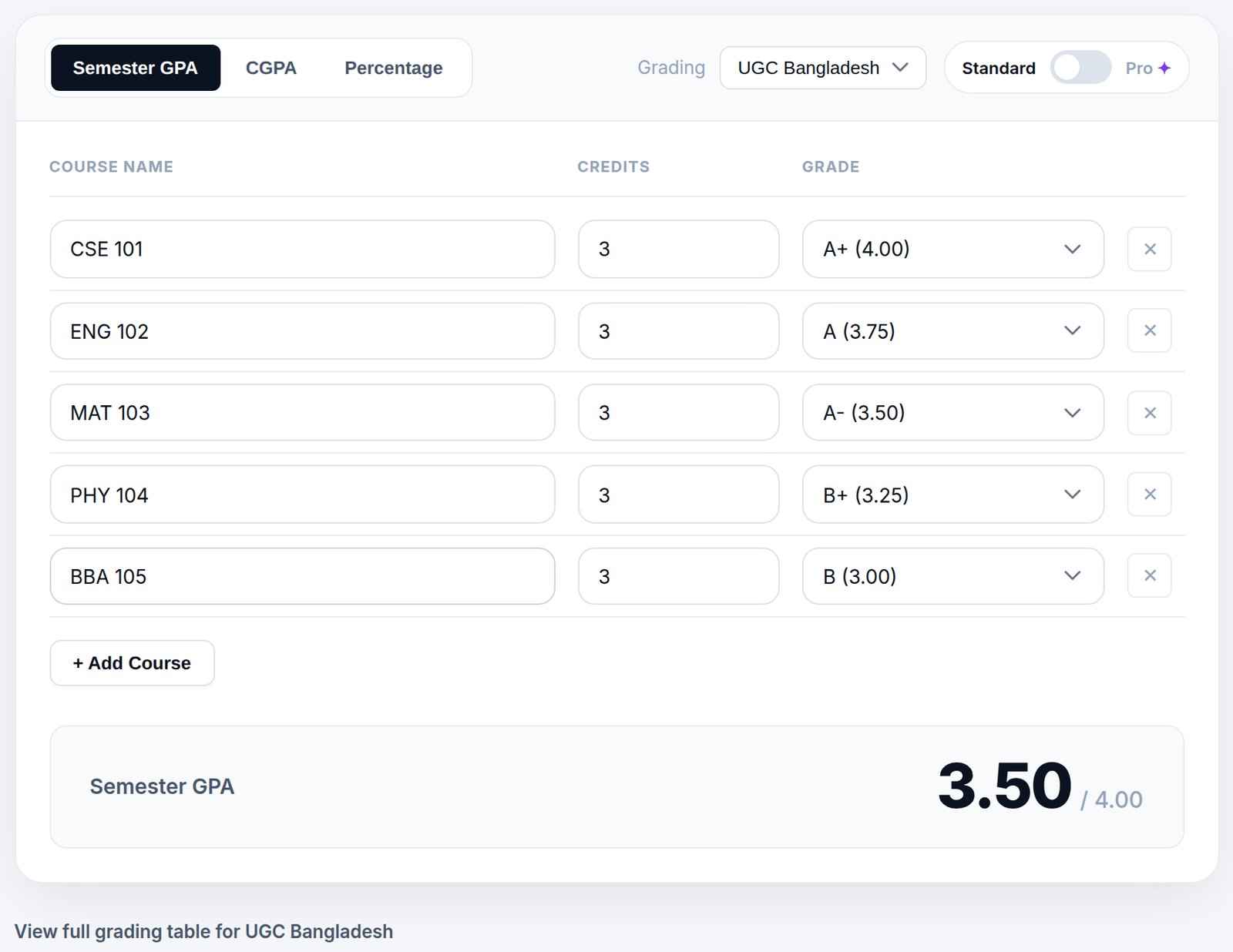
- Click + Add Course once for every course in the semester. Type the course code (e.g. CSE 101), type the credit hours – note that the field may show a default “3” but will not count until you type the number yourself – and pick the letter grade from the dropdown, matching by letter (e.g. “B+ (3.25)”).
- Read the result panel: it shows your Semester GPA, total credits, and total grade points. That is your VU GPA for the semester.
The Official VU Grading Table
Varendra University publishes this table on its own program pages – the JCMS department page introduces it with the exact words: “VU follows the following Letter Grade and Grade Point system introduced by the UGC as a uniform grading system for all public and private universities.” The same table appears in VU’s department curricula and on every official result notice. Memorize the boundaries, not just the letters, because a single mark can move you between bands:
| Numerical Grade | Letter Grade | Grade Point | Remarks |
|---|---|---|---|
| 80% and above | A+ | 4.00 | Pass |
| 75% to less than 80% | A | 3.75 | Pass |
| 70% to less than 75% | A- | 3.50 | Pass |
| 65% to less than 70% | B+ | 3.25 | Pass |
| 60% to less than 65% | B | 3.00 | Pass |
| 55% to less than 60% | B- | 2.75 | Pass |
| 50% to less than 55% | C+ | 2.50 | Pass |
| 45% to less than 50% | C | 2.25 | Pass |
| 40% to less than 45% | D | 2.00 | Pass |
| Less than 40% | F | 0.00 | Fail – must retake |
Three official rules come with this table, and they are the part students usually miss. First: every grade from A+ through D is a pass grade. A D is not a failure at VU, no matter how it feels. Second: an F means you must go for a retake – VU’s words, not a suggestion. Third: your final transcript shows the letter grade, the grade points, your attempted and earned credits, and your CGPA – but numerical marks are never shown. If you scored 73 in a course, your transcript will say A- (3.50) and nothing else. That is not an error; it is VU policy.
The GPA Formula at VU, Step by Step
Your semester GPA (which at VU is the number published on each semester’s result sheet) is the weighted average of your grade points, weighted by credit hours:
GPA = Total grade points earned / Total credit hours attempted
To use it by hand:
- For each course, convert your percentage marks to a letter grade using the official table above.
- Multiply the course’s credit hours by the grade point of that letter. A 3-credit course with a B+ gives 3 x 3.25 = 9.75 grade points.
- Add up all the grade points and all the credit hours.
- Divide the first total by the second. That is your semester GPA.
A quick reality check on step 1. Suppose in your LL.B course you scored: attendance 8 out of 10, class tests 15 out of 20, assignment 8 out of 10, mid-term 24 out of 30, and the trimester final 21 out of 30. The LL.B marks distribution (attendance 10%, class test 20%, assignment 10%, mid-term 30%, final 30%) gives you 8 + 15 + 8 + 24 + 21 = 76 out of 100. On the official table, 76 falls in the 75-to-less-than-80 band, so that course is an A (3.75) – even though 76 “feels” like a B to students coming from other boards. Boundary bands decide grades at VU, so always map the percentage first.
The CGPA Formula and the Two Graduation Floors
VU publishes its CGPA formula in department curricula (for example the EEE curriculum):
CGPA = Sum of (Earned Credit x Corresponding Grade Points) / Total Credits
In plain terms: do the same weighted-average calculation as the GPA, but across every course you have completed in the program. The formula deliberately says earned credit in the numerator – a failed course earns zero credit, so it contributes nothing to the numerator, while the transcript separately tracks what you attempted. More on that in the earned-vs-attempted section below.
Now the part that actually decides whether you graduate. VU has two different floors:
- Most programs: minimum CGPA 2.00. The EEE curriculum and other department handbooks state it plainly: passing all courses individually and maintaining a minimum CGPA of 2.00. Students with any F grade are not eligible for the degree, and the program must be completed within seven academic years.
- LL.B (Hons): minimum CGPA 2.50. The current LL.B program page requires a minimum of 130 credit hours with a minimum CGPA of 2.50 from the Spring-2023 session onward. This is the trap: a law student sitting at 2.30 has not “almost made it” – they have missed the floor by a full 0.20 and need a real recovery plan. Worked Example 3 below walks through exactly that math.
If you are unsure which floor your program uses, ask your department office – the 2.50 LL.B rule is the only published exception to the 2.00 standard, and program handbooks win over rumors.
Worked Example 1: Semester GPA of 3.50 (matches the screenshot)
Take a realistic VU first-year semester – five 3-credit courses, a mix of strong and average results:
| Course | Credits | Grade | Grade Point | Grade Points |
|---|---|---|---|---|
| CSE 101 | 3 | A+ | 4.00 | 3 x 4.00 = 12.00 |
| ENG 102 | 3 | A | 3.75 | 3 x 3.75 = 11.25 |
| MAT 103 | 3 | A- | 3.50 | 3 x 3.50 = 10.50 |
| PHY 104 | 3 | B+ | 3.25 | 3 x 3.25 = 9.75 |
| BBA 105 | 3 | B | 3.00 | 3 x 3.00 = 9.00 |
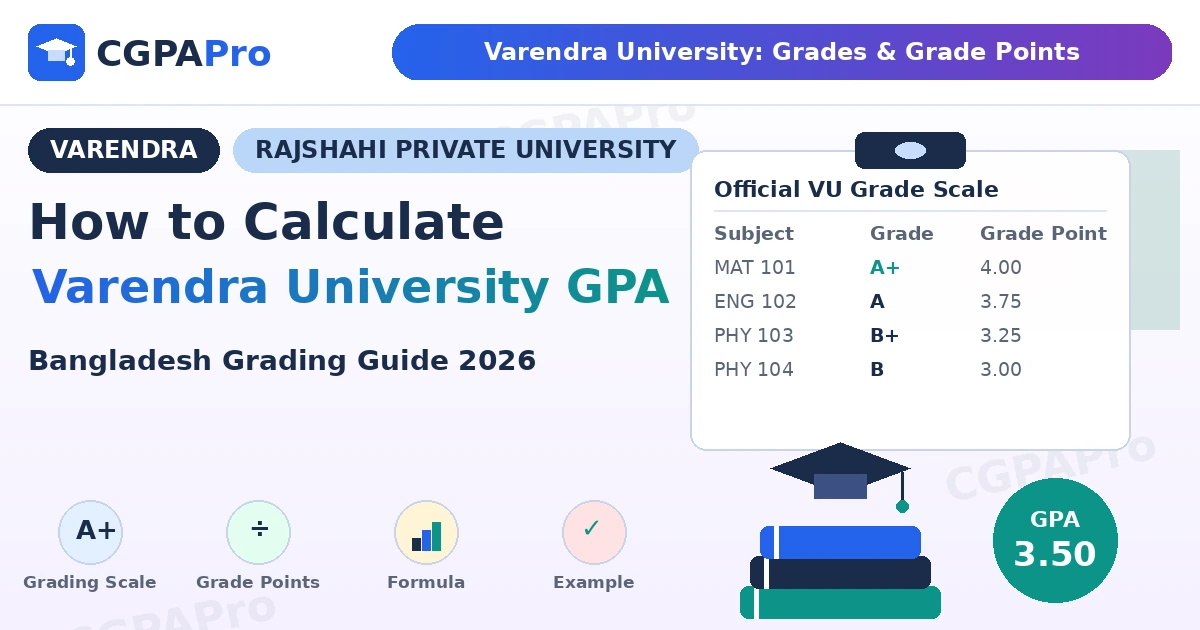
Add the grade points: 12.00 + 11.25 + 10.50 + 9.75 + 9.00 = 52.50. Add the credits: 3 + 3 + 3 + 3 + 3 = 15. Divide: 52.50 / 15 = 3.50. That is exactly what the CGPAPro calculator shows in the screenshot above – every figure is hand-verified, and the teal badge on this article’s featured image shows the same 3.50.
Notice how the B in BBA 105 quietly costs half a point of GPA compared to a B+. In a 15-credit semester, each 0.25 grade-point step in one 3-credit course moves the final GPA by 0.05 (0.25 x 3 / 15). Small differences in one course matter less than consistency across all of them – which is why the tips section focuses on attendance and class tests first.
Worked Example 2: CGPA Across Three Semesters = 3.14
CGPA is just the same weighted average stretched over your whole program. Suppose you have finished three semesters:
- Semester 1: 15 credits, GPA 3.40 – grade points = 15 x 3.40 = 51.00
- Semester 2: 16 credits, GPA 3.10 – grade points = 16 x 3.10 = 49.60
- Semester 3: 14 credits, GPA 2.90 – grade points = 14 x 2.90 = 40.60
Total grade points = 51.00 + 49.60 + 40.60 = 141.20. Total credits = 15 + 16 + 14 = 45. CGPA = 141.20 / 45 = 3.14 (rounded to two decimals).
Two things worth noticing. First, the CGPA is not the average of the three GPAs – (3.40 + 3.10 + 2.90) / 3 = 3.13, which is close here only because the credit totals are similar. When semesters carry different credit loads, the simple average is wrong and can cost you a real answer on a scholarship form. Second, the weak third semester (2.90) dragged a 3.25 average down to 3.14 – early high GPAs are a cushion, not a guarantee. For the full method across different credit loads, see how to calculate SGPA with formula and examples.
Worked Example 3: The LL.B Rescue – Can a 2.10 Student Still Reach 2.50?
This is the most valuable calculation in this article, because the LL.B 2.50 floor surprises students late. Suppose an LL.B student has completed 45 credits with a CGPA of 2.10 and has 45 credits remaining (a 90-credit program for this example).
- Grade points so far: 45 x 2.10 = 94.50
- Grade points needed for a 2.50 final CGPA: 90 x 2.50 = 225.00
- Still needed: 225.00 – 94.50 = 130.50 points from 45 remaining credits
- Required average: 130.50 / 45 = 2.90 per credit
A 2.90 average sits between B- (2.75) and B (3.00) – demanding but genuinely achievable with consistent B/B+ grades. Now the impossibility check: if the same student had only 30 credits remaining, they would need 225.00 – 94.50 = 130.50 points from 30 credits, an average of 4.35 – above the 4.00 maximum, i.e. mathematically impossible. That is the moment to talk to the department about retakes, credit load, or program timelines instead of hoping. The recovery playbook for failed and weak courses is covered in how to calculate CGPA with failed subjects and backlogs.
GPA vs SGPA vs CGPA at VU
Students use these three terms interchangeably, and VU’s own documents do not help – the published result sheets say “GPA” for a semester’s result and “CGPA” for the running total. Here is the clean version:
- GPA (semester GPA) covers one semester only. It is the number on your semester result sheet, the “Merit Position” lists on VU’s notice board are built on it, and it decides your standing for that term.
- SGPA is the same thing spelled out – Semester Grade Point Average. VU documents rarely use the word, but if a scholarship circular asks for your SGPA, give your semester GPA.
- CGPA covers your entire program – every completed course, weighted by credits, per the official formula above. It is the number on your final transcript and the one the 2.00 / 2.50 graduation floors apply to.
A longer comparison with examples from several universities is at CGPA vs GPA vs SGPA: the difference explained.
Retake Rules: The F Is Not Optional
VU’s rule on failure is one of the bluntest among Bangladeshi private universities: “An F grade is considered as FAIL and in such cases students must go for a retake.” Practical consequences:
- A failed course must be retaken in a subsequent semester, like a regular student – you cannot simply carry an F to graduation.
- Students with any F grade are not eligible for the degree, even if the CGPA is above the floor. The F has to be cleared first.
- Until VU publishes a grade-replacement policy, assume both attempts stay visible on your record and confirm with your department how the retake grade enters the CGPA – departmental practice varies in Bangladesh.
Read more: How Retaking a Course Affects Your CGPA (2026 Guide) – grade-replacement math, when a retake is worth the fee, and the improvement-vs-moving-on decision framework.
Earned vs Attempted Credit: Reading Your Own Transcript
Your VU transcript has five columns that matter: letter grade, grade points, attempted credit, earned credit, and CGPA. Here is how they interact, using a real scenario: you attempt six 3-credit courses (18 attempted credits) and fail one.
- Attempted credit: 18 – everything you registered for.
- Earned credit: 15 – the F course earns zero credit, so it drops out of the earned total.
- The failed course contributes 0 grade points to the numerator of the official CGPA formula (earned credit x grade points = 3 x 0.00 = 0).
- The F stays printed on the transcript and blocks the degree until retaken – the formula ignores it, the graduation rule does not.
This is also why “numerical marks will not be shown” surprises so many students. Two students with 79 and 75 in the same course both get an A (3.75) on the transcript, and no one – not a future employer, not a foreign university – ever sees the 79 vs 75. The letter is the record. Boundary marks therefore have outsized value: one extra mark that lifts you from 74 to 75 buys you 0.25 grade points in that course.
The Trimester Calendar and How Your Marks Are Split
VU’s LL.B program runs on a trimester system: Spring (January-April), Summer (May-August), Fall (September-December), with 14 weeks of instruction per term. Engineering and other departments publish semester-based curricula with the same 14-week rhythm, so always check your department’s calendar – “trimester” and “semester” both appear in VU documents.
The marks split decides where your effort pays off. Two published examples:
- LL.B: class attendance 10%, class tests 20%, assignment/term paper 10%, mid-term 30%, trimester final 30%. Half your grade is decided before the final exam.
- EEE (2025 curriculum), theory courses: mid-term 20%, final 30%, and continuous assessment (class tests, quizzes, attendance, presentations) 50%. Lab courses: viva/project presentation 20%, quiz 20%, attendance 10%, lab assessment 30%, report 20%.
The pattern is clear: attendance and in-course assessments carry 30-50% of the final mark depending on the department. Students who treat the final exam as the whole course are leaving a third or more of their grade to chance.
A Quick Word on the Name “Varendra”
One genuine source of confusion: “Varendra” is also the name of the famous Varendra Research Museum in Rajshahi, and of the ancient Barind region of Bengal the university is named after. VU’s own handbook traces the name to the ancient Varendra region – about 300 km northwest of Dhaka – and says the university’s spirit is rooted in Somapura Mahavihara at Paharpur, one of ancient India’s great centers of learning. So if your search results mix museum history with admissions info, you are not the first: the region, the museum, and the university share a name but are three different things. Founded in 2012 by Hafizur Rahaman Khan, VU was the first UGC-approved private university in Rajshahi and the northern region of Bangladesh.
Common Mistakes VU Students Make
- Using a generic 4.0 scale. B+ is 3.25 and B- is 2.75 at VU, not 3.33/2.67. The wrong scale quietly shifts every GPA you compute.
- Panicking over a D. A D (2.00) is an official pass grade. It is not a good grade, but it is not a failure – do not retake a D out of panic without checking the retake fee and whether your department allows it.
- Ignoring the LL.B 2.50 floor. Law students tracking the general 2.00 rule discover the 2.50 requirement too late. Know your program’s floor in your first year, not your last.
- Forgetting the no-F graduation rule. A 3.00 CGPA with one uncleared F is still not a degree. Clear Fs first, then optimize the CGPA.
- Sleeping through attendance and class tests. With 30-50% of marks decided before finals, the “I’ll study at the end” strategy is mathematically broken.
- Averaging GPAs instead of weighting credits. CGPA is credit-weighted; the simple average of your semester GPAs is wrong whenever semesters carry different credit loads – and they almost always do.
Tips for a Strong VU CGPA
- Bank the cheap marks first. Attendance and assignments are the highest marks-per-hour in the LL.B and EEE distributions. A student scoring 76 vs 74 jumps a full grade band (A- to A) – and boundary jumps come cheapest from the 10% attendance slice.
- Track boundaries, not just letters. Keep a running percentage estimate per course. Knowing you sit at 68 vs 71 tells you whether one more class-test mark is worth a full 0.25 grade points.
- Clear Fs in the very next term. VU says retake “in the subsequent semester” – delaying pushes the zero-credit course into your busiest terms and keeps the degree block hanging.
- Front-load your strong semesters. As Worked Example 2 shows, early high GPAs are a cushion for harder later courses. A 3.5+ in year one buys you room for a 2.9 semester later without dropping below scholarship or floor territory.
- Recompute your CGPA every semester. Five minutes with the CGPAPro calculator after each result beats a graduation-term surprise. For a structured plan, how to improve your CGPA covers semester planning and credit-load tactics.
Read more: How to Improve Your CGPA: 12 Proven Strategies (2026) – semester planning, credit-load tactics, and the retake-first approach in detail.
Frequently Asked Questions
Is Varendra University UGC approved?
Yes. VU received government approval in March 2012 and UGC approval on March 20, 2012, under the Private University Act 1992. It was the first UGC-approved private university in Rajshahi and the northern region of Bangladesh.
Is a D a passing grade at Varendra University?
Yes. VU’s official rules state that letter grades A+ through D are all pass grades. A D (40% to less than 45%, 2.00 grade points) earns full credit for the course. Only F is a fail.
What CGPA do I need to graduate from VU?
Most programs require a minimum CGPA of 2.00, with all courses passed individually and no F grades on the record. The LL.B (Hons) program is the published exception: it requires a minimum CGPA of 2.50 (from the Spring-2023 session). The program must also be completed within seven academic years.
Do I have to retake a failed course?
Yes. VU’s rule is explicit: an F grade means you must go for a retake in a subsequent semester, and students with any F grade are not eligible for the degree until every failed course is cleared.
Why does my VU transcript not show my marks?
That is official policy, not a printing error: “Numerical marks in the Grade Sheet/Transcript will not be shown.” Your transcript carries the letter grade, grade points, attempted and earned credits, and CGPA only.
Does VU use semesters or trimesters?
Both terms appear in VU documents. The LL.B program runs on a trimester calendar (Spring January-April, Summer May-August, Fall September-December) with 14 weeks of instruction per term; engineering and other departments publish semester-based curricula on the same 14-week rhythm. Check your department handbook for your program’s calendar.
What is a good CGPA at Varendra University?
Anything above the graduation floor keeps you safe, but competitively: 3.50+ puts you in the top tier for most purposes. Whether a 3.50 is “good enough” for jobs, scholarships, or study abroad depends on the target – see is 3.5 CGPA good for jobs, scholarships and abroad for the breakdown.
What VU Has Not Published (Honest Gaps)
A grading guide should tell you what it cannot confirm, not paper over it. In every official VU source checked for this article – program pages, department curricula, and result notices – the following are not published: a probation and dismissal ladder (unlike some universities, VU states no public “three probations and out” rule), Dean’s List criteria, retake and improvement fees, whether a retaken course’s original F stays visible on the transcript or is replaced, and any department-level variations in the grade bands. If any of these decide your next move, get it in writing from your department office or the Registrar – not from a seniors’ group chat. The general probation-and-Dean’s-List landscape across Bangladeshi universities is covered at Dean’s List, CGPA requirements and probation, but treat VU’s own handbook as the final word for VU.
Conclusion
Varendra University’s grading system is straightforward once you separate the three things that actually matter: the official UGC 4.00 table with its pass-down-to-D boundary, the CGPA formula built on earned credits, and the graduation floors – 2.00 for most programs, 2.50 for LL.B, with zero tolerance for an uncleared F. Map every percentage to the table before you celebrate or panic, weight every GPA by credits, and clear failures immediately. Do that from your first semester in Rajshahi, and the transcript that prints only letters and numbers – never your raw marks – will say exactly what you want it to say.
Sources
- Varendra University – LL.B (Hons) program page: official grade table, pass/F-retake rules, CGPA formula, 2.50 graduation floor.
- Varendra University – JCMS program page: UGC uniform grading system statement, transcript and marks policy.
- Varendra University – Wikipedia: founding (2012), approvals, departments, student and faculty numbers.